You come home from work in Atascocita and find a detective's card on your door. Or a Harris County Sheriff's Office deputy calls about an alleged fight at a neighborhood bar, park, or private residence. Within minutes, a heated argument can become a criminal investigation, and the words aggravated assault can threaten your freedom, employment, family relationships, and reputation.
If you're searching for information about aggravated assault in Atascocita, TX, start with the exact accusation, not a generic punishment summary. Texas law separates simple assault from aggravated assault based largely on the alleged injury or weapon. Harris County's local enforcement patterns, bond conditions, and court procedures also affect how quickly you need to act. This guide gives you the practical information to protect your position from the first contact with law enforcement through a final resolution.
When an Assault Charge Changes Everything
The resident at the door may not even know what incident the detective is referring to. Perhaps a neighbor reported a confrontation after a dispute in a subdivision. Perhaps someone from a bar near Humble says a bottle, vehicle, or firearm was involved. The detective may describe the contact as a chance to “clear things up,” but an investigation can already be focused on building a felony case.
That moment creates a dangerous temptation. You may want to call the alleged victim, explain that the story is wrong, or send messages to friends who were present. Those reactions can create new evidence, violate a no-contact condition, or give investigators statements they'll later use against you. An accusation isn't a conviction, but an unguarded response can make the defense much harder.
Aggravated assault is generally a felony under Texas law. It can involve an allegation that someone suffered serious bodily injury, or that a deadly weapon was used or exhibited. The charge can therefore arise from a chaotic incident where the parties remember events differently, an object's legal classification is disputed, or an injury appears more severe in a police report than it proves to be medically.
Your first job isn't to persuade the detective. It's to preserve your rights and keep the facts from becoming distorted.
Atascocita cases move through the Harris County criminal-justice system. That means the initial arrest, bond conditions, charging decision, grand-jury review, discovery, and negotiations can all affect your family before a judge or jury decides the facts. The sooner a defense lawyer examines the report, witness accounts, video, medical records, and communications, the sooner you can make decisions based on evidence rather than panic.
How Texas Law Defines Aggravated Assault
Texas begins with the broader offense of assault under Penal Code § 22.01. In practical terms, simple assault can involve intentionally, knowingly, or recklessly causing bodily injury. Texas also recognizes assault theories involving threats or offensive physical contact, so physical injury isn't always required for an assault allegation. Aggravated assault under Texas Penal Code § 22.02 adds a more serious feature to the alleged conduct.
There are two primary pathways:
- Serious bodily injury. The accusation claims the person suffered an injury creating a substantial risk of death, serious permanent disfigurement, or a protracted loss or impairment of a bodily function. A broken jaw, permanent vision damage, or a major loss of movement may prompt this theory, but the medical evidence and statutory definition still matter.
- Deadly weapon. The state claims you used or exhibited an object capable of causing death or serious bodily injury, either by its design or by the way it was used. A firearm and knife are familiar examples. A vehicle driven toward someone, a heavy bottle swung at a person, or another improvised object may also become the focus of the allegation.
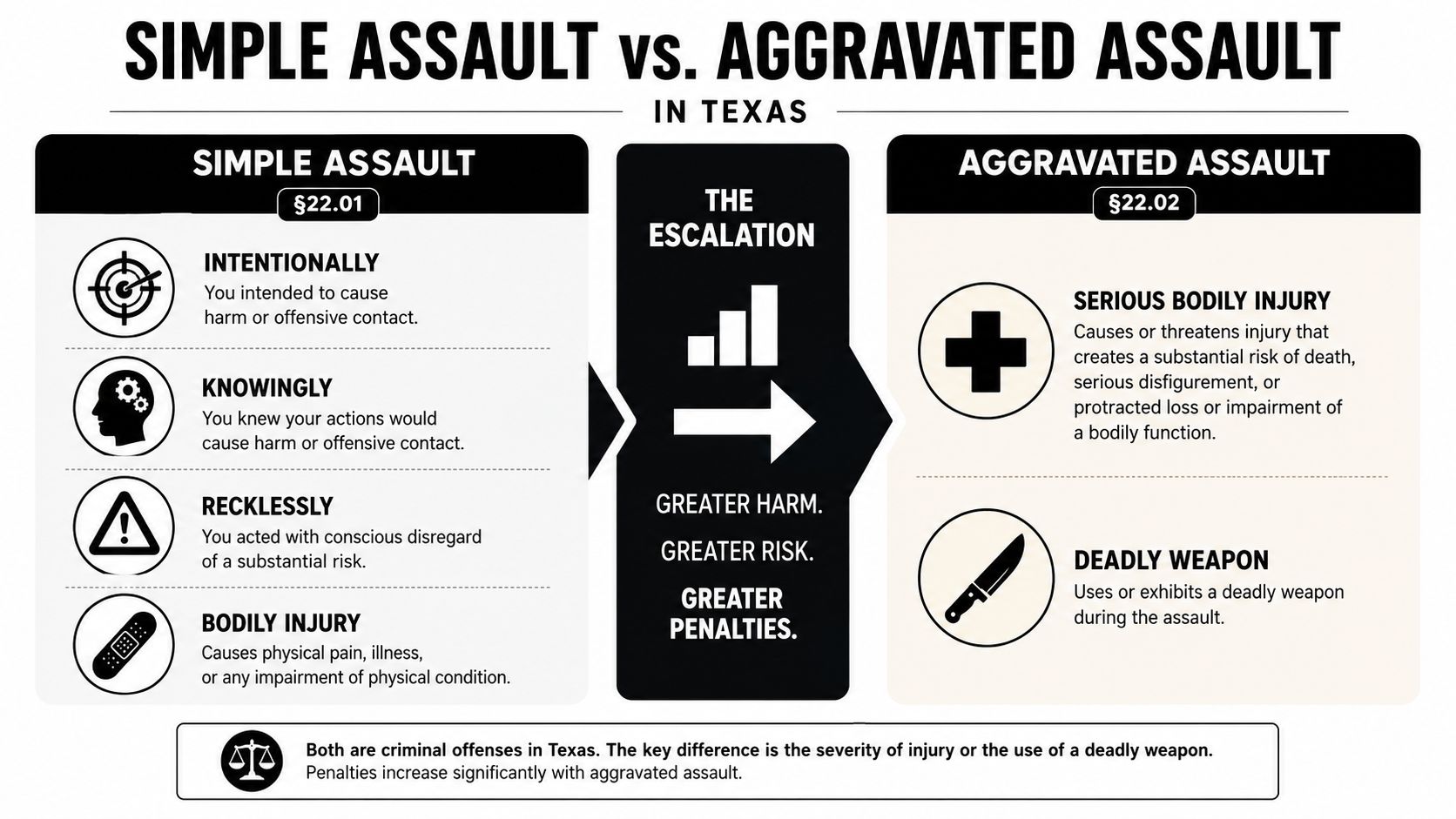
The disputed words often decide the charge
Suppose two people fight outside a Humble business and one person later reports a broken jaw. The prosecution still has to prove the injury qualifies as serious bodily injury, not merely that the person visited a hospital. Medical records, imaging, treatment history, photographs, and expert interpretation can all affect that classification.
Now consider a confrontation where nobody is cut, but one person displays a knife. The state may argue that exhibiting the knife satisfies the deadly-weapon path. The defense must examine what happened, what the object was, how it was displayed, whether the witness saw it clearly, and whether the evidence proves the required mental state and conduct.
The prosecution must prove every element beyond a reasonable doubt. That burden doesn't disappear because an officer selected a serious charge during booking. For families handling separate legal concerns, Divorce Lawyer in Atascocita, TX represents clients in Atascocita and Harris County, but a criminal allegation involving family members requires a separate criminal defense strategy.
Penalties and Felony Degrees You Face
The ordinary aggravated-assault classification is a second-degree felony. Under Texas punishment rules, that degree carries 2 to 20 years in prison and an optional fine of up to $10,000, as summarized in this Texas aggravated assault penalty guide.
Some allegations raise the case to a first-degree felony. Under Texas Penal Code § 22.02, specified aggravating circumstances include certain serious-injury cases involving family or household relationships, protected public officials, and catastrophic traumatic brain or spinal injuries that result in a persistent vegetative state or irreversible paralysis. The statute, not a police label, controls whether the alleged facts fit an enhancement.
| Felony Degree | Prison Range | Maximum Fine | Common Triggers |
|---|---|---|---|
| Second-degree felony | 2 to 20 years | Up to $10,000 | Serious bodily injury or deadly-weapon allegation |
| First-degree felony | 5 to 99 years or life | Up to $10,000 | Statutorily specified aggravating circumstances |
The first-degree range is 5 to 99 years or life imprisonment, with an optional fine of up to $10,000. A prior criminal record can also affect negotiations, punishment arguments, and potential enhancement treatment. Don't assume the range on the charging document tells the whole story. The indictment, prior convictions, alleged relationship, injury evidence, and weapon language all deserve close review.
A felony conviction can create consequences beyond incarceration. Firearm restrictions, employment barriers, professional licensing problems, housing difficulties, and immigration consequences for non-citizens may follow. Sex-offender registration can apply in certain cases, depending on the specific offense and facts. Parole eligibility also depends on the sentence, offense classification, statutory rules, and prison conduct, so no lawyer should promise a release date from the range alone.
If the accusation involves a spouse, dating partner, household member, or relative, the criminal case can overlap with family-law consequences. Texas Family Code § 71.004 defines family violence broadly to include conduct or threats intended to cause physical harm, bodily injury, assault, or sexual assault, or threats that reasonably place a family or household member in fear of imminent harm. A no-contact condition can affect children, housing, and custody discussions immediately.
Harris County Enforcement Trends That Affect Your Case
Atascocita sits within the Harris County law-enforcement and court system, so local numbers provide useful context even though they don't predict the result of an individual case. Texas agencies reported 90,759 aggravated assault offenses in 2022, compared with 90,876 in 2021, according to the Texas Department of Public Safety 2022 crime report. The statewide total remained near 91,000 across those years, and only 31,843 cases were cleared in 2022, a clearance rate of 35.09%.
The same report recorded a five-year increase from 74,165 aggravated assaults in 2018 to 90,759 in 2022, a net increase of 22.4%. That history matters because it shows why prosecutors and investigators treat the category seriously. It doesn't prove guilt, and it doesn't mean every Atascocita allegation deserves the highest charge.
Harris County figures are uneven, not uniform
One Harris County compilation recorded 5,249 aggravated assault incidents in 2024. A separate monthly series listed 2,110 incidents in March 2021, 2,169 in March 2022, 2,202 in March 2023, 2,132 in March 2024, and 1,603 in March 2025. The Harris County crime data compilation reports that March 2025 was 24.81% lower than March 2024 and 27.2% below the March 2023 peak in that series.
A Harris County Sheriff's Office narrative also found firearm-related aggravated assault cases rose 66%, from 1,350 in 2019 to 2,246 in 2021, as reflected in the same county-level source. More recent reporting identified 1,587 aggravated assault incidents in May 2025, a 33.26% decrease from May 2024 and the lowest May count in that 2021 to 2025 series, according to the March 2025 Crime Index report.
| Metric | Harris County | Texas Statewide |
|---|---|---|
| Aggravated assaults in a reported year | 5,249 in 2024 | 90,759 in 2022 |
| Reported clearance figure | Monthly and county-level data vary | 31,843 cleared in 2022, 35.09% |
| Recent pattern | Monthly volatility, including 1,603 in March 2025 | Five-year rise from 2018 to 2022 |
The practical lesson is simple. A recent decline doesn't automatically mean fewer arrests, weaker cases, or less aggressive charging. Reporting practices, policing priorities, evidence, and the facts of each allegation still control the outcome. Your lawyer needs to challenge the individual proof, not rely on broad trend lines.
The Arrest and Court Process in Harris County
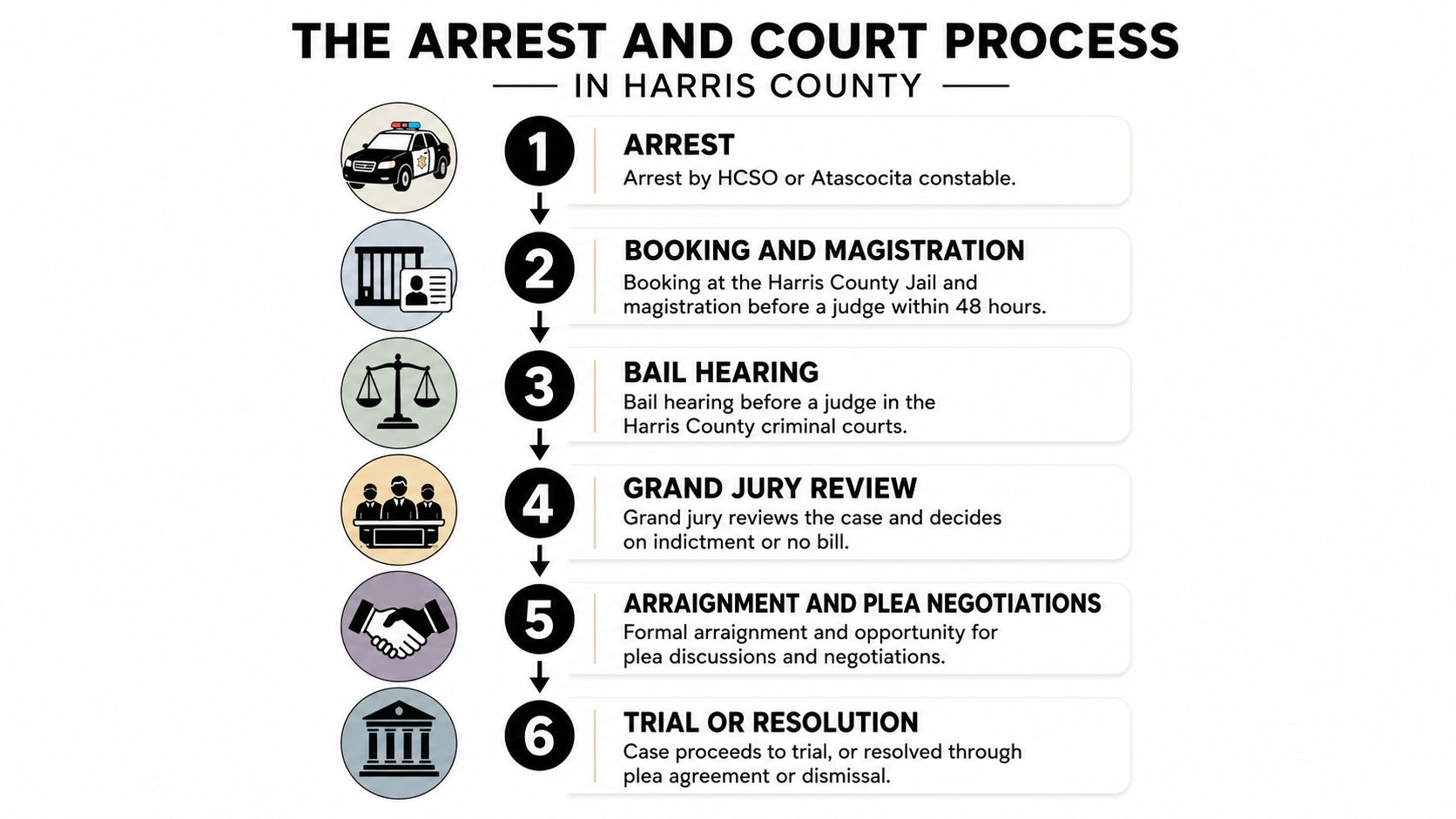
An aggravated assault arrest can move quickly. If a Harris County Sheriff's Office deputy or Atascocita-area constable arrests you, booking and release decisions may begin before your family understands what happened. Keep your focus on the procedural stages and avoid making statements about the incident.
The first stages
- Arrest and booking. Officers take identification information, inventory property, and process the allegation. Don't argue the facts during booking. State that you want a lawyer and stop discussing the incident.
- Magistration and probable-cause review. A magistrate reviews the arrest and release conditions. The timing can be critical, and the Harris County criminal courts handle the applicable proceedings.
- Bond determination. The court may impose conditions such as no contact, geographic restrictions, firearm restrictions, or monitoring. Violating a condition can create new legal problems and jeopardize release.
- Felony court assignment and grand jury review. The prosecution presents the case for indictment. A grand jury may indict or return a no-bill decision. An indictment isn't a conviction, but it formally moves the case forward.
- Arraignment and pretrial litigation. The court addresses the charging instrument, plea, discovery, motions, and scheduling. You can review practical information about what happens at an arraignment hearing.
- Resolution. The case may end through dismissal, reduction, negotiated resolution, or trial. Your lawyer should evaluate the evidence before recommending any plea.
Discovery can include police reports, recordings, photographs, medical records, witness statements, and other materials the prosecution must disclose under applicable Texas procedure. Your defense team should compare those materials against the original scene, digital evidence, and your account. For general bond-related information outside Texas, this resource on Forsyth County aggravated assault help offers a useful contrast, but Harris County conditions must be evaluated under Texas law and the order in your case.
The stages are easier to follow when you can see them in sequence.
This video provides additional general background on the criminal court process:
Defense Strategies That Can Protect Your Future
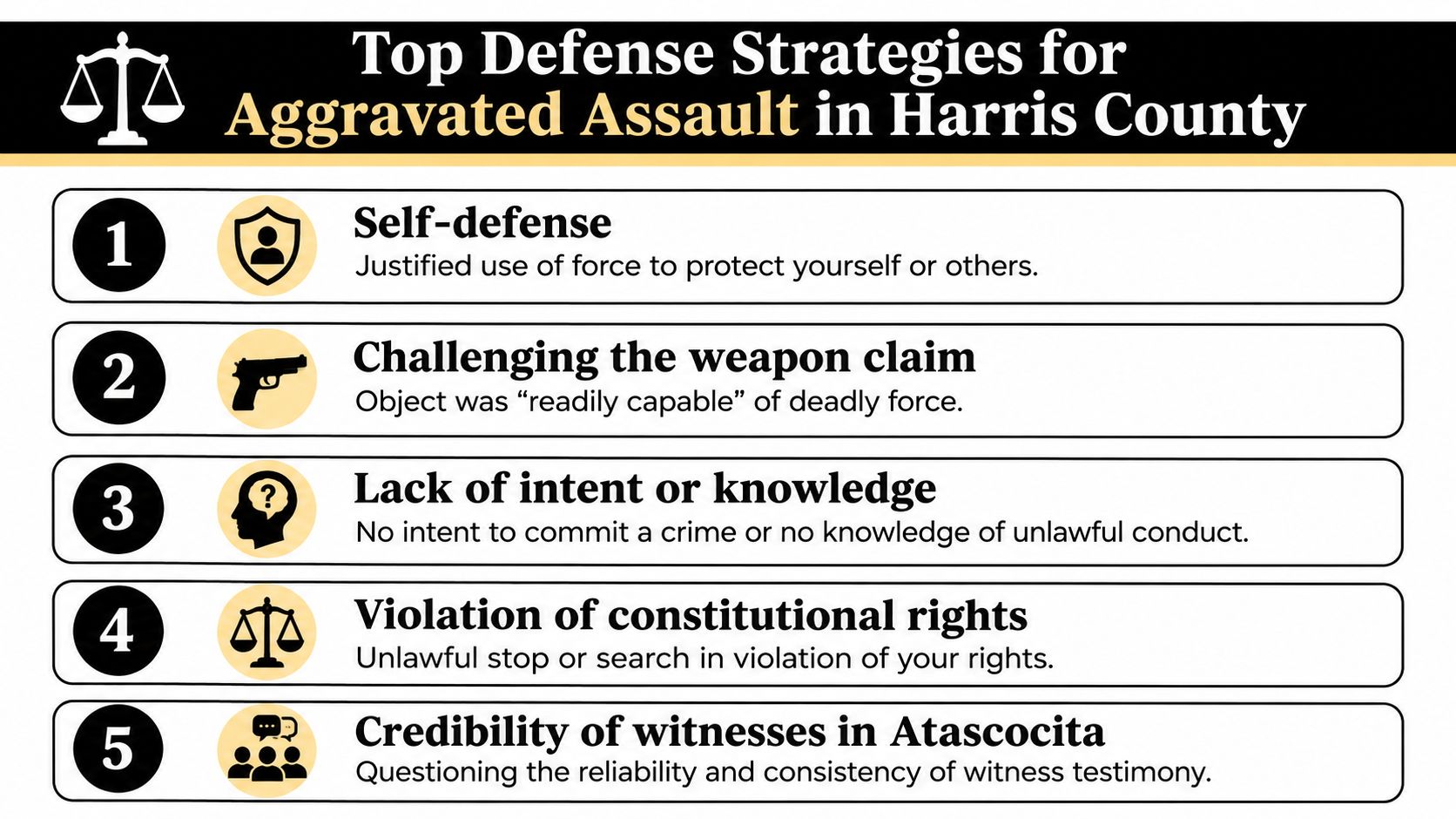
A strong defense starts by identifying what the state can't prove. The arrest report may use confident language, but the report isn't the evidence itself. Your lawyer must test the injury classification, weapon allegation, witness reliability, intent, and legality of the investigation.
Attack the aggravating feature
If the prosecution relies on serious bodily injury, obtain complete medical records and consider an independent medical review. A hospital visit alone doesn't establish the statutory definition. The defense may show that the injury healed, didn't create the required risk, or didn't cause the alleged long-term impairment.
If the state alleges a deadly weapon, examine the object and the way it was allegedly used. A vehicle can qualify in one setting and not another. An object that was present may not have been used or exhibited as alleged. Video, distance, lighting, fingerprints, property records, and witness visibility can all matter.
Build the factual defense
Self-defense or defense of another person may apply when the evidence shows an immediate unlawful threat and a proportionate response. The analysis includes who initiated the physical encounter, whether the alleged victim advanced, what you reasonably perceived, and whether your actions stopped when the threat ended.
Other defenses may focus on intent and credibility:
- Intent and knowledge: An accident, reflexive movement, or misunderstood action may not prove the required mental state.
- Witness reliability: Compare statements made at the scene, during interviews, and later. Look for inconsistent descriptions, alcohol impairment, limited visibility, personal bias, or a motive to shift blame.
- Constitutional violations: A lawyer can investigate whether officers unlawfully stopped, searched, seized, or interrogated you. Suppression litigation may limit what the prosecution can use.
The most useful defense evidence often disappears first. Video systems overwrite footage, witnesses stop answering, and memories change.
Early work also gives counsel time to request preservation of surveillance, inspect the scene, interview independent witnesses, and analyze digital communications. A practical overview of criminal defense strategy can help families understand why the defense needs to begin before the first major court setting.
Immediate Steps to Take After Being Charged
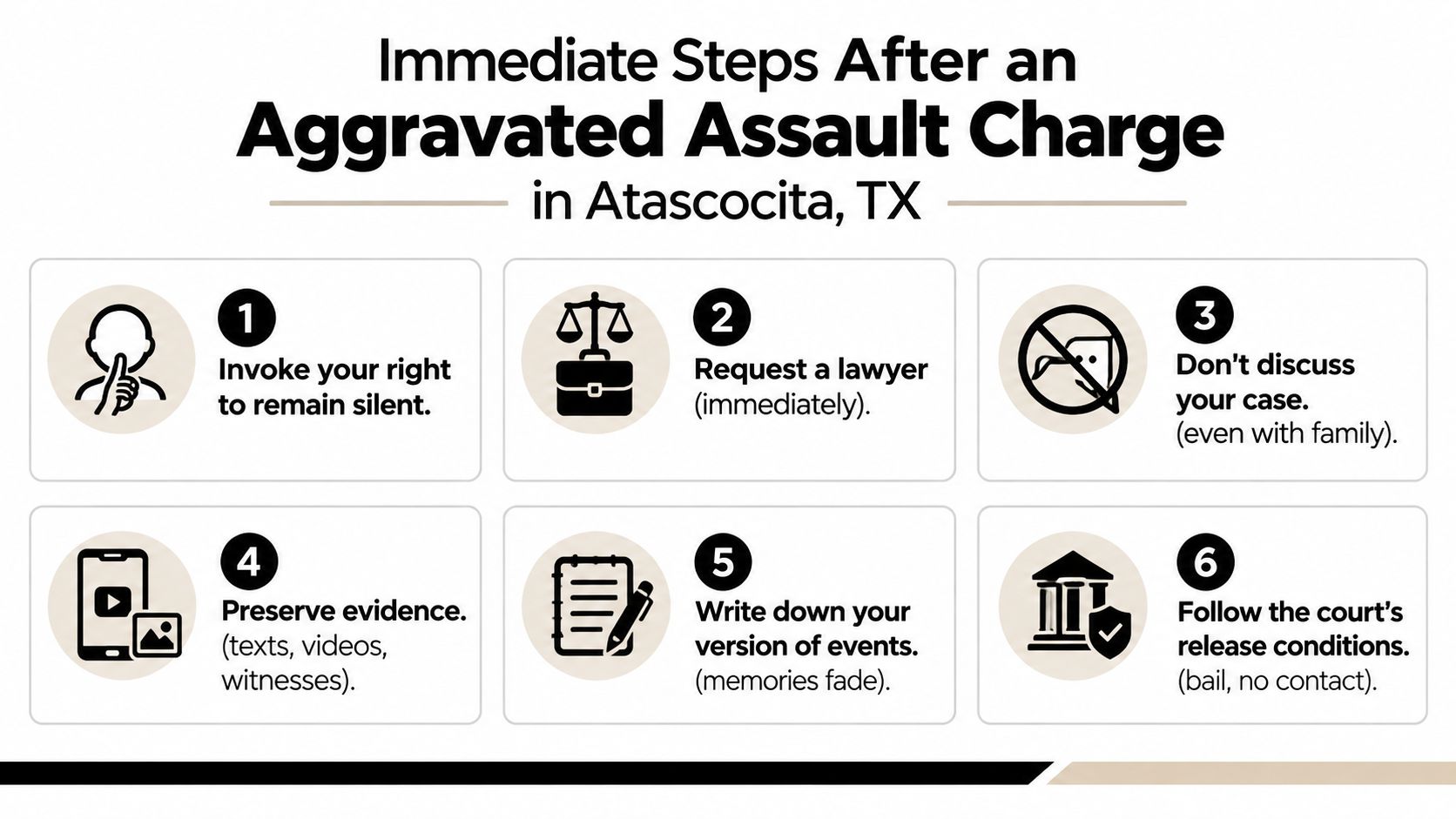
Your first decisions should reduce risk, preserve evidence, and keep you from creating a second problem. Follow this checklist even if you believe the allegation is completely false.
- Invoke silence. Tell officers you're invoking your right to remain silent and want a lawyer. Don't explain the incident during a phone call, interview, or informal conversation.
- Do not contact the accuser. A call, apology, angry message, or request to “work this out” can be used against you or violate a no-contact order.
- Keep the case off social media. Don't post photographs, accusations, location details, or vague statements about betrayal or revenge. Preserve relevant content privately for counsel instead.
- Preserve evidence. Save text messages, emails, videos, call records, photographs, location information, and names of witnesses. Don't edit or delete material.
- Write a private timeline. Record what happened before, during, and after the incident while your memory is fresh. Include the location, people present, statements made, injuries observed, and any police contact.
- Follow every release condition. No-contact rules, GPS monitoring, travel restrictions, firearm restrictions, and other conditions are court orders. Ask your lawyer about modification rather than ignoring a condition.
A character reference or employment record may support a bond argument, but don't send materials directly to investigators or the prosecutor without legal advice. The same document that helps show community ties may also contain statements that create problems.
If you're unsure what police may ask or what silence protects, review your Miranda rights and then speak with counsel. Your family can help by collecting records and arranging representation, not by contacting the alleged victim or debating the case online.
How a Local Atascocita Attorney Can Help
A local defense lawyer should do more than explain the charge. Counsel should obtain the available reports and recordings, identify witnesses, preserve surveillance, examine medical evidence, assess the alleged weapon, and determine whether law enforcement followed constitutional requirements. Those tasks can shape whether the case is dismissed, reduced, negotiated, or tried.
The Law Office of Bryan Fagan, PLLC serves individuals and families in Atascocita, Humble, and Harris County across criminal-defense and related legal matters. For a person facing aggravated assault, the practical value of local representation lies in organizing the evidence, communicating with the Harris County District Attorney's Office, addressing bond conditions, and preparing a defense suited to the facts rather than relying on a generic Texas assault explanation.
If a family-law dispute overlaps with the allegation, criminal and family counsel must coordinate carefully. A no-contact order, family-violence finding, or pending criminal case can affect communication, housing, and custody decisions. You can also browse Sarah White portfolio for an example of an attorney portfolio that shows how legal services may be presented professionally.
Don't wait for the first court date to begin collecting evidence. Witnesses become difficult to locate, digital footage can disappear, and an early statement can affect bond and charging decisions. Schedule a confidential consultation at the Atascocita office to discuss what happened, what the state alleges, and what steps should come next.
The Law Office of Bryan Fagan – Atascocita TX Lawyers provides criminal-defense guidance for aggravated assault investigations and charges in Atascocita, Humble, and Harris County. Visit Law Office of Bryan Fagan – Atascocita TX Lawyers to schedule a free consultation, protect your rights, and begin a focused defense before evidence and options narrow.