Skip to content

A Humble business owner may discover an arbitration clause only after a customer dispute has escalated. An Atascocita parent may be weighing a private process for a parenting disagreement while wondering whether a judge still has a say. In either situation, the choice between arbitration and litigation can shape who decides the dispute, what the process looks like, and how much court involvement remains.
Neither route is automatically right for everyone. The terms of a contract, the type of dispute, privacy concerns, likely costs, and the need for review can all matter. For families in Atascocita, Humble, and northeast Harris County, child-related cases also raise a special issue: parents may agree to arbitration, but Texas courts retain authority to protect a child's best interests.
Two Paths to Resolving a Dispute
Suppose a Humble contractor and a customer disagree about payment for work. If their contract contains an enforceable arbitration clause, the dispute may go to a private arbitrator instead of a courtroom. If it doesn't, either party may bring a lawsuit, and a judge or jury may decide the case if it reaches trial.
Those paths can both produce a binding result, but they work differently. Litigation is the formal process of resolving a case in court. The parties file documents, exchange information under court rules, and may present evidence at a public trial. A judge decides legal questions, and a judge or jury may decide disputed facts.
Arbitration is a private dispute-resolution process in which one or more neutral arbitrators hear the parties' positions and issue an award. The arbitrator isn't a judge, and the hearing generally doesn't take place in a public courtroom. Parties may have more flexibility to shape the procedures, depending on their agreement and the rules that apply.
| At a glance | Arbitration | Litigation |
|---|---|---|
| Decision-maker | A private arbitrator or panel | A judge, or a judge and jury |
| Setting | A private hearing | A public court proceeding |
| Process | Procedures may be tailored to the dispute | Formal court rules and procedures apply |
| Review | Court challenges are limited | Appeals may be available under applicable rules |
The differences aren't just about where people sit. Court litigation offers formal procedures and a route to appeal a judgment, while arbitration can offer privacy and a more customized hearing. But the details of an arbitration agreement can limit discovery, shape who pays forum fees, and affect how quickly a hearing happens.
Start with the agreement, not the label. A contract's dispute-resolution clause may determine whether you can choose court at all.
A Humble business owner should check the contract before filing a lawsuit. A parent considering private decision-making should first ask whether the issue is one Texas law permits the parents to arbitrate. Time, cost, privacy, and control matter, but they're not the only considerations. The strongest choice is the one that fits the dispute and the rules that govern it.
How Arbitration Works Step by Step
Arbitration usually begins with a written agreement. A clause may be part of a business, employment, or consumer contract, and a person may not notice it until a disagreement arises. Under the Federal Arbitration Act, written arbitration agreements in many maritime and interstate-commerce contracts are generally treated as valid and enforceable, subject to ordinary contract defenses. The act was enacted on February 12, 1925, and took effect on January 1, 1926. (Federal Arbitration Act overview)
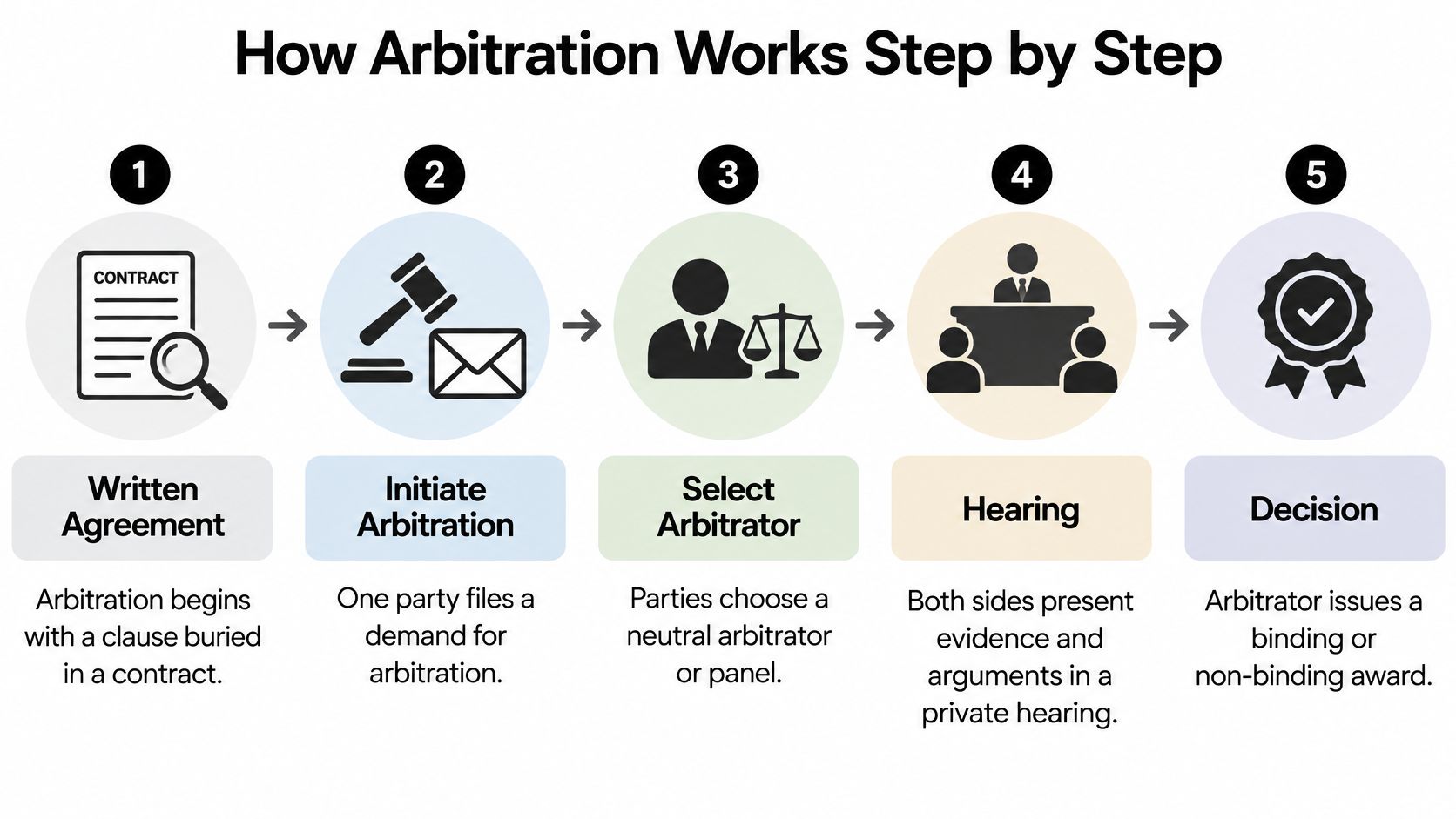
For a small business owner in Atascocita, the process may look like this:
- Read the clause. Check whether the contract requires arbitration, identifies an arbitration administrator, or sets procedures for choosing an arbitrator.
- Start the case. A party initiates arbitration by submitting a demand under the agreement or applicable rules. If the other side has already sued, a party may ask a court to enforce an applicable clause.
- Choose the neutral. Depending on the agreement and rules, the parties select an arbitrator or panel. The arbitrator is expected to decide the dispute impartially.
- Prepare and attend the hearing. The parties exchange evidence and present their arguments. The process may be less formal than a trial, but that doesn't mean evidence or preparation no longer matter.
- Receive the award. The arbitrator issues a decision, which may be binding or nonbinding depending on the agreement and the type of dispute. A court may later be asked to enforce or, in limited circumstances, review a binding award.
Time can be a reason parties choose arbitration, though it's not a promise of a quick result. A 2017 comparison found a median time from filing to a merits hearing of 11.6 months in arbitration and 24.2 months in U.S. district court. The same analysis found that arbitration remained nearly two years faster when an appeal was included, but extensive discovery, experts, or procedural disputes can still prolong arbitration. (Comparison of arbitration and court timelines)
An award isn't a second trial waiting to happen. Under the Federal Arbitration Act, a party generally has three months to seek to vacate an award on narrow grounds, such as corruption, evident partiality, serious misconduct, or an arbitrator exceeding their powers. A party who disagrees with the result can't usually get a court to reconsider all the evidence just because they believe the arbitrator was wrong.
The video below provides another overview of how arbitration works.
How Litigation Unfolds in Court
A lawsuit begins when a party files a petition or complaint describing the dispute and the remedy sought. The other party responds, and the court sets a schedule for the case. In a Harris County civil matter, that schedule and the applicable court rules help determine when the parties must provide information and prepare for the next stages.
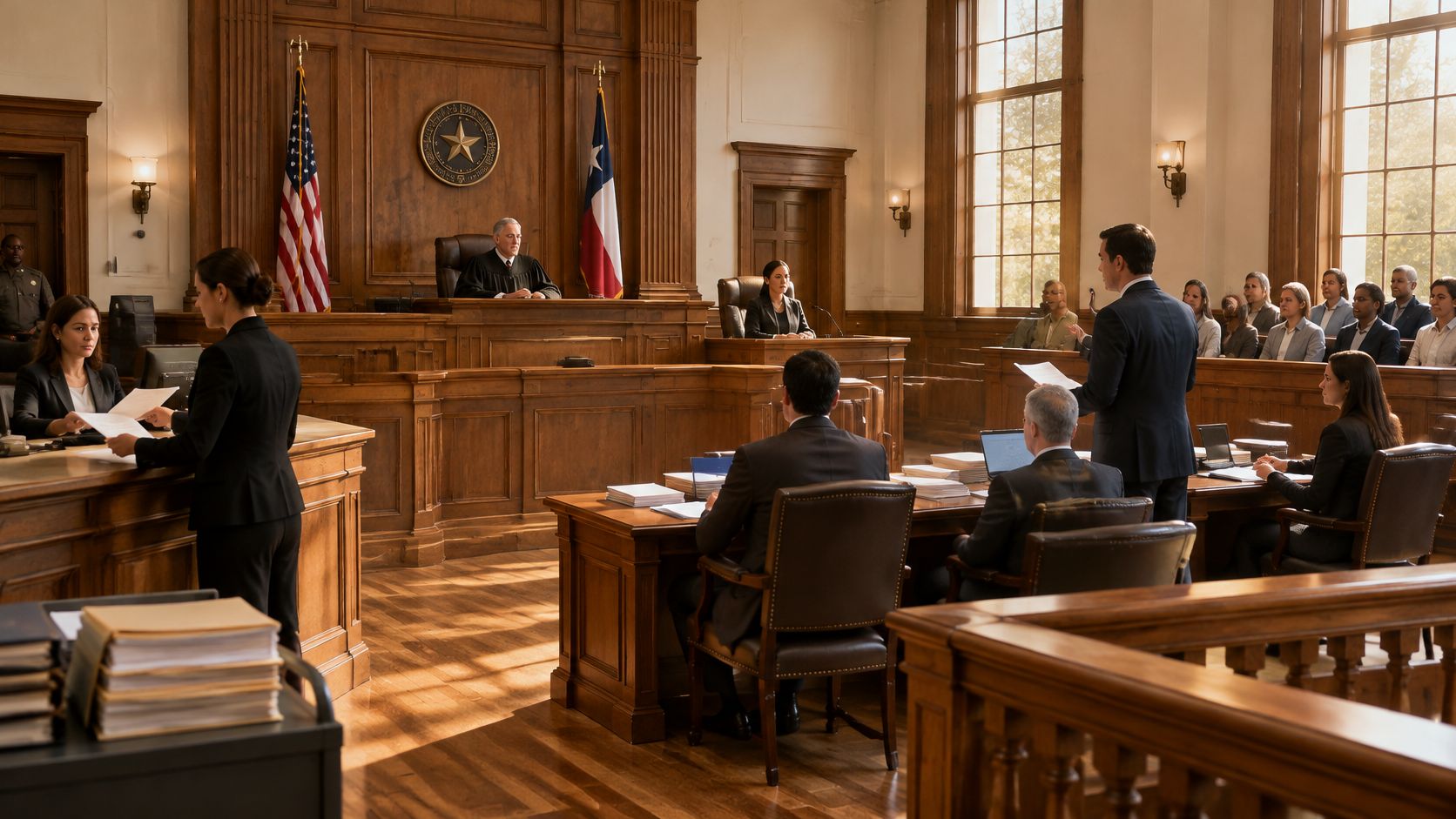
The case commonly moves through several stages:
- Pleadings: Each side sets out its claims, defenses, and requested relief.
- Discovery: The parties seek relevant information and evidence from each other and, where permitted, from other sources.
- Motions: A party can ask the judge to resolve a legal issue or narrow what remains for trial.
- Trial: The parties present evidence and arguments. A judge, or a jury where available and properly requested, decides the case.
- After trial: The parties may ask the court to reconsider certain issues or pursue an appeal if the law allows.
Court proceedings are generally public, and court records may be available to the public. That visibility can be a concern for people who would rather keep a contract or family dispute private. For a plain-language introduction to how family court can address parenting issues, readers can consult this guide to family court for parents.
Litigation can also take time. An analysis of employee-plaintiff cases that ended in victory reported an average of 665 days in court, while the longest 10% of court cases averaged 1,283 days. Those are averages from particular comparisons, not a timetable for an individual Harris County case. (Analysis of arbitration and employment litigation timing)
A contract clause doesn't always erase the role of a court if someone files a lawsuit. Under Section 3 of the Federal Arbitration Act, a court must stay, or pause, a trial when the dispute is referable to arbitration under a written agreement and a party requests the stay. A stay leaves the court with continuing jurisdiction while arbitration proceeds, unlike dismissal, which may change the parties' immediate options. (Explanation of stays in arbitration cases)
Small claims disputes may follow a different court route from a larger civil lawsuit. Residents can read more about Harris County JP Court small claims for Atascocita residents before deciding how to pursue a claim.
Comparing Time, Cost, Evidence, and Appeal
Choosing between arbitration and litigation works like choosing between two routes to the same address. Both can get you there, but the tolls, the speed limits, and the exits differ. The comparison below is a starting point, because the contract, the applicable rules, and the facts of the dispute can shift any row.
| Criterion | Arbitration | Litigation |
|---|---|---|
| Time | May reach a hearing sooner, but procedural disputes can add delay | Court schedules, discovery, and appeals can extend a case |
| Cost | Arbitrator and administrator fees can add expense | Court-related fees may be lower, but discovery and trial work can add costs |
| Evidence | Procedures can be shaped to the dispute; discovery may be narrower | Formal court rules apply, with discovery governed by procedure |
| Appeal or review | Courts generally have limited grounds to set aside an award | A judgment may be appealed under applicable rules |
| Privacy | Hearings are generally private | Court proceedings and records are generally public |
Timing favors arbitration on paper, but the margin is easy to overstate. The employment-case comparison described in the litigation discussion above found arbitration finishing sooner on average, and it also showed how wide the spread can run in court, where the slowest cases took far longer than typical ones. Averages describe groups of cases, not yours. A contested Harris County dispute can run long in either forum, and a fight over the arbitration clause itself can consume the speed advantage before a hearing ever starts.
Cost needs its own calculation. Arbitration often involves administrator charges and arbitrator fees, which may exceed court filing costs when considered alone. The final bill depends on counsel time, discovery, hearing length, and whether anyone seeks review afterward. With that many moving parts, neither route is automatically cheaper, and the answer changes case by case.
Evidence rules differ in ways that matter once a dispute gets going. Arbitration procedures can be more flexible, but parties should not assume they can present anything without limits. Court litigation follows formal evidentiary rules and offers supervised discovery, which helps when one side holds records the other side needs. Obtaining and reviewing that material takes work, which feeds back into time and cost.
Appeal rights shape how comfortable a person feels living with the result. Arbitration awards are difficult to overturn, while court judgments can be challenged when the law and the record support an appeal. Family cases carry a wrinkle that surprises many parents: Texas courts retain authority over disputes involving children even when the parents agreed to arbitrate, so the court's role does not fully end at the award. For readers weighing a challenge to a court ruling, this guide to appealing a family court decision explains why deadlines and legal grounds matter.
Privacy rounds out the table. Arbitration hearings are generally private, while court proceedings and records are generally public, a difference that matters to families and businesses alike. Mediation works differently from either route: it helps the parties negotiate but imposes no decision unless they agree. Readers who want to compare processes can review settlement alternatives for civil disputes before committing to a forum.
Which Option Fits Your Case Type
The right route depends in part on what the dispute is about. A contract dispute between businesses doesn't raise the same concerns as a disagreement over parenting time. For people in Atascocita, Humble, and northeast Harris County, the practical starting point is to identify the kind of claim, check any agreement, and ask whether the court has a continuing role.
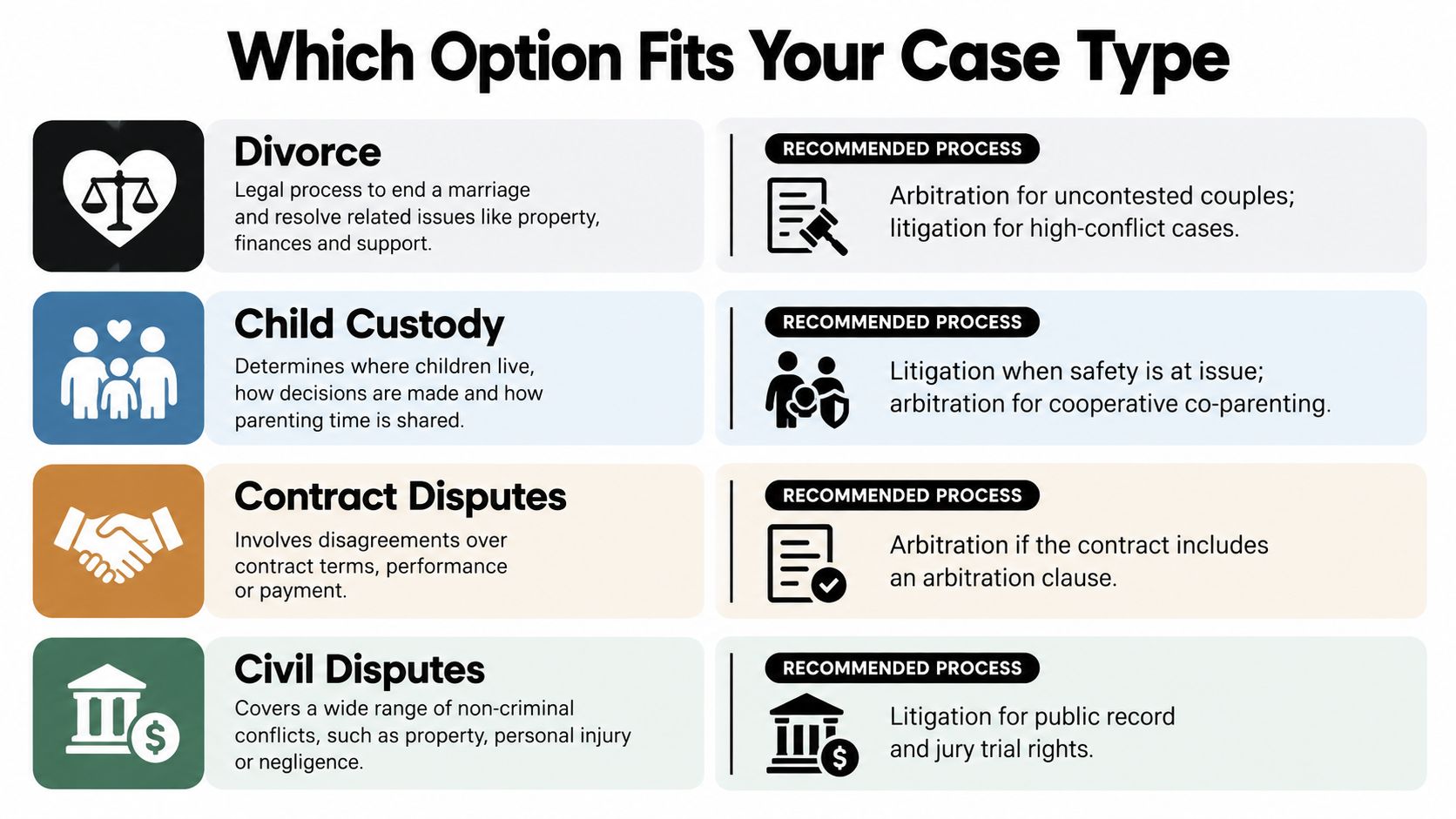
Divorce and property issues: Some spouses may prefer private dispute resolution for particular disagreements, while others need a court to resolve contested issues. The choice depends on what the parties agree to, the issues still in dispute, and the applicable legal process. A Divorce Lawyer in Atascocita, TX provides divorce representation for clients in Atascocita and Harris County.
Child custody and parenting disputes: Texas treats arbitration involving a suit affecting the parent-child relationship differently from ordinary commercial disputes. A court may refer the matter to arbitration only when the parties agree in writing, and the agreement must say whether the process is binding or nonbinding. Even if parents choose binding arbitration, the court must enter an order reflecting the award unless, after a nonjury hearing, the court determines the award isn't in the child's best interest. Courts can't compel arbitration over child-related claims because they retain continuing and exclusive jurisdiction over those matters. (Texas Family Code provision on arbitration in parent-child cases)
That authority matters when a child's needs or safety are at issue. A private hearing may give cooperative parents a way to address specific disagreements, but it can't override the court's child-centered responsibility. A Child Custody Lawyer in Atascocita, TX represents Atascocita families in custody and conservatorship matters.
Contract disputes: A Humble small business owner or Atascocita professional should review the contract before starting a case. If a valid arbitration clause applies, it may determine the forum. For questions about options after a contract has been broken, see breach of contract remedies.
Other civil disputes: Arbitration may suit parties who value a private process or want procedures fitted to their dispute. Litigation may be preferable when public court process, broad discovery, or a potential jury trial is important. Neither path guarantees a favorable result, so the decision should reflect the evidence and practical needs of the case.
A Practical Decision Checklist for Clients
Say a Humble homeowner finds an arbitration clause buried in a remodeling contract, or an Atascocita parent wonders whether a private hearing could resolve a disagreement faster than court. The right answer depends on details that are easy to miss on a first read. A short checklist helps you pin down what you know, what you still need to find out, and where a lawyer's eye makes a difference.
Work through these questions before you commit to a forum:
- Find any arbitration clause. Pull out the signed contract and any rules it references. Check the wording and the circumstances around signing before assuming the clause controls, or assuming it does not.
- Define what you're seeking. Write down the claim, the result you want, and the information you would need from the other side to prove it.
- Estimate the full expense. Consider claim value, likely counsel fees, discovery needs, hearing length, and any administrative or arbitrator charges. The cost comparison above shows why forum fees alone do not settle the question.
- Ask who pays forum fees. Check the agreement and the applicable rules rather than assuming costs will be divided a particular way. Fee allocation can decide whether a private process makes practical sense.
- Consider privacy and review. Decide whether keeping the proceeding private matters to you, and how much you value the possibility of an appeal or broader court review.
- Weigh safety and fairness in family matters. Ask whether both parents can negotiate freely and whether a child's needs call for a court's continuing oversight. As noted earlier, Texas judges keep authority over child-related issues even when parents agree to arbitrate, and no checklist item changes that.
One caution about speed. A quicker hearing sounds appealing, but limited discovery or restricted review can leave you stuck with a problem you cannot fix later. In a moderate-value dispute, forum fees and preparation time can even affect whether bringing the claim is worthwhile.
If anything on this list raises a question you cannot answer, bring the complete agreement and related correspondence to a lawyer. A careful review can clarify the forum, the likely process, and the questions worth resolving before you act.
Talk to a Local Attorney About Your Case
A dispute can feel different when you're the person facing a contract deadline, an uncertain custody arrangement, or a court filing. Residents of Atascocita, Humble, and northeast Harris County don't have to sort through those choices without support. A local attorney can review the agreement, explain which procedures may apply, and help you understand what decisions are yours to make.
Bring the documents connected to the dispute, including any contract, court papers, and relevant communications. Be ready to explain what outcome you're seeking and what concerns you most, such as privacy, cost, safety, timing, or the ability to challenge a decision. That gives the attorney a practical foundation for discussing possible next steps.
The Law Office of Bryan Fagan – Atascocita TX Lawyers represents individuals and families in family law, civil litigation, criminal defense, and estate planning matters. A consultation can help you understand how the arbitration clause, court process, or family-law rules may affect your particular situation. You can ask questions and discuss your options without assuming that arbitration or litigation is automatically the right answer.
The Law Office of Bryan Fagan – Atascocita TX Lawyers offers personalized legal guidance for residents facing arbitration questions, civil disputes, or family-law concerns. Schedule a free consultation by visiting Law Office of Bryan Fagan – Atascocita TX Lawyers to discuss which path may fit your case.