Skip to content

It's late, you're back home in Atascocita after a night that went sideways, and your phone won't stop buzzing. A deputy left a card. A family member says there's a warrant. Or you're reading this for someone sitting in the Harris County Jail waiting to see a magistrate.
You're not looking for a law school lecture. You're asking a simple question about Assault Charges Jail Time in Texas, and you need a straight answer you can use this week.
A Calm Starting Point for People Facing Assault Charges
The people I talk to start in the same place. They had an argument in a driveway in Humble, a scuffle outside a restaurant off FM 1960, or a heated fight at home that brought deputies to the door. Nobody planned on an arrest, and now work, kids, and rent are colliding with a court date.
Take a breath and sort the panic into three separate questions. They get tangled together online, but they aren't the same thing.
The Three Questions That Actually Matter
- What's the worst the law allows: That's the statutory range tied to your exact charge level, not the outcome you're guaranteed to get.
- Will you sit in jail before trial: Pretrial detention can happen even though you haven't been convicted, and bond conditions control whether you go home.
- What can you do right now: Preserving texts, video, and witness names, and following every release condition, often matters more in the first week than arguing about the maximum sentence.
Plain truth: The word assault on a booking screen tells you almost nothing by itself. The subsection, the alleged injury, and your relationship to the other person drive the exposure.
That distinction is why generic answers frustrate families in northeast Harris County. One neighbor gets a ticket level case for offensive contact. Another faces a felony because prosecutors allege strangulation or a prior family violence conviction. Both cases say assault, but they live in different legal worlds.
Don't try to fix it by calling the other person to smooth things over, especially if a no contact condition is in place. Don't give a recorded statement hoping you'll talk your way out. Write down what happened while it's fresh, save everything, and keep it for your lawyer.
You also need to think about life outside the courtroom. Missing shifts, losing access to your own home, and explaining an arrest to an employer are real consequences that start long before sentencing. A good plan addresses the charge and those practical problems together.
Read the charging paperwork line by line. If you don't have it yet, that's normal early on, but get it as soon as you can. Once you know the level and the exact allegation, the conversation about Assault Charges Jail Time stops being guesswork and starts being a strategy.
How Texas Classifies Assault from Class C to Felony
Texas sorts assault by what prosecutors say you did and who they say you did it to. Under Texas Penal Code Chapter 22 on assaultive offenses, causing bodily injury intentionally, knowingly, or recklessly is generally a Class A misdemeanor, while threatening imminent bodily injury or causing offensive or provocative contact is generally a Class C misdemeanor.
That one paragraph explains most of the confusion I hear in Atascocita. A shove that prosecutors view as offensive contact is not the same charge as a punch they say caused pain or injury. Threatening words during a road rage argument aren't automatically the same as an aggravated case involving a weapon.
This ladder gives you the visual version before we get into the details.
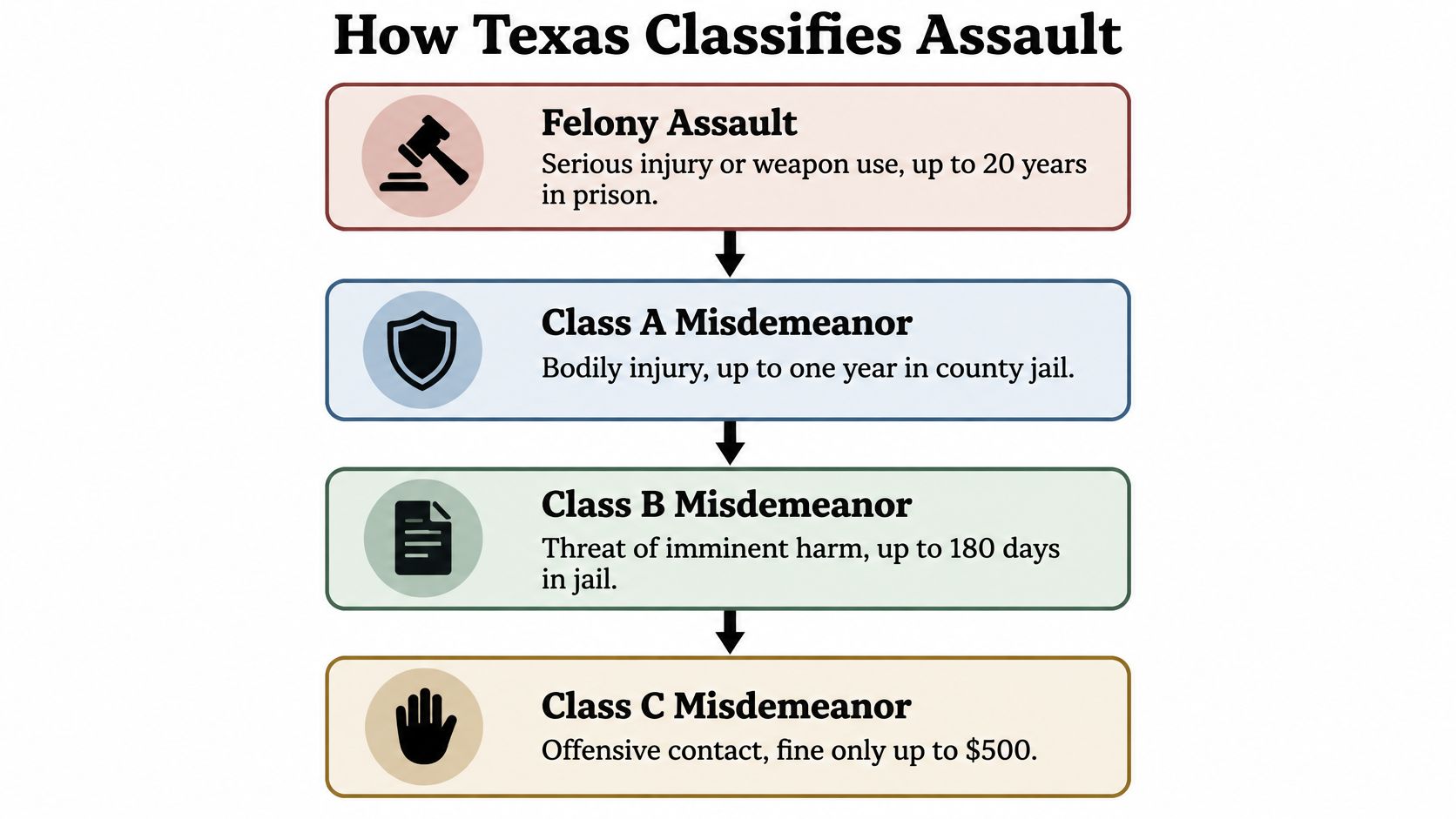
Texas Assault Charge Levels at a Glance
| Charge Level | Typical Conduct | Rough Punishment Range |
|---|---|---|
| Class C misdemeanor | Threat of imminent injury or offensive contact | Fine only under the ordinary range |
| Class A misdemeanor | Causing bodily injury | County jail possible |
| State jail or higher felony | Bodily injury with statutory aggravators | State jail or prison possible |
| Aggravated felony assault | Serious bodily injury or deadly weapon alleged | Lengthy prison exposure possible |
Start at the bottom. Class C cases usually involve a threat or contact the other person reasonably regarded as offensive or provocative, like poking someone in the chest during an argument at a youth game. There's no allegation of bodily injury in that version.
Move up one rung and injury changes everything. If prosecutors allege you caused bodily injury to a partner during a household fight in Kingwood or Atascocita, you're typically looking at the Class A level first. Victim status can then push it higher, for example when the complainant is a public servant on duty, a security officer, or emergency services personnel.
Felony territory begins when specific aggravators enter the charging document. Prior qualifying convictions, family or household relationships, impeding breathing, serious bodily injury, and deadly weapon allegations can all change the classification. Don't rely on what an officer said at the scene, because the filed charge is what controls.
Statutory Jail and Prison Ranges by Felony Degree
The charge on your paperwork sets the starting point for possible jail or prison time. Those statutory ranges are not predictions. The outcome can change with the evidence, prior convictions, plea negotiations, and whether probation is available.
A Class A misdemeanor may carry up to 1 year in county jail and a fine of up to $4,000, under the Texas Penal Code punishment framework compiled by the Texas Legislative Council. A Class C misdemeanor ordinarily carries no jail time, though a fine may apply. If your charge is Class C, jail is not part of the standard punishment for that charge alone. If it is Class A, county jail is possible. Your lawyer should assess whether the facts support a reduction, diversion where available, probation, or taking the case to trial.
Felony Ranges Under Chapter 12
For felony degrees, the ranges come directly from Chapter 12 of the Penal Code. A third-degree felony carries 2 to 10 years in prison, a second-degree felony carries 2 to 20 years, and a first-degree felony carries 5 to 99 years or life. A state jail felony generally carries 180 days to two years in a state jail. These ranges are set out in Texas Penal Code Chapter 12, unless a more specific statute changes the punishment.
A maximum is not a forecast. It marks the outer limit. Your lawyer's job is to challenge the charge and seek an outcome the facts and law support.
The type of custody matters. Misdemeanor jail time is generally served in county jail. A state jail felony can mean time in a state jail facility, while other felony sentences are served in prison through the Texas Department of Criminal Justice. These systems differ, including in how credit for time already served may apply. Pretrial detention is separate from a sentence: time in custody before conviction does not tell you what punishment a court will impose, though eligible jail credit can affect time remaining.
Enhancement allegations can raise the punishment range. Prosecutors may rely on a prior conviction, a family violence finding, or a deadly weapon allegation. If the allegation does not fit the prior case or the law, your lawyer should challenge it. A successful challenge can change the years at stake.
Do not assume you will receive a sentence in the middle of a range. First confirm the exact degree and whether an enhancement applies. Then assess the evidence, injury proof, criminal history, and whether the case is likely to resolve by plea or verdict. A bond condition or protective order may also shape what you can do while the case is pending, but neither changes the statutory sentencing range.
Factors That Push a Sentence Up or Down
Two men from Humble can both be charged with assault on the same weekend and face completely different recommendations. One had no record and the injury claim rests on conflicting statements. The other has a prior family violence conviction and prosecutors allege he impeded his partner's breathing.
The courtroom where those differences get argued looks a lot like this.

Texas courts explain the spread this way. The Texas courts judgment form instructions on Penal Code §22.01 assault note that different forms of assault can range from a Class C misdemeanor to a second-degree felony, and assault involving impeding a dating or family partner's breathing can rise from a Class A misdemeanor to a third-degree felony when the relationship and conduct requirements are met.
What Pushes Exposure Higher
- Prior convictions: A qualifying prior assault can convert a new family violence allegation into a felony fight.
- Injury severity: Medical records, photos, and consistent complaints of pain make bodily injury easier for prosecutors to prove.
- Weapon allegations: A deadly weapon claim moves the conversation toward aggravated assault and prison.
- Victim status and relationship: Family, household, and dating relationships trigger enhancements and protective order issues, which we address on our Atascocita assault and family violence defense page.
What helps is just as concrete. A clean record, weak or inconsistent injury proof, credible self-defense evidence, prompt counseling where appropriate, and perfect compliance with bond conditions give your lawyer material to negotiate with. None of that guarantees a dismissal, but prosecutors notice the difference between a defendant creating new problems and one stabilizing his life.
Self-defense needs evidence, not just your word. Save doorbell video, keep the shirt that was torn, photograph your own injuries, and write down witness names before people scatter. If the other person was the aggressor, we need to prove it early.
Don't underestimate the relationship finding. A family violence finding can affect firearms, future enhancements, custody disputes, and protective orders long after any jail question is settled. Sometimes avoiding that finding matters as much as avoiding custody itself.
Pretrial Detention, Bond, and Conditions of Release
Here's the assumption I correct most often. People think jail time starts at sentencing. For plenty of Harris County defendants, it starts the night of arrest.
Pretrial detention means you're held before trial because bond hasn't been set, you can't post it, or a judge imposed conditions you haven't met. You haven't been convicted, but you're still missing work and sleeping in a cell. That reality shapes plea decisions, which is why we attack bond problems immediately.
This flow shows the decision points between arrest and release.
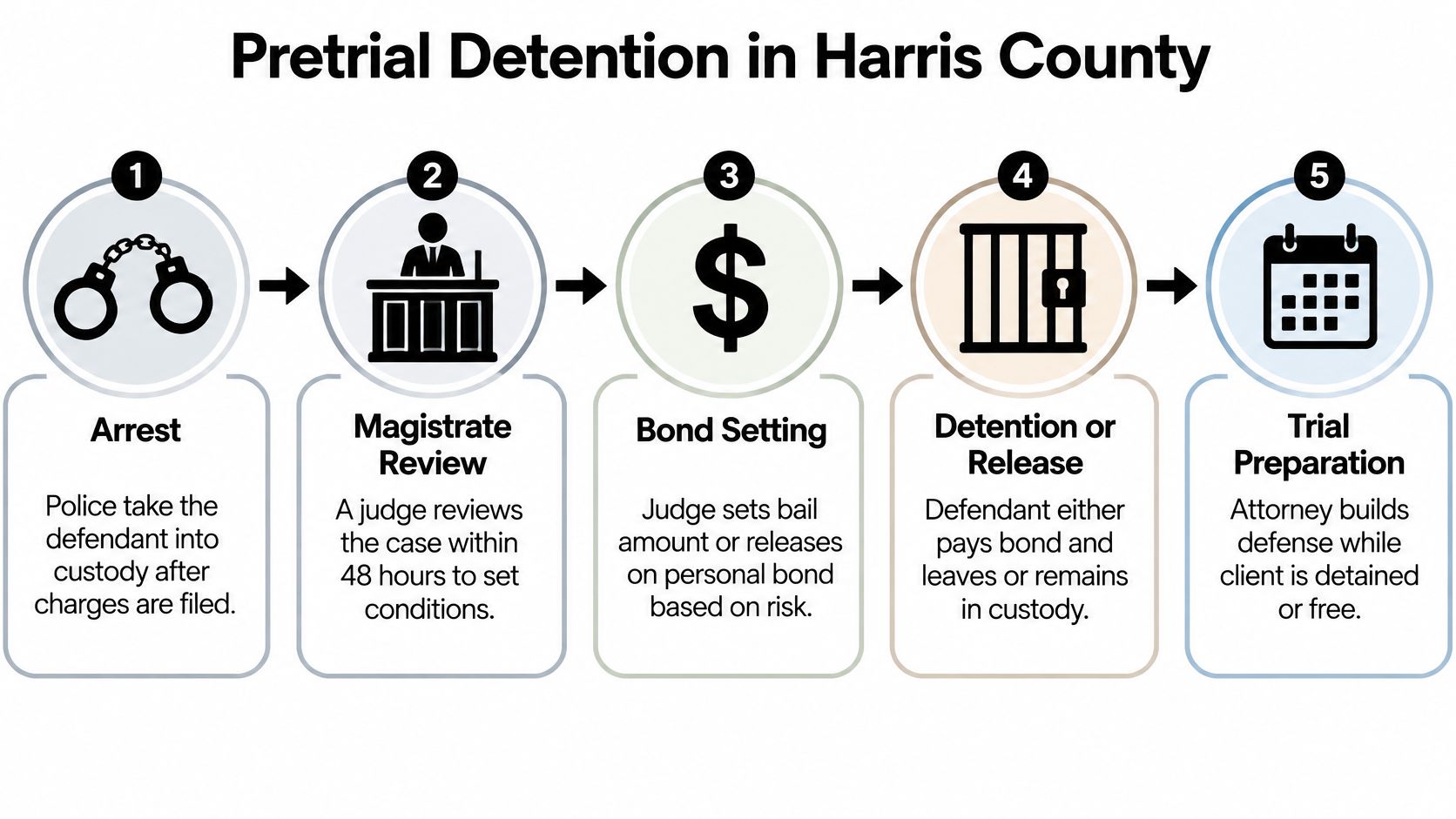
Bond comes in different forms, including personal recognizance, cash, and surety bonds through a bondsman. The amount is only part of the burden. Conditions can control where you live, who you contact, whether you carry a firearm, and whether you submit to monitoring or curfews.
Family violence allegations tighten those screws. Texas Code of Criminal Procedure §17.03 on bail conditions identifies assault punishable as a felony when family violence is involved and aggravated assault under §22.02 as cases where courts may impose specific release conditions affecting contact, return to a shared residence, weapons, and pretrial freedom.
Watch this short explanation, then read your own conditions again with fresh eyes.
Violating a no contact order to apologize is still a violation, even if the other person texts you first. Going home to grab clothes can be a violation if the residence is excluded. Call your lawyer and arrange a lawful retrieval instead of testing the order.
Time spent detained before disposition may later matter for jail credit if a sentence is imposed, so keep booking paperwork and release dates. Don't assume the calculation will be automatic or correct. We verify it.
What Real Outcomes Look Like in Texas Assault Cases
Two assault cases can carry different charges and end differently. Statutes set the possible penalties, while case outcomes depend on the evidence, the charge, and the decisions made as the case proceeds.
A Bureau of Justice Statistics study of felony assault defendants convicted in state courts found that 83% were sentenced to prison or jail. Among family assault cases resulting in incarceration, 68% led to jail, with a mean sentence of almost 7 months. For nonfamily assault cases resulting in incarceration, 62% led to prison.
The same study reported an average state prison sentence of about 38 months for family assault. These are historical national figures, not a forecast for a Harris County case filed today.
How These Cases Actually Resolve
A case may end in dismissal if the evidence does not support the charge. A felony may be reduced to a misdemeanor when proof of injury, identity, or intent is weak. Depending on the charge and circumstances, the State may offer probation or deferred adjudication. The distinction matters, so review deferred adjudication and pretrial diversion in Atascocita before weighing an offer.
Some cases go to trial. That may make sense when the evidence supports self-defense or the accusation is false. No one can responsibly predict the outcome without reviewing the body camera footage, medical records, and witness statements.
Don't plead guilty just to leave jail sooner. First understand the consequences for your record, firearm rights, and family court matters.
Family assault cases can differ from stranger assault cases in how prosecutors charge them and courts sentence them. Treat the consequences seriously. Your lawyer should address protective orders, access to your children, and possible future enhancement alongside the question of custody.
At your consultation, ask direct questions: What degree is charged? Which element is hardest for the State to prove? Is there a legally available outcome that avoids jail and a damaging finding? You deserve clear answers grounded in the evidence and the law.
Defense Options and Local Court Strategy in Atascocita
Good defense work starts boring and specific. We read the complaint or indictment word by word, match each element to the evidence, and look for the mismatch that changes the charge level.
That first document review often happens across a desk like this, with your paperwork spread out in front of us.

Remember the baseline distinction. Under the Penal Code framework discussed earlier, bodily injury is the line that generally separates a Class A case from lower level offensive contact or threat allegations. If prosecutors can't prove bodily injury as charged, reduction discussions get real.
Steps to Take This Week
- Preserve evidence: Save texts, call logs, photos, and video in original form, and don't edit or delete anything.
- List witnesses: Write full names and phone numbers for anyone who saw or heard the incident in Atascocita, Humble, or wherever it happened.
- Follow bond conditions exactly: Treat every condition as a court order, because it is one.
- Stay off social media: Don't post your version, tag witnesses, or message the complainant.
- Build the strategy early: Our criminal defense strategy overview for Atascocita clients explains how early motions and negotiation can shape the options before a trial setting.
Local procedure matters. Harris County cases move through magistrate settings, pretrial services, and court appearances at the Criminal Justice Center, and missing a check in can create a warrant problem on top of the assault charge. Put every date in your phone and confirm transportation the day before.
Some families face a parallel investigation when children were present. In that situation, a CPS Defense Attorney in Atascocita handles defense against CPS investigations for Atascocita families, and coordination matters so statements in one matter don't damage the other.
The Law Office of Bryan Fagan, Atascocita TX Lawyers handles criminal defense for people charged in Atascocita, Humble, and northeast Harris County, including assault and family violence allegations. We sit down with you, identify the exact degree and enhancements, review bond conditions, and map the fastest lawful path toward dismissal, reduction, or a trial defense.
Don't wait for the first court date to start. Evidence disappears, witnesses forget, and bond violations happen in the gap. Get counsel now and make the State prove its case.
If you're facing an assault charge in Atascocita, Humble, or elsewhere in Harris County, schedule a free consultation so we can review your charging document, explain your real jail exposure, and build a defense plan before your next court date. Visit Law Office of Bryan Fagan – Atascocita TX Lawyers to contact our Atascocita office and get clear, local guidance on your next step.