A divorce decree says one spouse will keep the Atascocita home. The closing is scheduled, the equity division appears settled, and both spouses expect the transfer to be routine. Then the title company finds an unpaid MUD tax balance or a recorded tax lien, and the transaction stops.
This situation creates more than a paperwork problem. A decree can tell the former spouses who must pay a debt, but it generally can't erase the government's rights against the property. For families in Atascocita, Humble, and northeast Harris County, understanding that distinction before signing a property settlement can prevent delayed closings, reimbursement fights, and a serious foreclosure risk.
Understanding How a MUD Tax Lien Can Change Your Divorce Timeline
A common Atascocita scenario starts with an agreement that seems practical. One spouse keeps the house, assumes the mortgage and utility-related obligations, and pays the other spouse the agreed share of the equity. The decree is signed, the divorce becomes final, and everyone moves on.
Months later, the spouse who kept the home tries to refinance or sell. The title company discovers delinquent MUD taxes or a related lien. The lender won't close until the title issue is addressed, and the former spouse argues that the decree already assigned the debt to the other person. Meanwhile, the taxing authority isn't bound by the couple's private understanding in the same way the former spouses are.

The immediate consequences can include a postponed closing, an unexpected payoff demand, or a dispute over who should provide the money. If the debt is larger than the home equity available at closing, the spouse keeping the property may have to negotiate with the former spouse, contribute personal funds, or reconsider whether retaining the home is financially realistic.
Why standard property language may not be enough
Many decrees include broad language requiring a spouse to pay community debts. That language may create an obligation between the former spouses, but it doesn't necessarily provide the title company with proof that the lien has been paid or released. It also doesn't prevent the taxing authority from pursuing collection against the property.
The timing matters, too. Texas property tax liens attach under rules that don't depend on whether the spouses have already divided the home in a divorce. A spouse who receives the house can't assume the transfer date erased earlier unpaid obligations.
For residents who are still waiting to finalize a divorce, the Texas waiting period for divorce in Atascocita is an opportunity to investigate the home's tax and MUD history, not merely time to wait for the final order. A careful review before the decree is signed is usually more useful than trying to repair the title after an agreement has become binding.
What Is a MUD Tax Lien in Texas and Why It Has Priority
A municipal utility district, commonly called a MUD, may levy charges connected to local infrastructure and services such as water, sewer, or drainage. When property taxes owed to a taxing unit remain unpaid, the obligation can become a lien attached to the real estate. The practical question isn't only how much is owed. It's whether the lien can interfere with ownership, refinancing, or a sale.
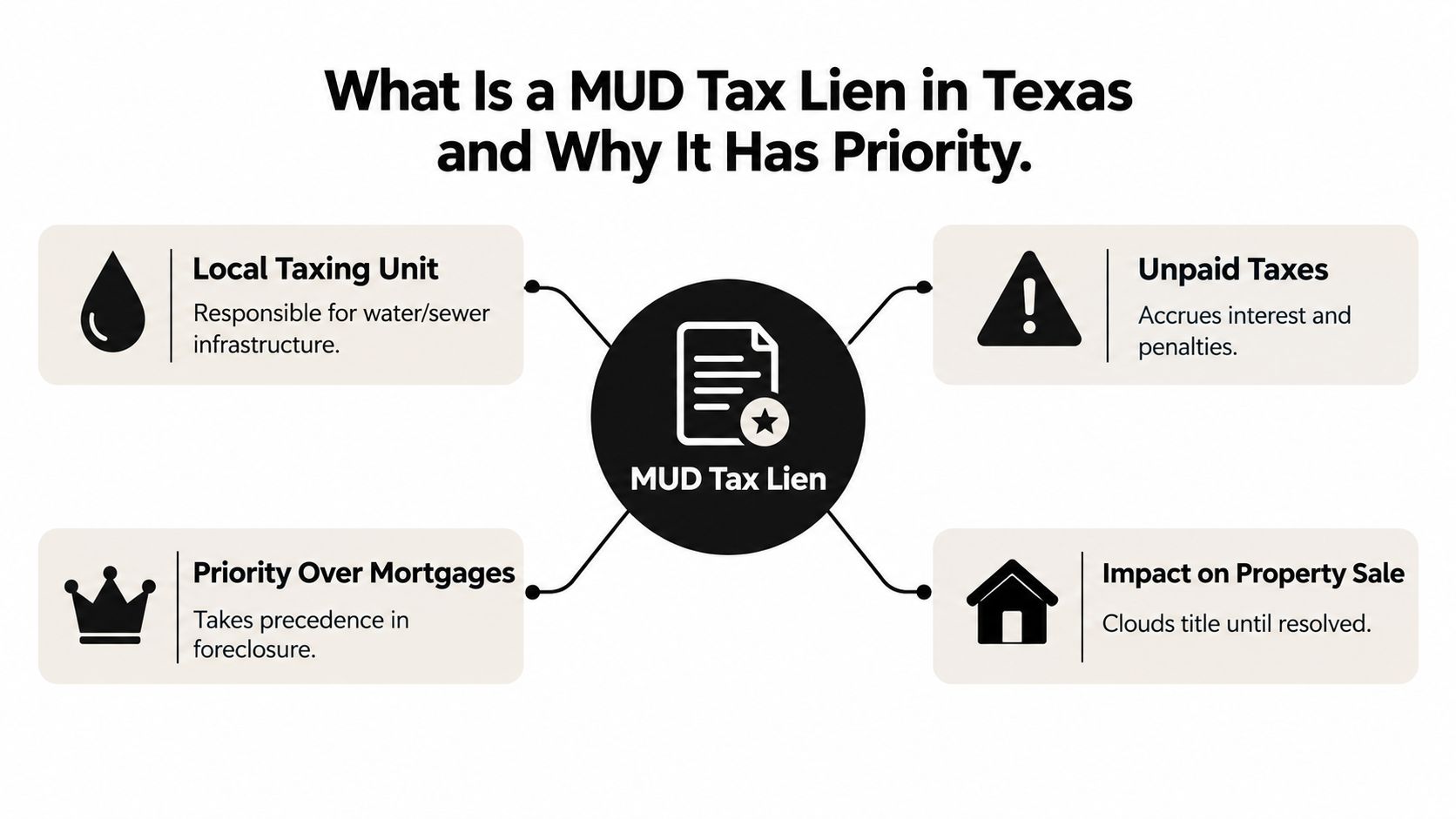
Texas gives delinquent tax liens unusually strong priority. Under Texas Tax Code Section 32.05, a tax lien on real property has priority over a homestead interest, most creditor claims, later-recorded liens, and even future interests, regardless of when many competing interests existed. Texas law also authorizes a taxing unit to sue to foreclose its lien after taxes become delinquent, with the suit filed in the county where the tax was imposed.
A useful analogy is a heavy anchor attached to the house. A divorce decree can determine which spouse must pay the debt, but the anchor remains attached until the taxing authority receives payment or the lien is otherwise resolved and formally released.
Why a divorce transfer doesn't outrank the tax claim
A deed or decree transferring the home may change who owns the property between the spouses. It doesn't automatically change the priority of a tax lien that Texas law protects. A later-recorded transfer can leave the awarded spouse with title that remains subject to the unpaid obligation.
The records matter in local practice. Harris County clerk records separately classify documents such as “Divorce Decree” and “Notice of Tax Foreclosure,” which reflects the way family-law orders and real-property enforcement can intersect in title work. Residents who need a general explanation of how their family case proceeds may also consult Harris County Family Courts: A Atascocita Resident's Guide, which addresses family-law cases in the Harris County courts serving Atascocita.
Practical rule: Treat the MUD balance as a property and title issue, not merely as a disagreement between former spouses.
The priority rule creates a real trade-off. Keeping the home may preserve stability for children and avoid a forced move, but the spouse accepting the property also accepts the need to identify and resolve liens. Selling may provide a cleaner exit, yet an unpaid lien can reduce the proceeds available for division. Neither choice works well if the balance and release requirements remain unknown.
Can a Divorce Decree Remove a MUD Tax Lien or Shift Liability
The direct answer is usually no, not by itself. A Texas divorce decree can assign responsibility for delinquent property taxes or a MUD-related obligation between spouses. It generally can't release the taxing authority's lien or prevent the government from pursuing a person who remains legally liable.
That distinction is easier to understand by separating two relationships:
- Between the former spouses, the decree can require one spouse to pay, reimburse, indemnify, or protect the other from the debt.
- Between the taxpayer and the taxing authority, the government retains the collection rights provided by law.
- Against the property, the lien can remain attached until the taxing authority's requirements are satisfied.
Texas property tax liens attach automatically on January 1 of each tax year to secure the taxes, penalties, and interest assessed for that year, and the lien is perfected on attachment without further action by the taxing unit, as explained in this discussion of property tax liability after divorce in Texas. A divorce allocation doesn't interrupt that attachment.
How the outcome changes depending on the decree
Suppose a decree awards the Atascocita home to one spouse and states that spouse must pay all delinquent MUD taxes. That provision may allow the other spouse to seek enforcement or reimbursement if the assigned spouse fails to pay. It doesn't guarantee that the taxing authority will ignore the lien while the debt remains unpaid.
If the decree requires payment from sale proceeds, the title company may need a payoff statement and evidence of release before distributing equity. If the decree requires one spouse to indemnify the other, the awarded spouse may still face the immediate title problem, then pursue the former spouse under the decree. The legal remedy and the closing solution aren't always the same thing.
A vague reference to “community debts” also creates avoidable uncertainty. The decree should identify the property, the delinquent tax or MUD obligation, the responsible spouse, payment deadlines, reimbursement rights, and what happens if a lien must be paid at closing.
The Atascocita divorce decree enforcement attorney page addresses the separate problem of enforcing an order after a former spouse fails to do what the decree requires. Enforcement may help recover money or compel compliance, but it doesn't substitute for confirming the lien's status with the taxing authority and title professionals.
Divorce Decree Language and Title Risks in Harris County
The wording of the decree can determine whether a future dispute is manageable or expensive. Compare these two provisions:
| General language | Specific language |
|---|---|
| “Spouse A will pay community debts associated with the home.” | “Spouse A will pay all delinquent property taxes and MUD-related amounts identified through the closing payoff, reimburse Spouse B for covered payments, and indemnify Spouse B from enforcement arising from those obligations.” |
| Leaves the property, tax years, deadlines, and remedy unclear. | Identifies payment responsibility and the consequences of nonpayment. |
| May create an argument between former spouses. | Gives the parties and title professionals clearer instructions, subject to the taxing authority's rights. |
A specific clause still doesn't bind the government to release a lien without payment or other legally sufficient resolution. It does, however, reduce the chance that the former spouses will fight over what they agreed to. The decree should also address whether the debt will be paid before transfer, paid from sale proceeds, or handled through a documented reimbursement arrangement.
Recording and timing affect title
A Texas divorce decree may materially affect ownership. In Prewitt v. United States, the Fifth Circuit discussed a tax lien that arose on December 15, 1982, while the divorce decree awarding the property to Johanna had become final two months earlier. The court's discussion illustrates why the timing of ownership and the existence of an enforceable interest can matter in a tax dispute. The case also shows why a decree affecting title should be properly recorded in property records rather than left only in a family-court file. See the Prewitt v. United States decision for that historical example.
Recording protects against some title confusion, but it doesn't solve an unpaid MUD obligation. A title company still needs to know whether the lien has been satisfied, released, or must be paid as part of the transaction.
Choosing among the practical options
- Pay before finalizing the decree: This offers the clearest title position, but the couple must decide who advances the money and how the payment affects the property division.
- Require payment at closing: This can preserve liquidity before sale, but it may reduce the equity available to divide and requires accurate payoff information.
- Assign payment after transfer: This may help a spouse retain the home, but it creates greater enforcement and foreclosure exposure if the spouse doesn't follow through.
- Sell instead of retaining the home: A sale can resolve the lien from proceeds, but it may conflict with a parent's desire to keep children in their Atascocita home.
A Contested Divorce Attorney in Atascocita may be relevant when the spouses disagree about the home's value, the tax allocation, or the language needed to protect each party in a high-conflict Harris County case.
Practical Steps for Atascocita Spouses During Property Division
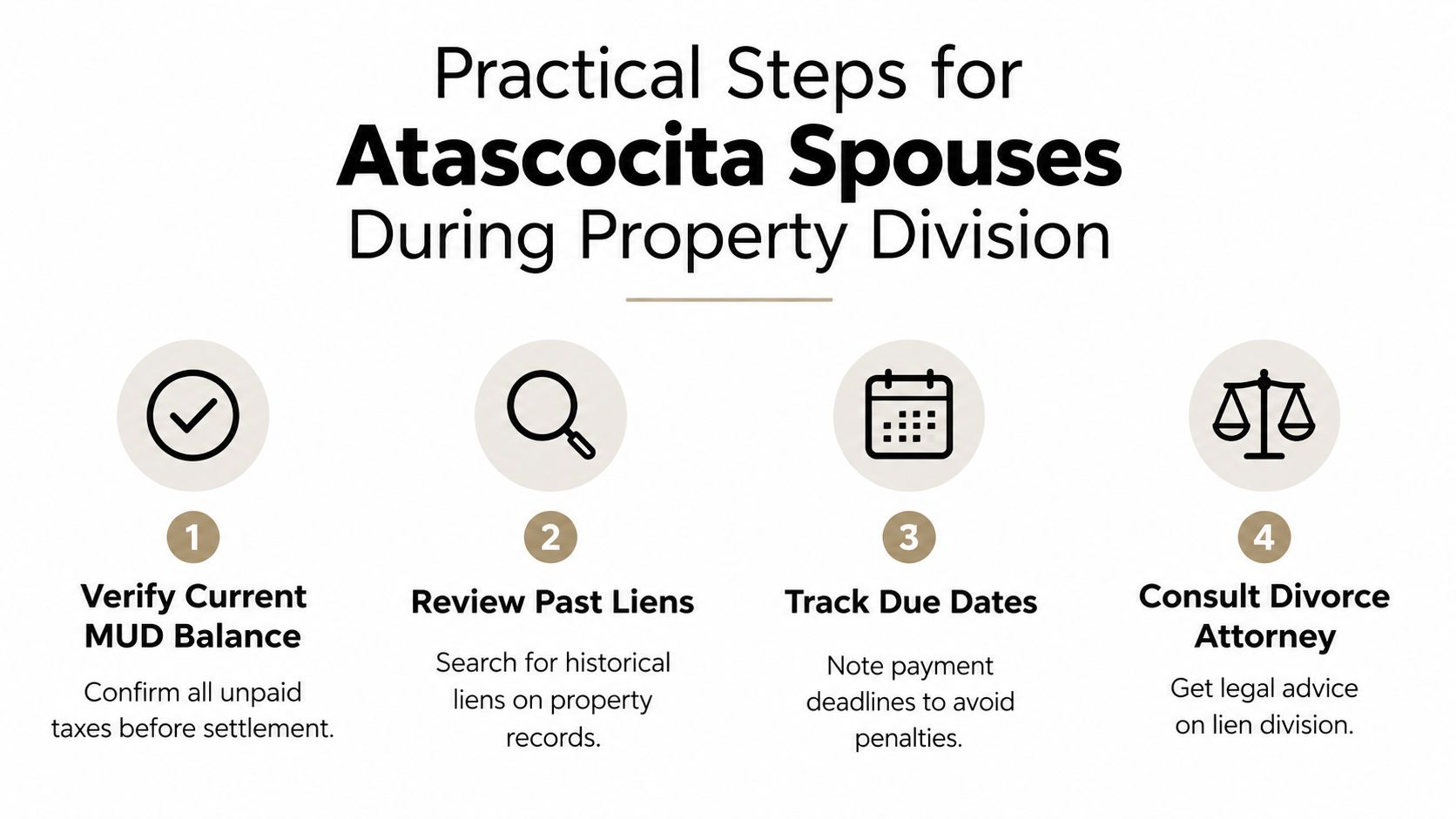
The safest time to investigate a MUD tax lien is before the property settlement becomes final. Don't rely only on a spouse's statement that the taxes are current. Obtain records from the relevant taxing authorities, review the title work, and keep written proof of every payoff or release.
Start with the records, not the assumptions
- Request the current balance. Confirm unpaid MUD taxes, penalties, interest, and any other amounts claimed against the property. Ask how long the payoff quote remains valid.
- Check historical obligations. Review prior tax statements and the title commitment for recorded liens, notices, and exceptions. A current account statement may not answer every title question.
- Ask about foreclosure activity. Confirm whether a lawsuit, notice, or other collection action is pending. A divorce lawyer should know this before recommending that a spouse accept the home.
- Coordinate with the title company. Give the title professional the proposed decree and ask what must be paid, recorded, or released before a transfer or refinance can close.
The Atascocita MUD district assessments and divorce property division resource addresses the local connection between MUD assessments and a divorce property settlement. The attorney drafting the decree should still obtain case-specific records rather than treating a general explanation as a payoff statement.
Draft the decree around the actual risk
The order should identify who pays current and delinquent amounts, whether the responsible spouse must reimburse the other, and whether indemnity applies if the taxing authority pursues collection. Include a deadline, a method for proving payment, and instructions for handling a sale or refinance.
If one spouse will keep the home, consider requiring proof of payment before the transfer or setting a clear consequence if payment doesn't occur. If the lien will be paid at closing, state how the payoff affects equity calculations and whether either spouse receives credit for advancing funds.
A signed decree is not a substitute for a tax payoff letter, a title review, or a recorded release.
Finally, separate tax issues from other household obligations. Mortgage debt, HOA charges, utility accounts, MUD assessments, and property taxes may involve different entities and different collection rights. The decree should identify each obligation instead of grouping everything under an informal reference to “the bills.”
When a MUD Tax Lien Becomes a Foreclosure Risk in Atascocita
A delinquent tax lien becomes more urgent when the taxing unit moves from billing and collection notices toward legal enforcement. Harris County states that property can be sold for delinquent taxes, and that a lawsuit for tax lien foreclosure may be filed before a court judgment allows the foreclosure process to move forward. The county's property tax frequently asked questions explain that local enforcement path.
The warning signs are practical:
- A formal notice arrives: Keep the envelope, notice, account details, and date received. Don't assume the notice is covered by the divorce decree.
- The title company identifies a foreclosure notice: Ask whether the notice is merely recorded information or part of an active legal proceeding.
- A lawsuit is filed: A spouse named in the case needs prompt legal advice about deadlines, defenses, payment options, and the effect of the divorce order.
- A closing is approaching: Tell the title company and family-law attorney immediately. Waiting until the day before closing can leave no room to obtain a payoff or negotiate the distribution of proceeds.
The homestead does not answer every lien question
Texas homestead protection has exceptions, including debts for taxes due on the property and certain court-ordered owelty of partition. That means a homeowner shouldn't assume that a homestead claim automatically blocks a tax-related lien or every lien created through property division. The relevant exceptions are discussed in Texas homestead lien case law.
If the divorce is already final, the former spouses should review the decree, obtain the current balance, determine whether a foreclosure suit exists, and document which person was assigned payment responsibility. The decree may support a claim for reimbursement or enforcement, but it doesn't make an active property lien disappear.
The best response is early coordination. A family-law attorney can address the order, while a title company and appropriate tax or real-property professionals confirm the property's current status. Each person should know whether the immediate objective is payoff, settlement, refinance, sale, or a defense to an enforcement action.
Working with an Atascocita Divorce Lawyer on Tax and Utility Liens
A spouse keeping a home after divorce needs more than a property paragraph in the decree. The attorney should review the title commitment, request tax and MUD information, identify the person responsible for each obligation, and coordinate the final language with the expected transfer or closing process.
For example, a client in Humble may want to keep the home for the children but discover that the available equity won't cover the delinquent obligation and the agreed payment to the other spouse. An attorney can help compare retaining the property with selling it, then draft terms that address reimbursement, indemnity, payoff, and proof of payment instead of leaving those decisions to a later argument.
Legal guidance can also address related family-law issues, including custody and support, when the home's stability affects the children. Separate counsel may be appropriate for tax, title, or civil litigation questions, particularly if a foreclosure lawsuit has already been filed.

If you're facing an Atascocita MUD tax lien and a divorce decree dispute, bring the decree, title documents, tax notices, MUD statements, and any closing correspondence to a consultation. Early review gives you more choices than waiting until a sale, refinance, or foreclosure deadline forces the decision.
The Law Office of Bryan Fagan – Atascocita TX Lawyers helps clients address divorce property division, decree language, and related title and lien concerns in Atascocita, Humble, and Harris County. Schedule a free consultation by visiting Law Office of Bryan Fagan – Atascocita TX Lawyers so an attorney can review your documents and help you plan the next step.