Skip to content

Your child gets the good news first. They made the team. They got the solo. They were accepted into the robotics program. Then the second wave hits. Registration fees, uniforms, equipment, travel, lessons, and surprise add-ons that weren't part of your monthly budget.
For many parents in Atascocita, Humble, and northeast Harris County, that's the moment the same question comes up: can child support include extracurricular expenses texas atascocita families are dealing with every season? It's a fair question, and it often comes up after a divorce or custody order is already in place.
The hard part is that regular child support and activity costs don't always line up neatly. A parent may assume monthly support should cover soccer, band, dance, or summer camp. The other parent may see those costs as optional and separate. Both parents may care a great deal about the child and still disagree about who should pay.
That confusion is common. It's also fixable when you understand how Texas courts usually treat these expenses and what kind of order language makes those costs enforceable.
Your Child's Passion vs Your Budget A Common Atascocita Dilemma
A parent in Atascocita might open a school email and find out their child has a spot in band, cheer, club volleyball, or a travel baseball program. The child is excited. The parent is proud. Then the cost sheet arrives, and the conversation changes quickly.
One parent says, “Child support should cover this.” The other says, “I already pay support, so this is extra.” That disagreement can turn a happy milestone into a stressful standoff.
Where families often get stuck
The biggest problem usually isn't whether the activity is good for the child. Most parents agree that sports, music, clubs, and camps can help a child build confidence, discipline, friendships, and routine. The conflict starts when nobody clearly addressed those costs in the court order.
In real life, these expenses can show up in layers:
- Upfront fees: Registration, uniforms, instruments, or equipment
- Ongoing costs: Monthly lessons, coaching, or tournament dues
- Hidden extras: Travel, hotel stays, meals, photos, and end-of-season charges
Some activities are much more expensive than parents expect. If you're trying to estimate what a sport may involve before you agree to split it, this guide to managing sports expenses can help frame the budget conversation in practical terms.
Parents usually don't need more arguments. They need a clear rule before the bill arrives.
The local reality in Harris County
This issue comes up often in Harris County because children's schedules evolve fast. A child who was in elementary school when the order was signed may now be in middle school band, competitive dance, select baseball, or summer programs in Humble or Atascocita. The order may say plenty about possession and monthly support, but nothing about extracurriculars.
When that happens, the answer usually doesn't come from guesswork. It comes from the exact language in the order, the parties' agreement, and the proof each parent can bring if the issue reaches court.
Child Support 101 What Texas Guidelines Cover and What They Don't
Texas starts with guideline child support. This represents the base layer of support for a child's ordinary, recurring needs. It's closer to rent, groceries, utilities, and day-to-day living than to elective activities or special programs.
Under Texas Family Code §154.125, child support is generally calculated using a percentage of the paying parent's net monthly resources. The guideline table applies up to a statutory cap that rose to $11,700 per month on September 1, 2025, and the standard percentages are 20% for one child, 25% for two, 30% for three, 35% for four, and 40% for five or more children, as explained in this Texas child support deviation overview.
That same source also explains the point many parents miss. Extracurricular activities such as sports, music lessons, and clubs are usually treated as separate or additional expenses, not automatically built into ordinary guideline support. Courts may deviate from the guideline amount when a child has proven needs, including educational or special expenses, but those claims typically require documentation.
A simple way to think about it
Guideline support covers the basics.
Extracurriculars are usually handled separately.
That doesn't mean a court can never require contribution toward those expenses. It means those costs usually need their own legal treatment instead of being assumed to fit inside the monthly child support payment.
If you want a fuller breakdown of how Texas calculates support in the first place, this Atascocita child support guide is a useful starting point.
Guideline Child Support vs Additional Expenses in Texas
| Expense Category | Typically Covered by Guideline Support? | How It's Handled |
|---|---|---|
| Basic day-to-day child expenses | Usually yes | Included in ordinary guideline support |
| Medical or dental obligations | Often addressed separately | Usually stated specifically in the order |
| School-related ordinary needs | Often part of general support unless otherwise addressed | Depends on the order and facts |
| Sports, music lessons, clubs, camps | Usually no | Often negotiated separately or added by court order |
| Special educational or proven extra needs | Not automatic | May support a deviation if documented |
Why this distinction matters
Parents often hear “child support” and assume it means every child-related bill. Texas law is more structured than that. The formula handles the recurring baseline. The extras usually need separate language, separate proof, or both.
Practical rule: If an activity matters enough that you'll want reimbursement later, treat it like an item that needs to be named in the order.
Making Extras Official Including Extracurriculars in Your Court Order
The most effective place to solve this problem is the court order itself. If your decree or custody order clearly says how extracurricular expenses will be handled, you reduce the chance of future conflict.
Texas guidance explains that extracurricular costs are generally treated as separate, add-on obligations rather than part of the core monthly child support baseline. Non-school extracurricular activities are not automatically included in standard orders unless the parents specifically negotiate them and the court incorporates them, as explained in this Texas Law Help discussion of extracurriculars and child support orders.
Early in the process, many parents benefit from seeing the steps laid out visually.
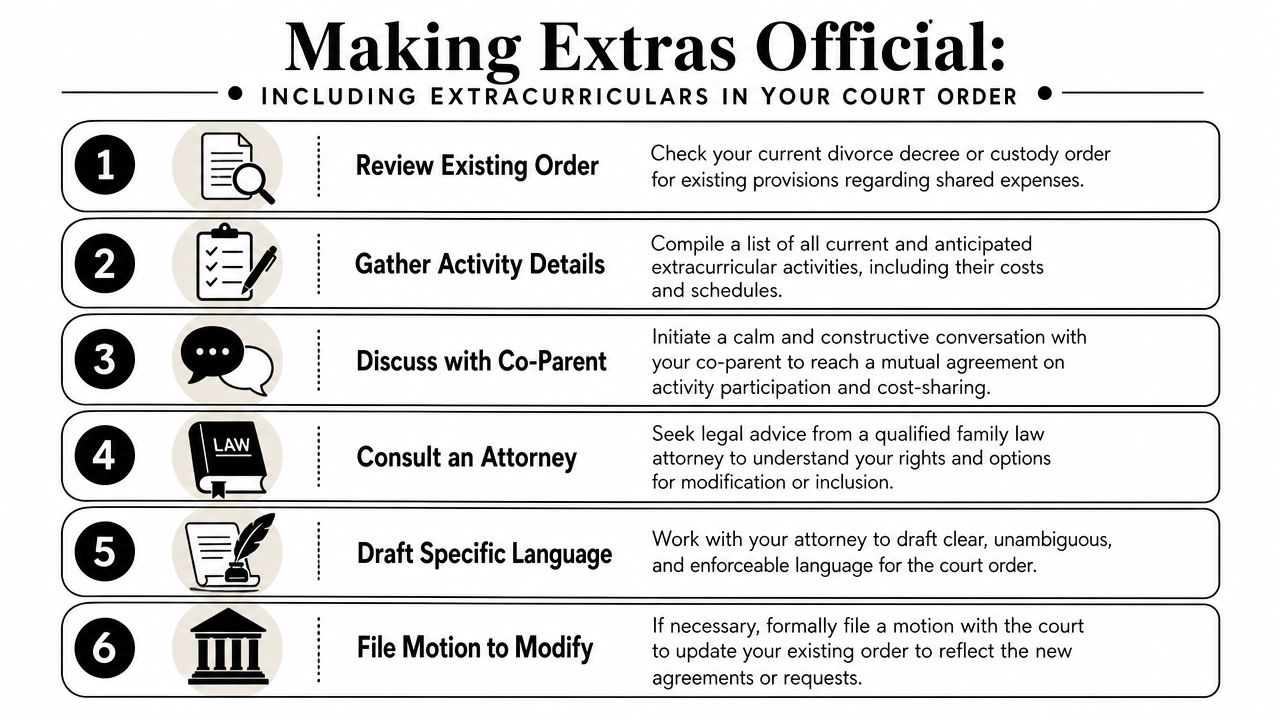
What clear order language usually addresses
A good order doesn't just say “the parties will share extracurricular expenses.” That sounds helpful, but it leaves too many questions unanswered.
A stronger order often addresses points like these:
- Which activities count: School sports, private clubs, music lessons, dance, camps, or tutoring
- How approval works: Whether both parents must agree before enrollment
- How payment is split: By equal shares or another agreed method
- What the spending limit is: A cap, if the parents want one
- How reimbursement happens: Deadlines, receipts, and payment method
Here are examples of the kind of practical language parents often discuss with counsel:
- Mutual approval model: The parents must both approve an activity before either can seek reimbursement.
- Shared-cost model: Once approved, each parent pays the assigned share of registration, uniforms, equipment, and related fees.
- Advance-notice model: The enrolling parent must give written notice with cost details before committing the child.
- Cap model: Expenses above a stated amount require additional written agreement.
Two common paths to get this included
The first path is agreement. Parents can negotiate these terms in mediation or settlement and ask the court to include them in the final order.
The second path is asking the judge to include specific provisions in the final orders after hearing evidence and argument.
A short video can also help if you're trying to understand how Texas courts treat support issues in practice.
Why drafting matters so much in Harris County
Once the order is signed, the text becomes the rulebook. If the order is vague, enforcing payment later gets harder. If the order is specific, both parents know the process before disputes start.
That's why the drafting stage matters so much for Atascocita families. The parent seeking contribution usually can't rely on a general support obligation alone. They need the order to say what must be paid, when, and under what conditions.
Proving the Need Evidence for Your Atascocita Court Case
When parents can't agree, the question becomes practical: what will a judge want to see? In Harris County, a request to share extracurricular costs is usually stronger when it is organized, documented, and tied to the child's real needs and routine.
Texas child-support guidance often leaves a gray area around activities like band, travel sports, robotics, and summer camps. These may feel ordinary to one family and discretionary to another, which is one reason these issues are frequently disputed, as discussed in this Texas overview of what child support covers.
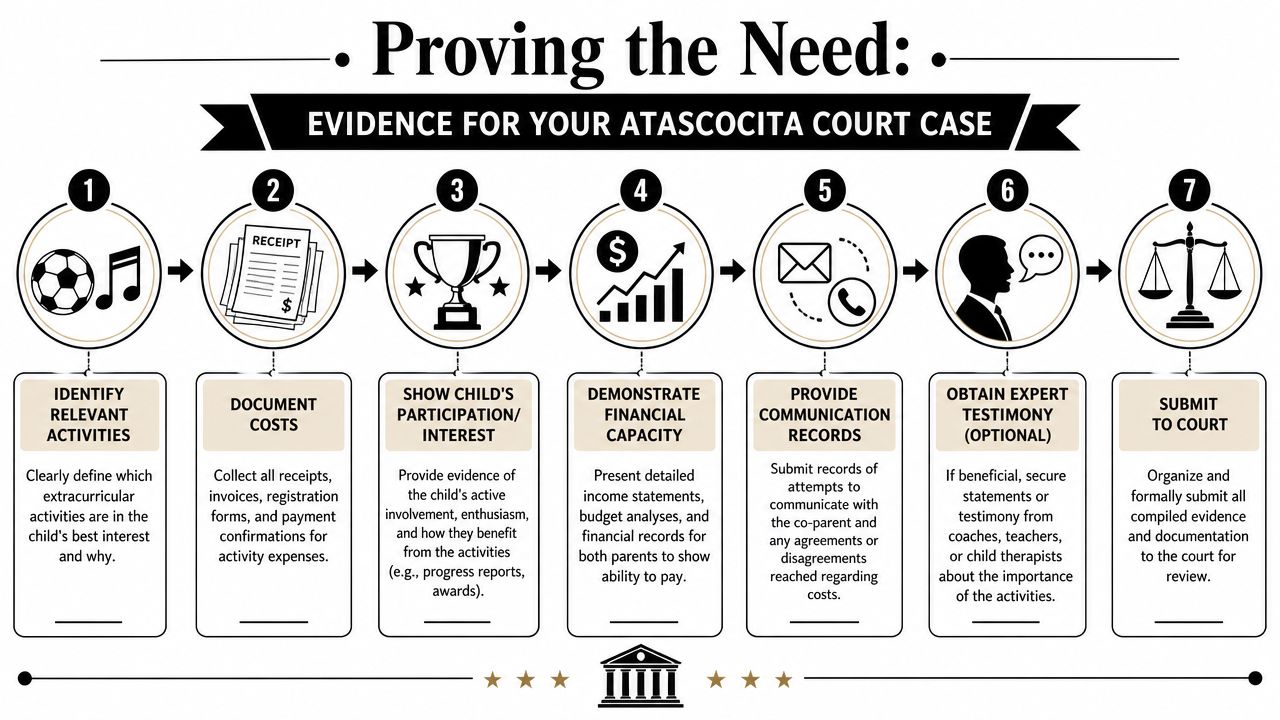
What evidence usually helps most
A judge usually needs more than a parent saying, “This is good for our child.” Helpful evidence often includes:
- Registration paperwork: Forms that show the activity, the dates, and the required cost
- Receipts and invoices: Proof of what was charged and paid
- Program materials: Team handbooks, studio policies, or school schedules
- Fee pages from official websites: For example, a school or program page showing required expenses
- Messages between parents: Emails or app messages about notice, approval, or objections
- Proof of participation: Photos, progress reports, awards, attendance records, or coach communications
The judge is looking for a story that makes sense
The strongest presentation usually connects the documents to the child's life. Has the child participated for years? Is the activity connected to school involvement, structure, social development, or a known talent? Was the other parent told ahead of time? Was the cost reasonable in light of the family's finances?
Those details matter because courts tend to look closely at necessity, reasonableness, and clarity.
If your paperwork shows only a bill, the court sees an expense. If your paperwork shows a pattern, notice, and a child-centered reason, the court sees a case.
Build your file before court, not the night before
If you think this issue may end up before a judge, start gathering records now. Keep a folder with invoices, screenshots, confirmation emails, and any discussions with the other parent. Save documents in a way that shows dates clearly.
If you already have a hearing coming up, review this Atascocita child support court date guide so you can prepare the practical side of the court process as well as the evidence.
What If the Order Is Already Final Modifying Support for New Activities
A lot of parents don't face this issue during the original case. The problem appears later, when the child gets older and their interests become more expensive or more structured. A child who was in preschool when the order was signed may now want to join a competitive team, school band, or specialized training program.
That raises a tougher question. If the final order says nothing about extracurriculars, can it be changed?
Why modification is harder than initial planning
Texas family law has historically been cautious about forcing parents to pay optional or future expenses outside ordinary support. Texas-focused family-law guidance explains that courts generally do not order parents to fund discretionary future costs unless those expenses are specifically addressed, and that families often use settlement terms such as shared categories, caps, reimbursement rules, and advance-notice provisions to manage activities, as described in this Texas family-law discussion of extracurricular costs in custody arrangements.
That means modifying an order usually requires more than saying, “Our child wants to do something new.” The court will want a legal basis for changing the existing order.
What material and substantial change means in plain English
In plain language, a material and substantial change in circumstances means something important has changed enough that the old order no longer fits the family's current reality.
That change might involve the child's needs, a parent's financial circumstances, or another meaningful shift in family life. Whether a new activity meets that standard depends heavily on the facts, the order already in place, and the proof available.
A Harris County parent might argue that the child's age, established participation, school demands, or developmental needs have changed enough to justify adding specific expense-sharing terms. The other parent may argue the activity is optional and should remain voluntary.
Typical modification steps
The process often looks like this:
- Review the current order to see what it already says about support and shared expenses.
- File a petition to modify asking the court for revised language.
- Serve the other parent through the proper legal process.
- Exchange information and evidence about costs, need, and ability to pay.
- Attempt mediation if the court requires it or the parties agree.
- Present the issue to the judge if no agreement is reached.
If you're at that stage, this Atascocita child support modification lawyer page explains the legal service involved in requesting a change to an existing order.
Beyond the Courtroom Alternatives for Managing Activity Costs
A common Atascocita problem looks like this. Your child gets accepted onto a team, the registration deadline is Friday, and both parents want to support the activity. The disagreement is about who pays, when they pay, and what happens if extra costs keep showing up during the season.

Court is only one option. In many Harris County families, a clear written system solves the actual problem faster than a hearing because the issue is often less about refusing to support the child and more about avoiding surprise bills.
Mediation vs informal agreement
Mediation works well when conversations turn tense but both parents are still willing to work toward a plan. A neutral third party helps both sides pin down the details that usually cause repeat arguments, such as advance approval, spending caps, deadlines for sending receipts, and how quickly reimbursement must happen. If you already know the weak spots in communication, mediation gives you a place to address them before the next registration fee lands.
Informal written agreements can work too, but they need to be specific. A vague text saying “we'll split it” is a shaky foundation. A better version reads more like a checklist: which activities are covered, whether both parents must agree first, what proof of payment is required, and what happens if one parent signs the child up alone. The more precise the agreement, the less room there is for two different memories later.
One practical rule helps many families. No reimbursement request goes out without the invoice, proof of payment, and a clear deadline.
Tools that reduce conflict
A shared recordkeeping system matters more than many parents expect. Scattered texts, screenshots, and half-remembered phone calls make even reasonable people suspicious. An app like OurFamilyWizard or AppClose can keep messages, receipts, and payment requests in one place so there is a clean paper trail if a disagreement grows.
That recordkeeping habit also helps if you later need court involvement in Harris County. Judges and mediators usually respond better to organized proof than to broad statements about who “always” pays or who “never” communicates. In that sense, these tools work like a household ledger. They turn a messy argument into a timeline with documents attached.
Some families also ask for legal drafting help before filing anything. The Law Office of Bryan Fagan – Atascocita TX Lawyers handles family law matters involving child support, custody orders, and modification requests, which can be useful when parents want to turn a rough verbal understanding into language a court can enforce.
A calm written system often carries more weight than a verbal promise made during a stressful week.
Frequently Asked Questions About Extracurriculars and Child Support
What if one parent signs the child up without asking the other?
That often becomes an order-language problem. If the court order requires mutual approval, the enrolling parent may have trouble forcing reimbursement without it. If the order is silent, recovery is usually less certain.
Are school activities treated differently from private club sports?
Sometimes parents assume school-related programs are automatically covered while private activities are not. The actual answer usually depends on the order and the facts. A school band fee may feel more necessary than a private travel team, but courts still look closely at what the order says and how the expense is characterized.
Can a judge require both parents to share these costs?
Sometimes, yes. But extracurricular expenses are not typically automatic. The parent asking for contribution usually needs either clear order language or a successful request for updated terms.
What if I already paid and now want reimbursement?
Gather proof immediately. Keep invoices, payment confirmations, registration forms, and your communications with the other parent. Your ability to recover those costs often depends on whether the order supports reimbursement and whether proper notice or approval was given.
What if the child quits the activity early?
That can create a fairness dispute. Some parents address this in advance by agreeing how nonrefundable fees will be handled if the child stops participating. If your order doesn't address that situation, it may become a negotiation issue rather than a clear enforcement issue.
What should I do first if I'm unsure?
Start with the order. Read the exact wording on support, reimbursement, shared expenses, and decision-making. Then gather the activity details and communications before you decide whether to negotiate, mediate, or ask the court for relief.
If you're dealing with sports fees, band costs, dance tuition, or another child activity expense in Atascocita, Humble, or northeast Harris County, a clear legal plan can prevent a lot of stress. A consultation with Law Office of Bryan Fagan – Atascocita TX Lawyers can help you review your current order, identify what's enforceable, and decide whether negotiation, mediation, or modification makes the most sense for your family. Schedule a free consultation with the Atascocita office to get practical guidance suited to your situation.