A neighbor calls the Harris County Sheriff's Office after seeing fresh paint across a fence in Summerwood. At two in the morning, deputies knock on the homeowner's door, ask questions, and explain that the allegation may fit Texas criminal mischief law. In another Atascocita case, a young adult leaves a gas station near FM 1960 with a citation after a damaged side mirror is photographed and a repair estimate is requested. The handcuffs or citation can feel like the entire case has already been decided. It hasn't.
For an Atascocita resident, the important questions are practical. What level of offense does the alleged damage create? Will the case stay in a local misdemeanor docket, or move into a Harris County felony court? What happens at magistration, and can a lawyer challenge the damage estimate, bond conditions, or the State's evidence? Just as important, can the allegation affect employment, a custody dispute, or another criminal case?
A Knock at the Door in Atascocita
The first mistake people make is treating a property-damage allegation as a minor argument that will disappear after someone pays for repairs. A fence, vehicle, storefront, mailbox, or wall can become evidence. The complainant may provide photographs, surveillance footage, witness statements, and an estimate from a local body shop or contractor. Officers may then decide that the facts support a citation or an arrest under Penal Code Section 28.03.
The second mistake is explaining too much at the door. A worried homeowner might say the paint was accidental, the property belonged partly to the accused, or the neighbor gave permission to make changes. Those facts may matter, but an impromptu statement can be incomplete, emotional, or inconsistent with video footage. The safer response is respectful and brief: identify yourself, comply with lawful instructions, and request a lawyer before answering investigative questions.
What the first contact can mean
An officer may hand over a misdemeanor citation, or deputies may take someone into custody on a warrant or probable-cause determination. The immediate paperwork matters because it can identify the alleged offense level, the court involved, and any release conditions. It also tells your attorney which evidence needs attention first.
A repair estimate isn't automatically the value the State can prove. The estimate may include upgrades, unrelated damage, unnecessary replacement, or work that wasn't performed. A defense lawyer should examine photographs, invoices, ownership records, witness accounts, and the calculation used to classify the case.
Practical rule: Don't contact the alleged victim to argue, apologize, or negotiate repairs before you understand the bond conditions and legal consequences.
This article focuses on criminal mischief in Atascocita, Texas, including the statewide offense ladder, the Harris County processing path, defenses and diversion, and the collateral issues that many short online summaries overlook. If the allegation arose during a family conflict, the court process described in Harris County Family Courts: A Atascocita Resident's Guide may also help explain how family-law cases proceed in the Harris County courts serving Atascocita.
What Texas Law Calls Criminal Mischief
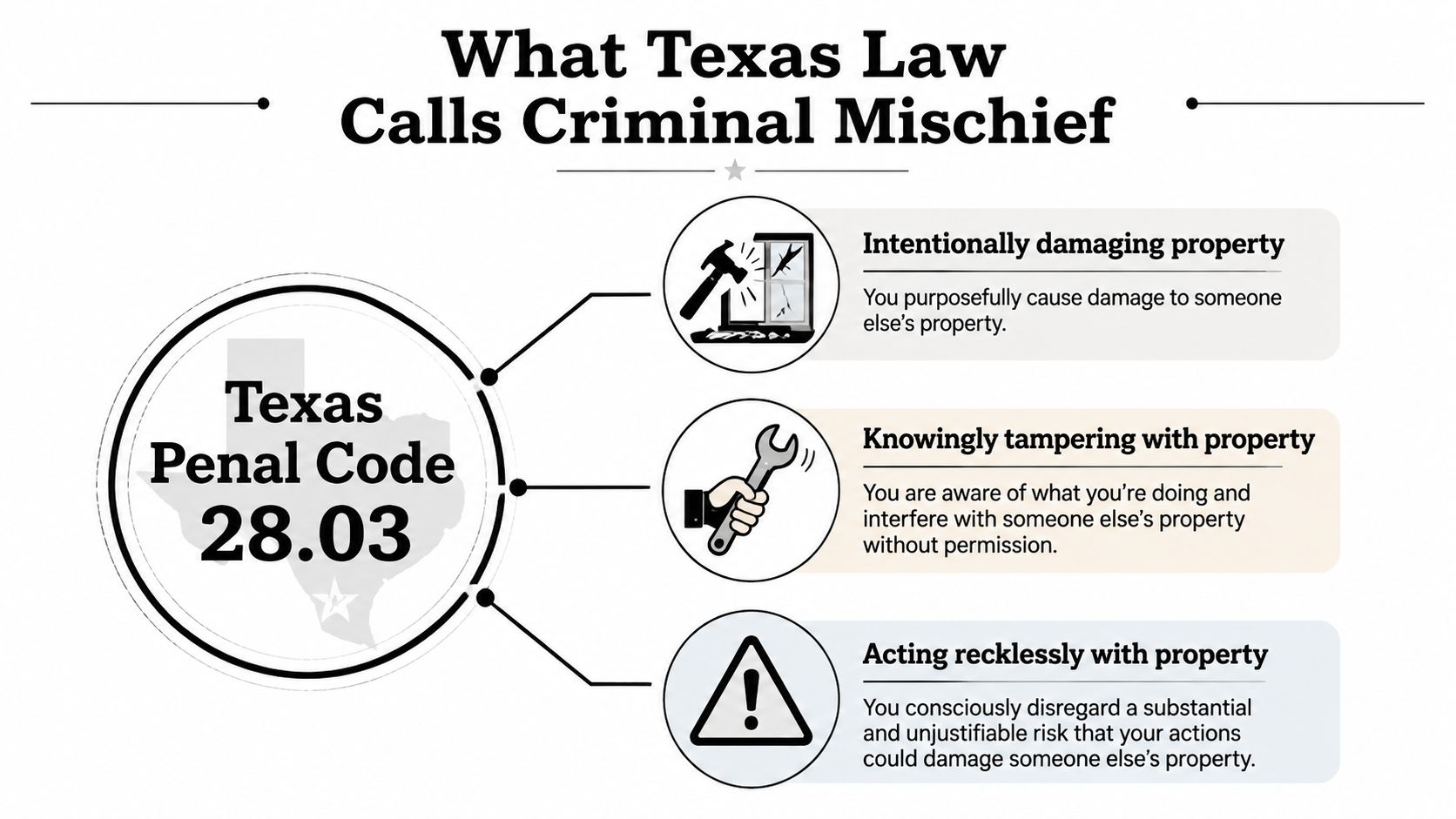
Texas Penal Code Section 28.03 addresses criminal mischief. In plain English, the statute covers intentionally or knowingly damaging or destroying another person's tangible property without effective consent. It also covers tampering with property in a way that causes pecuniary loss or substantial inconvenience, and making markings such as inscriptions or drawings on property. The Texas Penal Code places the offense on a graduated punishment ladder that can begin at a Class C misdemeanor and rise to a first-degree felony.
The State's basic proof
A prosecutor generally must prove the required mental state and conduct beyond a reasonable doubt. That means the State must connect the accused to the property and show more than mere presence near a damaged object.
The core questions are:
Was the conduct intentional or knowing? A broken window caused by an accident is different from a window struck during an argument. The prosecution must prove the mental state required by the charged theory.
Was the property someone else's property? Ownership can be complicated when spouses, roommates, business partners, tenants, or family members share possession or title. A person may have a defense if they had legal authority to alter the property.
Was there effective consent? Permission can be express or arise from the circumstances, but it must be legally effective. A vague conversation about repairs may not answer whether the person had permission to paint, remove, break, or alter the specific item.
Three ways the allegation can arise
The first category is direct damage or destruction. Examples include breaking a vehicle mirror, damaging a door, cutting a fence, or destroying business equipment. The second is tampering that substantially impairs the property's function or value, even if the item isn't permanently destroyed. The third involves markings, such as spray paint, inscriptions, or drawings, where the property and circumstances fall within the statute.
Intent drives the defense. The State may point to angry messages, a confrontation, a tool found nearby, or video footage. The defense may point to an accident, mistaken identity, consent, ownership, or a failure to connect the accused to the damage. The dollar value then determines how seriously the case is classified, so the repair calculation deserves careful scrutiny rather than automatic acceptance.
Misdemeanor and Felony Thresholds in Plain English
Texas uses a graduated structure for criminal mischief. The alleged pecuniary loss or damage value is a central charging fact, and the penalty increases as that value rises. The statute also treats certain property and circumstances differently, including a firearm-related enhancement that can raise the offense classification.
The threshold ranges and punishment descriptions below reflect the Texas property-penalty framework summarized by the Texas Criminal Justice Coalition comparative chart.pdf). The exact court assignment depends on the charging instrument, the alleged property, and the applicable statute. A lawyer should verify the classification rather than rely on a repair estimate supplied by the complainant.
| Damage Value | Offense Class | Punishment Range | Typical Court |
|---|---|---|---|
| $0 to $100 | Class C misdemeanor | Fine up to $500, no jail | Justice of the Peace or municipal-level fine docket |
| More than $100 to $750 | Class B misdemeanor | Up to 180 days in jail and a fine up to $2,000 | Harris County misdemeanor court |
| More than $750 to $2,500 | Class A misdemeanor | Up to one year in jail and a fine up to $4,000 | Harris County Criminal Court at Law |
| More than $2,500 to $30,000 | State jail felony | 180 days to two years | Harris County Criminal Court at Law or felony setting, depending on filing |
| More than $30,000 to $150,000 | Third-degree felony | Two to ten years | Harris County District Court |
| More than $150,000 | First-degree felony | Five to 99 years and a fine up to $10,000 | Harris County District Court |
Why the estimate matters
The important dividing line is $2,500. Damage under that amount is generally misdemeanor-level criminal mischief, while damage above it can move the allegation into felony territory under the verified Texas statutory summary. That doesn't mean every estimate under or over the line automatically controls the outcome. It means the defense must investigate the valuation early.
A replacement quote isn't always the same as the property's repair value. The parties may dispute whether the item could be repaired, whether depreciation applies, whether the alleged damage was preexisting, or whether the complainant selected an unnecessarily expensive option. Photographs, receipts, contractor opinions, and insurance records can change the classification conversation.
The local forum changes the strategy
A Class C matter may be handled through a local fine process, while higher misdemeanor cases proceed through Harris County criminal courts. Felony cases bring more serious exposure and different court procedures. The Harris County Justice of the Peace criminal fines schedule includes a specific criminal-mischief fine line item, confirming that low-level property-damage cases are routinely processed through local misdemeanor dockets.
That forum affects timing, appearance requirements, bond conditions, and negotiating power. Don't assume that paying restitution ends the criminal case, and don't assume that a low dollar amount makes a citation harmless.
How a Case Moves Through Harris County Courts
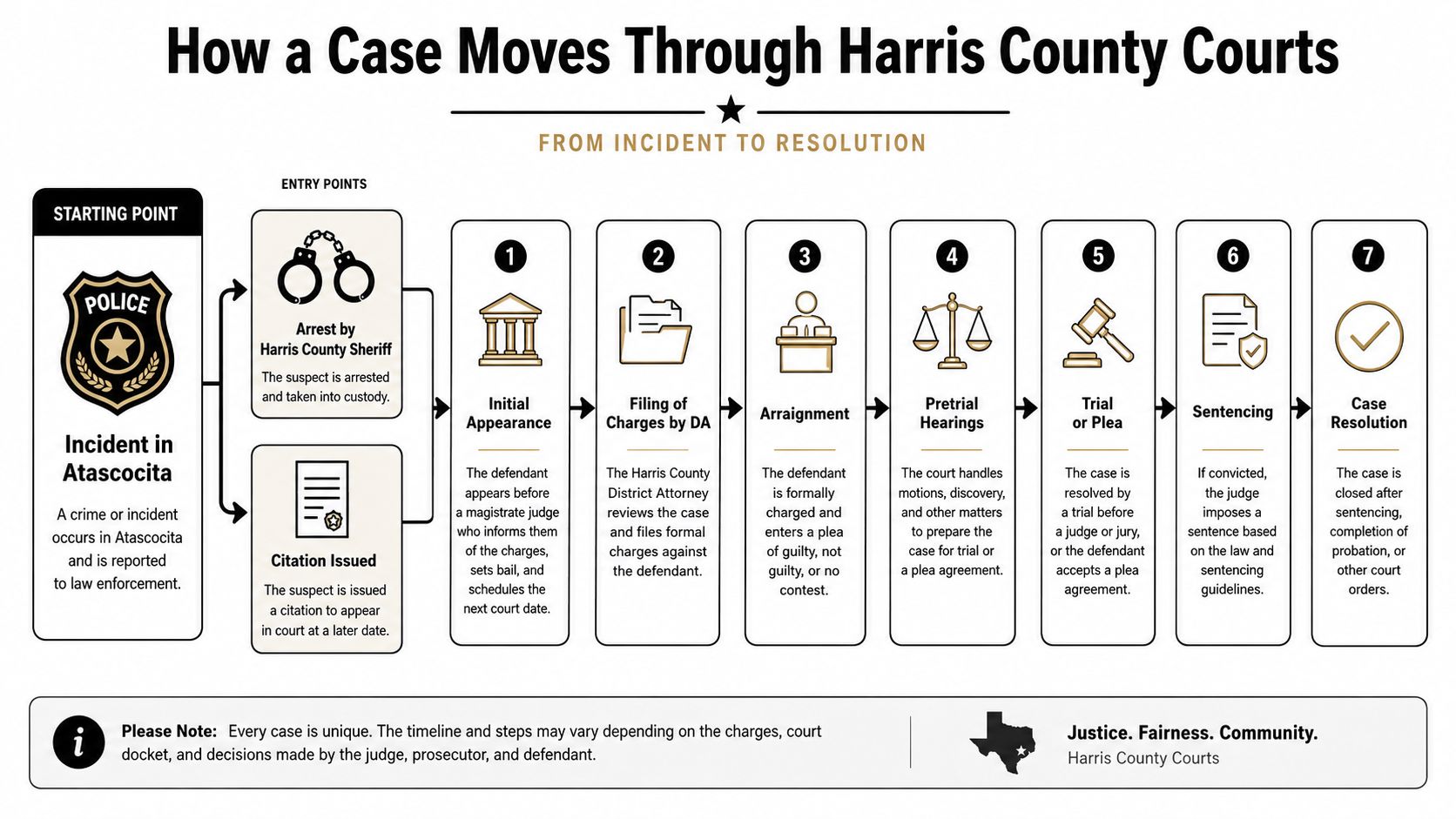
An Atascocita criminal mischief case usually enters the system in one of two ways. Harris County deputies may arrest someone based on a warrant or probable cause, or an officer may issue a misdemeanor citation and release the accused with instructions to appear. The paperwork, not the emotional intensity of the incident, determines the next procedural step.
The first court contact
After an arrest, the accused is brought before a magistrate for an initial appearance. For Atascocita matters, that commonly involves the Harris County Justice of the Peace system serving the area, including Precinct 4. The magistrate addresses probable cause, bond, and release conditions. Depending on the facts and applicable rules, the court may set a monetary bond or consider release conditions that don't require the same financial arrangement.
A bond can include restrictions involving contact with the complainant, travel, residence, or alleged property. Violating a condition can create a new legal problem and make the original case harder to resolve. Read every condition and ask counsel before seeking clarification directly from the alleged victim.
Filing, arraignment, and pretrial work
The prosecution files the charging instrument and assigns the matter to the court with jurisdiction over the alleged offense. A Class C case may remain in a Justice of the Peace setting, while higher misdemeanor charges generally proceed in a Harris County Criminal Court at Law. Felony allegations move through the felony court system, typically involving a Harris County District Court.
At arraignment, the accused receives formal notice of the charge and enters a plea. The practical details of this hearing are explained in what happens at an arraignment hearing. The hearing is not the time to give a spontaneous narrative to the judge or prosecutor.
Pretrial work can include discovery review, witness interviews, motions challenging evidence, valuation analysis, and negotiations with the Harris County District Attorney's Office. Possible outcomes include dismissal, pretrial diversion, a negotiated plea, a bench trial, or a jury trial. The strongest resolution often depends on work completed before the first serious plea discussion.
Defenses, Diversion, and Plea Options That Work
The right defense depends on the evidence, but four questions deserve immediate attention. Did the accused act intentionally or knowingly? Did the accused have permission or an ownership interest? Can the State prove identity? Is the alleged repair or replacement value accurate?
An accident can defeat the required mental state when the evidence supports that conclusion. Consent or ownership can also change the case, especially where roommates, spouses, tenants, employees, or business partners dispute who had authority over the property. A defense lawyer should preserve messages and documents that show permission instead of relying on memory alone.
Challenge the damage number
The dollar amount isn't a technical detail. It can determine whether the allegation remains a misdemeanor or becomes a felony. Get independent repair bids, photographs, receipts, maintenance records, and information about preexisting damage. If the complainant claims replacement is necessary, ask whether repair was possible and whether the claimed replacement reflects the actual property involved.
The State still must prove its case, even when the accused is willing to pay. Restitution can support negotiation, but it doesn't automatically establish guilt or guarantee dismissal.
| Strategy | Best When | Typical Outcome |
|---|---|---|
| Contest intent | Damage appears accidental or unplanned | Reduced charge, dismissal, or trial defense |
| Contest ownership or consent | The accused had permission or a property interest | Dismissal or stronger negotiation position |
| Challenge valuation | Estimates include disputed, inflated, or unrelated work | Lower offense classification or reduced punishment exposure |
| Pretrial diversion | The accused may qualify and the evidence supports a nonconviction resolution | Potential dismissal after successful completion |
| Deferred adjudication | A negotiated nonconviction path is available | Case may be dismissed after conditions are completed |
| Restitution-focused plea | Evidence is strong but financial repair is central | Capped punishment with payment terms |
| Trial | The State's proof has material weaknesses | Acquittal or conviction after a judge or jury decides |
Diversion and negotiated resolutions
Harris County may offer pretrial intervention in appropriate cases, and Texas law includes misdemeanor and felony deferred-adjudication mechanisms. Eligibility isn't automatic. The prosecutor may consider the charge, record, complainant's position, restitution, and the facts shown by the file.
A person may also face straight probation, bench probation, or a restitution-only agreement. An agreed nuisance plea under the applicable procedure may be considered when the evidence is strong but the defense needs to limit the consequences. These choices have different effects on records, future cases, reporting obligations, and immigration or licensing concerns.
Before accepting an offer, review the consequences with counsel. The distinctions explained in deferred adjudication versus pretrial diversion in Atascocita can affect the decision.
Your First 48 Hours After Being Charged
The first two days are about protecting the case, not winning an argument with the complainant. Whether you received a citation in Atascocita or were arrested by the Harris County Sheriff's Office, follow a deliberate sequence.
Invoke silence: Tell the investigator you want to remain silent and speak with a lawyer. Don't guess, fill gaps, or try to persuade a detective during an interview.
Request counsel: Contact a criminal-defense lawyer before magistration when possible. Counsel can review the accusation and address bond, release, and conditions.
Write a private timeline: Record where you were, who was present, what happened before and after the alleged damage, and any reason you had access to the property. Give it to your attorney, not to the complainant or police.
Preserve digital evidence: Save Ring or Nest footage, business CCTV information, text messages, photographs, location records, and receipts that may show consent or an alternative explanation. Don't edit or delete anything.
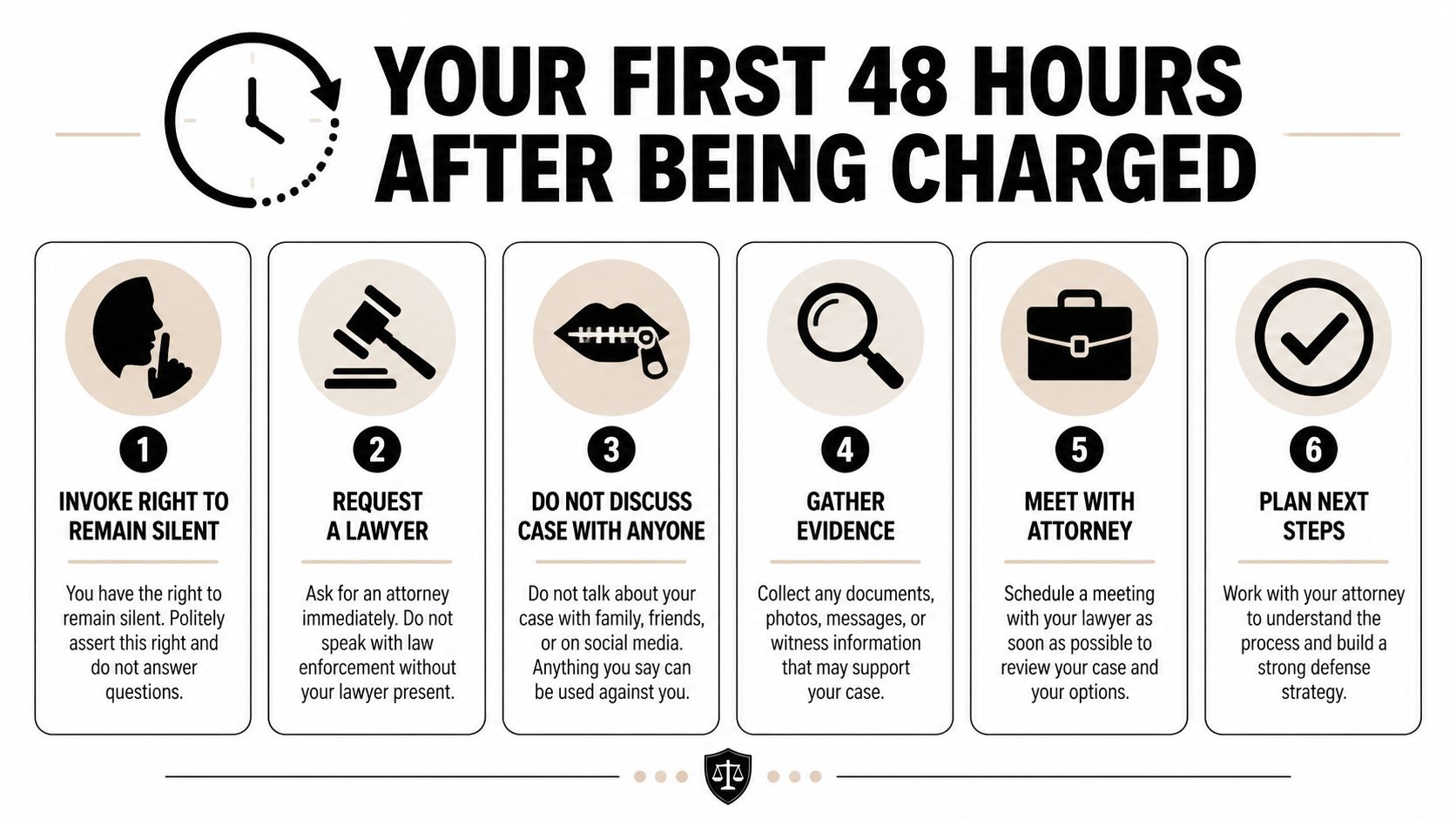
Avoid contact: Don't call, text, visit, or send another person to the alleged victim or witnesses. A no-contact bond condition may apply, and even voluntary contact can be portrayed as intimidation or harassment.
Gather property records: Collect photographs, repair estimates, insurance information, purchase records, and names of people who saw the condition of the property before the incident.
Do not post your defense on social media. A frustrated message, photograph, or comment can become evidence long after the original argument ends.
Give law enforcement one point of contact through your attorney. Meet every appearance date and bond condition. If you need clarification about a restriction, ask counsel before acting.
Hidden Stakes Beyond the Criminal Case
A criminal mischief allegation can affect more than the property owner's repair bill. A pending charge may become relevant in a custody or protective-order dispute when the facts overlap with family conflict, threats, harassment, or alleged violence. Family courts consider the broader circumstances presented to them, so an unresolved accusation shouldn't be ignored simply because the underlying property damage seems modest.
Texas Family Code Section 6.702 generally prevents a court from granting a divorce before the 60th day after the petition is filed, subject to narrow family-violence exceptions involving a final conviction or deferred adjudication, or an active protective order or emergency protection order based on family violence. The statute is available through this Texas Family Code Section 6.702 reference. A criminal mischief charge isn't automatically family violence, but the surrounding facts can matter in a connected family-law case.
Practical consequences to evaluate
Bond restrictions: No-contact orders, travel limits, or location restrictions can interfere with work, school, parenting exchanges, and housing arrangements.
Employment and licensing: A conviction may appear in background screening and prompt questions from employers, licensing bodies, or credentialing organizations. Answering accurately and understanding disclosure rules is safer than guessing.
Future prosecution: Deferred adjudication isn't the same as erasing every record or preventing every future consequence. A later arrest can cause prosecutors and courts to examine the earlier disposition.
Financial fallout: Restitution, court obligations, insurance issues, and property disputes can continue after the criminal docket closes. If cleanup involves hazardous material or a serious scene, a general resource on insurance for crime scene cleanup may help you identify questions for an insurer, although it isn't a substitute for legal advice.
The recent Harris County environment also shows why context matters. County data summarized from FBI-derived reports lists 33,050 property crimes and 7,666 violent offenses in 2024, with property offenses representing roughly 81.2% of the combined total, as reported by Harris County crime statistics. Local prosecutors and courts see property allegations regularly, but a routine docket doesn't make your individual record or family situation routine.
Getting Local Help for Your Atascocita Case
Start by organizing the documents before the consultation. Bring the citation or charging instrument, bond paperwork, photographs, text messages, repair estimates, insurance material, and witness names. If the allegation involves a business, identify the location and ask whether surveillance footage may exist, but don't contact employees or request records in a way that could create additional problems.
A local lawyer should know which Justice of the Peace docket handles the matter, how the case is assigned after filing, and what information the Harris County prosecutor will likely request. The practical difference isn't a slogan. It is knowing where to look, which deadlines matter, and how the allegation may affect a related custody, divorce, employment, or estate issue.
For general background while arranging counsel, a family guide to Houston bail bonds can explain common bail terminology. It won't tell you whether a particular bond condition is lawful or strategically acceptable, so direct legal questions to your defense attorney.
The Law Office of Bryan Fagan – Atascocita TX Lawyers handles criminal-defense matters along with family law, divorce, custody, estate planning, probate, and civil disputes for clients in Atascocita, Humble, and Harris County. If a criminal allegation is colliding with a family case, information about a Divorce Lawyer in Atascocita, TX describes divorce representation for clients in Atascocita and Harris County. You can also review how to find a good criminal defense attorney before choosing counsel.
Act promptly. Early representation can protect digital evidence, address bond conditions, test the damage valuation, and position the case for dismissal, diversion, a controlled plea, or trial.
The Law Office of Bryan Fagan – Atascocita TX Lawyers provides local guidance for criminal mischief allegations, bond issues, evidence preservation, and related family-law concerns in Atascocita, Humble, and Harris County. Schedule a free consultation through Law Office of Bryan Fagan – Atascocita TX Lawyers before arraignment so you can protect your rights and make decisions based on the actual charging documents and evidence.