Skip to content

If you're reading this at the kitchen table after a night shift, or between calls at the station, you're probably worried about the same thing I hear from Atascocita parents all the time. You love your child, you work hard, and your schedule doesn't look anything like a normal Monday-through-Friday job. That makes the usual custody language feel stacked against you.
It isn't.
A workable custody schedule for parents with alternating work shifts texas atascocita is absolutely possible. In northeast Harris County, that issue comes up constantly for nurses, refinery workers, EMTs, deputies, plant operators, and parents commuting from Atascocita and Humble into Houston. The court's real concern is not whether you work odd hours. The court wants to know whether your child will have a stable routine, reliable care, and a parent who shows up consistently.
That's the part many parents get wrong. They spend all their energy defending their job, when they should be proving their plan.
Beyond the Standard Texas Custody Schedule
Texas starts with a familiar template called the Standard Possession Order, or SPO. Under Texas Family Code § 153.3101–153.317, the usual model gives the non-custodial parent time on the first, third, and fifth weekends, Thursday evenings during the school year, and up to 42 days of summer parenting time. That framework works well enough for parents with ordinary work hours. It often fails for shift workers. The statute-based structure is explained in plain terms on this page about the Texas Standard Possession Order.
For a parent working nights at Kingwood Medical Center, rotating EMS shifts, or long plant hours near the refineries, first-third-fifth weekends can be a terrible fit. If your work rotation lands on those exact weekends, you miss time with your child through no fault of your own. That's not good parenting. That's bad scheduling.

Texas courts have increasingly approved customized custody schedules for parents with shift work, moving away from the standard framework. The typical SPO still uses the first, third, and fifth weekend model, but many shift workers, including nurses and refinery workers, successfully pursue 50/50 equal custody through modified schedules such as the 2-2-3, 2-2-5-5, and week-on/week-off formats, as discussed in these Texas custody guidelines for shift-working parents.
Why the SPO feels unfair in Atascocita
Atascocita families don't live in a nine-to-five bubble. A lot of parents here work:
- Hospital shifts at night or on rotating weekends
- Emergency response schedules with long blocks on duty
- Refinery and oilfield rotations that change by week or by assignment
- Industrial schedules with overtime, swing shifts, and callouts
A rigid order ignores how those jobs work. It also ignores a basic truth. A child benefits more from predictable, meaningful time with both parents than from a schedule that looks neat on paper but falls apart in real life.
Practical rule: If the order only works when your employer gives you perfect weekends off, it's the wrong order.
What Harris County judges usually care about
Parents often walk into a custody dispute believing they have to prove their schedule is ideal. They don't. They need to prove their schedule is manageable and that the child's life stays stable.
That means your proposed order should answer questions like these:
| Court concern | What your plan should show |
|---|---|
| School routine | Who handles drop-off, pickup, homework, and late arrivals |
| Sleep and bedtime | How your child keeps a steady routine during shift changes |
| Backup care | Who steps in if you're called in or held over |
| Communication | How both parents receive updates and schedule changes |
| Transportation | Who drives, where exchanges happen, and how traffic is handled |
The better mindset
Stop asking, “Will the court punish me for working shifts?” Ask, “Can I present a better structure than the default?”
That's the right question. In Harris County, customized possession orders are not unusual. They are often the smartest option for families in Atascocita, Humble, and nearby communities where shift work is common. If your child's week is calm, your exchange plan is clear, and your backup care is solid, you're already speaking the court's language.
Designing a Workable Schedule for Your Atascocita Family
The best schedule is the one your child can live with. Not the one your co-parent thinks sounds fair in theory. Not the one copied from a friend's decree. The one that fits your work cycle, your child's school life in Humble ISD, and the daily rhythm of two homes.
Texas parents with alternating shifts should usually do three things right away. Propose a shift-aligned rotation, document 6-12 months of shift calendars, and file for an Alternative Possession Order when the standard format doesn't fit. Prepared shift workers who show consistent involvement and use shared calendars have reported 65-75% approval for equal-time arrangements in Texas courts in this example of a 50/50 custody schedule in Texas.
For a broader overview of shared parenting, this page on joint custody in Texas helps explain the legal framework behind these schedules.
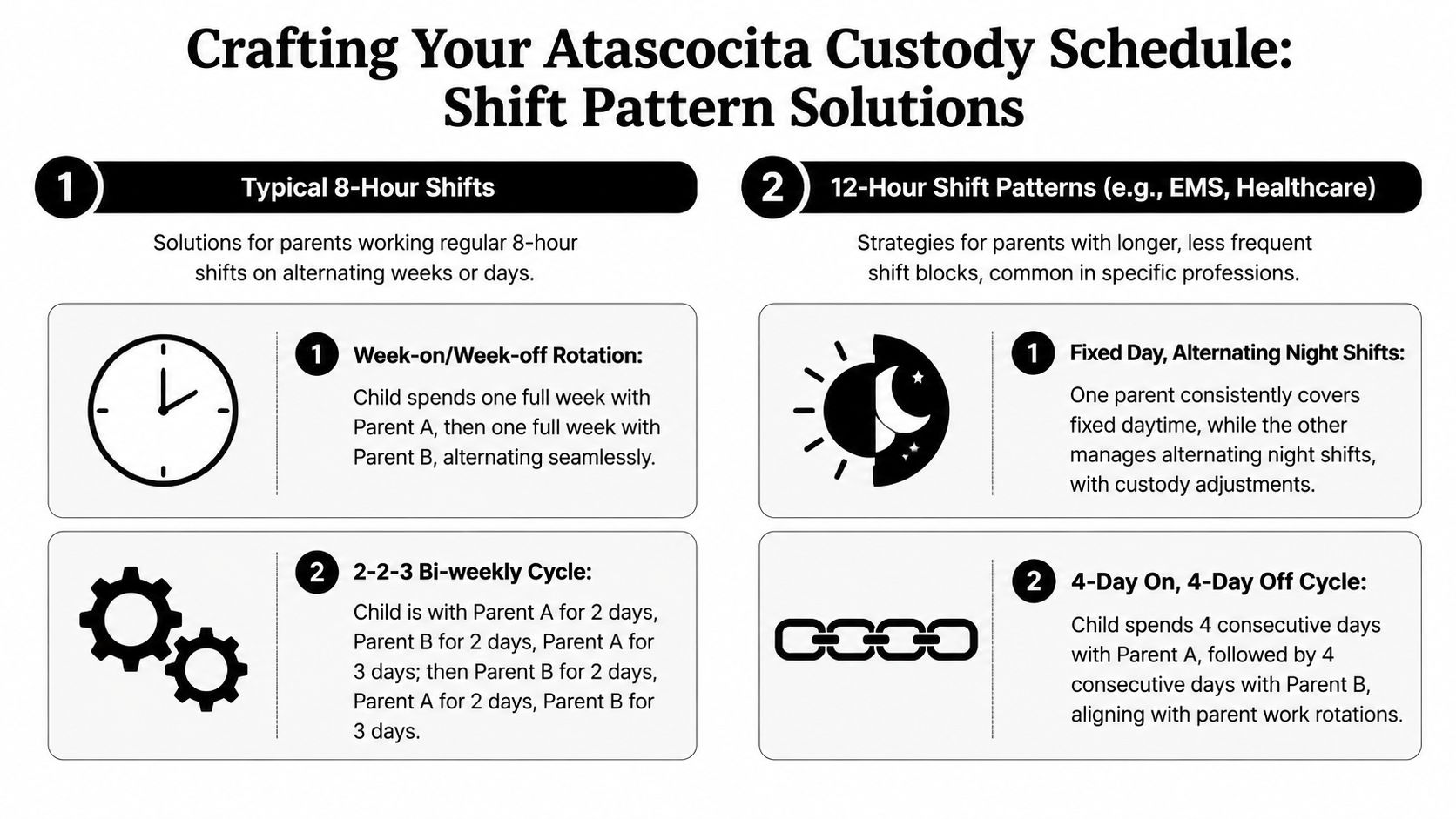
The 2-2-3 schedule
This is one of the strongest options for younger children and for parents who want frequent contact. One parent has two days, the other has two days, then the first parent gets the three-day weekend. The next week flips.
A simple version looks like this:
| Week | Mon | Tue | Wed | Thu | Fri | Sat | Sun |
|---|---|---|---|---|---|---|---|
| 1 | Parent A | Parent A | Parent B | Parent B | Parent A | Parent A | Parent A |
| 2 | Parent B | Parent B | Parent A | Parent A | Parent B | Parent B | Parent B |
This works well for:
- Nurses on repeating hospital rotations
- First responders with known duty blocks
- Parents who live close enough for smooth school exchanges
The downside is obvious. There are more handoffs. If you and the other parent can't communicate without conflict, this schedule becomes exhausting fast.
The 2-2-5-5 schedule
If your child does better with fixed weekdays, this model is often better. One parent always has Monday and Tuesday. The other always has Wednesday and Thursday. Weekends alternate in longer blocks.
That consistency matters. Kids know where they'll be on school nights. Parents know who handles spelling tests, soccer bags, and dentist appointments on the same weekdays each week.
This is usually a strong fit for:
- Parents with alternating but somewhat predictable schedules
- School-age children in Humble ISD
- Co-parents who want fewer surprises during the week
When a child can say, “I'm always with Mom on Monday and Tuesday,” the schedule is already doing part of the emotional work for you.
The block schedule for refinery and oil rotation work
Local reality matters here. In Harris County and other industrial regions, courts have adapted to shift work in the oil and energy sectors. For parents working 14-day rotations, judges often approve extended blocks of parenting time during off-rotations instead of forcing the standard alternating-weekend setup, as explained in this discussion of how Texas oil industry jobs affect custody arrangements.
If you work a long on-and-off cycle, stop trying to squeeze that life into a school-calendar template. It doesn't fit. A better plan may give you longer possession during your off-rotation, with exchange dates tied to your actual work schedule rather than a fixed weekend.
That approach often makes more sense for:
- Refinery workers
- Oil and gas employees
- Parents whose shifts are intense but predictable in blocks
What to build into any schedule
The calendar itself is only half the job. Judges want the surrounding details too.
Use this checklist:
- School exchange points: Use school pickup and drop-off when possible. It reduces conflict.
- Sleep plan: If you work nights, say exactly where the child sleeps and who handles bedtime.
- Extracurricular continuity: Show who gets the child to practice, tutoring, or therapy.
- Backup names: Include grandparents, trusted relatives, or licensed caregivers.
- Calendar sharing: Use a co-parenting tool and update it constantly.
Some parents prefer dedicated co-parenting apps. Others want a simple digital planning system they can both stick with. If you're comparing options for managing custody with Everblog tools, focus on one thing above all else. Pick a tool that creates a clear written record and makes schedule changes easy to confirm.
My direct recommendation
If you work alternating shifts in Atascocita, start with the child's school week and your actual shift calendar. Don't start with what feels emotionally “equal.” Start with what is repeatable.
A schedule that survives overtime, weekend call-ins, and traffic on West Lake Houston Parkway is better than a pretty plan that collapses after two weeks.
Gathering the Right Evidence to Support Your Custody Plan
A schedule by itself won't carry your case. Paperproof does.
Harris County family courts, including the courts serving Atascocita, often expect shift-working parents to produce 6-12 months of prior work schedules during discovery to show stability. The same local reporting says parents who proactively present shift-sync plans with makeup time through court-mandated apps are significantly more likely to overcome the disadvantage shift workers often face in custody litigation, as described in this article about equal custody with an irregular schedule in Texas.
That's why preparation matters more than speeches. If you walk in saying, “I can make it work,” but bring no records, the court may hear hope instead of proof.

For parents preparing for a hearing, this guide on how to prepare for a custody hearing is a good place to organize the basics.
Your evidence file should include more than a calendar
Build your file like you expect someone skeptical to read it. Because they might.
Start with these categories:
- Work history records: past schedules, posted rotations, overtime notices, and any employer documentation showing how shifts are assigned
- Future schedule projections: if your employer posts rotations in advance, include those too
- Childcare backup details: names, addresses, phone numbers, and written statements from reliable backup caregivers
- Parent involvement records: school portal screenshots, doctor visit records, counseling attendance, activity sign-ins, and messages about homework or appointments
- Communication history: messages showing you inform the other parent about schedule changes and ask for reasonable coordination
What judges are really testing
Judges aren't impressed by promises. They're looking for three things.
| What the court wants to know | What proves it |
|---|---|
| Are you predictable | Months of work records and a proposed rotation |
| Are you supported | Backup caregiver affidavits and care plans |
| Are you involved | School, medical, and activity records |
A shift-working parent with a documented routine usually looks stronger in court than a nine-to-five parent with no records and no plan.
The mistake that hurts good parents
A lot of strong parents make the same error. They assume the court should automatically understand shift work because it's common in this area.
That's not how litigation works. Common is not the same as proven.
If you work nights, say who has the child overnight and when your parenting time happens during the day. If you trade shifts, explain the trade process. If your mother in Humble watches your child when you're held over, put that in writing. Specifics make you credible.
Build a file that answers objections before they're raised
Think like opposing counsel for an hour. What would they attack?
Probably these points:
- You're unavailable too often
- Your schedule changes too much
- The child won't have a stable bedtime
- You rely too heavily on third parties
- You communicate changes too late
Now build documents that answer each one.
That's the difference between a parent who reacts and a parent who leads. In Harris County, especially in busy family courts, the parent who arrives organized usually has the stronger footing.
Navigating Mediation and Harris County Court
It is 6:15 a.m. in Atascocita. You just finished a night shift at Kingwood Medical Center, your co-parent is texting about pickup, and mediation is set for next week. That is the point where good parents panic and start talking too much.
Do not do that.
Mediation in Harris County usually rewards the parent who is organized, calm, and specific. A mediator does not need a speech about how hard shift work is. A mediator needs a plan that a judge in the 246th or 247th can sign without cleaning up loose ends. If you want a neutral overview before you walk in, this guide to understanding mediation and arbitration costs gives useful background on process and expense.
What productive mediation looks like in Harris County
In local family courts, shift work is ordinary. Refinery schedules, hospital nights, fire service rotations, and plant turnarounds are part of life here. The issue is never whether your job is unusual. The issue is whether your proposed order gives the child a steady routine.
Bring a marked calendar. Bring your posted rotation. Bring a draft possession schedule with exchange times, school drop-off details, holiday language, and a backup plan for holdovers. If you work a DuPont schedule, a 2-2-3 rotation, or a rotating 12-hour hospital schedule, say exactly how possession changes from week to week and when makeup time happens.
That is what gets cases settled.
A strong mediation proposal usually answers four questions without prompting:
- When does each possession period start and end?
- Who handles school pickup and drop-off?
- What happens if a shift is changed, traded, or extended?
- Who keeps the child if a parent is unexpectedly called in?
What to say in the room
Keep your language plain and child-focused. Harris County mediators hear enough blame to last a lifetime. They respond better to parents who sound practical.
Use statements like these:
- “My work schedule posts two weeks ahead, and I want the order tied to that schedule with clear notice deadlines.”
- “School-night consistency matters, so I am proposing exchanges at school whenever possible.”
- “If I am held over, my backup caregiver is already identified and the other parent gets notice by text right away.”
- “If a shift change cuts into my time, I am proposing specific makeup periods so the schedule stays fair.”
That framing works because it solves problems. It does not invite an argument about who has suffered more.
Parents from Atascocita, Humble, and Kingwood usually do better in mediation when they walk in with a calendar and draft terms, not a stack of complaints.
If your case goes in front of a judge
Judges in the 246th, 247th, and 257th District Courts have seen every version of rotating work schedules. They are not surprised by overnight nursing shifts, refinery overtime, or emergency call-outs. What frustrates them is a parent asking the court to approve a vague promise that everyone will “work it out.”
That usually fails.
Local judges want to know whether your plan is workable on a Tuesday in October, not just on your best month. They look closely at school attendance, exchange logistics, communication rules, and whether the child knows where they are sleeping on school nights. If an amicus attorney is appointed, expect the same focus. That lawyer is evaluating stability, follow-through, and the child's daily routine.
Here is my honest advice. Do not force the court to build your schedule from scratch. Put a proposed order in front of the mediator and, if needed, the judge. A detailed proposal gives the court something concrete to approve, revise, or compare against the other parent's plan. In Harris County, that is often the difference between a custom order that fits your real life in Atascocita and a standard schedule that does not.
Long-Term Success Strategies for Your Alternating Schedule
Getting the order signed is not the finish line. It's the operating manual.
The parents who do well long term aren't the ones with perfect jobs or perfect co-parents. They're the ones who build systems that absorb real life. That means traffic on FM 1960, late call-offs, school events, overnight shifts, and last-minute swaps.
For parents working nights in Harris County, successful orders often include Daytime Possession Blocks, flex clauses allowing 48-hour shift swaps by text or email, and co-parenting apps. That approach can secure 40-50% possession time, and the same local source reports it has boosted adherence by 90% and reduced returns to court for modification by 60% in these night-shift parenting schedule strategies.

Use fixed systems for recurring problems
Don't renegotiate the same conflict every week. Put the answer in the order or in your co-parenting routine.
Good long-term systems often include:
- Transportation rules: one parent picks up, the other drops off
- Exchange location rules: school, daycare, or another neutral place
- Notice deadlines: when a shift change must be reported
- Swap procedures: text or app confirmation only
- Missed time makeup rules: same week, next off day, or next cycle
Daytime possession can be smart, not second-best
Parents who work overnight often assume they're at a disadvantage because their parenting time won't look traditional. That's the wrong frame.
If your child is in school and the other parent works daytime hours, Daytime Possession Blocks may be exactly what keeps your relationship strong. You can handle lunches, appointments, after-school routines, and recovery time after your work rotation without disrupting the child's sleep.
That's not a compromise. In many cases, it's the cleaner plan.
Keep communication boring
Boring communication wins. It creates fewer fights and better records.
Use one method consistently:
- OurFamilyWizard
- AppClose
- email, if both parents are disciplined enough to use it
Keep messages short. Confirm dates, times, school events, and medical details. Don't argue in the app. The point is documentation and clarity.
The best co-parenting message is usually the one that could be read out loud in court without embarrassing you.
Know when to modify the order
Some schedule changes are temporary. Some aren't.
If your employer permanently changes your rotation, if one parent moves, if your child starts a new school routine, or if the current plan keeps breaking down, you may need a formal modification. Don't keep patching a broken order with side agreements and wishful thinking. That usually creates bigger fights later.
A good custody order should survive ordinary disruption. If it can't, fix it before the conflict grows.
Frequently Asked Questions About Atascocita Shift Work Custody
Can I still get equal custody if I work nights or rotating weekends
Yes, you can. The issue isn't whether your hours are unusual. The issue is whether your parenting plan is stable, detailed, and workable for your child. If your order accounts for school, sleep, transportation, and backup care, a nontraditional work schedule does not automatically block equal or near-equal possession.
What if my shifts change every month
Then your custody plan needs built-in flexibility. A rigid calendar usually fails if your work calendar changes often. In that situation, many parents do better with a rotation tied to posted shifts, plus makeup-time language and a required notice period for updates. If your work pattern is unpredictable, your documentation and communication need to be stronger than average.
Will Harris County judges really approve custom schedules instead of the standard order
Yes, when the custom schedule is better for the child and better supported by evidence. Local courts see a lot of shift-work families. A judge is far more likely to approve a custom plan when it looks organized, child-centered, and easy to enforce. Vague flexibility is a problem. Specific flexibility is often the answer.
Should I agree to an informal schedule first and fix it later
Usually, no. Informal schedules create confusion fast. They also make it easier for the other parent to change the rules when conflict starts. If you already know the standard schedule won't fit your work life, address that early and put the right language into a formal order.
What matters most if I want the court to take my plan seriously
Three things matter most. First, bring actual work records. Second, show exactly how the child's routine stays stable. Third, present a schedule with practical details, not general promises. Parents who do those three things usually present far better than parents who insist they deserve more time.
If you need help building a realistic custody schedule around hospital shifts, refinery rotations, or first responder hours, the Law Office of Bryan Fagan – Atascocita TX Lawyers offers free consultations for families in Atascocita, Humble, and northeast Harris County. A clear, court-ready parenting plan can protect your time with your child and reduce conflict before it gets worse.