Skip to content

When children are involved, the idea of divorce brings a wave of new worries. Your first instinct is to protect them. For families in Atascocita, finding a compassionate divorce with children lawyer in Atascocita who understands this is more than just a legal step—it's about securing your family's future. You need an advocate who can guide you through the process, shield your children from conflict, and help build a stable, positive new beginning for everyone.
Your First Steps in a Divorce with Children
Facing a divorce with children can feel overwhelming, like you're trying to navigate a storm without a compass. For families here in Atascocita, Humble, and across northeast Harris County, the number one priority is always the children's well-being. Let's walk through what you can expect, starting with the first, most critical steps.
This guide isn't about legal jargon; it's about providing a practical map for the road ahead. By understanding the basics of Texas family law from the very beginning, you can start making clear, informed decisions for your family instead of reacting out of stress or uncertainty.

Why Early Legal Guidance Is Critical
In a divorce involving children, the stakes couldn't be higher. The decisions made in the first few weeks can impact your child’s emotional health, financial stability, and your parental rights for years to come. This is one of a family’s most consequential moments, and you don't have to face it alone.
The statistics highlight the importance of careful planning. A U.S. Census Bureau study revealed that children of divorced parents might see a 9% to 13% drop in their income by their late 20s compared to their peers. The immediate impact is just as significant. Here in Harris County, many families see their household income cut in half, and there's a 35% chance they'll have to move within the first year, disrupting school and friendships. You can see the full report on how divorce affects children from the U.S. Census Bureau for more details.
This is why connecting with an experienced local attorney isn't just a good idea—it's essential for protecting your family’s stability.
To help you get organized, here are the most important things to focus on right now.
Initial Priorities in a Divorce with Children
This table breaks down the immediate action items for Atascocita parents at the beginning of a divorce. Focusing on these areas first helps establish stability for your kids and protects your legal standing from the outset.
| Priority Area | Key Action for Atascocita Parents | Why It Matters for Your Family |
|---|---|---|
| Child Stability | Maintain your child’s daily routine as much as possible. Keep them in their school and activities in the Atascocita area if you can. | Consistency is comforting for kids. A stable environment minimizes disruption and shows the court you prioritize their well-being. |
| Legal Consultation | Speak with a divorce lawyer who specializes in cases with children before making any agreements with your spouse. | Early legal advice prevents costly mistakes. An attorney can explain your rights regarding custody, child support, and property in Harris County. |
| Financial Documentation | Begin gathering key financial documents like pay stubs, tax returns, bank statements, and mortgage information. | This information is crucial for calculating child support and dividing marital property fairly. Being prepared saves time, money, and stress. |
| Communication Strategy | Establish a calm, business-like way to communicate with your spouse, preferably in writing (like email or a co-parenting app). | A written record is vital evidence if disagreements arise. It shows you are being reasonable and focused on co-parenting. |
Getting these four areas under control will provide a much stronger foundation as you move forward.
Understanding Key Texas Family Law Terms
As you step into the world of Texas family court, you'll hear a lot of specific legal terms. Don't let them intimidate you. Understanding this language empowers you to take an active role in your case alongside your attorney.
In Texas, every divorce with children is built on three main pillars:
- Conservatorship: This is what most people call "custody." It defines who has the legal right to make important decisions for your child, such as where they go to school or what medical care they receive.
- Possession and Access: This is the visitation schedule. It's the calendar that lays out exactly when the children will be with each parent—weekends, holidays, summer breaks, and everything in between.
- Child Support: This refers to the financial payments one parent makes to the other to help cover the costs of raising the children. Texas has specific guidelines for how this is calculated.
An experienced family law attorney from The Law Office of Bryan Fagan can sit down with you and explain exactly how these concepts will apply to your family’s unique circumstances right here in Atascocita. Taking that first step is the beginning of securing your family’s future. Call our Atascocita office to schedule a free, no-obligation consultation to go over your case.
Understanding Texas Child Custody and Conservatorship
When you're facing a divorce with children in Texas, one of the first things you'll notice is our unique legal language. A Harris County judge won't talk much about "custody." Instead, the term that truly matters here is conservatorship.
Understanding what conservatorship means is one of the most important steps you can take to protect your relationship with your children and ensure their future stability. It is the legal framework that dictates who makes major decisions for your child. Think of it as the blueprint for how you and your ex-spouse will co-parent after the divorce.
Here in Texas, the law outlines two main types of conservatorship. A court's decision will always be guided by one single principle: what is in the best interest of the child. A skilled divorce with children lawyer in Atascocita is crucial to presenting a case that shows how your goals serve your child's needs.
Joint Managing Conservatorship (JMC)
The vast majority of divorces with children in Texas result in a Joint Managing Conservatorship (JMC). This is the standard arrangement, and it's what judges in Atascocita, Humble, and throughout Harris County strongly prefer. The law presumes it's best for a child to have both parents actively involved in their life.
You can think of a JMC as a co-parenting partnership. Both parents share the rights and responsibilities to make major decisions together. These are the big-picture calls about things like:
- Education: Deciding where the child attends school.
- Medical Care: Making non-emergency decisions about doctors, dentists, and therapists.
- Legal Rights: Choices that affect the child's legal status.
- Religious Upbringing: Guiding the child's moral and religious life.
Even within a JMC, one parent is typically named the "primary" conservator. This parent has the exclusive right to determine the child's residence, though it's usually limited to a specific geographic area. For many local families, that might mean being restricted to Humble ISD or a neighboring district to keep the child's life stable and consistent.
Sole Managing Conservatorship (SMC)
In much rarer situations, a court will order a Sole Managing Conservatorship (SMC). This is a very different arrangement that gives one parent the exclusive, independent right to make all major decisions without any legal requirement to consult the other parent.
The other parent is then named the "possessory conservator." They will still have visitation rights (possession and access), but their decision-making authority is removed.
A Texas court will only grant a Sole Managing Conservatorship if it finds compelling evidence that a joint arrangement would be harmful to the child's physical or emotional well-being. This is a very high legal standard to meet.
What kind of situation would lead a judge to grant an SMC? This is reserved for serious circumstances that could put a child at risk. A judge might consider an SMC if one parent has a documented history of:
- Family violence or child abuse
- Current and ongoing substance or alcohol abuse
- Extreme conflict or hostility that makes joint decisions impossible
- Being absent from the child's life for a long period of time
Understanding the difference between these two structures is foundational to your case. If you're looking for more details, you can learn more about the specifics of Texas conservatorship laws in our comprehensive guide.
An attorney at The Law Office of Bryan Fagan can review your family's unique situation and help you understand which arrangement is most likely. We'll advise you on how to advocate for the outcome you believe is right for your children. Schedule a free, confidential consultation at our Atascocita office to discuss your rights and start building a strategy that puts your children first.
Creating a Practical Possession and Access Schedule

After determining conservatorship, the next major step is creating the possession and access schedule. This is the official Texas term for a visitation calendar. It serves as the roadmap for your co-parenting life, clearly defining when your children will be with each parent. For children, this predictability is a source of great comfort and security.
For families here in Atascocita and Humble, this is about more than just dividing days on a calendar. It’s about ensuring your children can maintain their routines, see their friends, and get to their activities at places like the Atascocita High School or local sports fields without a hitch. The goal is a plan that reduces conflict and provides everyone with meaningful time together. A skilled divorce with children lawyer in Atascocita is crucial here, helping you build a schedule that’s fair, stable, and works in the real world.
The Texas Standard Possession Order (SPO)
The starting point for nearly every schedule in Harris County is the Texas Standard Possession Order (SPO). This is the default schedule created by the Texas Legislature, and judges rely on it because it's designed to provide children with consistent time with both parents. In the eyes of the court, the SPO is presumed to be in your child's best interest.
The SPO lays out a clear, predictable framework. It generally gives the non-primary parent possession on specific weekends and divides holidays.
The Standard Possession Order is designed to be a one-size-fits-all solution, but family life is rarely one-size-fits-all. While it provides a solid foundation, its real strength lies in its flexibility when customized by parents and their attorneys to fit their family's needs.
Here's the basic breakdown of a typical SPO:
- Weekend Possession: The non-primary parent typically has the children on the first, third, and fifth weekends of a month.
- Holiday Schedules: Major holidays like Thanksgiving and Christmas are alternated between parents each year, so everyone shares in those special moments.
- Summer Vacation: The non-primary parent usually gets an extended period, typically 30 days, during the summer break.
While this standard schedule works for many families, it can't account for every family's unique rhythm. That’s why understanding how to customize it is so important. You can get a much deeper look by reading our guide that explains in detail what the Texas Standard Possession Order is and how it works.
Customizing Your Schedule for Atascocita Families
The most effective possession schedules are those tailored to fit your family's life. A generic plan can create constant headaches for a parent who works weekends, travels for their job, or has a child with a demanding extracurricular schedule. This is where having an experienced local lawyer really pays off.
For instance, we’ve worked with Atascocita families whose children play competitive sports, with games and practices often scheduled on Friday nights. A rigid SPO pickup time would mean a child constantly misses out. A simple customization can fix this, stating that weekend possession begins after the game, removing a source of stress and disappointment.
Or consider the parent who works as a nurse at a local hospital with a rotating shift. A standard "first, third, and fifth weekend" plan is completely unworkable. We can help build a custom schedule that follows their work rotation, ensuring they get regular, quality time with their kids, even if it doesn't fit the standard mold.
Here are a few common customizations we regularly build into our clients' orders:
- Mid-week overnight visits to break up long gaps between weekends.
- Specific pickup and drop-off locations, like a neutral spot in Humble or Atascocita, to minimize friction.
- Modified holiday schedules that protect unique family traditions.
- A "right of first refusal," which requires you to offer the other parent the chance to watch the kids before calling a babysitter.
A thoughtfully drafted possession schedule anticipates future problems and solves them before they start. By working with a knowledgeable lawyer at The Law Office of Bryan Fagan, you can create a practical, stable plan that puts your children’s well-being first. To talk about how we can build a custom schedule for your family, contact our Atascocita office for a free consultation.
How Child Support Is Calculated in Harris County
For most parents in Atascocita, the topic of child support brings a wave of uncertainty. How is the amount determined? Who decides? Fortunately, Texas law provides a clear and predictable formula, so the final number isn't left to guesswork. Harris County courts follow specific, guideline-based calculations to ensure children receive the financial support they need from both parents.
Understanding this process can help you feel more prepared and give you a realistic picture of your family's new financial reality. The entire system is built to be fair and transparent, with the child's well-being as the single most important goal.
Determining Net Monthly Resources
The starting point for any child support calculation is determining the paying parent's (the "obligor's") net monthly resources. This is more than just take-home pay. The court starts with the parent's gross income from all sources and then subtracts a handful of specific, state-approved deductions.
Common sources of income include:
- Wages, salary, overtime, tips, and bonuses
- Income from self-employment
- Rental income
- Retirement benefits, pensions, and annuities
- Social Security and most disability benefits (but not SSI)
From that total income, the court will deduct things like Social Security taxes, federal income tax (calculated for a single person with one exemption), union dues, and the cost of the child's health insurance. What you cannot deduct are personal expenses like car payments, 401(k) contributions, or loan payments.
A common misconception is that a new spouse's income is included—it is not. Child support is an obligation that belongs solely to the child's legal parents. Because calculating net resources can be complex, having an experienced divorce with children lawyer in Atascocita is key to ensuring income is reported accurately and all appropriate deductions are applied.
Applying the Texas Guideline Percentages
Once the final "net monthly resources" number is established, the court applies a standard percentage based on the number of children involved. It's important to note that Texas caps the income used for this calculation; for any case filed after September 1, 2019, that cap is $9,200 per month.
The financial and emotional weight of divorce can hit children hard. Research has shown that divorce can lead to long-term negative outcomes, especially when financial instability forces families to move. With 35% of families moving in the first year, often to areas with fewer resources, the disruption can be immense. For parents here in Atascocita and Harris County, where one in six adults has been divorced, getting child support right is a vital part of providing children with the stability they need. You can read more from the National Bureau of Economic Research about divorce and its long-term effects on children.
A quick but critical note: Health and dental insurance for the child are handled separately from the base child support calculation. The court will order one parent to provide coverage, and that cost is factored into the final orders.
With the net resources determined, applying the guidelines is straightforward.
Texas Child Support Guideline Percentages
Here is how the standard percentages break down based on the number of children you and your co-parent have together.
| Number of Children | Percentage of Net Monthly Resources |
|---|---|
| One Child | 20% |
| Two Children | 25% |
| Three Children | 30% |
| Four Children | 35% |
| Five Children | 40% |
| Six or More | Not less than 40% |
For example, a parent with net monthly resources of $5,000 and two children would typically have a guideline child support obligation of $1,250 per month (25% of $5,000). To see more examples and get into the finer details, you can learn more about how much child support might be in your case in our comprehensive guide.
The attorneys at The Law Office of Bryan Fagan work with these guidelines in Harris County courts every day. We can help you approach this process with clarity and confidence. Call our Atascocita office for a free consultation to talk about your family’s situation.
Navigating the Harris County Divorce Process
When you’re facing a divorce with children, the legal system can feel like an intimidating maze. The good news is that here in Harris County, there is a defined process from start to finish. Understanding the steps can reduce anxiety and give you a sense of control. For anyone living in Atascocita or Humble, that path begins at the Harris County Civil Courthouse downtown.
An experienced divorce with children lawyer in Atascocita acts as your personal guide through it all. We are here to ensure no deadline is missed, every form is filed correctly, and your story is heard—whether in negotiations or before a judge. Our job is to make this difficult process as clear and predictable as possible for you and your family.
Filing the Original Petition for Divorce
The process officially begins when one spouse files an Original Petition for Divorce with the Harris County District Clerk. This is the legal document that opens your case with the court. It outlines the basic facts: who you are, that you meet Texas residency requirements, and the grounds for the divorce.
Most of the time, we file on "no-fault" grounds, stating that the marriage has become insupportable. Crucially, this petition also includes a "Suit Affecting the Parent-Child Relationship," asking the court to make orders about conservatorship, possession, and child support that are in your children's best interest.
Service of Process and the Initial Waiting Period
After the petition is filed, your spouse must be formally notified of the lawsuit. This is called service of process. Typically, a constable or private process server will hand-deliver a copy of the paperwork to them. This is a formal but necessary step to ensure they are aware the case has begun and have an opportunity to respond.
Once the petition is filed, a mandatory 60-day waiting period begins. No divorce in Texas can be finalized before this period ends. It's often called a "cooling-off" period, but it's most practically used to begin the work of negotiating the terms of your divorce.
Discovery: The Information Gathering Phase
Next comes the discovery phase. This is the formal process where both sides exchange information and evidence. It allows us to get a complete picture of the marital property and debts and gather the facts needed to build a strong case for custody and support.
We use specific legal tools to gather information:
- Requests for Production: We ask for documents like bank statements, tax returns, pay stubs, and retirement account information.
- Interrogatories: These are written questions that your spouse must answer in writing, under oath.
- Depositions: This is a formal, in-person interview where we ask questions face-to-face while a court reporter transcribes the testimony.
Thorough discovery is the foundation of a fair settlement. It prevents assets from being hidden and ensures final decisions are based on facts, not assumptions.
Mediation: Finding Common Ground Outside of Court
Before you ever see the inside of a courtroom for a final trial, Harris County judges will almost always require you to attend mediation. This is a private, confidential meeting with a neutral third-party mediator whose only job is to help you and your spouse reach a settlement. You, your attorney, your spouse, and their attorney will all participate.
Mediation is your best opportunity to control the outcome of your divorce. The agreements reached here are often far more practical and customized to your family’s needs than anything a judge might order. A successful mediation saves a tremendous amount of money, time, and emotional energy.
Even cases that begin with high conflict are often resolved in mediation. It provides a structured, private setting where you make the final decisions about your children and finances, rather than leaving it up to a judge.
Child support is always a major topic in mediation. The process for calculating the baseline amount in Texas is actually quite clear.
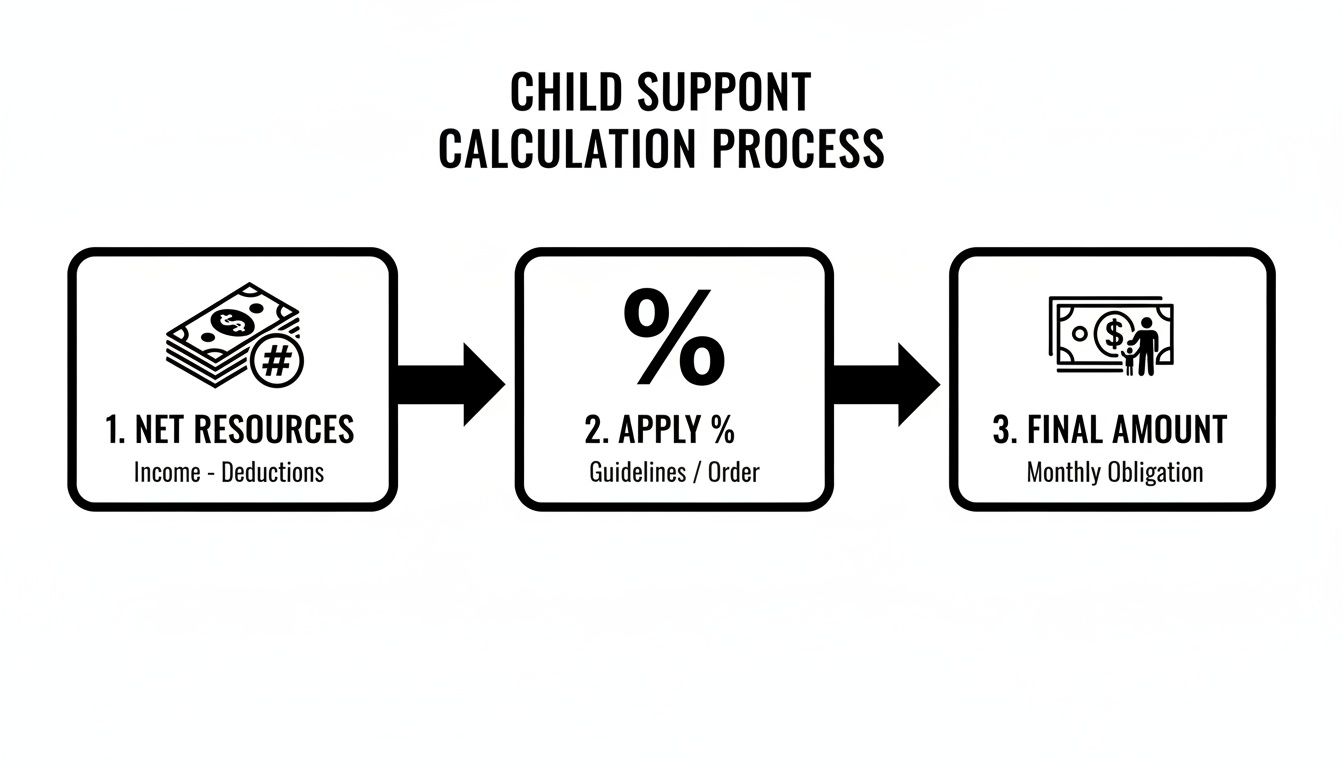
As you can see, the process starts with a parent's financial resources, applies a set percentage based on the number of children, and arrives at a monthly support figure. This formula provides a solid starting point for negotiation.
If you cannot reach a full agreement in mediation, the next step might be a temporary orders hearing or, as a last resort, a final trial. At The Law Office of Bryan Fagan, we are prepared to advocate for you on either path. To learn how we can help you navigate the Harris County divorce process from our Atascocita office, schedule a free, confidential consultation today.
How to Prepare for Your Lawyer Consultation

The first meeting with a lawyer is a pivotal moment. It’s your opportunity to move from reacting to a crisis to creating a proactive plan. This is where you begin to take back control of your future.
To get the most out of that meeting, a little preparation goes a long way. When you walk into your consultation with key documents and a list of questions, you enable a potential divorce with children lawyer in Atascocita to give you specific, practical advice, not just general possibilities. Our goal is for you to leave our Atascocita office feeling heard, understood, and with a clear path forward.
Your Document Checklist
You don't need to bring every piece of paper from your marriage, but a few key documents provide a huge head start. This information helps us quickly understand your family’s financial landscape.
- Recent Pay Stubs: Your last couple of pay stubs are a great start. If you can safely access your spouse's, bring those too.
- Tax Returns: Your last two years of joint tax returns provide an excellent financial snapshot.
- Financial Statements: Recent statements for bank accounts, retirement plans (like 401(k)s), and credit cards are incredibly helpful.
- List of Major Assets and Debts: No need for a formal spreadsheet. A simple list of what you own (house, cars) and what you owe (mortgage, car loans) is perfect.
Don't worry if you can't find everything on this list. Just bring what you can easily and safely access.
Key Questions to Ask Your Potential Lawyer
Choosing the right attorney is the single most important decision you'll make in this process. You aren’t just hiring someone to file paperwork; you're seeking a trusted partner who will guide you through one of life's most challenging experiences.
The right legal partner does more than just file paperwork. They listen, they strategize, and they champion your family’s best interests with a deep understanding of the local court system and community.
Here are the questions you should absolutely ask any attorney you consider hiring:
- What is your specific experience with divorce cases involving children in the Harris County courts? This is critical. You need someone who knows the local judges and how they tend to rule on issues relevant to families in our community.
- Based on what I’ve shared, what is your initial assessment of my case? Ask for their honest, big-picture take. What are the potential strengths and weaknesses they see right away?
- How will you and your office communicate with me? Will you speak directly with the attorney? How often can you expect updates? Make sure their communication style works for you.
- What are the potential costs, and how does your billing work? A good lawyer will be transparent about their retainer, hourly rates, and the estimated total cost for a case like yours.
Ultimately, finding the right fit is about both expertise and your own comfort level. You need to be able to trust this person. Here at The Law Office of Bryan Fagan, we are committed to providing that level of support to our neighbors in Atascocita and Humble. We invite you to schedule a free, confidential consultation at our Atascocita office so we can listen to your story and show you how we can help protect your family.
Frequently Asked Questions About Divorce and Children
When you're facing a divorce with children, your mind is likely filled with urgent questions. Here in our Atascocita office, we've heard them all, and we understand the weight behind each one. Let's walk through some of the most common concerns parents bring to us.
Can I Move Out of Atascocita with My Children During the Divorce?
This is one of the first questions many parents ask, and the short answer is almost always no—not without permission. Once a divorce is filed in Harris County, the court typically puts a geographic restriction in place. This order usually limits the child's residence to Harris County and its directly bordering counties.
The court’s goal is to maintain stability for the children and ensure both parents have consistent access while the case is ongoing. Moving without the other parent's written consent or a judge's permission can seriously damage your credibility and your case. Before you consider moving, it is vital to speak with your divorce with children lawyer in Atascocita to navigate the proper legal channels.
What Is a Temporary Restraining Order and Do I Need One?
The term "restraining order" can sound alarming, but in a Texas divorce, a standard Temporary Restraining Order (TRO) is a routine procedural tool. Think of it as a financial and logistical "pause button" that establishes ground rules at the beginning of a case.
A TRO is designed to prevent either spouse from making sudden, drastic changes while the divorce is in progress. It prohibits actions like:
- Selling the house or other major community property
- Emptying joint bank accounts
- Removing the children from their current school or daycare
- Incurring large amounts of new debt
Your attorney will almost always file for a TRO to protect your family's stability. It's a standard, smart first step. If you fear for your physical safety, that is a different situation entirely, and we would seek a Protective Order to ensure your protection.
How Long Does a Divorce with Children Take in Harris County?
Everyone wants to know how long this difficult process will last. In Texas, the law requires a mandatory 60-day waiting period from the day the divorce petition is filed until a judge can sign the final decree. No divorce can be finalized faster than that.
If you and your spouse agree on all issues—custody, support, and property—you might be able to finalize your divorce soon after the 60-day mark, making the total timeline around 3-4 months. This is the best-case scenario. If you have disagreements that require mediation or court hearings, the process can easily stretch from six months to over a year. An experienced local lawyer helps manage the timeline and pushes for efficient resolutions to bring your case to a close as quickly as possible.
At The Law Office of Bryan Fagan – Atascocita TX Lawyers, we understand the unique challenges faced by families in our community because we are a part of it. We know the roads, the schools, and the courts that matter to you. If you are overwhelmed by questions about your children's future and your rights, we are here to provide clear, straightforward answers and compassionate guidance. Contact our Atascocita office today for a free, confidential consultation to discuss your specific situation.