You may be sitting at home in Atascocita, trying to figure out how you'll get to work, care for your children, or explain a second DWI arrest to your family. Maybe the stop happened near Humble, on a familiar road in northeast Harris County, and you're still replaying the officer's questions and the testing process. The fear is understandable, but an arrest isn't a conviction, and you still have legal decisions to make.
A second DWI creates two parallel problems. The criminal case can affect your freedom and record, while the administrative license process can affect your ability to drive before the criminal case ends. Understanding both tracks early helps you avoid preventable mistakes and gives your attorney time to examine the stop, testing, bond conditions, and available defenses.
What a Second DWI Means in Atascocita and Harris County
A second DWI arrest can disrupt ordinary plans in Atascocita, from commuting through Humble to caring for family. The case may involve more than a citation and a court date. Texas treats a repeat DWI as a more serious matter, while Harris County officials may review the earlier conviction, the new traffic stop, chemical evidence, and conditions intended to protect the public.
Atascocita and Humble follow the same Texas criminal rules as the rest of the state. A second DWI is generally a Class A misdemeanor, carrying a maximum fine of $4,000, a jail range of one month to one year, and possible driver's-license loss of up to two years. These figures appear in Texas impaired-driving guidance from the Texas Department of Transportation.
Practical rule: Treat the arrest as two cases from the beginning. A criminal defense plan alone may not protect your driving privileges.
The first track is criminal court. It usually begins with booking and bond, then proceeds through formal charging, court settings, evidence review, negotiations, motions, and possibly trial. The second track concerns your license. It may include an administrative suspension, a hearing request, and ignition-interlock requirements, each operating separately from the criminal prosecution.
The two tracks can move at different speeds. Your criminal case may remain pending while your license is already at risk. A license proceeding may also continue even if the criminal case changes direction. Deadlines, bond conditions, and evidence preservation therefore matter on both sides. Missing one requirement can create a driving problem before the court resolves the charge.
For someone living near Atascocita's restaurants, Humble roads, or northeast Harris County workplaces, that difference has practical consequences. Counsel may need to address court obligations while also protecting lawful transportation to work, school, and medical appointments.
The Law Office of Bryan Fagan – Atascocita TX Lawyers works with residents of Atascocita, Humble, and northeast Harris County on criminal defense matters by explaining the process, reviewing evidence, and helping clients make informed decisions. A prior arrest does not decide the new case. The State still must prove the current charge with admissible evidence.
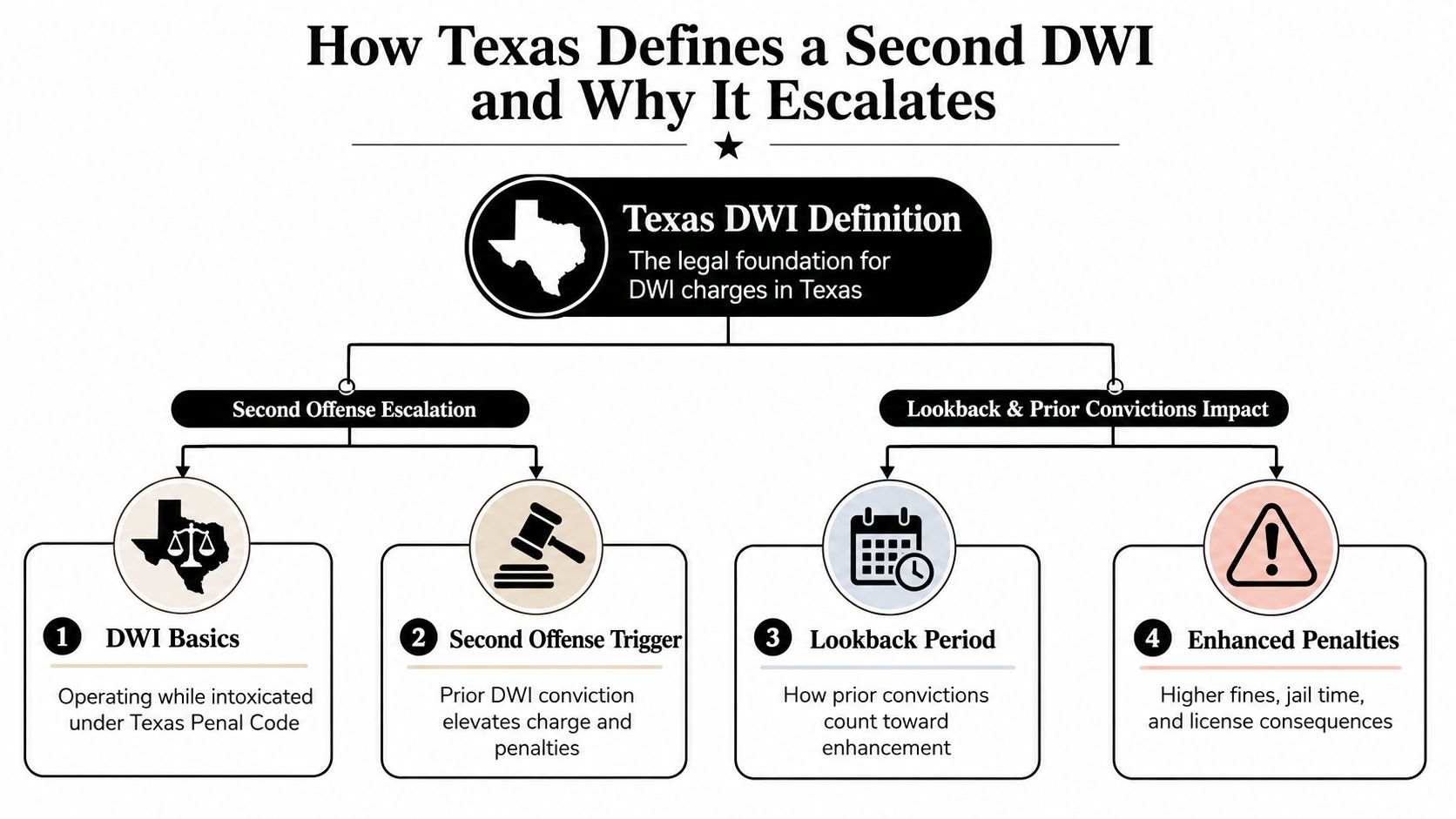
How Texas Defines a Second DWI and Why It Escalates
Start with the basic idea. Texas DWI law focuses on operating a motor vehicle in a public place while intoxicated. Intoxication may be alleged through loss of normal use because of alcohol, drugs, or a combination, or through chemical evidence concerning alcohol concentration.
A second DWI isn't "the same charge again." The State must connect the new allegation to a prior qualifying DWI conviction. That prior conviction can increase the new charge and increase the punishment range. The practical question isn't only what happened during the recent traffic stop. It's also whether the State can properly prove the prior conviction and use it for enhancement.
The prior conviction matters
People often use “lookback period” to describe how older DWI history may affect a new case. The important point for a person arrested in Atascocita is that the prosecutor must establish the legal significance of the prior matter, not merely mention that an old arrest exists.
A prior arrest isn't automatically the same as a prior conviction. Records, judgment documents, and the wording of the earlier disposition may matter. Defense counsel should examine whether the State has reliable proof of the earlier conviction and whether it matches the person charged in the new case.
Why the charge becomes a Class A misdemeanor
A standard second DWI is generally treated as a Class A misdemeanor, rather than the lower-level misdemeanor classification commonly associated with a first offense. That classification increases the potential jail and fine exposure and changes how the court may approach bond, negotiations, probation, and sentencing.
The charge level also affects strategy. An attorney may need to challenge the current stop or testing evidence, examine the prior-conviction proof, and consider whether a negotiated resolution would create fewer long-term problems than accepting the charged offense.
A simple way to understand the escalation is this: the State is presenting the new incident as both a current intoxication allegation and a repeat-offense allegation. Your defense must address both parts. The prior case may be legally defective, incorrectly documented, or insufficiently connected to you. The new investigation may also contain problems involving the traffic stop, field sobriety testing, statements, or breath or blood procedures.
Penalties Fines and Long Term Consequences You Should Expect
A second DWI can disrupt far more than the criminal case. For many Atascocita and Humble residents, losing access to a vehicle affects work, school transportation, medical appointments, childcare, and basic errands. The consequences run on two parallel tracks: the criminal court decides punishment, while separate administrative requirements can affect your license and ability to drive.
Texas guidance describes the standard second-offense framework as a Class A misdemeanor, with a maximum fine of $4,000 and a jail range of one month to one year. A license suspension may last up to two years, as noted earlier.
Comparing the main exposure
| Penalty Element | Standard Second DWI | High BAC 0.15+ and Added Costs |
|---|---|---|
| Charge classification | Generally a Class A misdemeanor | A BAC of 0.15 or higher can create a higher-penalty category |
| Fine | Maximum of $4,000 under the standard framework | One Texas DWI reference identifies a fine of up to $6,000 for a 0.15+ case, as described in this Texas second-DWI reference |
| Jail | One month to one year | Higher-penalty treatment may affect sentencing exposure |
| License consequences | Loss of driving privileges for up to two years | Added consequences depend on the facts and applicable orders |
| Other financial effects | Interlock, calibration, transportation, insurance, and reinstatement burdens | Costs may increase when additional conditions apply |
A BAC of 0.15 or higher can place the case in a higher-penalty category. The number alone does not answer whether the sample was collected correctly or whether the result is reliable. Those questions may affect the criminal case, while the court's final orders can create additional financial and driving obligations.
A second DWI may also bring an annual driver responsibility surcharge of up to $2,000 for three years, according to the Texas Impaired Driving Task Force's explanation of DWI laws and consequences. This charge is separate from the criminal fine. Together, the fine, surcharge, court costs, interlock expenses, transportation, insurance, and reinstatement requirements can place sustained pressure on a household budget.
The practical effects often reach family life. A suspension can interfere with employment, professional duties, or transporting children. If the household is also considering divorce, The Divorce Process in Atascocita: What to Expect explains the filing process in Atascocita and Harris County. Divorce is a separate legal matter, but reduced income and transportation problems can affect decisions about schedules, childcare, and household planning during a DWI case.
License Suspension and Ignition Interlock Requirements in Texas
The license case operates on an administrative track, separate from the criminal prosecution. It may be triggered by the arrest and the circumstances involving a breath or blood specimen, including an alleged failure or refusal. You shouldn't wait for the criminal case to resolve before addressing the license issue.
A second DWI commonly brings a license-suspension range of 180 days to two years, while Texas transportation guidance summarizes the possible loss of driving privileges as up to two years. A neutral Texas legal summary discusses that range in its comparison of first, second, and third DWIs.
The administrative timeline
The first practical step is identifying the deadline on your paperwork for requesting an administrative hearing. The deadline is limited, and missing it can remove an opportunity to contest the suspension. Your lawyer should review the notice, determine what triggered the action, and prepare the hearing request promptly.
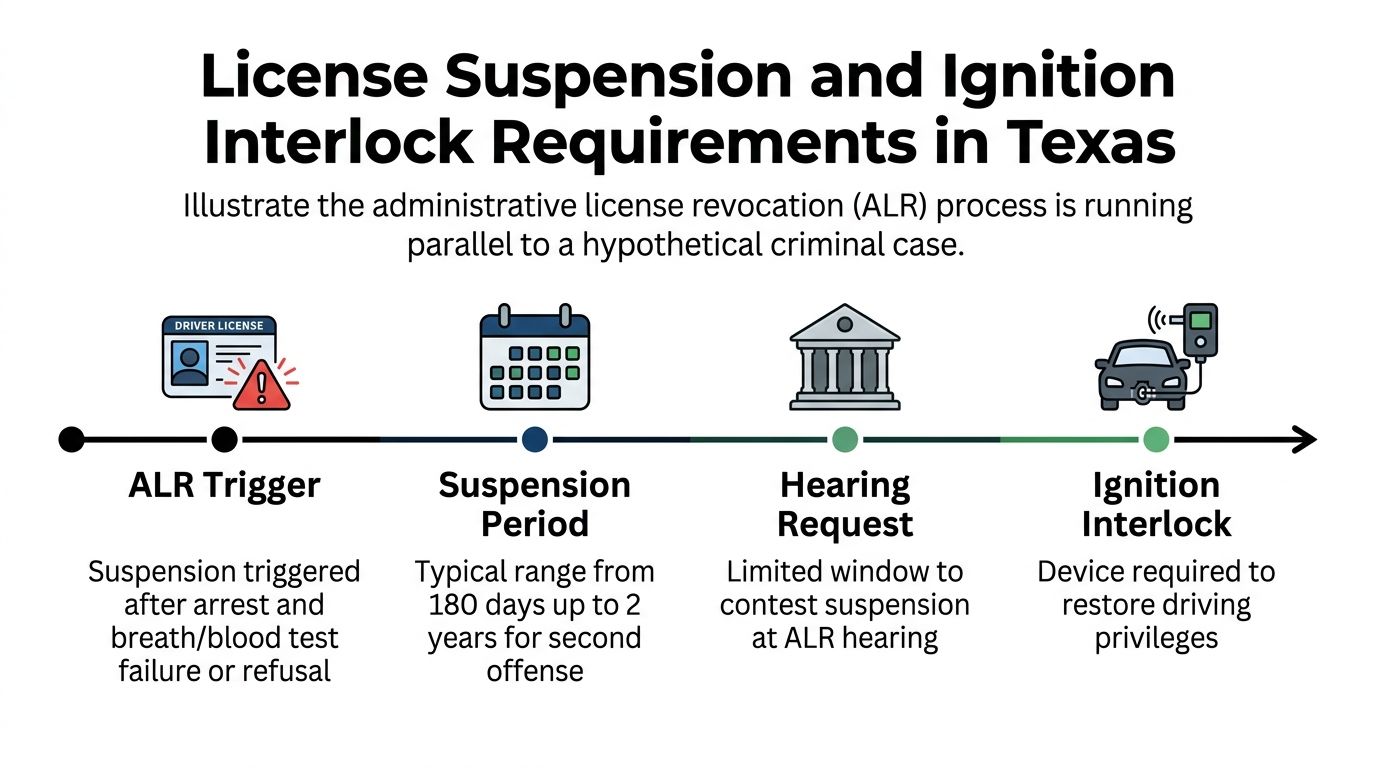
A second-offense driver who wants to keep driving during suspension may need an ignition-interlock device for six months to two years, according to Texas ignition-interlock guidance. The device requires an alcohol-free breath sample before the vehicle starts and may require additional samples while driving.
Why interlock compliance matters
Texas court guidance also explains that a judge can require an IID as a bond condition in a second DWI case and as a probation condition. Installation, monthly calibration, service appointments, and reporting requirements become part of case planning. A missed appointment or failed test can create new legal complications, so keep every receipt, service record, and compliance document.
If you need to understand restricted driving options, review occupational license guidance after a DWI in Atascocita. Your attorney can explain whether an occupational license may fit your circumstances and what restrictions could apply.
A license suspension can also affect parenting logistics. For context, a Child Support Attorney in Atascocita resource addresses establishing, modifying, and enforcing child support in Harris County. That subject is distinct from DWI law, but transportation problems can complicate court appearances, exchanges, and support-related responsibilities.
Harris County Court Process and Timelines After a Second DWI Arrest
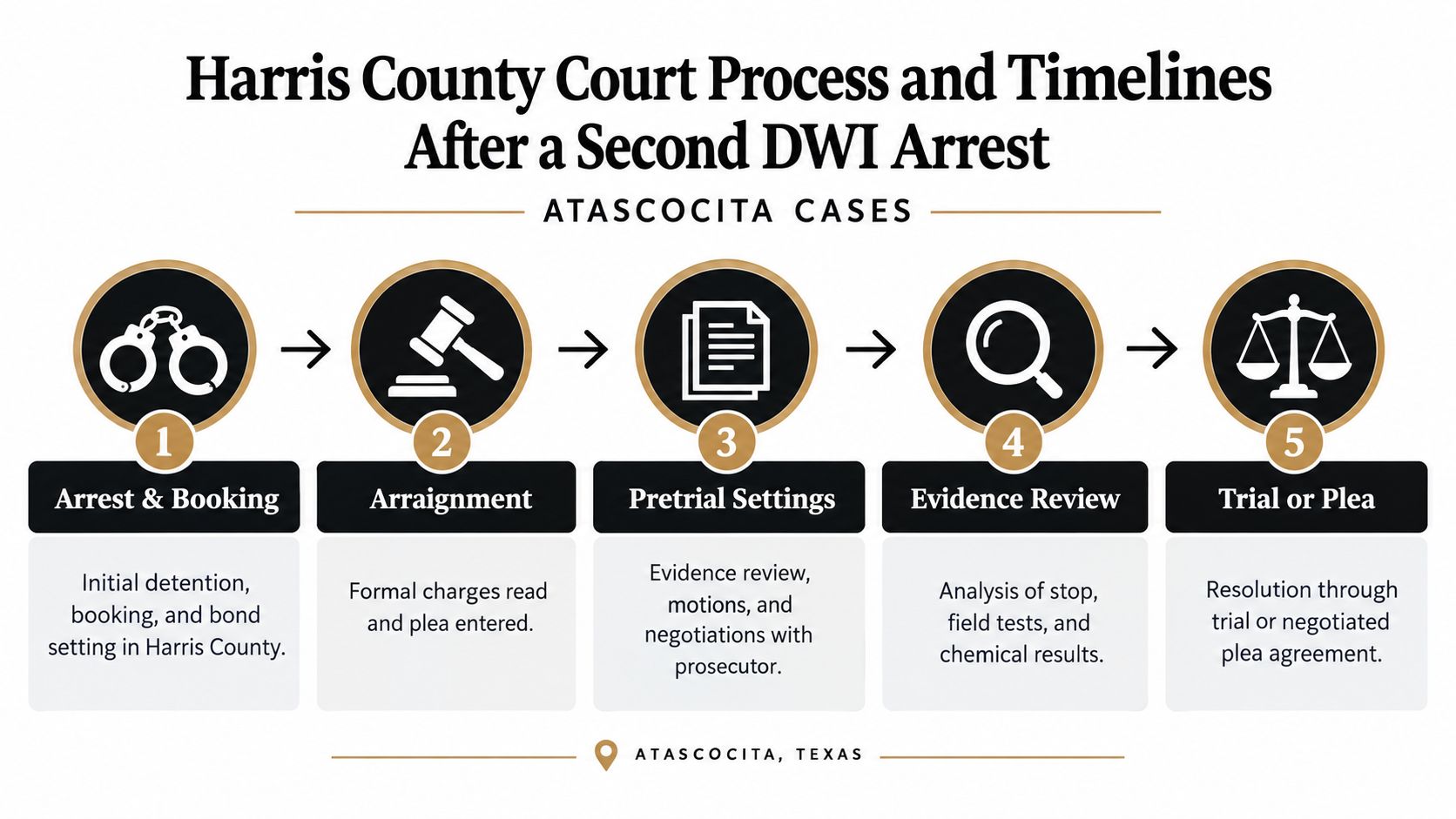
The criminal case usually develops through several stages, and each stage serves a different purpose. Booking and bond address immediate release and conditions. Arraignment formalizes the accusation. Pretrial settings give the defense time to obtain evidence, investigate, file motions, and negotiate. A trial or plea resolves the criminal charge.
What happens first
After arrest and booking, a Harris County court addresses bond. Conditions may include no alcohol, testing, travel restrictions, regular court appearances, and an ignition interlock requirement. Don't assume bond conditions are informal. Violating them can create a separate problem and weaken your position in the DWI case.
At arraignment, the charge is formally presented and a plea is entered. A not-guilty plea commonly preserves the defense's ability to investigate and challenge the evidence, but your attorney should explain the plea and any immediate obligations in light of your actual paperwork.
Evidence review changes the strategy
During pretrial settings, counsel may obtain the offense report, dash-camera footage, body-camera footage, dispatch records, test records, laboratory materials, and documentation concerning the prior conviction. The defense should compare those materials with the officer's narrative and your own recollection.
Legal teams often organize this material through defined stages of legal document review. In a DWI case, that means sorting documents, identifying missing records, comparing dates and statements, and flagging issues for motions or negotiations.
A court date is not the same as a resolution date. Preparation between settings often determines whether the defense can challenge evidence effectively.
The case may end through a negotiated plea, dismissal, or trial. No attorney can promise a particular result. The appropriate path depends on the stop, the testing evidence, the prior-conviction proof, witness credibility, available video, and the consequences of each possible resolution.
For residents seeking local representation, the Harris County criminal defense attorney resource explains the role of defense counsel in Harris County criminal matters. Bring your bond paperwork, driver's-license notices, court documents, and any records from the prior DWI to your consultation.
Defense Strategies and Mitigation Options That Can Make a Difference
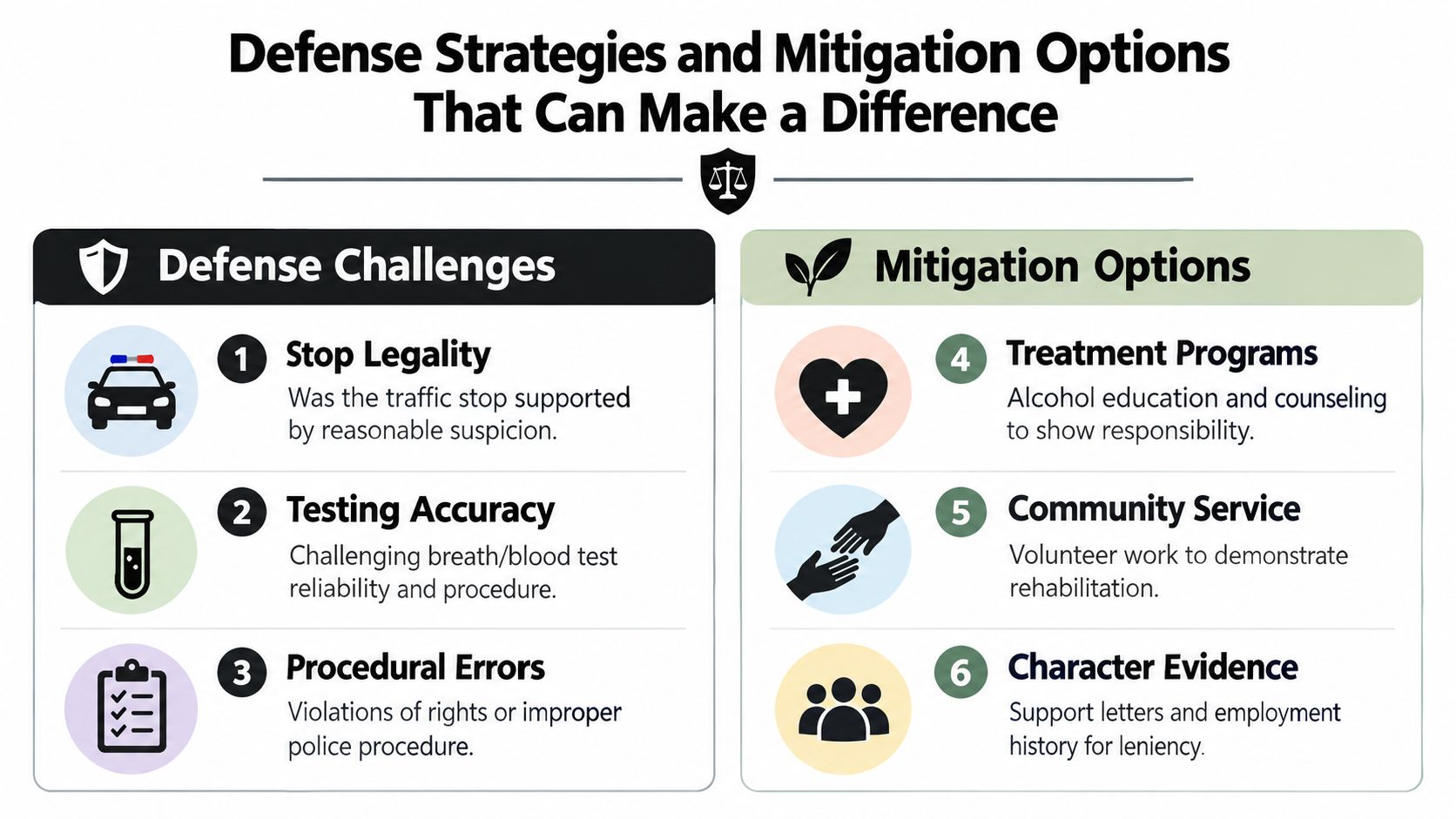
Defense and mitigation serve different purposes. A defense strategy challenges whether the State can prove the charge. Mitigation accepts that the case may carry risk and presents facts that may support a more manageable resolution or sentencing position. Strong preparation often examines both without assuming either will succeed.
Defense challenges
Stop legality: The attorney asks why the officer stopped the vehicle and whether the facts supported reasonable suspicion. Dashcam footage, dispatch information, road conditions, and the wording of the report may matter.
Field sobriety testing: Balance, coordination, medical conditions, footwear, lighting, uneven pavement, instructions, and anxiety can affect roadside performance. Video may show whether the officer's description matches what occurred.
Chemical evidence: Breath and blood results should be examined for testing procedures, maintenance records, operator qualifications, timing, chain of custody, and laboratory handling. A number on a report doesn't eliminate the State's burden to prove admissibility and reliability.
Mitigation choices
Treatment or alcohol education may show that you're addressing the concern underlying the allegation. It won't erase a weak stop or defective test, but it may help counsel present a responsible plan when discussing supervision or sentencing.
Community service can provide another way to demonstrate constructive conduct. Character evidence, employment records, family responsibilities, and compliance with bond conditions may also give the court a fuller picture than the arrest report alone.
A careful strategy uses mitigation to support the person, not to concede facts the State still has to prove.
Language access matters too. If you or a family member needs legal interpreting, Translators USA for law firm interpreting offers context about interpreting services for legal settings. Clear communication helps clients understand bond terms, evidence decisions, and proposed agreements.
The right approach depends on the facts. In one Atascocita case, the strongest issue may be an unsupported stop. In another, the evidence may require a close review of the blood draw or laboratory chain. In a third, the defense may focus on reducing the practical harm through carefully negotiated conditions. A DWI lawyer should explain the strengths, weaknesses, risks, and costs of each path instead of promising a result.
For local information about representation, see the DWI lawyer resource for Atascocita. The central objective is to preserve your rights while building a decision based on evidence rather than panic.
Immediate Steps to Protect Your Rights and Get Local Help
A second DWI arrest can create two parallel tracks. The criminal case concerns the court, while the administrative track concerns your driver's license and possible ignition interlock requirements. In Atascocita and Humble, missing a notice or court setting can create problems on either track, so organize both from the start.
- Gather every document: Keep the arrest paperwork, bond conditions, license notice, court settings, receipts, and interlock materials in one place.
- Record what happened: Write down the route, reason for the stop, officer's statements, field tests, chemical testing, medical issues, and witnesses while your memory is fresh.
- Protect your privacy: Do not post about the arrest or explain it to coworkers. Statements can reach people you did not intend to involve.
- Track license deadlines: Give the license notice to your attorney promptly. An administrative hearing issue may have a deadline separate from your criminal court date.
- Follow bond conditions: Complete required testing, use any ordered interlock, attend court, and follow no-alcohol rules. Ask counsel before treating a condition as flexible.
- Preserve recordings and records: Identify nearby businesses, passengers, witnesses, vehicle systems, and other sources that may clarify the stop, testing, or arrest.
If you are researching investigative resources for a separate matter, SkipForge tracer.com alternatives explains how tracing tools differ. Online research should not replace preserving evidence through your attorney.
Atascocita and Humble residents need advice that addresses both tracks. The publisher's Law Office of Bryan Fagan – Atascocita TX Lawyers provides legal guidance for individuals and families in Atascocita, Humble, and Harris County, including DWI defense and related concerns. Bring your records, ask direct questions, and choose your next step after you understand the possible consequences.