Skip to content

If you're reading this, you're probably already carrying a lot. Maybe you're in Atascocita or Humble, trying to keep your child's routine steady while also wondering how on earth a judge is supposed to understand what really happens in your home. You know you love your child. You know how much you do each day. The hard part is proving it in a Harris County custody case.
That's where many parents get stuck. They think custody evidence means dramatic proof, one perfect document, or a moment that changes everything. Most of the time, it doesn't work that way. Harris County courts usually look at the bigger picture. They want to see your child's daily life, your parenting pattern, and whether you can provide stability, care, and a healthy environment.
Regarding evidence needed for custody case Harris County Texas, generic checklists are frequently encountered. While these can offer assistance, they overlook a critical element. Your evidence must fulfill a dual purpose: demonstrating the truth about your parenting and conforming to the local court process. Both are essential.
Your Guide to Child Custody Evidence in Harris County
A custody case can make ordinary life feel heavy. School drop-offs, doctor visits, text messages about pickup times, report cards, and calendars suddenly seem like legal evidence instead of normal parenting. That shift is unsettling, especially when you're trying to protect your child and keep conflict from getting worse.
In Harris County, custody evidence isn't just about showing that you're a good parent in a general sense. The court looks at what serves the best interest of the child. That means the judge is looking for reliable proof about your child's needs, your parenting ability, the stability of each home, and whether each parent supports the child's development and wellbeing.
For many families in northeast Harris County, that's good news. Why? Because the strongest custody evidence often comes from ordinary life. It comes from records that show who takes the child to school, who communicates with teachers, who handles medical care, and how each parent behaves over time.
Practical rule: Good custody evidence usually shows a pattern, not a single accusation.
That's also why this process can become manageable once you stop thinking about evidence as a pile of paperwork. A stronger approach is to think of it as a documented story about your child's life. The question is not just, “What do I have?” The better question is, “What does this show about my child's needs and my role in meeting them?”
For parents in Atascocita, Humble, and nearby communities, local court procedure adds another layer. Even strong evidence can lose impact if it isn't organized, selected carefully, or submitted the right way. That's where thoughtful preparation matters just as much as the documents themselves.
The Goal of Your Evidence Telling Your Child's Story
You walk into a Harris County courtroom with a stack of papers, a phone full of messages, and a head full of memories. The judge sees only a small slice of your family's life. Your job is to turn that slice into a clear, credible picture of what your child needs and how you meet those needs.
That is the fundamental goal of custody evidence. You are building a story the court can trust.
A good custody case works a lot like putting together a family photo album for someone who has never met your child. One picture may be meaningful, but a series of dated, consistent pictures shows growth, routine, and who has been present over time. Judges in Harris County look for that same pattern. They want to see how your child's daily life functions, who provides steadiness, how decisions get made, and whether each parent supports the child's wellbeing.
If you want a fuller explanation of the standards courts apply, this guide on how judges decide custody in Harris County, Texas gives helpful context.
What your evidence should help the judge understand
The strongest evidence usually answers four practical questions:
- Who keeps the child's life steady? This includes routines, punctuality, supervision, and follow-through.
- Who handles the child's actual needs? School, medical care, therapy, meals, homework, transportation, and emotional support all matter.
- Who makes decisions with good judgment? The court pays attention to consistency, honesty, and whether a parent acts calmly under stress.
- Who protects the child's relationships? Judges notice whether a parent encourages healthy contact with the other parent when appropriate, or creates unnecessary conflict.
That shift in focus helps many parents. The case becomes less about proving you are the better person and more about showing, with reliable proof, how your parenting affects your child's day-to-day life.
Story first, documents second
Parents often start by gathering every text, every photo, and every school paper they can find. That impulse is understandable. But a pile of records is not yet a case.
A stronger approach is to start with a few themes, then match each piece of evidence to those themes. For example, if your child has asthma, one theme may be consistent medical care. If school attendance has been a problem, another theme may be morning structure and follow-through. Once you know the themes, you can choose records that support them instead of burying the judge in paper.
That is how evidence becomes persuasive. It stops being random information and starts showing a pattern.
Three categories can make this feel manageable
Many parents do better when they sort evidence into simple groups before they worry about hearings, affidavits, or exhibits.
| Evidence type | What it includes | What it helps show |
|---|---|---|
| Records | School attendance, report cards, medical summaries, daycare logs, calendars, payment receipts | Daily caregiving, reliability, stability |
| Communications | Texts, emails, co-parenting app messages, voicemails | Decision-making, communication style, willingness to co-parent |
| People | Your testimony, teachers, counselors, relatives, coaches, childcare providers | Context, credibility, and what the child's routine actually looks like |
A parent in Humble might use teacher emails and attendance records to show who stays on top of school issues. A parent in Atascocita might use appointment summaries and pharmacy records to show who manages ongoing treatment. Another parent may use message threads and a clean parenting calendar to show who consistently arranged exchanges without conflict.
Short version. Judges usually trust patterns they can verify.
Harris County procedure matters too
Even strong evidence can lose force if it is sloppy, incomplete, or hard to review. Harris County courts expect parties to present material in an organized way, and electronic filing rules can affect whether a judge or opposing counsel can easily follow your exhibits. File names, page order, labels, and exhibit organization may sound administrative, but they shape how your story is received.
That is one reason clear scans and readable copies matter. If a school note is blurry or text screenshots are cut off, the point you are trying to prove may never land. Parents who are working from phone screenshots or old paper copies sometimes use tools like Legal Documentation Enhancement to improve legibility before sharing records with counsel for proper review and submission.
One caution here. Family law procedure has changed in recent years, so evidence gathering often requires more deliberate planning than parents expect. You and your lawyer need to identify what matters, request the right records, and prepare them in a form the court can use.
The judge cannot witness your child's life firsthand. Your evidence gives the court a dependable window into it.
Key Types of Evidence in a Custody Case
A Harris County judge is usually trying to answer a practical question. What does this child's real life look like on ordinary Tuesdays, school mornings, doctor visit days, and exchange weekends? The strongest evidence helps the court see that life clearly.
A good custody case is not a pile of papers. It is a story supported by proof. Each record should answer one of these questions: Who meets the child's daily needs? Who communicates in a healthy way? Who provides stability? Who follows through?
Records that show daily parenting
Daily life records often carry real weight because they are hard to fake and easy to compare over time. A judge may forget a heated accusation by next month. Consistent school, medical, and childcare records are much harder to brush aside.
Useful examples include:
- School records: attendance reports, tardy notices, teacher emails, report cards, behavior notes, parent conference records, and signed forms
- Medical records: appointment summaries, prescription history, therapy scheduling, vaccination records, and records showing who attended visits
- Childcare records: sign-in and sign-out logs, payment records, and emergency contact information
- Activity records: sports schedules, recital notices, tutoring records, and proof of who registered or transported the child
These records help the court see patterns. If one parent repeatedly handles school issues, schedules care, and responds to health needs, the paperwork often shows it without much argument.
Communication that reflects judgment
Texts, emails, co-parenting app messages, and voicemails can do more than prove what was said. They can show how each parent solves problems under stress.
Judges often look for tone, consistency, and child focus. A message about pickup time, homework, medicine, or schedule changes is usually more useful than a long thread about old relationship arguments. Clear communication shows maturity. Repeated threats, insults, or refusal to share information can suggest trouble with future co-parenting.
Social media can create the same problem in public form. Posts, comments, photos, and direct messages may be used to question a parent's judgment, honesty, or priorities. If that issue is part of your case, this explanation of how judges view social media in Texas custody cases can help you spot what may matter.
Financial and household proof
Money alone does not decide custody. Stability does matter, and financial documents can help explain whether a parent can maintain routines, provide housing, and meet the child's needs.
That proof may include:
- Income records: pay stubs, tax returns, and employment verification
- Support records: proof of payments made, payments missed, or reimbursement history for child expenses
- Housing documents: a lease, mortgage statement, utility bills, or similar records showing a stable residence
- Child-related spending: receipts for school supplies, lessons, uniforms, camp, medical costs, or other regular needs
Photographs can also help if they are fair and current. A few clear photos of the child's bedroom, study area, or sleeping arrangements usually do more good than a large batch of staged pictures.
Witnesses who see the child's actual routine
Witnesses are most helpful when they have first-hand knowledge of parenting, not just strong opinions. Courts often give more attention to people who regularly interact with the child than to relatives who mainly know the family conflict through one parent.
Helpful witnesses may include:
- Teachers and school staff who have seen who attends meetings, checks on progress, or responds to concerns
- Doctors, therapists, or counselors who can describe attendance, follow-through, and participation in care
- Coaches, tutors, and activity leaders who have observed punctuality, involvement, and reliability
- Neighbors, babysitters, or childcare providers who have direct knowledge of exchanges or day-to-day care
The closer the witness is to the child's routine, the more useful that testimony tends to be.
Evidence of safety concerns
Some cases involve more than scheduling and communication. If there are allegations involving family violence, substance abuse, unsafe supervision, untreated mental health issues, or repeated violations of court orders, the proof needs to be specific and carefully documented.
That might include police reports, medical records, photographs, threatening messages, prior court filings, or testimony from a person who directly observed the conduct. Judges usually respond better to concrete proof than to broad labels. “He is unstable” has little value by itself. Records showing missed exchanges, intoxicated messages, or a police response give the court something it can weigh.
The goal is not to overwhelm the judge with every bad fact from the relationship. The goal is to present the pieces that show how the issue affects the child's safety, stability, or well-being.
How to Properly Gather and Organize Your Evidence
Most parents don't lose ground because they cared too little. They lose ground because they gathered too much, gathered it poorly, or saved it in a way that makes it hard to use.

In Harris County, that problem gets sharper when a custody evaluation is involved. The Domestic Relations Office states that evaluators may accept no more than 25 pages of evidence from each party for review and consideration, according to the Harris County Domestic Relations Office custody evaluation rules. That limit changes the job. You are not building a giant archive for someone to sort through later. You are selecting the strongest pieces that show patterns of parenting.
Start with preservation, not editing
Your first job is to preserve evidence in its original form.
- Save complete screenshots: Include names, dates, and times when possible.
- Keep full conversations: Don't clip only the worst line if the larger exchange explains what happened.
- Download records regularly: School portals, medical portals, and apps can change over time.
- Store copies in two places: A secure digital folder and a printed backup often make sense.
If you need to improve readability for scans or old printed records before sharing them with counsel, tools focused on Legal Documentation Enhancement can help make documents clearer without changing their content.
Build a structure that a judge can follow
A cardboard box full of papers doesn't tell a story. A labeled system does.
Try using simple categories like these:
| Folder or binder tab | What goes inside |
|---|---|
| School | Attendance, teacher emails, report cards, conference notes |
| Medical | Appointment records, receipts, care instructions |
| Communication | Text threads, email chains, co-parenting app messages |
| Calendar | Parenting time logs, exchanges, activities |
| Financial | Support records, income documents, child expenses |
Inside each category, sort documents by date. Add a short note for yourself about why each document matters. For example: “Teacher email showing I arranged tutoring,” or “Pediatric visit record showing I attended and followed up.”
For broader hearing preparation, this guide on how to prepare for a custody hearing can help you think through presentation and timing.
What many parents get wrong in Harris County
Parents often assume that if evidence is relevant, the court will find a way to consider it. That's not how local procedure works. Administrative mistakes can keep useful evidence from being reviewed the way you expected.
Some common trouble spots include:
- Dumping everything together: More paper doesn't mean more persuasive proof.
- Using edited screenshots: Cropped images can create authenticity fights.
- Keeping only your own notes: Personal logs help most when they line up with outside records.
- Waiting too long to organize: Late sorting often leads to missed details and poor selections.
This short video gives a practical overview of hearing preparation and mindset.
A formal discovery process may also be part of your case. That's the legal method for requesting documents or information from the other side. If the other parent controls records you need, discovery may be how your lawyer obtains them and folds them into the broader case narrative.
Common Evidence Mistakes That Can Hurt Your Case
The hard part for many parents is not finding proof. It is avoiding the mistakes that make good proof less believable, less useful, or harder for the judge to review.
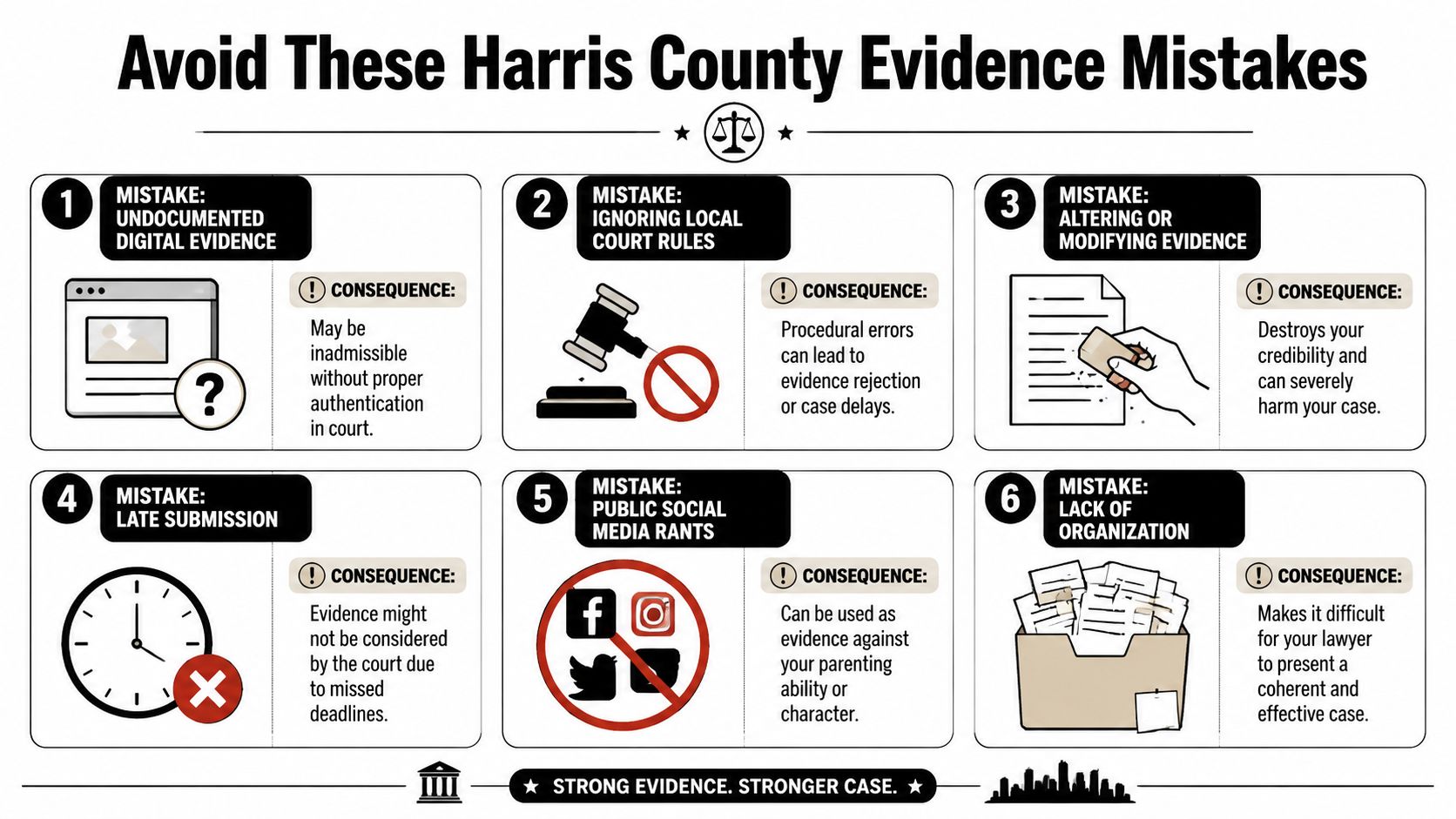
A common Harris County example looks like this. A parent has texts, school notices, medical records, and photos that could help. The hearing date arrives, but the exhibits are mislabeled, saved in the wrong format, missing key pages, or not submitted the way the court expects. The result is frustrating because the problem is administrative, not factual. For families in Atascocita and Humble, that can feel quite unfair, but local courts still expect parties to follow the court's exhibit process.
Procedural mistakes that catch people off guard
Evidence works a lot like a child's school project. Good content matters, but neat labeling, complete pages, and proper submission matter too. If the judge or staff cannot quickly tell what an exhibit is, why it matters, or whether it was properly provided, your strongest point can get lost.
Common procedural mistakes include:
- Bringing too much without a plan: A large stack of records can hide your best evidence instead of highlighting it.
- Using vague labels: “Screenshots” or “Texts” tells the court very little. Clear names such as “March 12 text about missed pickup” are easier to follow.
- Submitting incomplete exhibits: A cropped message thread or one page from a multi-page record often invites objections about missing context.
- Ignoring local submission rules: Harris County family courts may require specific digital handling for exhibits, including file organization and submission details, as outlined in Harris County Family District Court guidance.
- Waiting until the last minute: Last-minute exhibit prep leads to duplicates, missing dates, and files that are hard to open.
Judges see many cases in a short time. A clean, organized exhibit set helps your story come through faster.
Risky evidence collection mistakes
Parents under stress sometimes gather proof in ways that create new problems. Secret recordings are a good example. Texas law often allows a person to record a conversation they are part of, but trying to record other people's conversations without being part of them raises a different set of legal and evidentiary concerns.
Social media causes trouble too. A parent may post out of anger, sarcasm, or exhaustion and later learn that the other side is using that post to question judgment, cooperation, or stability. Even deleted posts can become part of the dispute if screenshots already exist.
Other mistakes show up often:
- Editing screenshots or photos: Even small changes can trigger arguments that the exhibit is incomplete or unreliable.
- Deleting texts, emails, or posts: Missing material can hurt credibility and invite questions about what was removed.
- Relying only on personal summaries: A journal can help, but outside records such as attendance logs, messages, and appointment notes usually carry more weight.
- Collecting private records improperly: Getting information through another person's account or device can create legal trouble that overshadows the point you wanted to prove.
How these mistakes weaken the story you want to tell
A custody case is not won by handing over the biggest folder. It is won by showing a judge a clear, credible picture of your child's daily life and your role in it.
That is why random screenshots and angry captions often fall flat.
If your evidence says five different things at once, the court may struggle to see the main point. If your records are organized around a few themes, such as school involvement, medical follow-through, stable routines, and respectful co-parent communication, the judge can connect the dots more easily. Good evidence does more than prove isolated incidents. It supports a story that makes sense from beginning to end.
Judges and mediators usually respond better to organized proof than to emotional summaries.
A useful question to ask yourself is simple: “What does this exhibit help the judge understand about my child's best interests?” If you cannot answer that in one sentence, the exhibit may need better context, better labeling, or may not belong in your final set at all.
How a Lawyer Uses Evidence to Build Your Case Strategy
A lawyer's job is not just to collect papers. It is to turn those papers into a case theory a judge can follow from start to finish.

Turning records into a legal theme
In a Harris County custody case, evidence works like bricks in a house. A school record by itself does not decide custody. A medical note by itself does not either. But when the records fit together, they show the judge something solid: who keeps the child's routine steady, who responds to problems, and who makes decisions with the child's best interests in mind.
That is where strategy starts.
A lawyer usually begins by asking a different question than a parent asks in the middle of stress. A parent often asks, “What do I have?” A lawyer asks, “What does this prove, and where does it fit in the story?”
Those questions may sound simple, but they shape the whole case:
- Which records show a pattern of steady parenting, not just one good weekend?
- Which messages show reasonable communication under pressure?
- Which exhibits support the parenting plan you are asking the court to order?
- Which documents belong in mediation, and which are better saved for a hearing?
- Which weak points need explanation before the other side raises them?
That process helps prevent a common problem. Parents often bring in stacks of material that feel important because they lived through every moment. A judge, though, sees only what is clearly presented. A lawyer helps sort the file into themes the court can absorb quickly, such as school involvement, medical follow-through, safe decision-making, reliable exchanges, or a parent's willingness to support the child's relationship with the other parent.
Building a story that fits the court process
A strong custody strategy is part storytelling and part procedure. Both matter in Harris County.
For example, if your position is that you provide the more stable weekday routine, your lawyer may line up attendance records, daycare sign-in sheets, homework emails, and calendar entries in date order so the pattern is easy to see. If the issue is poor co-parent communication, the lawyer may select a small set of messages that show tone, missed responses, or refusal to share information, instead of flooding the court with every text ever sent.
Judges usually respond better to a clean line of proof than to a pile of accusations.
A lawyer also looks at the rules surrounding the evidence, not just the content. In Harris County, deadlines, exhibit labels, and electronic filing or submission requirements can affect whether your materials are easy for the court to review. For families in Atascocita and Humble, that practical side matters more than many people expect. Good evidence can lose force if it is poorly prepared, hard to follow, or submitted in a way that creates avoidable problems.
Using your conduct during the case as part of the proof
A lawyer also watches for evidence that develops during the case itself. How you handle temporary orders, mediation, parenting classes, exchange logistics, and court instructions can reinforce the larger theme of your case.
For example, documents showing completion of required steps and attendance at scheduled events can support the point that you follow through and take the court's concerns seriously. The article on Harris County custody and divorce guidance discusses some of those local expectations. Those records do not replace evidence about your child's daily life. They do help confirm your judgment and reliability.
That can matter a great deal in close cases.
Matching evidence to each stage of the case
The same exhibit may serve a different purpose depending on where the case stands. A lawyer plans for that early.
| Stage | How a lawyer uses evidence |
|---|---|
| Negotiation | Shows the other side your position is supported by records, not guesses |
| Mediation | Connects facts to a workable possession schedule or decision-making plan |
| Evaluation | Selects a focused set of materials that shows patterns without overwhelming the evaluator |
| Trial or hearing | Organizes exhibits and testimony so the judge can quickly understand the child-centered theme |
This is also why lawyers leave some material out on purpose. More paper does not always mean a stronger case. Sometimes the better choice is to use ten well-chosen exhibits that tell one clear story, instead of fifty exhibits that pull the court in five directions.
If you are working with the Law Office of Bryan Fagan – Atascocita TX Lawyers, or another family-law attorney familiar with local practice, part of the value is this kind of judgment. The goal is not to make your file look bigger. The goal is to make your evidence easier for a Harris County judge to trust, follow, and apply to your child's best interests.
Strong custody cases are built by linking proof to a clear parenting story, then presenting that story in a form the court can actually use.
Get Help from an Atascocita Lawyer Who Understands
If you're dealing with a custody dispute, you don't need to figure out every rule and document on your own. The right evidence can be powerful, but only if it is gathered carefully, organized clearly, and connected to what a Harris County judge expects.
For most parents, the heart of the process is simple. Show the child's daily life. Show your consistency. Show your judgment. Show your willingness to support stability.
If you live in Atascocita, Humble, or another part of northeast Harris County, local procedure matters just as much as the facts. A thoughtful legal plan can help you avoid mistakes and present your case with confidence.
If you need guidance on the evidence needed for custody case Harris County Texas, schedule a free consultation with Law Office of Bryan Fagan – Atascocita TX Lawyers. You'll be able to talk through your situation, understand what records matter most, and get practical next steps for protecting your child and your future.