Skip to content

When you're a dad in Atascocita facing a divorce or custody battle, it's easy to feel like the deck is stacked against you. The uncertainty can be overwhelming, and your primary concern is, understandably, your future with your children. At The Law Office of Bryan Fagan, we understand. As your local Atascocita attorneys, we want to cut through the noise and talk about what really matters. Having a skilled father rights attorney in Atascocita, Texas in your corner isn't just helpful—it's often the single most important factor in protecting your place in your child's life.
Your Guide to Fathers' Rights in Atascocita

This guide is your roadmap, designed specifically for fathers in Atascocita, Humble, and the surrounding communities in northeast Harris County. We need to get one thing straight from the very beginning: Texas law is gender-neutral.
That old, outdated idea that mothers automatically get an advantage in court is a myth. It's simply not how our local courts operate anymore. Today, judges are legally required to focus on one thing and one thing only: what is in the "best interest of the child." This standard recognizes that a child's well-being depends on having two active and dedicated parents.
The Role of a Father Rights Attorney
Think of a father rights attorney as more than just your lawyer; they are your strategic partner and a supportive member of your community. Their job is to make sure your voice is heard and that the court understands the vital role you play in your child's life. They work with you to build a strong, clear case demonstrating why your continued involvement is essential for your child’s happiness and stability.
For instance, in a custody dispute, your attorney's expertise is critical. They fight to secure your possession and visitation rights, often defined by a standard possession order that can grant 35-50% of parenting time, based on the child's age. The numbers don't lie. According to 2026 data from Harris County family courts, fathers who had experienced legal representation in contested cases were awarded primary custody 25% more often than those who went it alone. We can help you understand how a lawyer's strategy impacts custody results and what that could mean for you.
Navigating a family law case requires understanding several interconnected legal areas. For dads in Atascocita, knowing where to focus your attention is the first step toward a successful outcome. The table below outlines the critical areas where an experienced attorney can make all the difference.
Key Legal Areas for Atascocita Fathers
| Legal Area | What It Means for an Atascocita Dad | Why It Is Crucial for Your Case |
|---|---|---|
| Establishing Paternity | This is the legal process of being recognized as the child's father, which is the foundation for all your rights. | Without it, you have no legal standing to request custody or visitation. It's the key that unlocks the courthouse door. |
| Custody & Possession | This determines who makes major decisions for your child (custody) and creates the schedule for when you see them (possession). | A well-drafted order protects your time with your child and ensures you remain a consistent presence in their life, from school events at Humble ISD to weekend soccer games. |
| Child Support | This involves the financial obligations for raising your child. It's not just about paying, but also ensuring the amount is fair. | Proper calculation ensures you aren't overpaying and that the support directly benefits your child's needs right here in our community. |
| Enforcement & Modification | These are the legal tools used when the other parent violates the court order, or when life changes require updating the order. | This is how you hold the other parent accountable and adapt your legal plan to new jobs, moves, or changing needs in your family's life. |
Each of these areas presents unique challenges and opportunities. Having a legal advocate who understands the local Harris County courts and how these pieces fit together is invaluable for protecting your relationship with your child.
At The Law Office of Bryan Fagan, we are proud members of the Atascocita community. We believe every father deserves the chance to make his case, and our mission is to empower you with the legal strategy needed to secure a fair result that honors your role as a dad.
This article will break down the essential steps you need to take, including:
- Establishing Paternity: The first, non-negotiable step to securing your legal rights.
- Custody and Possession Orders: How time with your child is decided and what it looks like.
- Child Support: Understanding your financial rights and obligations.
- Enforcement and Modification: What to do when things go wrong or your circumstances change.
We know the ins and outs of the Harris County family court system and are here to guide our neighbors through it with compassion and strength. To get advice tailored to your unique situation, contact our Atascocita office for a free consultation.
How to Establish Paternity and Secure Your Legal Rights
Here’s a hard truth for fathers in Texas: being a child's biological dad and being their legal dad are two different things. Until the law officially recognizes you as the father, you don't have enforceable rights. This crucial first step is called establishing paternity, and it's the foundation for everything else—custody, visitation, and having a say in your child's life.
Without that legal status, you have no guaranteed right to see your child (known as possession and access) or to weigh in on major decisions about their schooling or medical care. On the flip side, you also have no legal obligation to pay child support. Establishing paternity changes all of that, turning a biological fact into a legal reality with both rights and responsibilities.
The Two Pathways to Legal Fatherhood
For dads in Atascocita and Humble, there are two main ways to establish your legal rights as a father. The best path for you really depends on your relationship with the child's mother and the specifics of your situation.
The two methods are:
- Voluntary Acknowledgment: A straightforward path based on mutual agreement.
- Court Proceeding: A formal legal action when there's a disagreement.
Let's break down what each of these actually involves for a father living in our community.
Signing an Acknowledgment of Paternity (AOP)
The simplest and most common way to establish paternity is by signing a form called the Acknowledgment of Paternity (AOP). This is a binding legal document where you and the mother both agree, under oath, that you are the child’s biological father. Most parents sign this at the hospital right after their child is born, such as at HCA Houston Healthcare Kingwood.
Think of the AOP as the official document that formally creates the parent-child relationship in the eyes of the law. It’s a simple piece of paper, but signing it has profound and permanent legal consequences.
Once the AOP is signed and filed, your name can be put on the child's birth certificate. This is the perfect route for unmarried parents who are on the same page and want to avoid the time and expense of going to court. It starts your co-parenting journey on a cooperative note. You can get a deeper look at this process in our guide on how to establish paternity in Texas.
Initiating a Court Proceeding to Establish Parentage
What if the mother won't sign an AOP, or if there's a genuine dispute about who the father is? In that case, your next step is to file a Suit to Adjudicate Parentage. This is a formal lawsuit you file with the family court that serves Atascocita (which is in Harris County), asking a judge to make a legal determination of parentage.
This court process almost always involves DNA testing to get a scientific answer. Once a DNA test confirms you are the biological father, the judge will sign an order that legally establishes your paternity. This court order achieves the same result as an AOP, just through a more formal and sometimes contentious process.
Once paternity is legally established, the court can then issue orders for all the important details, including:
- Conservatorship: Your rights and duties to make decisions for your child.
- Possession and Access: A detailed schedule for when you have your child.
- Child Support: A monthly financial obligation.
- Medical and Dental Support: The responsibility to provide health insurance.
For any father in the Atascocita area, taking one of these steps is non-negotiable if you want to protect your role in your child's life. Without it, your ability to be an involved dad is entirely dependent on the other parent's goodwill. If that changes, you have no legal ground to stand on. If you're facing this situation, it’s critical to act now. The Law Office of Bryan Fagan offers free consultations to help you figure out your options and start securing your rights as a father.
Crafting a Custody Order that Protects Your Time
When you’re a dad in Atascocita facing a family law case, one thing matters more than anything else: your time with your child. You picture yourself at their school events, helping with homework on a Tuesday night, and just being there for them day in and day out. That future is what we fight for.
But to protect that future, you first need to understand how Texas courts look at custody. The legal jargon can be intimidating, but our team is here to explain it in plain English.
In Texas, we don't really use the word "custody" like you see on TV. Instead, the law splits the concept into two critical pieces: conservatorship and possession and access. Think of it like this: conservatorship is the right to make decisions for your child, while possession and access is the schedule that outlines when you are with your child.
Conservatorship: Your Right to Make the Big Decisions
Conservatorship is all about your legal authority to make crucial decisions for your child. Who has the final say on which school they attend in Humble ISD, what doctor they see, or their religious upbringing? That's what conservatorship determines.
In Texas, the law heavily favors parents working together. The most common arrangement, and the one courts presume is best for the child, is Joint Managing Conservatorship (JMC). This means you and the child’s other parent share the rights and responsibilities of making those big decisions. It’s a partnership.
JMC doesn't automatically mean a 50/50 split of time—we'll get to that in a minute. It simply means the court wants both parents to have a meaningful voice in their child's life.
The alternative, which is much less common, is Sole Managing Conservatorship (SMC). This is where one parent is given the exclusive right to make most of these decisions. Courts typically only order this in serious situations involving family violence, substance abuse, or a level of conflict so high that co-parenting is simply impossible. The other parent is then named a "Possessory Conservator" and still gets time with the child, but loses their say in the major life choices.
The good news for fathers is that the old-fashioned bias toward mothers is a thing of the past in Texas courtrooms. The law is gender-neutral. The only question a judge cares about is: what is in the best interest of the child? We've seen countless fathers prove they are the active, involved parent and win custody arrangements that reflect their role.
Possession and Access: Your Time with Your Child
If conservatorship is about your rights, possession and access is about the calendar. This is the part of your court order that spells out, in black and white, exactly when your child will be in your care.
For most families, the starting point is what's called the Texas Standard Possession Order (SPO). The SPO is a detailed, default schedule created by the Texas Legislature. It's designed to provide consistency for the child and give both parents predictable, substantial time.
For parents who live within 100 miles of each other, a typical SPO gives the non-primary parent possession on:
- The first, third, and fifth weekends of the month.
- A rotation for major holidays like Thanksgiving and Christmas.
- An extended block of time in the summer, usually 30 days.
Of course, before a court can even think about ordering possession, you have to be legally recognized as the father. This is the foundational first step.
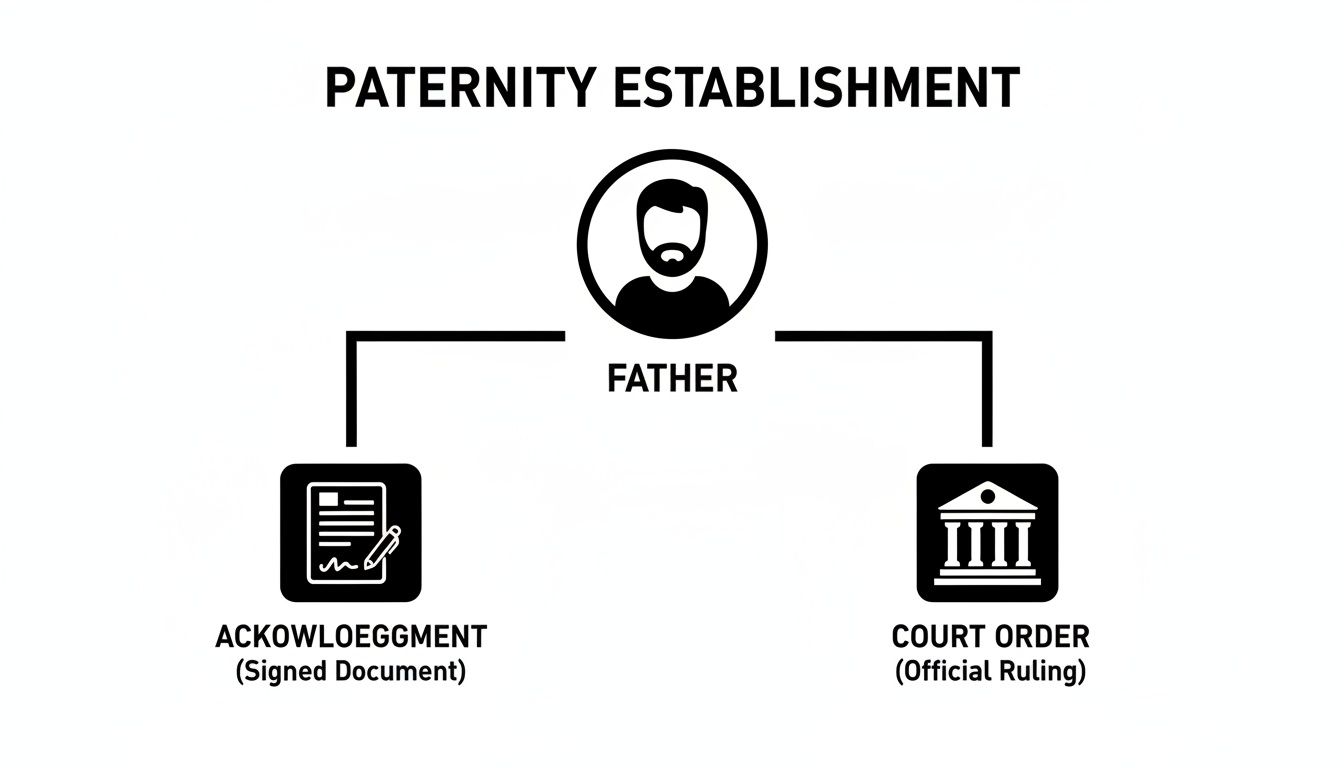
As this graphic shows, establishing paternity happens either by agreement with the mother (an Acknowledgment of Paternity) or by going to court. Once that's done, the door is open to securing your rights to possession and access.
Community Insight: The Standard Possession Order is a framework, not a straitjacket. It's a solid baseline, but it's meant to be adapted to the unique realities of your family's life here in the Atascocita area.
Making the Schedule Work for Your Real Life
What happens if the Standard Possession Order just doesn't work for you? Maybe you have a non-traditional job schedule, like many folks in the Atascocita and Humble area. If you work shifts at a plant in the energy corridor or have a demanding schedule as a pilot out of George Bush Intercontinental Airport (IAH), a "first, third, and fifth weekend" plan might be completely impractical.
This is precisely where an experienced father’s rights attorney makes a difference.
We don't just plug your life into a standard template. We help you build a custom possession schedule that actually works. We've helped fathers secure schedules that align with their real-world jobs. For an oil and gas worker, that might mean a "two weeks on, two weeks off" schedule with the kids. For a pilot, we can create a plan that works around a known flight calendar.
A judge can approve any schedule as long as it serves the child's best interest. The goal is to maximize your time in a way that feels consistent and stable for your child. For a deeper dive into the standard schedule, you can check out our detailed guide on the Standard Possession Order in Texas.
Ultimately, a court order is the blueprint for your relationship with your child for years to come. At The Law Office of Bryan Fagan, we know the local landscape of Atascocita and Harris County. We're dedicated to helping fathers craft orders that protect their time and honor their commitment.
If you’re worried about how your unique life fits into a court-ordered schedule, don't just hope for the best. Call our Atascocita office today for a free consultation. Let's talk about a strategy that works for you.
Figuring Out Child Support: Your Rights and Obligations as a Dad

Let's be honest—for most dads in Atascocita, the subject of child support is a huge source of stress. It's a topic riddled with myths and bad advice that can make you feel powerless. We're here to cut through that noise with clear, practical guidance. The key is to remember that support is for your child, and you, as their father, have specific rights and predictable obligations under Texas law.
Once you understand how child support is actually calculated, you'll feel more in control. It's not some random number a judge pulls out of thin air. It’s a formula, and knowing that formula lets you anticipate the costs and plan your life accordingly.
How Texas Calculates Child Support
In Texas, child support is based on a clear, percentage-based system tied to the paying parent's "net monthly resources." This is a critical term to understand. It's not just your paycheck. It’s the total of all money coming in—your salary, commissions, overtime, rental income, you name it—minus a few specific deductions like federal income tax and the cost of the child's health insurance.
After figuring out your net monthly resources, the court applies a set percentage based on how many children the order covers.
- 1 Child: 20% of net resources
- 2 Children: 25% of net resources
- 3 Children: 30% of net resources
- 4 Children: 35% of net resources
- 5 or More Children: 40% of net resources
These numbers can be adjusted if you're already legally responsible for supporting other children from a different relationship. And while the formula is the starting point, a judge can order a different amount if there's solid proof that following the guideline wouldn't be in your child's best interest.
A key point many people miss: Texas child support guidelines are capped. If you're a high-income earner, you don't pay a percentage on your entire income indefinitely. Support is only calculated up to a certain income threshold, which the state adjusts every few years. This makes having an attorney who stays on top of these changes absolutely vital.
Common Questions We Hear From Atascocita Fathers
As a father rights attorney in Atascocita, Texas, we talk to dads every day who have pressing questions about the financial side of custody. These are real-world concerns, and getting clear answers is the first step to protecting yourself and feeling supported.
"What if we have a 50/50 schedule? Do I still have to pay?"
This is probably the most common question we get. Many fathers believe that a 50/50 possession schedule automatically means no one pays child support. That's not always the case in Texas. While it can definitely influence the final amount, it doesn't wipe out the obligation, especially if one parent earns significantly more than the other. The court can still order support to ensure the child's standard of living is consistent between both homes.
"How do I know the money is actually being spent on my kid?"
It's a completely fair question. However, Texas law assumes the parent receiving support is using it for the child's expenses—both direct costs like clothes and indirect costs like housing and utilities. You can't legally demand a monthly report on where every dollar went. But if you have real evidence that your child's basic needs are being neglected, that's a much more serious issue that could warrant separate legal action to protect their welfare.
When Life Changes, Your Child Support Order Can, Too
Life doesn’t stand still. An order that was fair three years ago might be completely unworkable today. If you've had a major life event—like a layoff from a job in the oil and gas sector or, on the flip side, a major promotion—you may be able to modify your child support.
To do this, you must file a formal modification lawsuit in Harris County. You'll need to prove that a "material and substantial change in circumstances" has occurred. Just stopping payments or making a handshake deal with your ex isn't enough. Those informal agreements are not legally binding and can land you in a world of trouble with the court.
Grasping the details of these financial rules is critical. You can get a deeper look by reading our guide on how much child support you might pay in Texas.
Juggling your own financial stability while making sure your child has everything they need is tough. If you're facing a child support issue and need answers tailored to your situation, the team at The Law Office of Bryan Fagan is ready to help. Call us to schedule a free consultation at our Atascocita office and get the clarity you need.
How to Modify or Enforce a Court Order in Harris County
A court order for custody or child support is never set in stone. Think of it as a snapshot, a reflection of your family’s life at the specific moment a judge signed the papers. But life, especially in a place like Atascocita, doesn’t stand still. Jobs change, kids get older, and sometimes, the other parent simply decides not to follow the rules.
That’s where modifications and enforcements come into play. These are the legal actions you can take to make sure your court order keeps up with your current reality.
When Can You Modify a Court Order
Your court order is the official playbook for co-parenting. When the game changes significantly, you have the right to ask the court to update the rules. This is called a modification.
However, you can’t go back to court for every little disagreement. To get a modification in Texas, you have to prove there has been a material and substantial change in the circumstances of either a parent or the child. This is a high bar, designed to prevent an endless cycle of court dates over minor issues. The change must be a big deal, something that truly affects the child's best interest or the fairness of the original order.
So, what qualifies? Here are a few common scenarios we see with fathers in the Humble and Atascocita areas:
- A Parent Relocates: If the other parent is planning a move outside the Atascocita area, this can completely upend your possession schedule. It’s often a strong reason to revisit custody and even fight to become the primary parent.
- A Significant Income Shift: Maybe you were laid off from a good job in the energy sector. Or perhaps the other parent landed a major promotion. Either event could trigger the need for a child support modification to match your family's new financial situation.
- The Child’s Needs Evolve: A young child’s schedule looks very different from a teenager’s. Once a child turns 12, their own preference for where they want to live can become a major factor for the court. A new school activity that clashes with the old schedule can also be a valid reason for a change.
- A Change in Lifestyle: If the other parent’s home life has become unstable—perhaps due to substance abuse or a new partner who poses a risk—you can and should act to protect your child by seeking a modification.
Trying to handle these changes with a simple handshake agreement is a mistake. No matter how well you get along, a verbal promise is not legally binding. You must get the change approved by a judge to make it enforceable.
What to Do When Your Rights Are Denied
For a dedicated father, there's nothing more infuriating than showing up for your scheduled time with your child, only to have the door shut in your face. When the other parent denies your court-ordered possession, they are violating a direct order from a judge. This isn't something you have to put up with.
You have a powerful legal remedy called an enforcement action. This is a specific type of lawsuit filed right here in Harris County where you ask a judge to force the other parent to comply with the order.
The process is straightforward:
- First, we file a Petition for Enforcement. This document must be incredibly detailed, listing every single date and time you were denied your rightful possession.
- The other parent is then served with the lawsuit and is legally required to show up in court and answer for their actions.
- A judge will hear the evidence from both sides and make a ruling on whether the court order was violated.
If the judge agrees the other parent willfully ignored the order, the consequences can be serious. A court can order make-up visitation time to compensate you for the days you lost. They can also force the other parent to pay financial penalties and your attorney's fees. In cases with repeated violations, a judge even has the power to order jail time.
The need for skilled legal help in these matters is growing. You’ll find that attorney directories like Super Lawyers and Justia now list dozens of specialists who focus on these exact cases, reflecting a clear demand for a father rights attorney in Atascocita, Texas. Harris County saw over 15,000 family law cases filed in 2026 alone, a 10% increase from 2022, as more fathers fight for their rights. For more insights on local legal trends, you can find attorneys in the area.
A court order is meant to protect your relationship with your child. When that order is ignored, it’s not just an inconvenience—it's a direct threat to your rights as a father. Taking swift, decisive legal action is the only way to hold the other parent accountable.
Whether your life has changed or the other parent is refusing to play by the rules, you have powerful options. The Law Office of Bryan Fagan is committed to helping Atascocita fathers enforce their rights and adapt their court orders to the real world. Schedule a free consultation with our team today to get started.
Why a Local Atascocita Attorney Matters for Your Case
Getting a handle on the laws for paternity, custody, and child support is a great start. But knowing the rules of the game is one thing; having a seasoned coach who knows the field, the referees, and the other team's playbook is something else entirely. When it comes to your future with your child, the attorney you choose is that coach.
Choosing an attorney who is truly local to Atascocita isn't just about convenience. It's a real strategic advantage.
Family law doesn't happen in a textbook. It unfolds in very specific courtrooms, right here in Harris County, in front of judges who have their own ways of looking at things. An attorney who is in these courts day in and day out develops an intuition—a local knowledge—for how certain arguments land and what kind of evidence a particular judge finds compelling. That’s a home-field advantage you simply can't get from a book or an out-of-town lawyer.
An Advocate Rooted in Your Community
We're not just lawyers with an office sign in Atascocita. We're part of the fabric of this community. Our team lives and works right here alongside the families we help in Humble, Kingwood, and all the surrounding neighborhoods. That connection is personal, and it fuels our drive to do more than just represent you—we want to educate you and empower you for the road ahead.
When you bring on a father rights attorney in Atascocita, Texas from our firm, you're getting a partner who gets it. We understand the unique pressures and challenges families face here because we face them, too. Our job is to find practical, grounded solutions that actually work in your life.
Seeing a good local attorney as just another expense is a mistake. It’s an investment in the single most important relationship you have—the one with your child. It’s about making sure your story is told with clarity, confidence, and the local insight needed to give you the best shot at the future you want.
Connecting Your Rights to a Winning Strategy
We've walked through your fundamental rights as a father in Texas. Now, let’s talk about how we put those rights into action with a clear, effective game plan.
Paternity: The first, most critical step is establishing yourself as the legal father. We'll guide you through the process, whether it’s a straightforward Acknowledgement of Paternity or requires a more formal court order.
Custody and Possession: Our attorneys will build a case designed to maximize your time with your child and protect your role in their life. We fight to create possession schedules that fit your reality, not a one-size-fits-all template.
Enforcement and Modification: Life happens. If the other parent isn't holding up their end of the bargain, or if your circumstances have changed significantly, we take swift, decisive action to enforce your orders or get them modified.
No two families are the same. Your story, your goals, and your relationship with your child deserve a strategy built just for you. We are here to listen and to provide that dedicated, local advocacy.
Your role as a dad is too vital to leave things to chance. Protect your rights and start building a secure future with your child. The Law Office of Bryan Fagan is ready to stand with you. Schedule a free, confidential consultation at our Atascocita office today and let's start talking strategy.
Common Questions We Hear from Atascocita Fathers
Going through a family law case can feel like walking in the dark. You have questions, and you need answers now. As lawyers working right here in the Atascocita area, we talk to dads every single day who share many of the same worries. Let's tackle some of the most frequent questions we hear with clear, straightforward answers.
Does Texas Law Favor Mothers in Custody Cases?
This is probably the biggest myth we have to bust. The honest answer is no, it doesn't. Texas law is written to be completely gender-neutral. There's only one measuring stick a judge can use: the "best interest of the child."
A judge is literally prohibited by law from considering whether you're the mom or the dad when making a decision. While old-fashioned ideas might still float around, what matters in court is who has been the active, hands-on parent. If you're the dad who's involved in school, doctor's visits, and the day-to-day routine, you have a solid shot at being named the primary parent or getting a 50/50 schedule. It all comes down to showing proof of your involvement, and that’s where an experienced father rights attorney in Atascocita, Texas can make all the difference.
Can I Get Custody if I Was Never Married to the Mother?
Yes, absolutely. Whether you were married or not has zero impact on your rights as a father in Texas. For dads in Humble and Atascocita who weren't married to their child's mother, the first, non-negotiable step is establishing legal paternity.
There are two main paths to get this done:
- Acknowledgment of Paternity (AOP): This is a legal form that both you and the mother sign to voluntarily establish you as the legal father. It's often done at the hospital right after the birth.
- Court Order: If there's any disagreement, you can file a lawsuit. The court will then officially name you as the father, which may involve a DNA test to confirm it.
Once you are legally the father, you're on the exact same legal footing as any married dad. You can then ask the court for custody (conservatorship) and set up a clear visitation schedule (possession and access). Our firm walks unmarried fathers through this crucial process all the time.
Don't forget this key point: Until you legally establish paternity, you have no rights that a court can enforce. You can't force visitation. This is the bedrock on which all your other rights are built.
What if My Child's Mother Tries to Move Out of Atascocita?
This is a very real fear for a lot of dads in our community. The good news is that most Texas custody orders contain a geographic restriction. This clause usually stops the primary parent from moving the child’s home outside of a set area, like Harris County and the counties directly touching it (contiguous counties).
If the other parent ignores this rule and moves anyway, you need to act immediately. You can file an enforcement case asking a judge to order the child’s return. If they do it the right way and ask the court for permission to relocate, you have every right to stand up and object. Your attorney will help you build a case that shows why uprooting your child isn’t in their best interest. In these situations, timing is everything. You should call an attorney the second you suspect a move is being planned.
At The Law Office of Bryan Fagan – Atascocita TX Lawyers, we know the specific hurdles fathers in our community face. We believe that informed clients make the best decisions for their families. If you have more questions or need to start building a strategy to protect your relationship with your child, we’re ready to help. Call us to set up a free, no-pressure consultation at our Atascocita office or visit us at https://www.atascocitaattorneys.com.