Skip to content

If you live in Atascocita or Humble and your spouse is in the military, divorce can feel like two cases at once, the marriage itself and the retirement benefit that sits underneath it. One spouse wants to know what part of the pension is fair, the other wants to know whether DFAS will pay it directly, and both usually want the same thing, a result they can count on after the decree is signed. In a military retired pay division divorce Atascocita TX case, those questions matter long before a judge signs anything.
A common local fact pattern sounds simple at first. A service member has about 14 years of service, the marriage lasted 14 years, and the family has roots in northeast Harris County. The hard question isn't just whether the pension can be split, it's what will be received, when it will arrive, and who will send it. That answer depends on federal law, Texas community-property rules, DFAS paperwork, and a few traps that catch people off guard.
Atascocita families usually need the explanation in plain English. That's what this guide does, starting with the federal law that made division possible, then moving into the 10/10 rule, the Texas formula, the Frozen Benefit Rule, disability offset issues, and the reality of payment when DFAS won't step in. If you're filing in Harris County, the details in the decree matter just as much as the headline number.
A Typical Atascocita Military Divorce and the Retired Pay Question
A spouse in Atascocita calls because her husband is stationed near Houston and the marriage is ending after years of moving, deployments, and long stretches of making family decisions around military life. He's got service time, she's got a household budget, and both of them want to know what happens to the retirement benefit that's been building in the background for years.
The first confusion is usually the wrong question. People ask, “Can the pension be split?” That matters, but the question to focus on is how much, under what formula, and through which payment channel. In Harris County practice, that answer can change based on the length of the marriage, the overlap with military service, the exact divorce date, and whether the decree is written in a way DFAS can process.
Practical rule: the pension isn't just a number, it's a legal asset with a federal gatekeeper and a Texas family-law overlay.
In an Atascocita or Humble divorce, I'd want a client to leave the first conversation with a roadmap. We would identify the retirement system involved, look at the marriage and service dates, ask whether direct DFAS payment is even available, and then check whether disability benefits or a later retirement grade could affect the final result. That's the part many generic articles skip.
One local wrinkle is that Texas community-property law doesn't operate in a vacuum. Federal law gives the state court power to divide military retired pay, but the court still has to write an order that matches the facts and the federal rules. That's why an Atascocita case can look straightforward until the decree language is drafted.
If you're sorting through that right now, a useful local starting point is the firm's Military Divorce Lawyer in Atascocita page, because the military retirement issue usually can't be handled well in isolation from the rest of the divorce.
How Federal Law Made Military Retired Pay Divisible
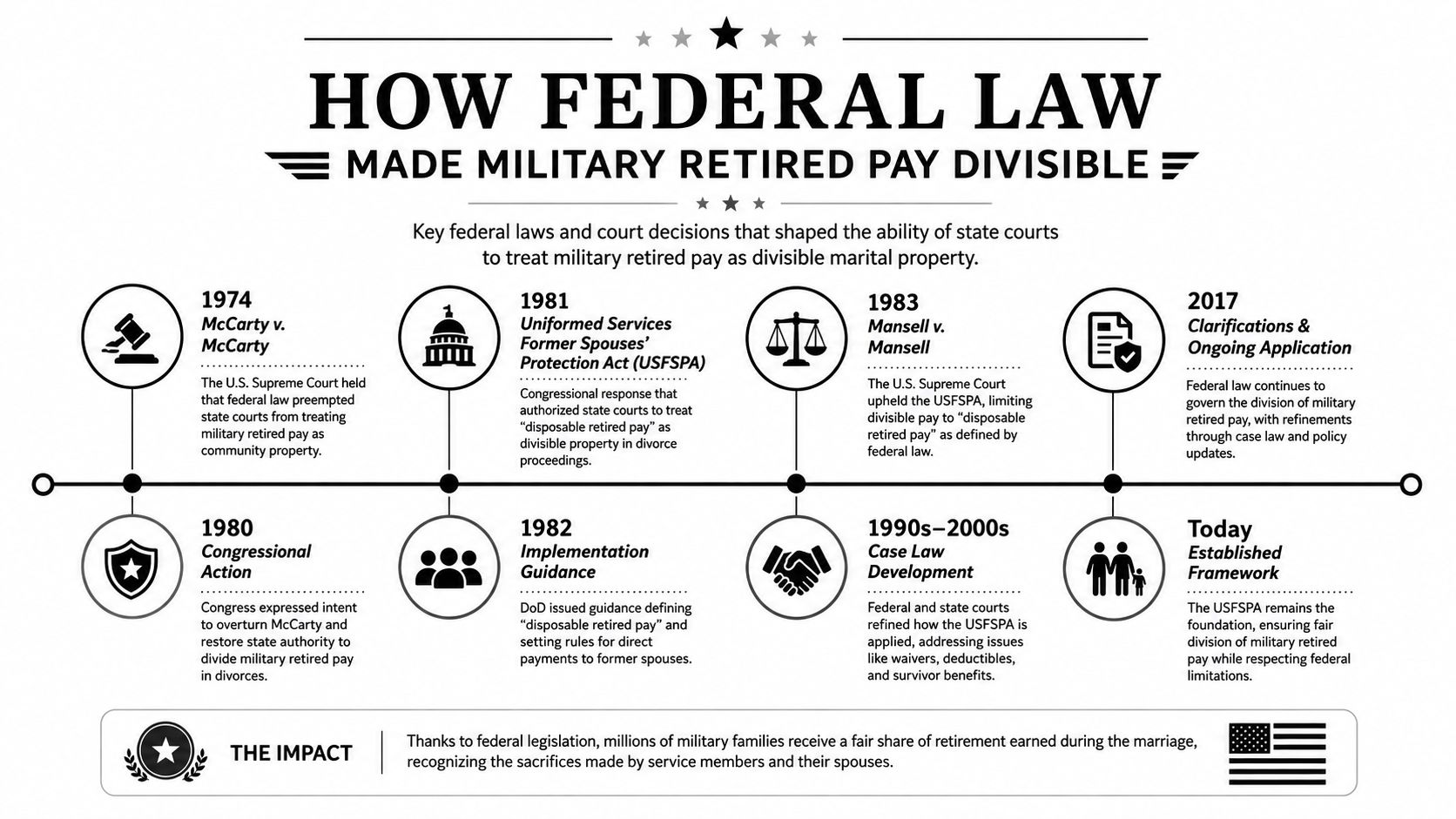
Military retired pay is divisible in divorce because federal law opened the door. The key statute is the Uniformed Services Former Spouses' Protection Act (USFSPA), enacted on 8 November 1985. Before that law, state courts had far less room to treat military retired pay like marital property.
The reason Congress stepped in traces back to the Supreme Court's McCarty decision. After that ruling, the federal framework changed, and the USFSPA let state courts treat military retired pay as divisible property, but only within the boundaries Congress set. In plain language, federal law says the benefit can be divided, but it doesn't hand the answer to the judge automatically. State family law still decides how the property division works in a Harris County divorce. Soldier for Life's former-spouse guidance is a useful reference for that federal timeline.
The cutoff date matters
The legal timeline is not trivia. Under the federal framework, only pay periods beginning 25 June 1981 and later fall within the divisible window tied to the McCarty era, and a 1990 amendment clarified that courts could not partition retired pay for periods before that cutoff. That means military-pension division is a creature of both federal statute and state family-law rules, not an automatic entitlement.
For an Atascocita spouse, that translates into a simple caution. Service before the cutoff isn't treated the same as later service, and the court order has to reflect the proper slice of the benefit. This is one reason military divorce planning in Harris County often starts with dates, not emotions.
Why Texas still matters
Federal law creates the possibility of division. Texas law decides the property characterization, the community share, and the decree wording. In practice, that means two families with similar service histories can end up with different outcomes if their divorce dates, overlap periods, or draft orders differ.
You can't fix that later with a vague sentence in the decree. The court needs clean facts up front, and the spouses need a plan that matches the federal rules from the beginning.
The 10/10 Rule and the 50 Percent DFAS Payment Cap
DFAS direct payment is often the part people care about most, because a direct check is easier to manage than collecting from an ex-spouse month after month. The commonly cited 10/10 rule has two separate tests. The couple must have been married for at least 10 years, and those 10 years must overlap at least 10 years of creditable military service. McClure Law Group's Texas military retirement overview explains that the overlap test controls whether DFAS can pay directly.
If that test is missed, the property award doesn't disappear. It just means DFAS won't be the collection route. Texas courts can still treat the retirement as divisible property even when the administrative payment pathway isn't available.
| Requirement | What It Means | What Happens If You Fail |
|---|---|---|
| 10 years of marriage | The marriage lasted at least 10 years | DFAS direct payment is unavailable |
| 10 years of overlap | Those 10 years overlapped with at least 10 years of creditable military service | DFAS direct payment is unavailable |
| DFAS payment cap | DFAS will not pay more than 50% of disposable retired pay for property division | The court award may still exist, but DFAS won't pay above the cap |
The 50% cap is another place people get mixed up. DFAS and military-family-law materials state that the amount paid directly to a former spouse can't exceed 50% of the member's disposable retired pay. That's a payment limit for DFAS administration, not necessarily a ceiling on what a Texas court may recognize in the overall property division. The Texas Guard's family-law materials say the same thing about that cap applying to DFAS administration, not the court's recognition of the property award. Texas JAG conference materials cover that distinction.
A simple Atascocita example helps. Say a couple was married 12 years and the service member had 14 years of creditable service. DFAS can make direct payment if the decree is written correctly and the overlap rule is met. If a court awards 40% of disposable retired pay, that sits below the 50% DFAS cap, so the award fits within the administrative ceiling.
This is also where a marital agreement can matter before divorce starts. A carefully drafted Prenuptial & Postnuptial Agreements in Atascocita review can help clarify how retirement will be handled if a couple is trying to reduce later uncertainty.
If the 10/10 rule isn't met, the award may still be real under Texas law. It just won't be the easy kind of award to collect.
How Texas Calculates the Community Share of Retired Pay
Texas starts with community property. In a military divorce, the court looks at the portion earned during the marriage and then divides the community share. For retired pay, the basic formula usually turns on the overlap between marriage and service, then applies the community-property split.
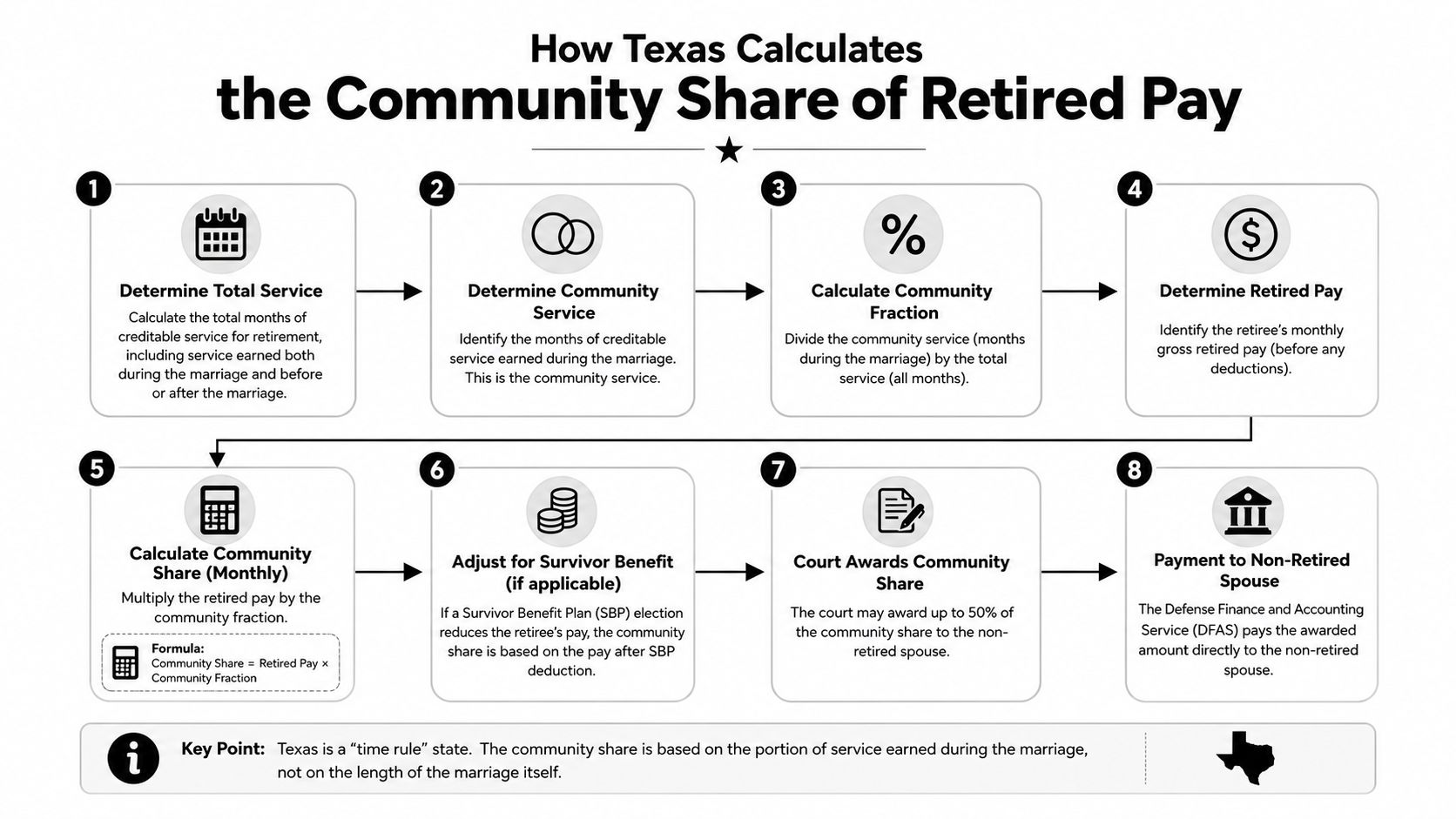
The starting point is disposable retired pay, which is the retirement amount available for division after the statutory deductions that federal law excludes from division. From there, Texas practitioners often use a time-based fraction. The numerator is the years of marriage overlapping service. The denominator is the total years of creditable service. Then the community share is commonly treated as 50% of that marital fraction.
A Harris County-style example makes the math easier. If a spouse spent 15 years of a 22-year Army career married to the service member, the marital fraction is 15/22. Texas then looks at the community's half of that marital portion. That's how the law turns a long marriage into a precise share instead of a rough guess.
The Frozen Benefit Rule changes the retirement date you care about
For divorces finalized on or after 23 December 2016, the Frozen Benefit Rule can limit the former spouse's share to the service member's rank and years of service at divorce rather than at later retirement. In practical terms, that means the date of divorce can matter as much as the final retirement date.
That matters in real life because promotions don't always stop after a couple separates. If the service member later moves into a higher rank or longer service tier, the former spouse may not automatically benefit from that later increase if the divorce falls under the Frozen Benefit Rule. Military divorce guidance on DFAS direct payment notes that the divorce date can materially affect the pension division outcome.
Atascocita and Humble clients often feel the process is unfair until the numbers are explained. Texas doesn't use a guess. It uses a formula. The formula then gets frozen, or not, depending on when the divorce is finalized.
Why the formula must be drafted carefully
A Texas judge can only divide the share that exists under the law and the facts. If the decree ignores the correct service dates, rank, or retirement structure, the result may be off even if both spouses thought they were being fair.
A clear decree should match the formula to the facts. A vague one often creates a second round of litigation.
For a related local explanation of the property side of the case, the firm's page on what is community property in Texas gives useful background on how Harris County courts think about marital assets generally.
Documents and Court Order Language DFAS Will Accept
A military divorce in Atascocita can be perfectly fair on paper and still fail at DFAS if the paperwork is incomplete. DFAS pays from documents, so the file has to show the service member's Leave and Earnings Statements, the DEERS record, the Retired Pay Account statement, the final decree, and any separate property settlement. If you are sorting through retirement, survivor benefits, and division language at the same time, the firm's division of retirement accounts in an Atascocita divorce page can help frame the issue in a Harris County case.
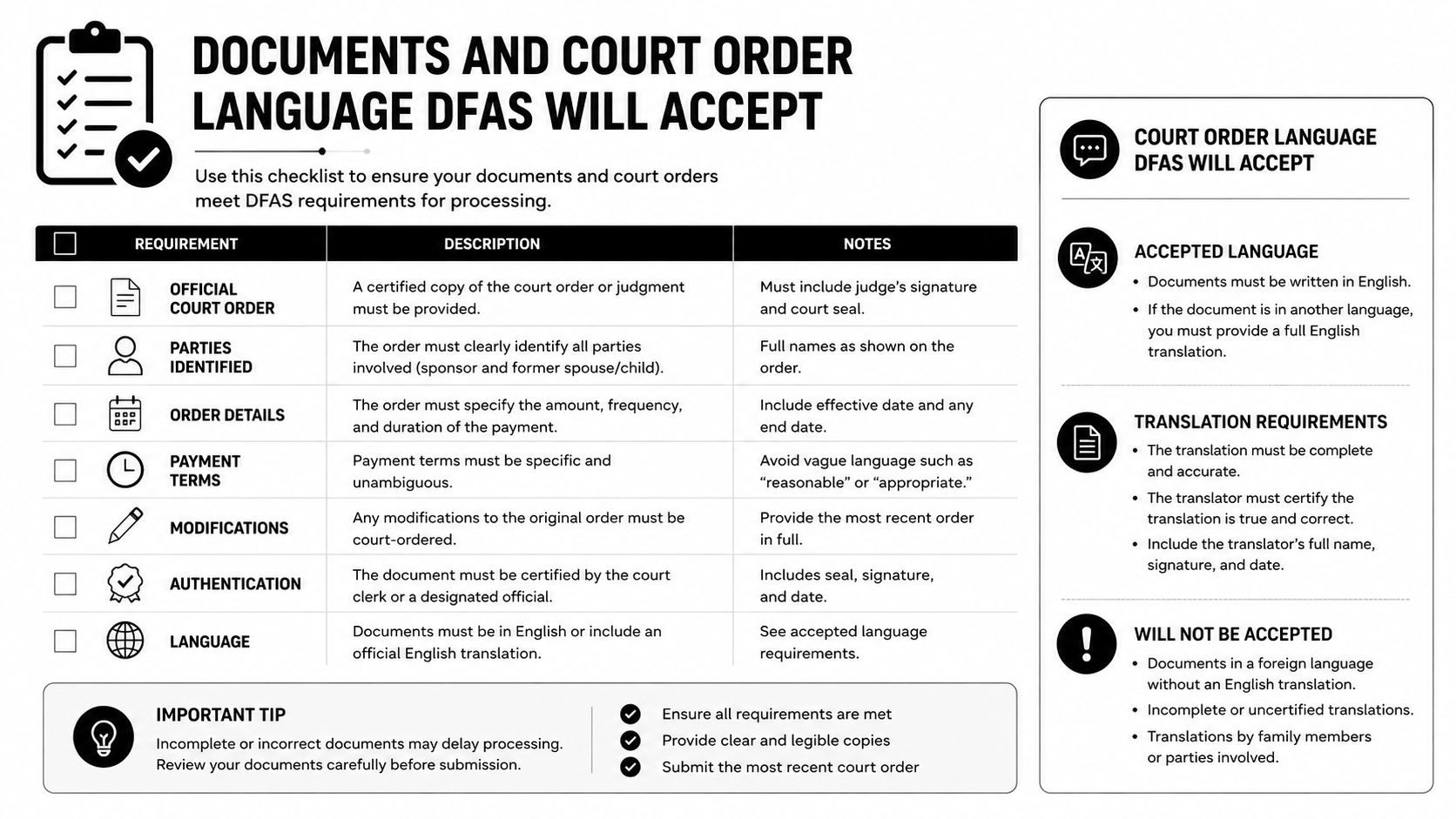
DFAS also reads court orders with a narrow eye. The former-spouse property award must appear in a final decree or qualifying property settlement, and the language has to state either a fixed dollar amount or a fixed percentage of disposable retired pay. If the wording is vague, DFAS can delay or reject the order, even when the spouses believed they had reached agreement. DFAS legal processing guidance explains that federal processing rules control how the award is handled.
Why Harris County lawyers often use formula orders
Many Texas family-law lawyers prefer a percentage-based formula order instead of a flat dollar figure. A dollar amount can become outdated if the benefit changes, while a percentage follows the retirement pay as DFAS administers it. That does not solve every issue in a military case, but it keeps the order tied to the benefit itself.
The same approach helps when the parties want flexibility without giving up clarity. In a military divorce, clarity is not a luxury. It is what keeps an agreed award from turning into a rejected order.
Harris County judges still need the facts that support the division, and DFAS needs the same facts in a different form. If the decree leaves out the service dates, the personnel history, or the retirement statements, the order may force everyone to guess. DFAS will not guess, and a court order that makes assumptions often causes more delay than a simple correction would have caused at the start.
A local family-law file in Atascocita usually needs two tracks at once, the court paperwork and the retirement paperwork. That is why lawyers often ask for more than a divorce petition and a decree draft. They need the records that show how the retirement was earned, how it is being paid, and how the award should be written so DFAS can process it without avoidable questions.
Bring these items to a consultation
- Marriage and service dates, so the overlap can be checked against the period the retirement was earned.
- Recent LES statements from the current duty station or retirement office, because Harris County courts and DFAS both need the latest pay structure to calculate disposable retired pay accurately.
- Any draft decree or settlement language, since a small wording change can decide whether DFAS accepts the order.
- DEERS and retirement account records, if you have them, so the attorney can match the court file to the military record.
- Questions about direct payment, because the 10/10 rule determines whether DFAS sends the money directly or the parties have to use another collection method.
A clean file does not guarantee a clean result, but a disorganized one usually creates another round of corrections.
The Disability Offset Trap That Can Shrink Your Share
The hardest surprise in military divorce is often not the division itself. It's what happens later if the service member waives retired pay to receive VA disability compensation. That can reduce the disposable retired pay available for the former spouse's award.
The issue comes up often in Texas because people assume a divorce decree freezes the amount forever. It doesn't. Federal law limits what state courts can do when disability elections enter the picture. Trial courts can't enforce agreements that effectively block a future disability election, and orders can only divide retirement as it exists at the time of judgment, not create protections against later federal benefit changes. Dallas divorce guidance on military retirement and disability benefits explains that limitation in plain terms.
Why the offset matters in real life
A retiree in Kingwood or Atascocita may later receive a disability rating, waive a portion of retired pay, and see the former spouse's payment drop. That's not because the decree vanished. It's because the payment source changed. Disability benefits themselves are generally treated as the service member's separate property, so they aren't just folded back into the marital pot.
That's where the misunderstanding starts. The former spouse may still have a valid property award, but the practical dollar amount can be smaller if the retiree elects disability compensation. The paper right and the payment stream are not always the same thing.
Drafting moves that help, without pretending to eliminate the risk
Experienced Harris County lawyers often try to reduce the damage rather than promise it away. Common moves include reserving jurisdiction for later disputes, requiring notice of disability applications, and addressing Survivor Benefit Plan elections when appropriate. Those tools don't erase federal limits, but they can improve the odds that both sides know what's happening before the payment changes.
Good drafting can't override federal disability law. It can still make the fight smaller and the surprise less severe.
If a spouse is asking whether the decree can permanently protect the retired pay share from a later disability election, the honest answer is that no Texas order can fully promise that. That's why this issue has to be discussed during settlement, not after retirement paperwork is already changing.
When DFAS Will Not Pay Directly and How You Get Paid Anyway
Sometimes the 10/10 overlap test isn't met. Sometimes the decree doesn't satisfy DFAS formatting rules. Sometimes both happen. In those situations, the former spouse can still hold a valid Texas property award, but DFAS won't administer direct payment.
That doesn't end the case. It changes the enforcement route.
The tools that may still be available
- Contempt motions, if the decree creates a clear duty and the payor refuses to comply.
- Writs of withholding, when the court's order allows direct wage-related enforcement.
- Garnishment of post-retirement paychecks, depending on what asset or payment stream is being reached.
- Reservation of jurisdiction, so the Harris County court can revisit the award if the structure of the case changes.
Texas practitioners in northeast Harris County often think ahead about where the money is likely to come from. If DFAS won't send the check, the decree has to give the spouse a realistic enforcement path. A valid award that nobody can collect is a weak victory.
The key point is that the court and the administrative system are different. DFAS only follows federal compliance. A state court can still recognize a property division, but collecting it may require a more hands-on enforcement strategy.
That is one reason local counsel matters in a military divorce. An attorney who knows Harris County practice can help shape the decree so the value date, payment route, and enforcement language all work together instead of fighting each other. In some cases, the best answer is a well-drafted settlement. In others, it's a decree that anticipates later enforcement from the start.
If you're interviewing lawyers in Atascocita, ask a direct set of questions. Does the attorney know how DFAS accepts orders, what happens if the 10/10 test is missing, how to draft around disability risk, and whether the decree should reserve enforcement authority? Those answers matter more than general promises.
An Atascocita Military Divorce Timeline and Your Next Step
A realistic military divorce in Atascocita doesn't happen all at once. First comes document gathering, and that usually takes 2 to 4 weeks if both sides cooperate. Then the petition and temporary orders move through a Harris County family court in about 1 to 2 months, followed by discovery and negotiation, including pension valuation, over another 2 to 4 months. A final decree with DFAS-compliant language often takes 6 to 12 months from filing, then DFAS processing of the former-spouse election is typically 90 days after decree, with the first direct payment arriving shortly after.
The dates that control the outcome are the ones people most often underestimate. The valuation date matters, the Frozen Benefit Rule cutoff matters, and the choice between DFAS payment or state-court enforcement matters. Those are not abstract legal details. They decide what shows up in a bank account after the case is over.
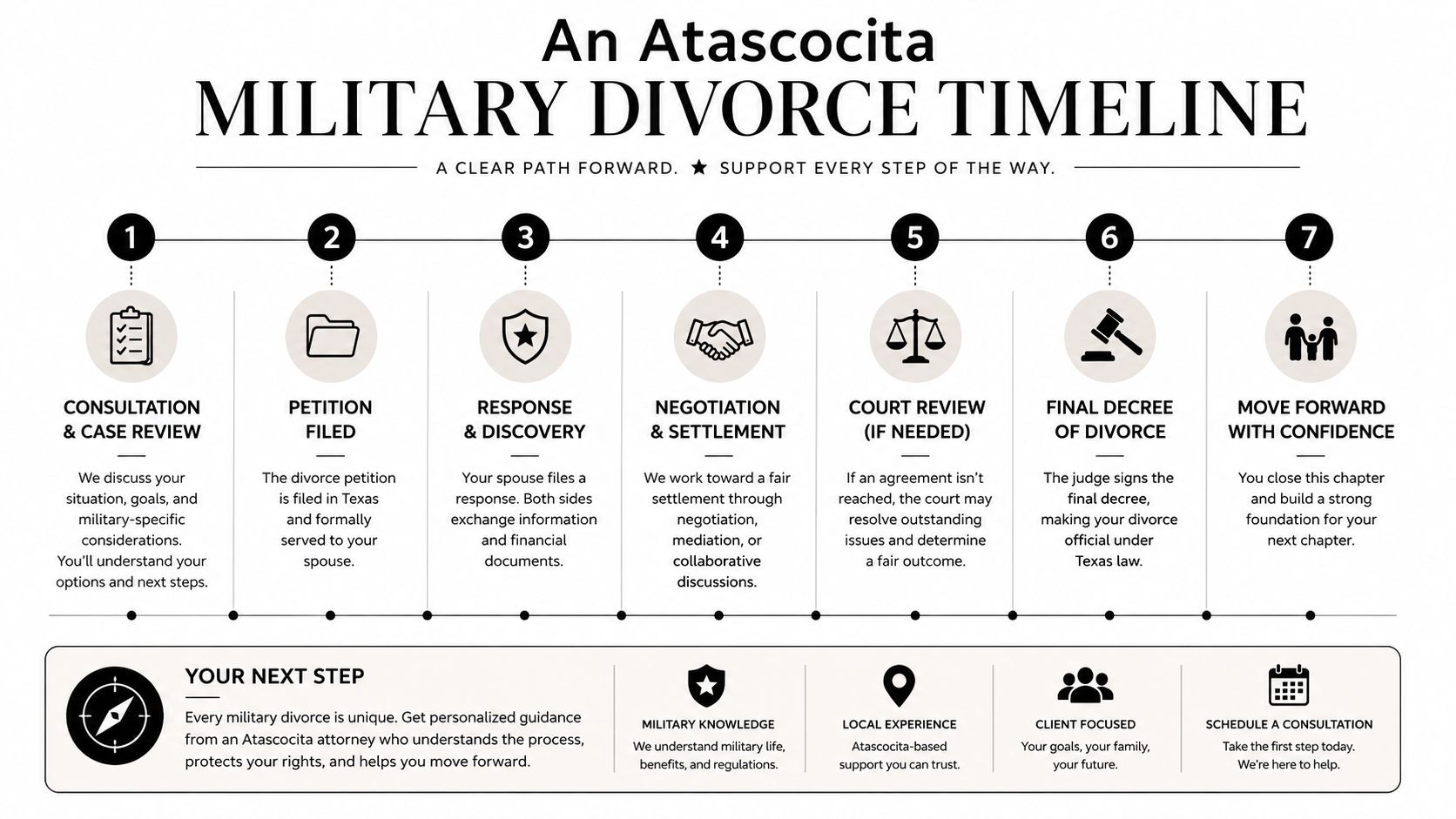
For families in Atascocita, Humble, and northeast Harris County, the best next step is usually a focused case review before any decree language is finalized. If military retired pay is on the table, a divorce lawyer should look at the dates, the documents, the disability risk, and the payment route together. That's how you avoid a settlement that sounds fair but doesn't work in practice.
If you're also sorting out broader divorce issues, the firm's divorce services in Atascocita page is a practical place to start while you gather your records and prepare questions for a consultation.
If you're dealing with military retired pay division in a divorce, the details matter more than the headline. The Law Office of Bryan Fagan – Atascocita TX Lawyers helps clients in Atascocita and Harris County understand the retirement, DFAS, and Texas property rules that affect the final decree. Visit Law Office of Bryan Fagan – Atascocita TX Lawyers to schedule a free consultation and talk through your next step with a local team that handles these issues every day.