Skip to content

A loved one passes away, and the first days rarely feel legal. They feel personal. In Atascocita and Humble, families are often trying to sort through a house key, a folder of papers, a few bank statements, maybe a deed, and a lot of emotion at the same time.
Then probate comes up, and people worry the process will be long, expensive, and hard to understand.
Sometimes it is. But sometimes Texas law offers a narrower, simpler path. If your loved one left a valid will and the estate fits strict rules, a Muniment of Title may let the court recognize the will and transfer property without putting a full estate administration into motion. For many northeast Harris County families, that can mean less stress at a time when life already feels heavy.
A Simpler Path After a Loss in Our Community
A common story around Atascocita goes something like this. A parent dies owning a home in Humble, maybe a vehicle, maybe a small account, and the family finds a will in a desk drawer. One adult child starts calling around. Another tries to figure out whether the mortgage matters. Someone asks if an executor has to be appointed. Nobody wants to make a mistake.
That confusion is normal.
Most families hear the word probate and picture months of paperwork, repeated court appearances, and a process that takes over their lives. In some estates, that level of court involvement is necessary. But in others, especially where the will is clear and debts aren't an issue, Texas allows a shortcut that can remove much of the administration burden.
A local example families recognize
Think of a widow in Atascocita whose husband left a valid will giving the home to her. There aren't unpaid credit cards or personal loans hanging over the estate. She doesn't need someone collecting assets for months or negotiating with unsecured creditors. She needs a legal way to show the world that title has passed according to the will.
That's where a muniment of title can make sense.
Instead of opening a full estate with an executor handling every step, the family asks the probate court to admit the will as proof of title. If the court approves it, that order becomes the tool heirs use to deal with property records and certain asset transfers. For the right estate, it can feel like a Texas-sized shortcut through a difficult season.
Practical rule: The simpler the estate, the more important it is to choose the right probate path early. Picking the wrong one can create delays that were avoidable.
Families in this area often face more than probate at once. Some are helping aging parents update wills. Others are managing divorce, custody questions, or household safety issues at the same time. Legal problems tend to arrive together, not one at a time. What helps most is clear guidance, plain language, and a realistic plan.
What Is a Muniment of Title in Texas
A Muniment of Title is a special Texas probate procedure that lets a court admit a will to probate without appointing an executor. The court order itself becomes the legal authority people use to transfer title. A helpful way to think about it is this. The will says who should receive property, and the court order works like the legal key that enables that transfer.
That “no executor” feature is what makes this process so different from standard probate. In a traditional estate, the court appoints a personal representative and issues authority for that person to act. In a muniment case, the court is saying no administration is necessary because the estate qualifies for this more limited route.
Why Texas families have this option
This isn't a nationwide probate shortcut. Texas is the only jurisdiction in the entire United Nation that legally permits this specific form of probate to transfer both real and personal property without appointing an executor under Texas Estates Code § 257.001, as described in this discussion of Texas muniment law.
That matters because many online probate articles mix together rules from different states. A family in Humble might read a national guide and assume every probate must involve an executor. Texas doesn't always require that. When a muniment fits, the court order and the admitted will can do the title work that an executor would otherwise handle.
What it does in plain English
Here is the simplest way to picture it:
- The will is valid: The decedent died with a will.
- The estate qualifies: The case meets the strict legal conditions for this shortcut.
- The court signs an order: That order admits the will as a muniment of title.
- Heirs use the order: They present certified copies where needed to show ownership passed under the will.
For real property, the order and will become part of the title chain. For some other assets, institutions may accept the order as sufficient proof. In other situations, they may ask for more, which is where families can get surprised if they expected one court order to solve every transfer issue automatically.
A muniment of title is simpler than full administration, but it isn't casual paperwork. It still has to be done correctly from the start.
Legal processes in Texas vary a lot by subject matter. Probate has its own rules, just as family safety matters may require tools like Protective Orders in Atascocita in domestic violence and family safety matters. The common theme is that local procedures matter, and broad internet advice often misses details that affect real families here in Harris County.
Is Your Family's Estate Eligible
This is the make-or-break question. A muniment of title only works when the estate checks every required box. If one major requirement is missing, the family usually needs a different probate route.
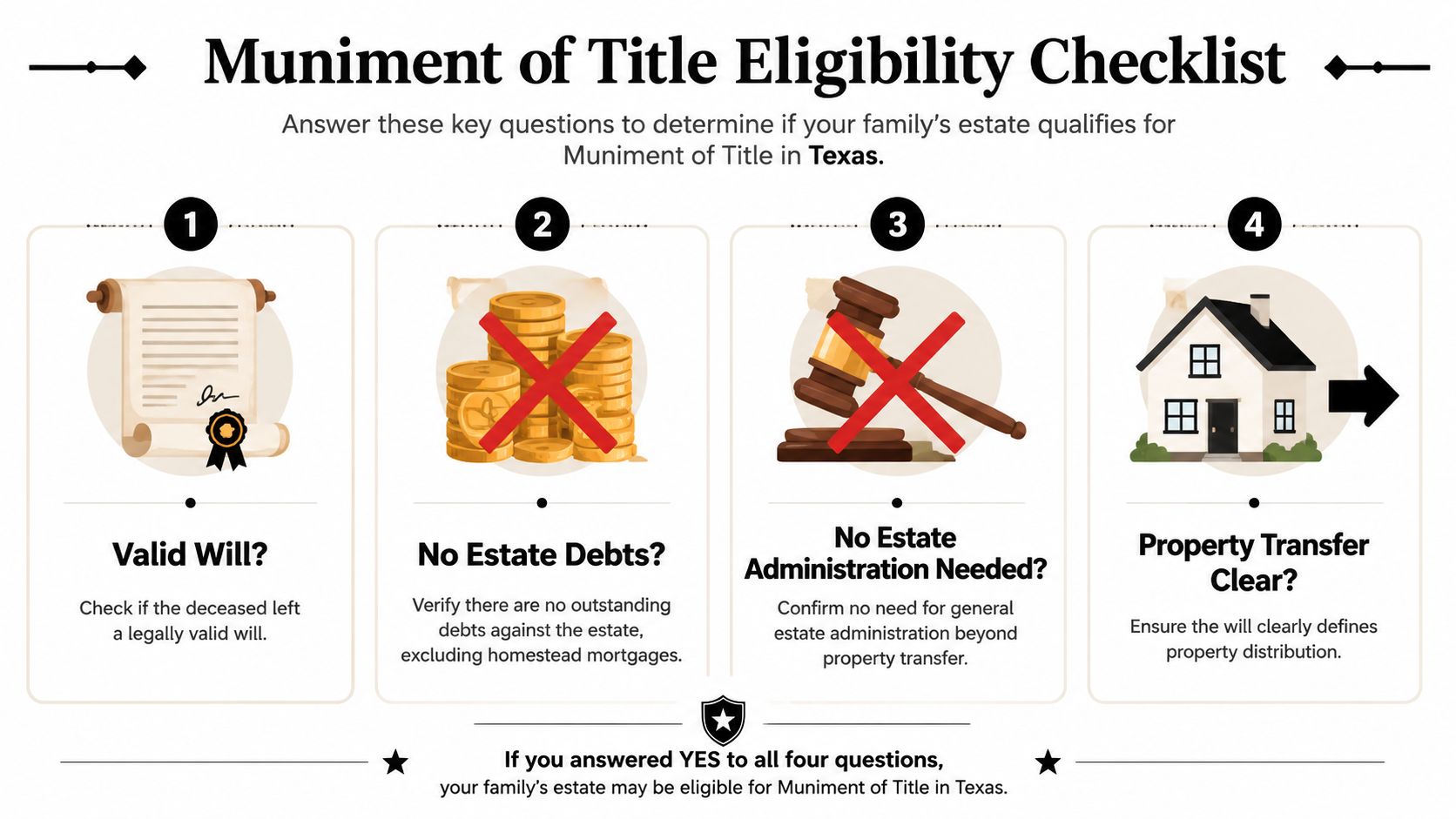
The short checklist
Start with these questions:
- Was there a valid will: A muniment of title is a will-based probate procedure. If there is no will, this option usually isn't the right fit.
- Is the original will available: Courts expect the original signed will for this process.
- Are there no unpaid estate debts: This is the strictest gatekeeping rule in most cases.
- Is administration unnecessary: The estate must be simple enough that no executor needs to be appointed to manage ongoing estate business.
If you're unsure what passes through probate, this guide on what assets go through probate in Texas can help frame the question before you decide on a filing path.
The debt rule is where many families get tripped up
Texas Estates Code § 257.051 allows a will to be probated as a muniment of title only if the decedent died without unpaid debts or obligations of the estate, except debts secured by liens on real estate, and if the decedent received Medicaid benefits on or after March 1, 2005, the Medicaid Estate Recovery Program (MERP) may assert a claim that can disqualify the estate, as explained in the Bexar County guide to muniment eligibility.
In plain language, that usually means this. A mortgage tied to real estate may not block a muniment. Unsecured debts often will.
Here is a practical way to separate the two:
| Issue | Why it matters for eligibility |
|---|---|
| Mortgage or other lien on real property | May still allow muniment treatment |
| Credit cards, personal loans, unpaid obligations of the estate | Often disqualify the estate |
| Possible MERP claim after Medicaid benefits | Can block the process unless the claim issue is resolved |
Why MERP deserves special attention
Families often focus on whether the loved one had “bills.” They don't always think about a potential state claim tied to Medicaid benefits. That's a serious mistake. A will can be perfectly valid and still not qualify for a muniment if MERP creates a claim against the estate.
Local caution: In Atascocita and Humble, estates often look simple on the surface. MERP is one reason they aren't always simple in probate court.
This is also where planning ahead helps. An Estate Planning Attorney in Atascocita handles wills, trusts, and estate plans for Atascocita families, and good planning can reduce uncertainty for the people left behind.
Comparing Probate Options in Texas
A family in Atascocita may know the will is valid and still feel stuck on the next question. Which probate path fits the estate without creating more work, delay, or expense than necessary?
That choice matters because these options do different jobs. A muniment of title is often the right tool when the main goal is to transfer title to property under a valid will. Independent administration is usually the better fit when someone needs formal authority to gather assets, deal with banks, pay claims, or sell property. A Small Estate Affidavit serves a different kind of estate entirely.
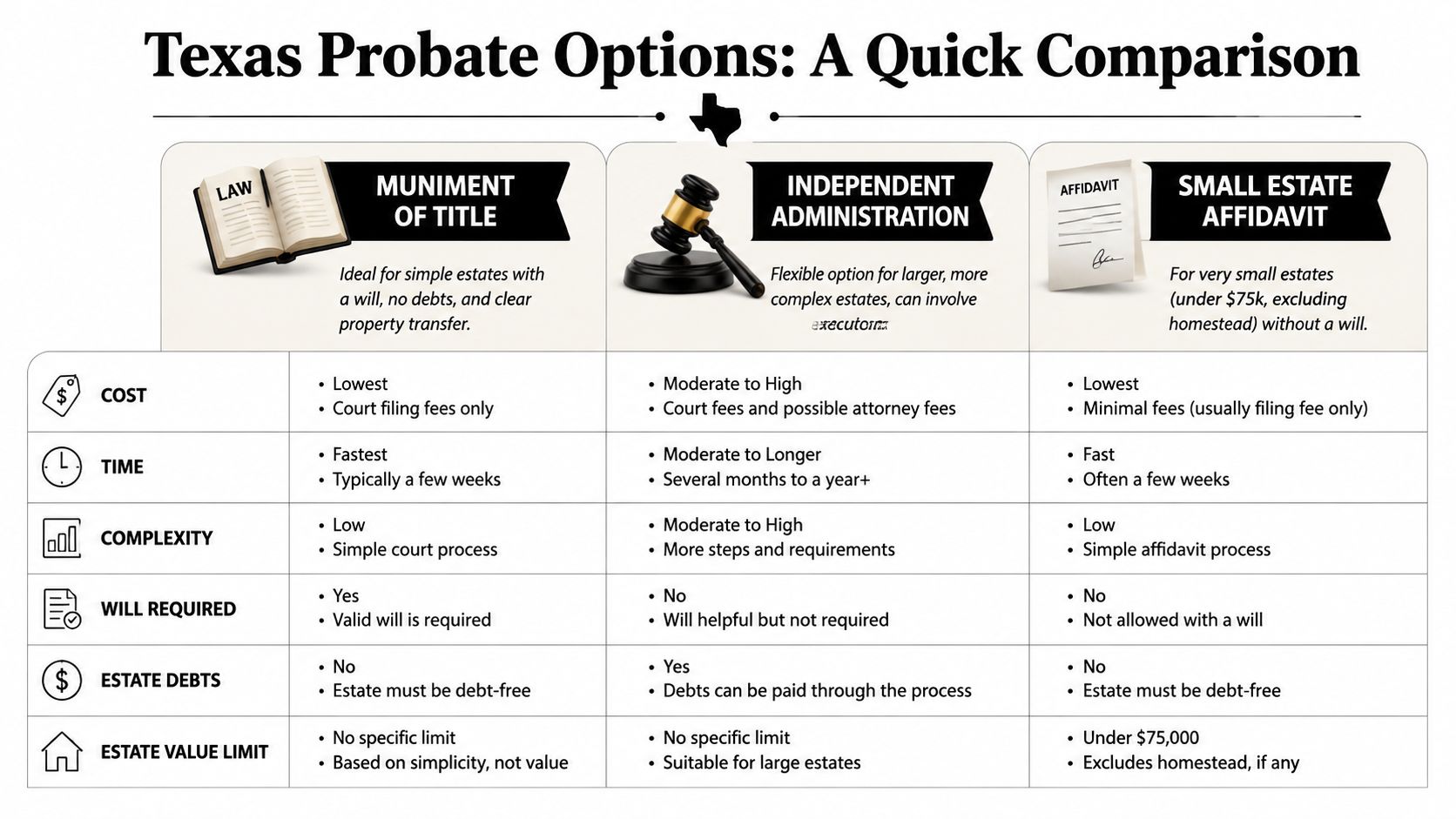
Side by side practical differences
In Harris County, the comparison usually comes down to what the estate needs the court to do, not just which option sounds easiest.
| Probate path | Best fit | Will required | Debt situation | Court involvement |
|---|---|---|---|---|
| Muniment of Title | Estate has a valid will and mainly needs title transferred to property | Yes | Must meet the strict no-debt rule except certain real estate liens | Limited |
| Independent Administration | Someone needs legal authority to act for the estate | Commonly used with a will | Better suited when debts, multiple assets, or management issues exist | More involvement than muniment |
| Small Estate Affidavit | Small estate that fits narrow statutory rules | No will | Must meet specific limits | A different simplified procedure |
A muniment can save a family from a full estate administration. That is the main appeal. But it is not a general-purpose probate shortcut. If a bank, title company, buyer, or creditor will expect an executor or administrator to sign and act on behalf of the estate, independent administration may prevent problems later.
That point becomes even more practical in our area. For example, an Atascocita family may be dealing with a Harris County home, a mineral interest in another Texas county, or a timeshare in another state. A muniment can work well for Texas title issues when the estate qualifies, but out-of-state property may bring extra steps in that other state. Generic probate guides often skip that problem, and families do not discover it until they try to sell or transfer the property.
For families comparing broader planning strategies, this guide on ways to avoid probate in Texas helps place muniment in the larger picture.
Cost and complexity matter
A common question is whether the simpler process is also less expensive. Often, yes. A muniment usually involves less court supervision and fewer moving parts than independent administration.
Still, lower cost on paper does not make it the right choice. If the estate has a MERP issue, unresolved claims, or assets that require someone with formal authority to act, filing the wrong probate case can cost more time and money than choosing the correct procedure at the start.
Why the Small Estate Affidavit isn't a substitute
It's easy to confuse a muniment with a Small Estate Affidavit because both sound simplified. They are not interchangeable. A Small Estate Affidavit is generally used when there is no will, and it only works in limited circumstances set by Texas law.
If the decedent left a valid will, the court usually needs a probate procedure that recognizes that will.
That distinction protects families from a common mistake. Someone hears that a Small Estate Affidavit is cheaper, files the wrong paperwork, and then learns the title company or court will not accept it for the job they need done. In Harris County, that kind of detour can slow down a home transfer when the family is already trying to settle insurance, taxes, and moving plans.
Independent administration highlights the same lesson from the other direction. Some estates benefit from having a clearly authorized fiduciary who can deal with banks, buyers, creditors, and government claim issues. A muniment works best when the estate is narrow enough for it.
Filing for Muniment of Title in Harris County
Once a family confirms the estate likely qualifies, the next question is procedural. What happens in Harris County probate court?
The sequence matters. Missing a document or misunderstanding the waiting period can delay the case.
A visual overview helps before looking at each step.
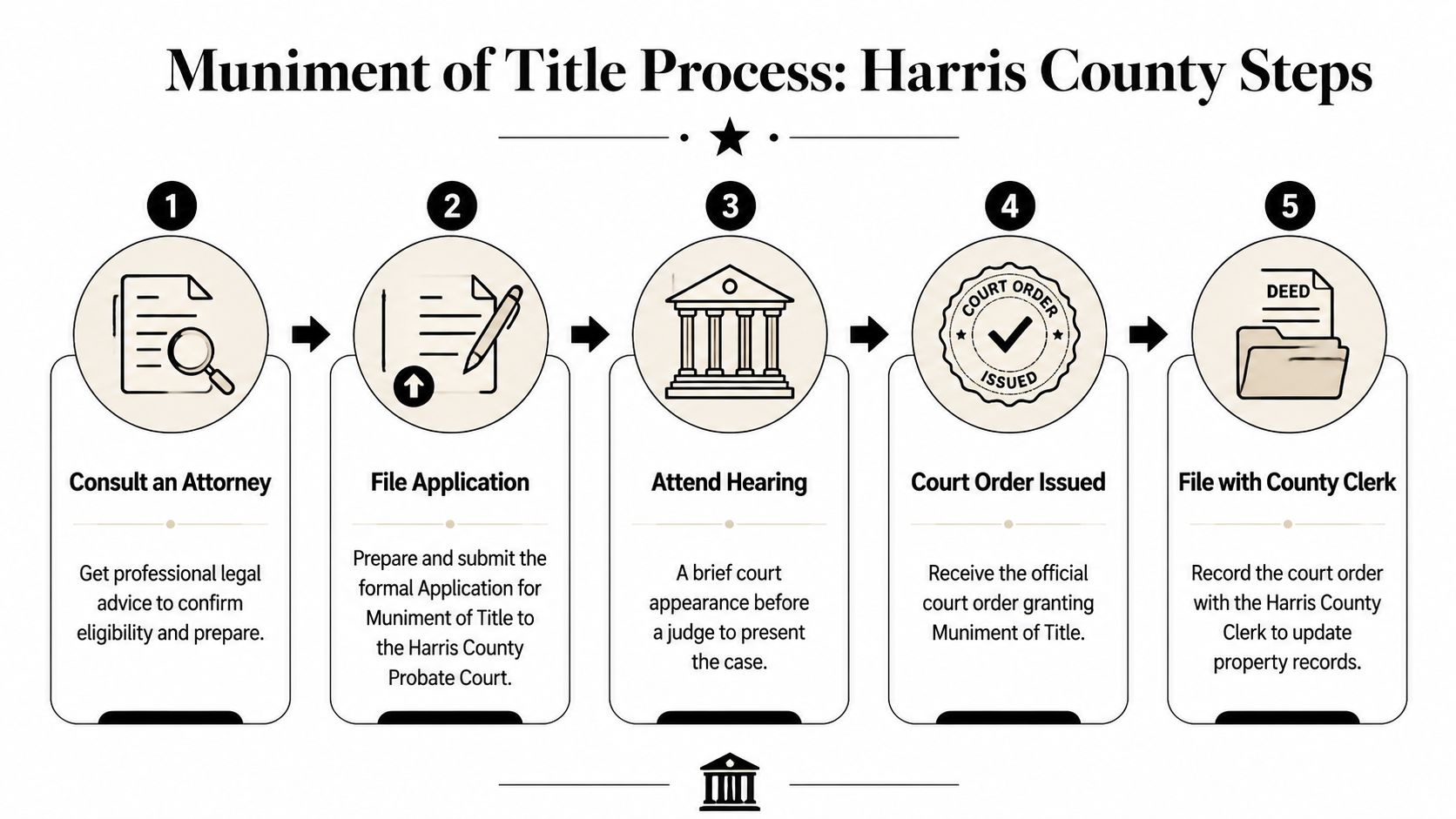
Step one through step three
Gather the core documents. The original signed will is critical. So is the death certificate. The court needs the actual legal foundation for the request, not just a family understanding of what the deceased wanted.
Prepare and file the application. In Harris County, the application is filed with the probate court through the county system. Families who are new to the process often benefit from reviewing the local clerk framework through this page on the Harris County Probate Clerk.
Wait for the required public notice period. Texas requires citation to be issued and posted outside the courthouse for at least ten consecutive days after the application is filed, and only after that period can a hearing be set, as noted in this explanation of the Texas muniment notice requirement.
That waiting period surprises many people. They assume a simple probate can be scheduled immediately. It can't.
Here is a helpful video overview before the hearing stage:
What happens at the hearing
The hearing is usually short, but it still matters. The judge needs enough information to admit the will to probate as a muniment of title. That generally includes proof of death, proof that the will is valid, and proof that the estate qualifies for this specific procedure.
Families often expect the hearing to feel dramatic. Usually it doesn't. It feels more like a legal checkpoint. The court is confirming that the estate fits the limited purpose of this process.
What happens after the order
Once the judge signs the order, the work isn't over.
- Use certified copies carefully: Third parties may need certified copies of the will and order.
- Record real-property documents: If the estate includes real property, the order should be recorded where the property is located so title records reflect the transfer.
- Complete the follow-up filing: Harris County muniment practice includes an affidavit of fulfillment after the order, confirming the will's terms were carried out.
People in family law often say a court order is only the beginning if no one follows through. That's true in other contexts too, including resources like The Divorce Process in Atascocita: What to Expect, which gives a step-by-step look at filing for divorce in Atascocita and Harris County. Probate works the same way. The signed order matters, but the post-order steps are what make the legal result usable in practice.
Costs and Common Mistakes to Avoid
The biggest misconception about a muniment of title Texas case is that “simple” means automatic. It doesn't. Another misconception is that if it costs less than full probate, it's always the smart choice. That isn't true either.
What families in Harris County usually pay
Verified Harris County figures show that full administration often costs $5,000 to $10,000, while a Muniment of Title typically ranges from $2,000 to $4,000, including a $360 court filing fee, a $32 e-filing fee, and $1,500 to $3,500 in attorney fees, according to this Harris County muniment cost breakdown.
Those numbers explain why families are interested. If the estate qualifies, the savings can be meaningful. But the lower range only helps if the filing is the right one from the start.
Mistake one is overlooking Medicaid issues
MERP is one of the highest-stakes probate surprises for local families. A son or daughter may believe the estate is debt-free because they don't see credit cards or old medical bills. Then they learn Medicaid benefits create an estate recovery issue that changes the analysis.
That can stop a muniment case cold.
Don't treat Medicaid history as a side issue. In many probate files, it's one of the first eligibility questions that should be answered.
A practical local example is an elderly parent who lived in Atascocita, owned a homestead, and had a clean-looking estate file. The family assumes the will solves everything. If there was qualifying Medicaid history, the state claim question has to be addressed before anyone feels safe relying on a muniment strategy.
Mistake two is assuming Texas orders solve out-of-state property problems
This comes up more than people expect. A family may have a Texas resident who also owned land, a timeshare, or another parcel outside Texas. They hear that the muniment order transfers title and assume that means every state and every title company will honor it the same way.
That assumption can be expensive.
Verified background for this topic notes that title insurers and registries outside Texas may reject a Texas muniment order because it doesn't include executor authority, and American Land Title Association 2024 data reported an 18% rise in title insurance denials for non-executor probate orders in interstate transactions, with lack of administrator authority cited as the primary reason. The practical takeaway isn't that out-of-state property can never work. It's that extra steps may be needed, and some families end up needing ancillary probate or additional proof.
Mistake three is expecting every bank or company to cooperate smoothly
Even when the probate court signs the order, third parties don't always react the same way. Some institutions understand muniment practice well. Others ask for documents that make more sense in a full administration.
That doesn't mean the court order was pointless. It means the legal sufficiency of the order and the practical behavior of the institution don't always line up perfectly. Families need to be ready for that possibility before they choose a probate path based only on simplicity.
Your Next Steps with The Law Office of Bryan Fagan
For the right estate, a muniment of title can be one of the most useful probate tools Texas offers. It can provide a cleaner path when a loved one left a valid will, the estate is simple, and debt issues don't block eligibility. For many Atascocita and Humble families, that means less court involvement and less expense during a difficult time.
But it isn't a do-it-yourself shortcut.
The details matter. The original will matters. Debt analysis matters. MERP screening matters. Property location matters. A single wrong assumption can turn a promising muniment case into a delayed or rejected filing.
A careful local review makes a difference
If you're trying to decide whether this process fits your family, start with the facts in front of you. Gather the will, death certificate, property records, and any information about debts or Medicaid history. Then get a probate-specific review before filing anything.
The Law Office of Bryan Fagan – Atascocita TX Lawyers provides legal representation for probate, estate planning, family law, criminal defense, and civil matters for families in Atascocita, Humble, and across Harris County. In a muniment case, that kind of review helps determine whether the estate qualifies and what practical transfer issues may still need attention.

A good probate plan doesn't just aim for the shortest route. It aims for the route that actually works.
If you've lost a loved one in Atascocita, Humble, or northeast Harris County and you're wondering whether a muniment of title is the right fit, a local review can give you clarity before fees and delays start adding up.
If you need help figuring out whether a Muniment of Title is the right option for your family, schedule a free consultation with Law Office of Bryan Fagan – Atascocita TX Lawyers. We can help you review the will, evaluate possible debt or MERP issues, and understand the probate steps that make the most sense for your situation in Atascocita, Humble, and Harris County.