Skip to content

A traffic stop near FM 1960 can change in seconds. A driver may pull over for a minor infraction, become nervous when an officer approaches, and pull an arm away during a pat-down. What felt like a frightened reaction can quickly become a resisting arrest charge in Atascocita, TX, with questions about jail, bail, court, and the future.
The most important point is also the one many online explanations miss. Texas law says the illegality of the underlying arrest or search is not a defense to resisting arrest. That doesn't mean every charge is valid, and it doesn't mean the officer's conduct is beyond review. It means the defense must focus on the elements the State still has to prove, the evidence recorded at the scene, and the force used by everyone involved.
This guide offers a plain-English starting point for residents of Atascocita, Humble, and northeast Harris County. It isn't legal advice for a specific case, but it can help you understand what Texas law says, which defenses may matter, and why early legal guidance can protect your options.
A Night in Atascocita That Changed Everything
The stop began like many others. A driver heading through Atascocita near FM 1960 noticed emergency lights, pulled over, and waited for the officer to approach. The officer asked the driver to step out, and the conversation became tense as the driver tried to understand why the request had been made.
During a pat-down, the driver's hand pulled away. The officer interpreted the movement as intentional resistance, reached for the driver's arm, and within moments the driver was handcuffed. At the station, the driver learned that the original traffic matter had become a criminal accusation involving resistance.
That person may now be sitting in a Humble-area holding facility, trying to explain what happened to family members while worrying about work, children, transportation, and a permanent record. The driver may believe the stop was unlawful or that the officer used too much force. Those concerns matter, but they must be raised through the right legal arguments.
Practical rule: Don't try to litigate the stop from a jail phone or during an argument with an officer. Preserve the facts, avoid discussing the incident publicly, and get advice before making detailed statements.
The rest of this guide focuses on the questions a worried neighbor usually has first. What does “force” mean? Does an unlawful arrest excuse resistance? What separates resisting arrest from evading or obstruction? What happens during the first court appearance in the Atascocita and Humble area?
A charge is an accusation, not a conviction. The State still has to prove its case, and the details of the encounter can matter greatly.
What Texas Law Says About Resisting Arrest
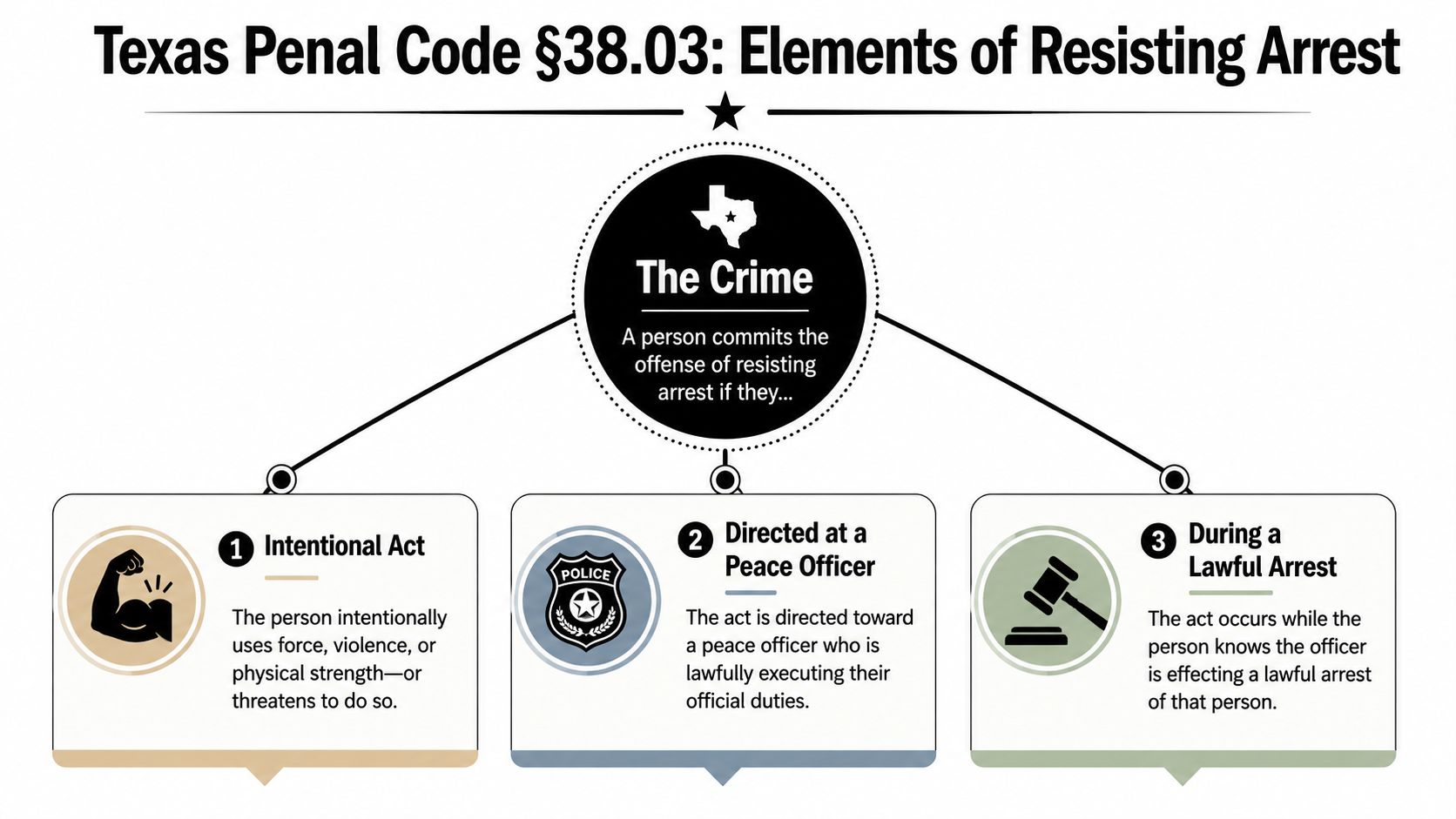
A person can believe an arrest was unlawful and still face a resisting-arrest charge. Texas Penal Code § 38.03 focuses on whether someone intentionally prevented or obstructed a known peace officer from making an arrest, conducting a search, or carrying out transportation by using force. The statute also states that the legality of the underlying arrest or search is not a defense. The statutory language appears in the Texas Penal Code § 38.03. The Texas resisting arrest statute provides another presentation of the same provision.
For a charge to fit the statute, the State generally must connect the evidence to three ideas:
An intentional act. A deliberate effort to stop or obstruct the officer differs from an accidental movement. Someone who stumbles into an officer presents a different fact pattern from someone who intentionally pushes an officer's hands away.
A known peace officer. The evidence must support that the person knew, or had reason to know, the individual was a peace officer performing official duties. A uniform, marked vehicle, spoken commands, identification, lighting, and the surrounding circumstances may all affect that question.
Force. The alleged resistance must involve physical force. The dispute may involve whether the person pulled away, stiffened an arm, pushed, twisted, or made another physical movement against the officer. The movement's timing and the available video may matter more than the label written in a report.
Force is not simple noncooperation
A person may be confused, upset, or verbally argumentative without committing resisting arrest. Saying, “I don't understand why you're arresting me,” is different from pulling an arm out of an officer's grasp. Whether a movement qualifies as force depends on the full evidence, including witness accounts, body-camera footage, and the sequence of events.
The arrest itself does not have to be lawful for the State to allege resistance. That rule explains why an argument focused only on an illegal traffic stop may miss the main issue. A defense may instead examine intent, whether the officer's status was known, whether force occurred, and whether the alleged movement prevented or obstructed the arrest, search, or transportation. Local court and bail procedures can then affect how quickly those facts are reviewed and how the case proceeds in Atascocita or Harris County. For separate information about family matters in the area, see Harris County Family Courts: A Atascocita Resident's Guide.
Penalties You Could Be Facing in Harris County
A late-night arrest in Atascocita can create more than an immediate court date. The classification of the charge affects the possible sentence, the court handling the case, and the pressure surrounding plea discussions. Texas ordinarily treats resisting arrest as a Class A misdemeanor, which can carry up to 365 days in county jail and a fine of up to $4,000. The applicable punishment depends on the charge and the evidence supporting it.
| Charge Level | Classification | Punishment Range |
|---|---|---|
| Ordinary resisting arrest | Class A misdemeanor | Up to 365 days in county jail and a fine of up to $4,000 |
| Resisting arrest involving a deadly weapon | Third-degree felony | 2 to 10 years in prison and a fine of up to $10,000 |
The allegation can rise to a third-degree felony when a deadly weapon is used during the resistance. That range can include 2 to 10 years in prison and a fine of up to $10,000 (Texas resisting arrest punishment ranges). The label alone does not resolve the issue. A vehicle, knife, or another object is not automatically enough. The defense must examine what the object was, how the State says it was used, and whether the available evidence supports the enhancement.
Why the classification changes the defense strategy
A misdemeanor case and a felony case follow different court paths and carry different long-term consequences. A felony allegation may affect employment, professional licensing, immigration concerns, firearm rights, and family-law disputes. It can also change the pressure during negotiations.
The charge level should be reviewed before considering a plea. Counsel may examine whether the evidence proves force, whether the object qualifies under the alleged theory, and whether the State can establish the required mental state. If the deadly-weapon allegation is weak, challenging it may change the direction of the case even if the underlying encounter remains disputed.
Harris County procedure matters as well. Bail conditions, court assignments, and the timing of evidence review can shape how quickly a defense team addresses those questions. An unlawful arrest by itself does not end the case, so the practical defense usually focuses on the prosecution's proof and the specific conduct alleged.
Residents handling separate family matters should keep those cases distinct. The Child Support Attorney in Atascocita resource addresses establishing, modifying, and enforcing child support in Harris County. A resisting arrest case may create family concerns, but child support procedure involves different legal questions and does not determine the criminal punishment.
Resisting Arrest, Evading Arrest, and Obstruction Compared
These charges can arise from one stressful encounter, but they describe different conduct.
Resisting arrest under Texas Penal Code § 38.03 centers on using force to prevent or obstruct a known peace officer during an arrest, search, or transportation. Evading arrest under Texas Penal Code § 38.04 centers on intentionally fleeing from an officer. Obstruction under Texas Penal Code § 38.15 concerns interference with an officer's duties and doesn't require the same use-of-force allegation described in the resisting statute.
Consider a driver stopped for speeding in Atascocita. The driver refuses to lower the window fully, argues with the officer, and then drives away when the officer tries to stop the vehicle. The State might investigate evading based on the driving away and resisting if the driver later uses physical force during the arrest. The two allegations would depend on separate acts, even though they happened during one incident.
Now consider a passenger during a DWI stop in Humble. The passenger loudly argues with an officer and blocks a doorway while officers try to move through it. If the evidence shows interference without force against the officer, prosecutors may consider obstruction rather than resisting. The exact charge depends on what the person did, what the officer was trying to do, and what the recordings show.
| Charge | Texas Statute | Key Act Required | Typical Penalty |
|---|---|---|---|
| Resisting arrest | § 38.03 | Intentional use of force to prevent or obstruct an arrest, search, or transportation | Ordinarily a Class A misdemeanor, with a third-degree felony allegation when a deadly weapon is used |
| Evading arrest | § 38.04 | Intentional flight from a known peace officer attempting an arrest or detention | Depends on the charged facts and applicable law |
| Obstruction | § 38.15 | Interference with an officer performing official duties | Depends on the charged facts and applicable law |
Why multiple counts complicate the defense
A prosecutor may file or pursue multiple allegations when the evidence appears to show separate conduct. The defense must address each count independently, then compare the police report, body-worn camera, dashcam, witness accounts, and timing.
That comparison can reveal problems. A report may describe a person as fleeing, while video shows a short delay before stopping. One count may describe force that another count's narrative never mentions. Those inconsistencies don't automatically end a case, but they can affect credibility, negotiations, and trial preparation.
Common Defenses and the Myths That Get People in Trouble
The most damaging misunderstanding is that a person may physically resist an arrest just because the officer lacked legal grounds. Texas law expressly says the legality of the underlying arrest or search is not a defense to resisting arrest. An unlawful-stop argument may still matter to other evidence or charges, but it doesn't answer the resisting allegation by itself.
Several other assumptions create trouble:
- “I can walk away and make it disappear.” Leaving the scene may create additional allegations, especially if the evidence supports flight or interference.
- “Refusing a field sobriety test leaves no evidence.” A refusal may be part of the surrounding circumstances, and the officer may still have other observations, recordings, or statements.
- “Recording the officer guarantees dismissal.” Video can help either side. It may support the defense, but it can also show movements the report describes.
- “If I was scared, my reaction was automatically justified.” Fear is important context, but the legal defense depends on the force used, the timing, and the statutory requirements.
Defenses that may actually matter
Excessive force by the officer can change the analysis. Texas self-defense doctrine is narrower than many people expect. Force used to resist an arrest is justified only when, before the resistance, the officer used or tried to use greater force than necessary, and only to the degree reasonably necessary to protect against that excess force. The facts must show more than a general feeling that the arrest was unfair.
Lack of force by the accused is another central issue. Mere noncompliance may not establish the force element. The defense should examine whether the person pushed, pulled, twisted, or otherwise physically obstructed the officer, and whether the movement was accidental or intentional.
Lack of knowledge may matter if the person didn't know the individual was a peace officer or didn't understand that the officer was performing official duties. Unmarked vehicles, unclear commands, poor visibility, and chaotic surroundings may become relevant evidence.
Necessity or choice of evils requires careful legal analysis. A recent Texas Court of Criminal Appeals development clarified that the resisting-arrest exclusion in the self-defense statute also applies to necessity claims, making it especially important to identify the exact defense theory and the facts supporting it. The Chanthakoummane line of cases is one reason local case-law analysis matters.
The first 48 hours can be decisive for preserving body-camera footage, dashcam video, photographs, witness details, medical records, and text messages. General information about possible dismissal strategies is available in how to get charges dropped, but a lawyer must evaluate the evidence in the individual case.
What Happens After the Arrest in Atascocita and Humble
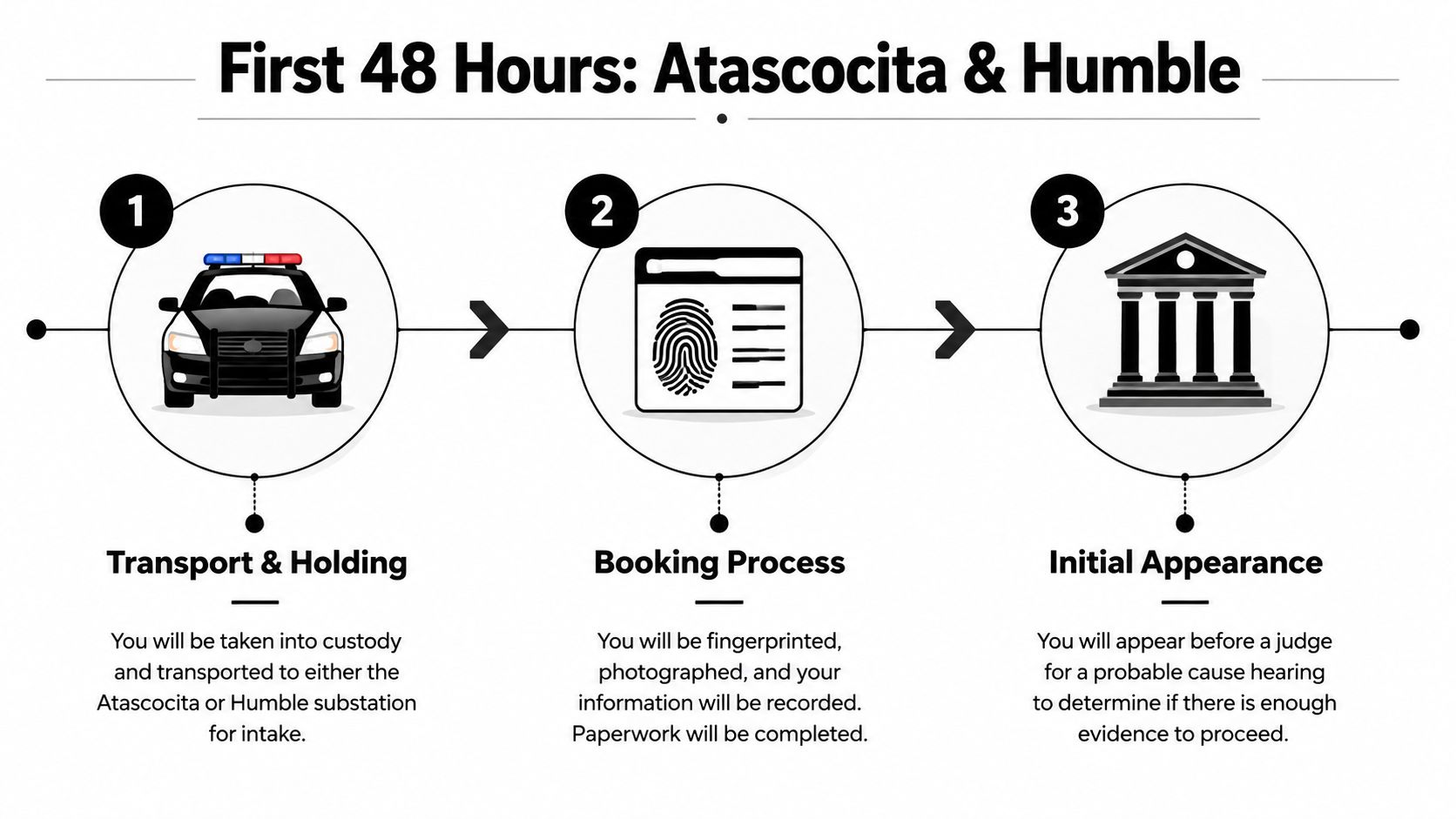
The first stage usually involves transport to a holding location connected with the Atascocita or Humble area, followed by booking. Officers and jail personnel process identification, fingerprints, paperwork, the alleged offense, and property. Family members may receive limited information at first, so one designated contact person should gather release details and avoid speculating about the facts.
The next major step is magistration, an initial appearance before a judge. For residents of Atascocita and Humble, this may involve a Justice of the Peace court serving the area, including JP Precinct 4 in the relevant local court structure. The judge may review probable cause, set bond, and impose conditions such as no-contact or protective restrictions when the allegations and circumstances support them.
Bond decisions can be influenced by the charge, prior criminal history, an alleged weapon, and accompanying allegations such as DWI or assault. The precise result depends on the record and the judge. A lawyer can present information relevant to release and identify conditions that could create problems if the accused doesn't understand them.
Practical steps during the first court phase
Don't discuss the incident on jail calls. Calls may be recorded or reviewed. Avoid explaining, apologizing, blaming another person, or trying to coordinate stories.
Ask about the conditions of release. A no-contact condition can affect communication with a complainant, witness, partner, or family member. Violating a condition can create new legal problems.
Prepare for release logistics. Family should identify transportation, medication, work communication, childcare, and a safe place to stay before release occurs.
Preserve evidence immediately. Tell counsel about nearby businesses, traffic cameras, passengers, witnesses, injuries, damaged clothing, and any phone recordings.
For a general overview of detention and release procedures, the what happens after arrest guide from Cherokee Bail Bonds can help families understand common post-arrest logistics. The later court process is different from magistration, and what happens at an arraignment hearing explains that separate stage.
A defense lawyer's early involvement can support bond arguments, send preservation requests for dashcam and body-worn camera footage, and prevent statements that prosecutors may later use. The first appearance isn't the trial, but decisions made then can shape the case.
This short video provides another general visual resource for understanding the early process:
How the Law Office of Bryan Fagan Can Help
A local defense lawyer can begin by separating the original stop from the alleged resistance. The review should include the officer's report, citation or arrest paperwork, bond documents, dispatch records, body-worn camera, dashcam, witness accounts, photographs, and any medical documentation. Bring whatever you have to the first meeting, including the names of people who saw the encounter and references to video.
The Law Office of Bryan Fagan – Atascocita TX Lawyers handles criminal defense matters for people in Atascocita, Humble, and Harris County. Early work may include requesting preservation of dashcam and body-camera footage, comparing the report with video, evaluating the force allegation, examining whether the knowledge element is supported, and identifying issues that can affect negotiation or trial.
What to bring to an initial consultation
- Arrest paperwork: Bring the charging document, release papers, citations, and any documents provided at booking.
- Video information: Write down where the stop occurred, nearby businesses, possible traffic cameras, and any body-camera references mentioned by officers.
- Witness names: Provide contact information for passengers, bystanders, family members, or people who saw injuries afterward.
- Timeline details: Record what happened in order while your memory is fresh, but don't send a long public explanation or contact witnesses to influence their accounts.
Law firms also use structured intake systems to collect facts consistently. For background on how conditional questions can organize legal intake, see this overview of conditional logic legal intake forms. A form doesn't replace legal judgment, but it can help identify the right documents and follow-up questions.
Possible case directions
A lawyer may pursue dismissal, a reduction, pretrial diversion, or deferred adjudication when the facts and eligibility requirements support those outcomes. In a misdemeanor case, the focus may be on challenging the force allegation, highlighting contradictory evidence, or negotiating an outcome that limits long-term consequences. If a deadly-weapon allegation creates a felony charge, counsel may investigate whether the enhancement is legally and factually supported and seek a reduction when appropriate.
Trial preparation remains important even during negotiations. The defense should be ready to test the officer's memory, compare testimony with recordings, question the timing of commands and movements, and present evidence showing why the State can't prove every element beyond a reasonable doubt.
You can review the firm's broader service information through its Harris County criminal defense attorney page. The practical goal is continuity, from the first magistrate hearing through arraignment and later proceedings in Harris County Criminal Court, with updates explained in plain English and the fee arrangement discussed before work begins.
The Law Office of Bryan Fagan, Atascocita TX Lawyers, can review a resisting arrest allegation, examine body-camera and dashcam evidence, and explain your bond, defense, and court options in plain English. Visit Law Office of Bryan Fagan – Atascocita TX Lawyers to schedule a free consultation about your Atascocita or Humble case and take the next step with local legal guidance.