If you're in Atascocita or Humble and you're asking whether an alleged father's rights can just be cut off because he disappeared, never signed anything, or never showed up, you're asking the right questions. Texas does let a court terminate an alleged father's rights, but it does not do it casually, and it definitely does not do it by private agreement alone. In Harris County, the difference between a clean path forward and a delayed mess usually comes down to notice, registry status, and whether someone understands how Chapter 161 works.
The hard truth is this. If you're trying to protect a child, clear the way for adoption, or resolve a custody problem, you need to know whether the man is legally an alleged father, whether the paternity registry matters in your situation, and whether a court order is unavoidable. Texas Family Code Chapter 161 controls the process, and Texas Law Help and the Texas Family Code make the same point plain, parental rights end by court order, not by a signed paper tucked in a drawer or a private promise between adults. Paternity Lawyer in Atascocita is one way families look at related paternity issues in Harris County, especially when legal fatherhood hasn't been sorted out yet.
Practical rule: if the father's status is unclear, stop guessing and verify it before you file anything. A bad filing can create service problems, registry problems, and a court date you didn't need.
For families in northeast Harris County, that's the starting point. If you want to move carefully and avoid a procedural trap, schedule a free consultation with the Atascocita office before you rely on a signature, a message, or silence as proof that rights are gone.
What Atascocita Parents Need to Know Before Starting
The parent who usually searches this topic is already under pressure. Maybe a new spouse wants to adopt, maybe the other man has been gone for years, or maybe everyone has been acting like biology alone decides the case. It doesn't.
Texas takes a formal approach. Under Chapter 161, the court can terminate an alleged father's rights only through the statutory process, and a signed relinquishment or waiver alone does not end rights. Texas law also ties termination to procedural nonresponse, which means the court looks at whether the man was served, whether he filed a paternity claim on time, and whether he registered with the paternity registry.
That's why Atascocita and Humble parents should stop and answer three questions first. Is the man really only an alleged father, or has he already become an acknowledged or adjudicated father? Was he ever on the paternity registry? And is there a path that requires service, hearing, and a judge's written order before anything is final?
If you skip those questions, you can waste weeks on the wrong filing. You can also create an adoption problem later if the court decides notice was handled badly. Texas Law Help's guidance on termination makes the point plainly, a parent's rights don't vanish because the other side wants them gone.
Plain truth: if your case depends on “he walked away,” that's not enough. The court wants the statutory paper trail, not a family story.
For a parent in northeast Harris County, that means acting early. Get the father's legal status sorted out, gather proof of notice issues, and talk to a lawyer before you file a termination petition that could stall in the courthouse.
Alleged Father, Acknowledged Father, and Adjudicated Father Explained
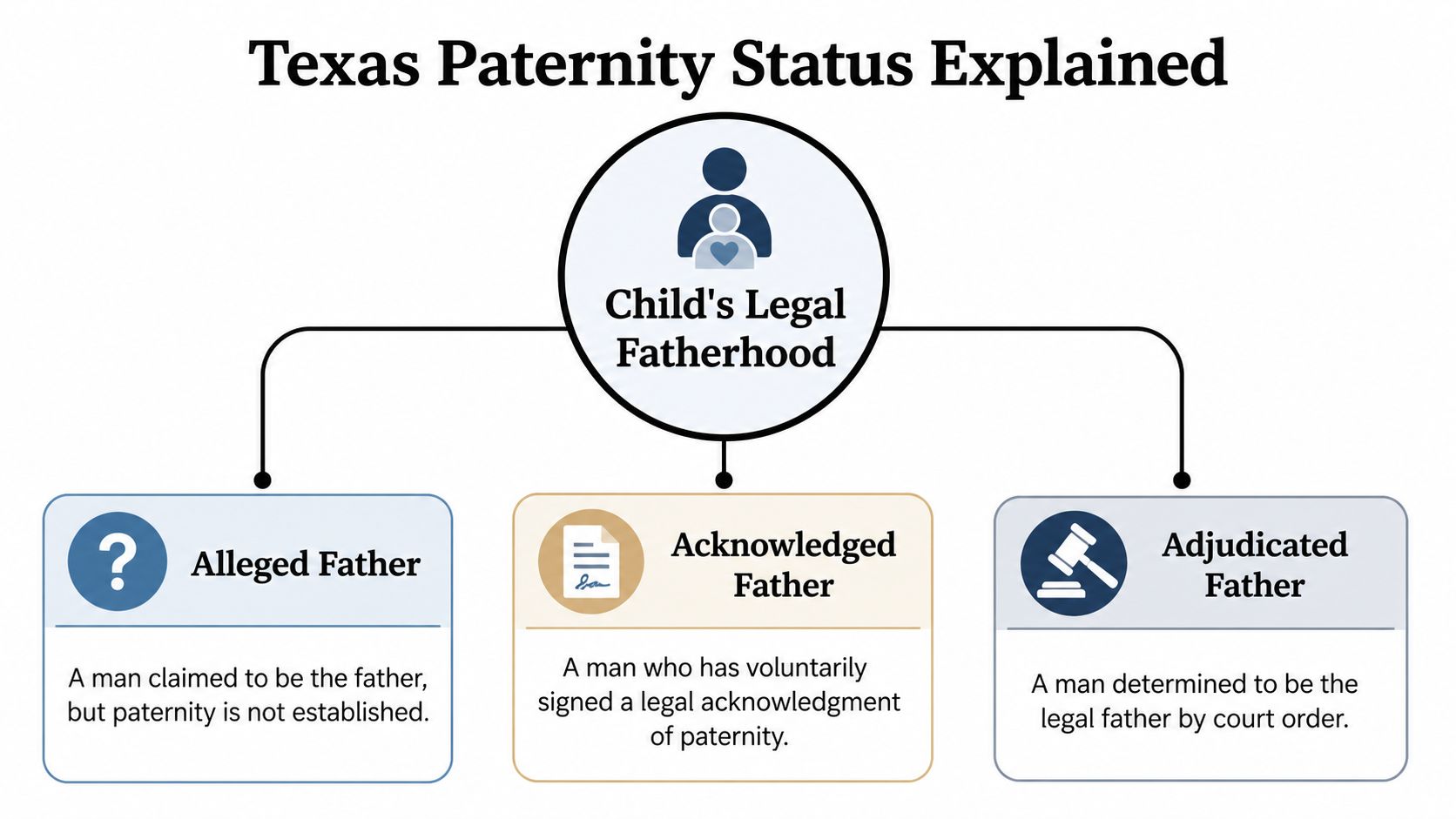
A child born in Atascocita can have one man everyone calls the father, while Texas law treats that status in separate ways. That difference controls the case. If you do not know which category applies, you do not know which legal path fits, and a suit to establish parentage may be the step that sorts it out before anyone tries to terminate rights.
The three legal statuses
An alleged father is a man who may be the biological father, but who has not taken the legal steps that make him the recognized father. An acknowledged father has signed a voluntary acknowledgment of paternity. An adjudicated father has been declared the legal father by a court order.
That distinction changes the route inside the courthouse. If a baby is born near Atascocita and the mother later seeks termination, she may be dealing with a man who never registered with the paternity registry and whose identity or location is unknown. In that setting, Texas law can allow termination without first proving biology, because the court is following the statutory process, not starting with DNA. Texas Law Help and the Texas Family Code both make the same point, parental rights end only by court order.
The practical effect is straightforward. An alleged father's silence can support the petition, but it does not end the matter by itself. The filing still needs the correct legal basis, the correct notice analysis, and a final order that holds up later. That is why local families often have to sort out paternity before they can sort out termination, especially when legal fatherhood is disputed and the case belongs in a custody fight as much as a termination case. Child Custody Lawyer in Atascocita, TX fits that kind of dispute, where custody, conservatorship, and paternity status are tangled together.
Why the registry changes the result
The Texas paternity registry is the pressure point. If the alleged father never registered, the court's path can be much shorter. If he did register, the petitioner usually has to do more on service before termination can move forward.
If the legal status is wrong at the start, the rest of the case can fall apart later.
For readers in Harris County, that is why legal status comes before emotion. The label controls the process, and the process controls whether termination can happen in the first place.
Grounds for Termination Under Texas Family Code Chapter 161
Texas doesn't let a court end an alleged father's rights just because a parent wants a cleaner family arrangement. The petitioner has to fit the facts into Chapter 161 and prove the case by clear and convincing evidence, which is a stronger standard than a mere preponderance of the evidence. That's the level that creates a firm belief in the judge's mind, and it matters because termination is permanent.
The alleged father pathway comes first
In Harris County cases involving an alleged father, the court looks first at whether the man registered with the paternity registry and whether his identity or location is known. Texas law says termination may proceed when the child is over age 1 at filing, the alleged father has not registered, and his identity or location is unknown. If the child is under age 1, registry failure can also be enough. That's the core procedural route many Atascocita families care about, especially when the father has vanished from the picture.
If the petitioner is working from a broader termination case, Texas law also lists other grounds for involuntary termination, including abandonment, endangerment, failure to support the child in line with the parent's ability for one year, and certain serious criminal convictions. Those grounds still need evidence, and not loose assumptions. The state's child-welfare guidance says they must be proved by clear and convincing evidence.
A useful drafting lesson for parents and lawyers alike is to keep the petition tight. If you want a good model for forceful but accurate legal framing, the piece on persuasive legal writing techniques is a practical resource because it shows how precise language supports the record without padding it.
The standard is high for a reason
Termination changes a child's legal future. That's why Texas sets the evidentiary bar high and why a Harris County judge won't rely on vague statements about absence or blame. The petitioner needs facts tied to the statutory ground, service, and the child's best interest.
That standard also explains why a family-law lawyer can't wing this. A custody dispute, a paternity fight, and a termination case can overlap fast, which is why termination of parental rights in Texas should be handled with a record that's built for court, not for casual conversation.
Who Can File and How the Harris County Process Works
A termination case in Harris County starts with a simple question, who has the right to file, and who has to be told the case is pending. Usually, the petitioner is a parent, a licensed child-placing agency, or the Department of Family and Protective Services in an emergency case. The filing party still has to prove standing, show service, and give the court a clean record. Harris County judges do not guess their way through those issues.
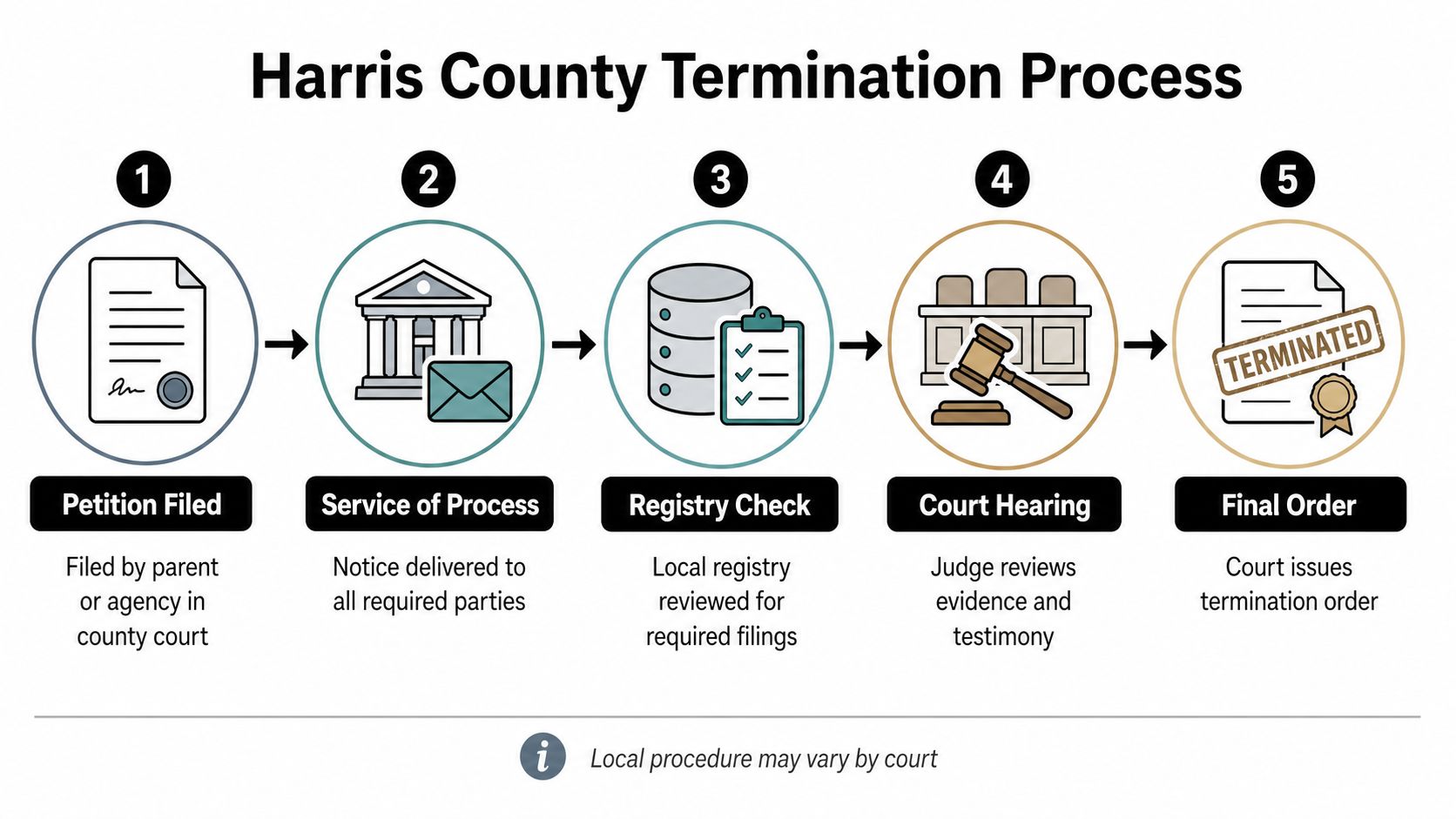
What happens after the petition is filed
The petition gets filed in the Harris County court that handles family cases for Atascocita and Humble residents. From there, the case turns on service of citation, because a petition alone does not bind anyone who has not been properly notified. Texas Law Help explains that filing usually involves court fees plus issuance and service fees when a person must be served, so this is a real court process, not just a stack of forms.
After filing, the petitioner has to deal with the paternity registry issue. If the alleged father registered, the petitioner must attempt personal service at the registry address and at any other known address before the court can move toward termination. If he never registered, Texas law may allow the case to proceed without first locating him, which often matters in adoption and custody cases where delay creates more risk than resolution.
Then the court holds a hearing and, if the evidence supports it, signs a final order. For a plain explanation of what actually happens at a Harris County family court hearing, that part of the process is where the judge checks service, registry proof, and the evidence for termination before signing anything. The written order is what controls. A waiver, a text message, or a family agreement does not take the place of a court order.
For families trying to understand how local cases move through the system, Harris County Family Courts: A Atascocita Resident's Guide is a helpful reference because it focuses on how cases proceed in the courts serving this area.
Why service diligence matters so much
When the father is known, the petitioner has to serve him the right way. Harris County judges expect the file to show what was done to notify him, especially if he registered with the paternity registry. If he later appears and says the notice was defective, that issue can slow the case down or knock it off track.
Courtroom reality: the petition is only the beginning. The service record is what keeps the case alive.
Atascocita parents often want speed, and that is understandable. Speed without clean service creates risk. If you want the order to hold, get the filing, service, and registry work right the first time.
Real Atascocita Scenarios Involving an Alleged Father
In a real Atascocita case, the facts usually decide the outcome more than the emotions do. Two families can use the same statute and still end up in completely different places, depending on whether the father is registered, identified, or ready to contest paternity.
Scenario A and Scenario B
| Issue | Scenario A, Unknown Alleged Father | Scenario B, Alleged Father Appears |
|---|---|---|
| Registry status | He never registered with the paternity registry | He later claims he is the father |
| Location | Unknown | Known after filing |
| Court focus | Whether statutory termination can proceed without locating him | Whether notice was proper and paternity should be tested |
| Likely pressure point | Service and registry proof | Timing, service, and genetic testing requests |
| Practical result | Termination may move faster if Chapter 161 requirements are met | The case can slow down because the court must address his appearance |
In Scenario A, a mother in Humble wants to move toward a stepparent adoption. The alleged father hasn't been around, and no one knows where he is. If he never registered and the child is old enough under the statutory pathway, the petitioner may be able to proceed through the Chapter 161 procedure without tracking him down first. That doesn't mean the case is automatic, but it does mean the law gives the petitioner a workable route.
In Scenario B, the father appears after the petition is filed and contests paternity. Now the fight changes. The court may need to sort out notice, registry issues, and whether genetic testing should happen before any termination ruling. A case that looked simple on day one can become a contested parentage case by the second hearing.
Those two scenarios are why one-size-fits-all advice is dangerous. A petition that works against an unknown man can fail badly when a registered father shows up with a defense. And if you're in that second position, the custody record matters too, which is why it helps to avoid mistakes in custody disputes before they harden the wrong facts into the case record. avoid mistakes in custody disputes is useful reading for the kind of conduct that later gets repeated in court.
Defenses, Consequences, and What Happens After the Order

An alleged father who sees a termination petition should react fast, not casually. The main defenses usually come down to service problems, registry issues, constitutional due process concerns, and requests for genetic testing if paternity has not been resolved. Chapter 161 moves on strict procedural lines, so timing matters from the first response.
The petitioning parent should expect that an alleged father may argue he never got proper notice, that he did register, or that the court should not terminate until paternity is tested. Those arguments can force the case into a slower lane. If the father was served properly and the registry history is clear, those defenses weaken. If the service record is sloppy, they get stronger.
What a final order actually does
A final termination order cuts off the father's legal rights to custody, visitation, and inheritance. In most situations, it also frees the child for adoption. That is the reason these cases are treated as serious final matters, not temporary family disputes.
The order also changes what can happen later. Future attempts to claim legal rights are extremely limited once the court signs that order. That's why both sides should treat the hearing like a permanent turning point, not a temporary setback.
If you want to understand how a judge weighs the broader family record while all this is happening, watching a related court explanation can help. The embedded hearing material below is useful because the courtroom rhythm matters in these cases.
The emotional aftermath is real. A parent who sought termination may feel relief and guilt at the same time. The other side may feel blindsided, angry, or shut out. A lawyer's judgment matters because one careless filing, one bad service attempt, or one missed response deadline can change the entire posture of the case.
Common Myths and How to Avoid Costly Mistakes
The biggest myth I hear is that walking away ends the problem. It doesn't. Not signing papers, never marrying the mother, or staying absent does not automatically erase parental rights in Texas. The court still needs the statutory process and a written order.
Another bad assumption is that filing alone is enough. It isn't. If service is defective or the registry issue is mishandled, a judge can slow the case down or reject the requested relief. That's how simple-looking termination cases turn into expensive repeat hearings.
A third mistake is thinking termination happens fast once the petition is filed. Sometimes it moves quickly, especially when the alleged father never registered and cannot be found. Other times, the case stalls because the father appears, contests notice, or asks for testing.
Bottom line: if the father's status is uncertain, don't guess your way through it.
For Atascocita and Humble parents, the safe move is to get the facts before you file and the service plan before you rely on it. If you're considering termination of an alleged father's rights in Atascocita TX, talk to a lawyer who knows how Harris County judges handle these records. The Law Office of Bryan Fagan – Atascocita TX Lawyers can help you review the paternity status, service issues, and next steps before the case gets harder than it needs to be.
If you're dealing with paternity, custody, or termination questions in northeast Harris County, the Law Office of Bryan Fagan – Atascocita TX Lawyers can review the facts, explain the Chapter 161 pathway, and help you avoid the service and registry mistakes that derail cases. Visit Law Office of Bryan Fagan – Atascocita TX Lawyers to schedule a free consultation at the Atascocita office and get straight answers before you file or respond.