
You're reviewing divorce paperwork at your kitchen table in Atascocita when the Walden bill arrives. The dues have always come from your joint account, but only your spouse is listed as the primary member. You want to know whether you're entitled to part of its value, whether the children can still use the club, and what happens to the boat-slip arrangement.
A Walden on Lake Houston golf and marina membership in a divorce calls for more than dividing an old initiation fee. The practical answer starts with what your contracts provide, how the interest was acquired, and whether any money can be refunded or transferred without losing the benefits you're trying to preserve.
How Texas Treats a Walden Membership at Divorce
Consider a Humble couple who paid Walden dues from their joint account while one spouse handled the membership application. The membership can represent a divisible economic interest, even though only one spouse is the primary member. That doesn't mean either spouse owns part of the golf course, marina, or club land.
Keep the financial interest separate from the right to use the facilities. A workable resolution may leave the membership with the spouse who will use it and account for its established value elsewhere in the property division. A court's allocation between spouses doesn't automatically give either person new contractual rights against the club.
Separate the questions before negotiating
Texas business-entity law illustrates the distinction between an interest and underlying property: under the Texas LLC statute, an LLC member doesn't own specific company property, and economic interests are distinct from management rights. That statute doesn't establish that your Walden account is an LLC interest. Your membership documents must identify what you hold.
What a Texas divorce can do with a Walden membership
| Question | What decides it | Practical result |
|---|---|---|
| Whose name is on the card | Date and source of acquisition | The name alone does not make it separate or community |
| Bought during marriage with marital earnings | Community-property presumption | Economic value may enter the marital estate |
| Owned before marriage | Separate-property origin, with community contributions examined separately | Original interest may stay separate with possible reimbursement |
| Golf course, marina, or club land | A club membership does not itself establish real-estate ownership | Court divides the economic interest, not the underlying property |
| Club limits sale or transfer | Club rules plus a just and right division | An offset may be more realistic than a forced split |
| Marina slip, storage, or wait list | Separate contract if one exists | Characterize and value it apart from golf dues |
Walden identifies Full Privilege Golf, Racquet, and Social family memberships and describes a “No Assessment” private club. Its public membership information doesn't establish an initiation fee, resale price, or marina entitlement that should be inserted into a divorce inventory without confirmation.
The date and source of the acquisition money matter more than the name on the card.
Match your paperwork to the relevant row before making a demand. If all you have is a billing statement, you haven't yet established whether the account contains refundable money, transferable rights, or only personal-use privileges.
Community or Separate Depends on How It Was Bought
Texas law presumes property possessed by either spouse at divorce is community property. A spouse claiming separate property must show that it was owned before marriage or acquired by gift or inheritance. The Texas Family Code's marital-property provisions set out these rules.
For a Walden membership, the application date and payment source are central to characterization. The application can show when the membership right began and what it included; financial records can help trace the money used to acquire it.

Follow the acquisition money
If marital earnings paid the initiation fee during marriage, putting only one spouse's name on the application does not, by itself, make the membership separate property. A bill paid from an account in one spouse's name also does not establish that the money was separate.
Start with four questions:
- Application date: When did the membership right begin?
- Purchaser: Who signed, and what category or rights did the application cover?
- Payment source: Do records show whether the acquisition money came from marital earnings, premarital savings, a gift, or an inheritance?
- Later changes: Did an upgrade replace the original interest or add a distinct benefit?
These details inform property division in divorce. An account title may help identify the parties, but it does not replace evidence tracing the acquisition.
A premarital membership needs a separate accounting
Suppose one spouse joined before marriage and the couple paid dues afterward. Those payments do not automatically convert the original membership into community property, nor do they automatically establish a reimbursement claim.
The accounting should distinguish ordinary payments for access already used from payments that may have acquired an additional economic right. An upgrade or refundable deposit, for example, may call for a different analysis than recurring golf dues.
The inception-of-title rule generally looks to when the right originated to characterize the original interest. Records of later contributions can help assess whether a separate reimbursement claim is supported. Keeping the acquisition documents and subsequent payment history together makes those questions easier to evaluate.
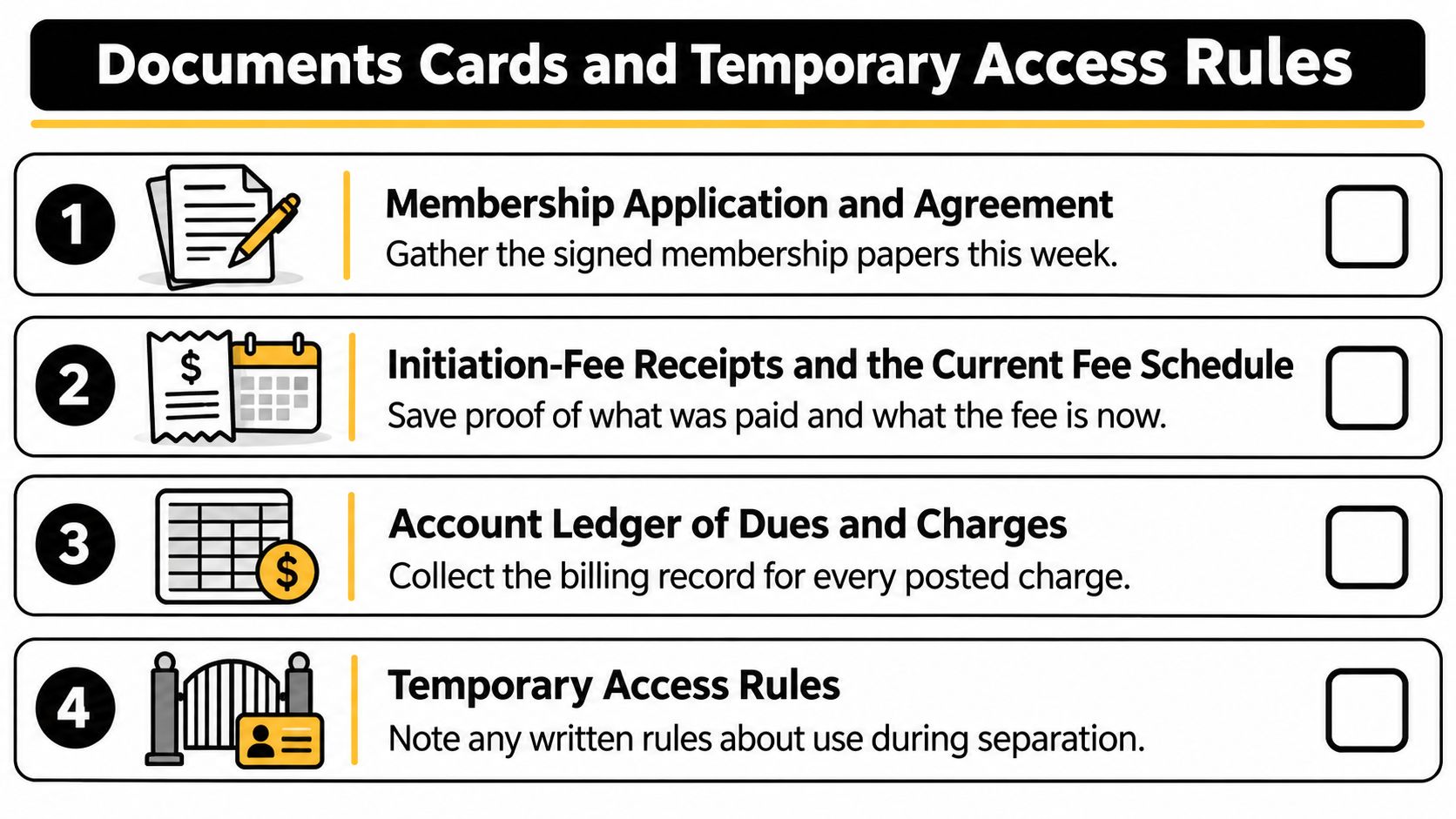
Documents, Cards, and Temporary Access Rules
Suppose a spouse's card stops working after separation, while the couple still disagrees about who may use the membership. The contract, account records, and club rules help clarify what each spouse can do. Collect complete documents, including attachments and amendments, and keep dated copies of club responses.
Collect the contract and the money trail
- Membership application and agreement. Include category descriptions, amendments, and signatures.
- Initiation-fee receipts and current fee schedule. Historical cost and current joining cost answer different questions.
- Account ledger. Request records of dues, upgrades, prepaid amounts, unpaid charges, and credits.
- Resignation, refund, and transfer rules. Ask the club to confirm in writing whether a transfer related to divorce is permitted.
- Marina agreements. Include slip, storage, launch, and wait-list paperwork.
- Bank and tax records. Preserve documents showing the source of payments.
- Member correspondence. Gather notices about alternate members and dependent children.
If an agreement is missing, request a replacement rather than guessing what it says. Ask for both the version governing the membership and any current rules the club says apply.
Access requires more than a property claim
Walden's rules and regulations state that primary and alternate members receive cards, and dependent children may receive cards. Lending a card is prohibited and may result in expulsion. A lost or stolen card must be reported immediately; the rules provide for a temporary card and a permanent replacement for $5. The club may require a card for purchases and activities.
A claim that a membership is community property does not itself authorize a spouse to use another member's card or bypass the club's account records. A temporary agreement between spouses can specify who may use the account, whether an alternate member remains authorized, and how children's access will be handled. It can also assign responsibility for purchases charged to the account.
For card-lending concerns, follow the club's rules rather than treating a card as a workaround. A divorce decree can allocate responsibilities between spouses, but the club administers access under its own governing documents.
What the Membership Is Actually Worth
If a couple paid an initiation fee years ago, that payment alone does not establish the membership's value today. Value the rights that remain under the governing agreement on the valuation date used in the divorce.
An initiation payment may have bought admission rather than recoverable equity. A refundable deposit, by contrast, may represent money the member can recover. Those amounts belong in different places on the marital balance sheet.
Count recoverable rights, not remembered costs
Broad third-party pricing bands associated with Walden's membership information, approximately $2,501–$10,000 for initiation and $0–$5,000 for annual dues, are not account-specific prices. They cannot establish a particular membership's value. Request the club's written figures and applicable terms.
A “No Assessment” description does not establish refundable equity, guaranteed resale value, or an exemption from ordinary dues. The contract determines what the label means.
Membership value components
| Component | Count it when | Leave it out or discount it when |
|---|---|---|
| Refundable deposit or initiation credit | The club will refund or credit it | It is nonrefundable |
| Current cost to join | It offers a market clue | It is treated as automatic equity |
| Prepaid dues | An unused prepaid balance remains | The benefit has already been used |
| Boat-slip deposit or marina prepayment | It is refundable or transferable | It is a revocable privilege with no refund |
| Unpaid dues or charges | They reduce the value | They are ignored rather than deducted |
| Transfer limits or no resale market | Evidence supports a liquidity discount | The full initiation fee is used anyway |
| Homeowner association fee or residence taxes | Never, for the club membership | A house listing is mixed in with club dues |
A Coldwell Banker residence listing reports a 2025 annual association fee of $375 and 2025 property taxes of $4,261 for a Walden residence. Those figures concern the property, not the private club, so they do not belong in the membership valuation.
Restrictions affect the evidence of value
A lack of a resale market does not automatically make every remaining right worthless. A refund, unused prepayment, deposit, or assignable benefit may still have value. Past family outings, however, are not recoverable cash.
Valuation safeguard: Check what the holder can recover or transfer under the contract, rather than using another family's cost to join as the membership's value.
The Texas Supreme Court decision on marital-property valuation reflects the need for evidence supporting asset values in a just and right division. The valuation date and contract terms help frame that evidence.
Marina Rights Are Not the Same as Golf Access
One spouse may have golf privileges while a separate marina agreement names the other spouse as the slip holder. Before assigning value to either right, identify whether the marina arrangement is an included membership benefit, a separate contract, personally owned equipment, a lease, or revocable permission.
A discussion of country-club memberships in divorce highlights why marina rights call for their own review. Transfer limits and expiration dates for a slip may differ from the rules for golf access.

Identify each marina-related right
Gather the club and marina documents separately. A single line labeled “membership” may hide distinct rights and obligations.
- Slip or storage space: Check who signed the agreement, its renewal and cancellation terms, and whether assignment is allowed.
- Wait-list position: Review whether the position survives divorce or can be reassigned.
- Launch privileges: Check whether access follows the member, a boat, or a separate permit.
- Deposits and prepayments: Record the refund conditions and who is entitled to payment.
- Equipment and improvements: Distinguish owned items from installed work governed by a lease or facility agreement.
For example, one spouse might keep golf access while both dispute a storage deposit paid from marital earnings. The deposit needs separate accounting, even if the spouse keeping the golf access never uses a boat.
Track use without confusing it with ownership
The name on a marina bill and the person using the dock don't, by themselves, resolve a possible economic claim. Exclusive use during divorce may raise accounting or reimbursement questions, but it does not automatically establish a right to reimbursement.
Separate initiation fees, recurring club dues, marina charges, boat equipment, deposits, and payments made after separation. For each payment, record who paid, the source of funds, and what the payment covered.
Families dividing waterfront real estate should also keep marina contracts distinct from Lake Houston shoreline property in an Atascocita divorce. A nearby home does not determine who holds a marina contract. The golf card and slip agreement are separate contracts, each governed by its own terms.
Buyout Transfer or Offset in a Settlement
The strongest settlement is one the spouses can carry out. A promised transfer has little practical value if the club won't approve it, and an offset based on unverified equity can leave someone surrendering real assets for a nonrecoverable benefit.
Texas Family Code Section 7.001 directs the court to divide the estate in a “just and right” manner while considering each spouse's rights and any children of the marriage. It doesn't require a mechanical 50/50 split of this particular asset.
Compare feasible settlement paths
Ways to divide a Walden membership
| Path | Fits when | Other spouse receives | Main risk |
|---|---|---|---|
| Keep and offset | One spouse will keep using golf or the marina | Cash, retirement, or another asset | The value is disputed |
| Club-approved transfer | Written rules allow assignment | The membership or sale proceeds, as agreed | The club can refuse approval |
| Resign and refund | A real deposit or refund exists | An allocated share of the net refund | The refund may be small or zero |
| Sell if transferable | The club confirms a resale path | An allocated share of net proceeds | There may be no public market |
A buyout can use cash, while an offset may allocate another marital asset instead. If retirement funds are proposed, the agreement needs the appropriate transfer documentation rather than an assumption that retirement dollars and available cash are interchangeable.
For a spouse who intends to continue golfing or boating, retention may avoid unnecessary disruption. The corresponding settlement should assign future dues, permitted charges, marina expenses, and responsibility for liabilities.

Write for club approval and possible refusal
A decree should not assume the club must issue a new card merely because spouses agreed to a transfer. Obtain written approval requirements and include a fallback if the proposed assignment fails.
If neither spouse wants continued use, resignation may be appropriate after confirming the actual refund and consequences. Don't promise an open-market sale until the club identifies a permitted resale process.
A settlement should say what happens if the club refuses, not just what the spouses hope it will approve.
Couples who agree can incorporate the arrangement into an uncontested divorce agreement. Those needing broader guidance can review Atascocita divorce representation and the role of a Property Division Lawyer in Atascocita in dividing community property and complex assets.
Contested value or approval issues may require mediation or trial. Keep the dispute focused on supported values and workable contractual outcomes rather than which spouse feels more attached to the club.
Negotiation and Court Strategy for a Walden Membership
Use the membership agreement, account statements, and the club's written response to shape a settlement offer the parties can carry out. Confirm who must approve a transfer and what paperwork the club requires before agreeing that either spouse will keep the membership.
Make an offer that can be performed
- Set out the proposed allocation. Specify whether the offset will use cash, a properly documented retirement transfer, or another marital asset.
- Assign ongoing responsibilities. State who will pay dues, permitted assessments, marina charges, and costs tied to authorized card use.
- Address club approval. Identify the required consent and provide a fallback if the club rejects the proposed arrangement.
Divorce mediation can help spouses resolve disagreements about settlement terms. Bring the membership agreement, written club response, account statements, bank records tracing significant payments, and any proposed temporary orders.
Preserve evidence and access during the case
If the spouses still dispute value, a qualified valuator may help assess the issue. A temporary order can specify who may use the benefits, who pays charges while the divorce is pending, and how the parties will account for payments made after separation.
Before resigning, stopping dues, or lending a card, review the contract, any applicable court orders, and the possible consequences. A lapse could affect contractual benefits or a potential refund, and informal card sharing may violate club rules. Reserve litigation for disputes the documents and negotiations cannot resolve.
Schedule a Free Atascocita Consultation Before You Sign
Your next move should reflect what you and your spouse already agree on. If you accept the property characterization, a documented net value, and who will continue using Walden, you can concentrate on the settlement language: the offset, payment responsibility, approval conditions, and what happens if the proposed arrangement fails.
Agreement on the headline isn't always agreement on the details. One spouse may believe retaining the membership includes every marina benefit, while the other expects a separate deposit back. Resolve those expectations before signing.
If you're already close to agreement
Bring the proposed property inventory, membership agreement, and latest account statement to your consultation. Mark any terms you don't understand, especially provisions concerning resignation, refunds, and continued family access.
An uncontested approach works best when both spouses understand exactly what they're accepting. Clear documentation can preserve that agreement instead of leaving unresolved account questions for after the divorce.
If value or transfer is still disputed
Don't resign the membership to end an argument. Preserve the records and identify what remains unknown: a payment source, refund condition, marina lease term, or required club consent.
Our divorce attorneys have local experience with the courts, judges, and legal environment of Atascocita and surrounding counties. We handle the divorce process from filing through negotiation and finalization, including the paperwork needed to develop and document a property resolution.
The initial consultation with an Atascocita attorney is free. Our listed office is 7702 FM 1960 Rd E, Suite 212, Humble, TX 77346, serving families from Atascocita, Humble, and northeast Harris County.
You don't need a finished valuation before seeking guidance. Bring what you have, identify what's missing, and get help deciding which records and decisions need attention before a club resignation or property agreement becomes binding.
Law Office of Bryan Fagan – Atascocita TX Lawyers offers divorce and property-division guidance to help you evaluate membership rights, marina contracts, and workable settlement terms. Visit Law Office of Bryan Fagan – Atascocita TX Lawyers to schedule your free consultation at the Atascocita office before signing a club resignation or property agreement.