Skip to content

You're stopped on a shoulder in Atascocita or Humble, your car is damaged, and the other driver is already gone. You may be hurt, shaken, or trying to help a family member who can't speak for themselves. What happens after a hit and run isn't one process, it's three connected tracks, a criminal investigation, an insurance claim, and a possible civil case for compensation. The steps you take in the first hours can support all three, so start with safety, medical care, and preserving what you saw.
The First Hours After a Hit-and-Run Crash
A driver leaving a neighborhood street in Atascocita hears a thud, feels the car jolt, and pulls over to find a crushed bumper and an empty roadway. There's no one to exchange names with, no insurance card to photograph, and no clear answer about who'll pay for repairs or treatment. That empty space is what makes these cases different from an ordinary collision.
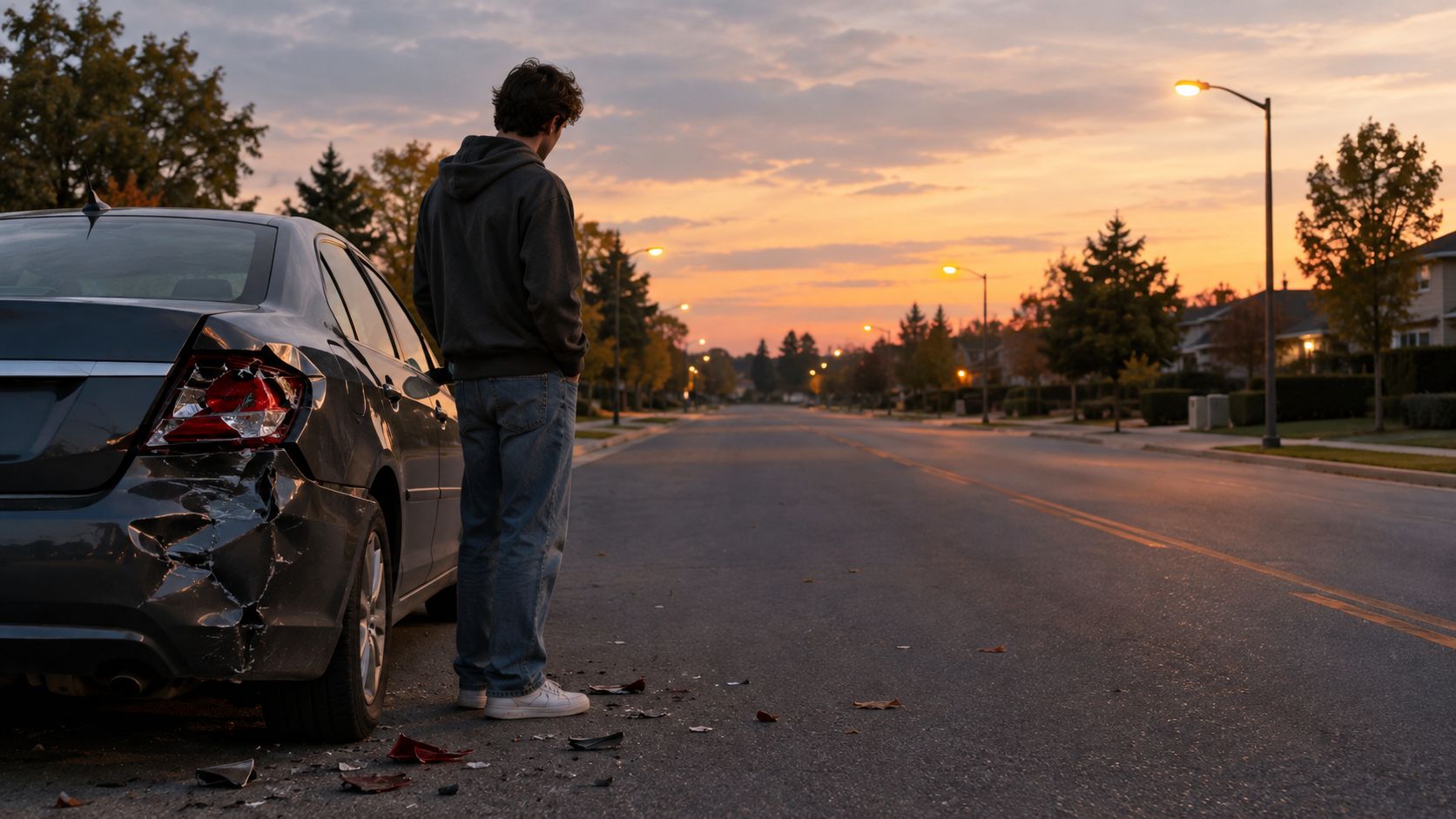
Safety comes before identification. Don't chase the fleeing vehicle or confront anyone who returns. Move out of traffic if you can, call for emergency help, and get checked even if pain seems minor at first. Some injuries don't show their full extent at the scene, and early records link your symptoms to the crash.
Who This Guide Is For
You may be reading as an injured victim, as a relative coordinating care after a serious injury or death, or as a driver who later realizes you may have been involved in a collision. Your next steps differ, but the early priorities overlap, prompt reporting, honest documentation, and no guessing about facts you don't know.
The scale explains why officers and insurers treat documentation seriously from the start. AAA reported 919,292 hit-and-run crashes in 2023, resulting in 242,886 injuries and 2,872 deaths, representing 15.0% of all police-reported crashes that year. A fast, organized response protects your health first. It also preserves the evidence that police, insurers, and lawyers will later need, without prejudging who was responsible.
What to Do Immediately After the Crash
Think in sequence, not all at once. First protect people, then create an official record, then preserve details that disappear quickly.
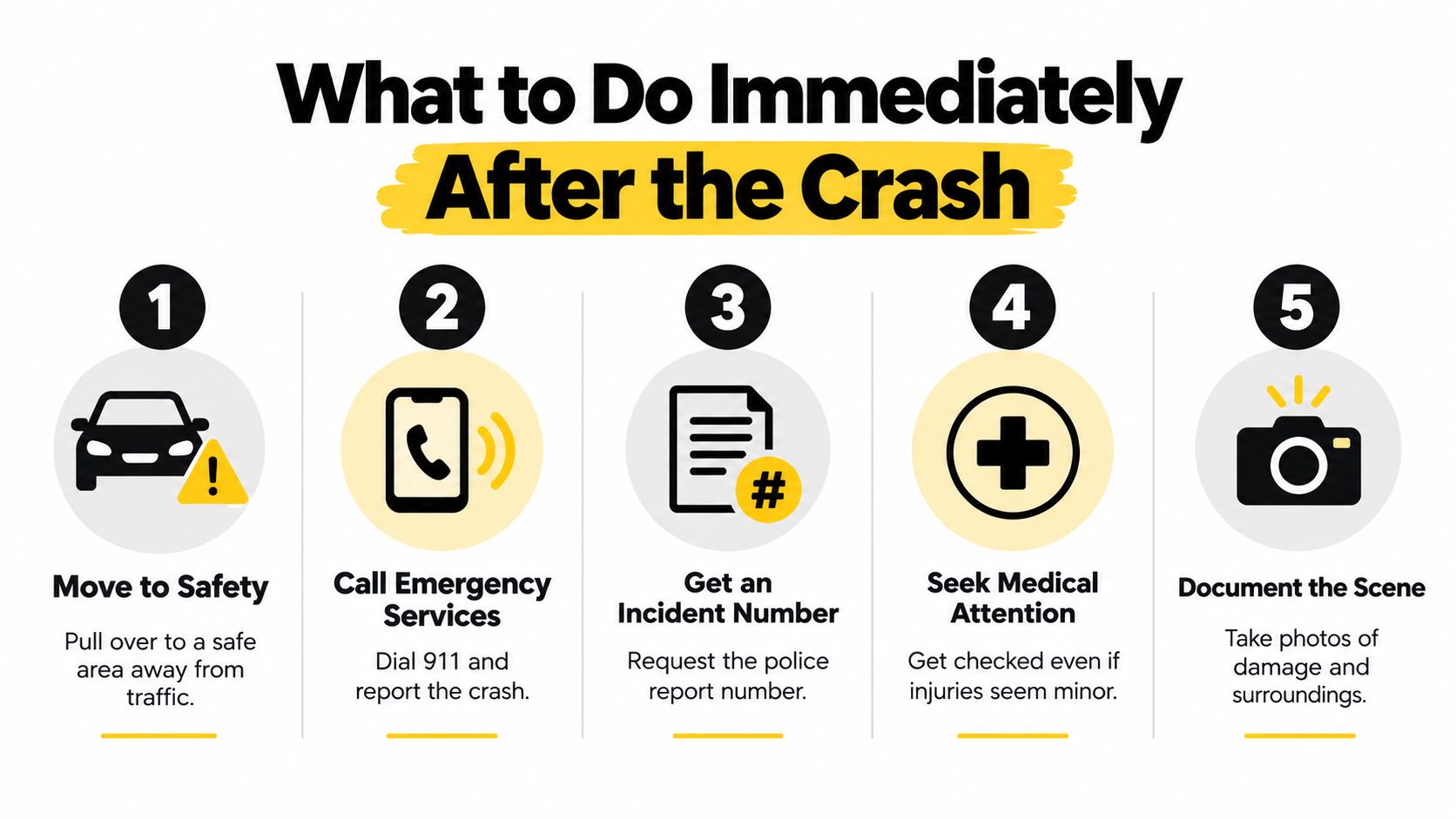
Move to a safe place away from traffic and call emergency services. Ask for an incident number before you leave contact with dispatch or the responding officer, because you'll need it for the report, your insurer, and any follow-up. Seek a medical assessment promptly and tell the provider how the crash happened, so the visit itself becomes part of the timeline.
Immediate Response Checklist
| Priority | Action | Why It Matters |
|---|---|---|
| Safety | Move out of traffic and call emergency services | Prevents a second collision and starts the official record |
| Medical care | Get evaluated the same day if possible | Connects injuries to the crash while details are fresh |
| Vehicle details | Write down direction, color, damage, and any partial plate | Gives police something concrete to search for |
| Witnesses | Get names and phone numbers before people leave | Independent accounts can confirm contact and direction |
| Photos and video | Photograph damage, debris, and the roadway if safe | Preserves positions and fragments before cleanup |
Don't pursue the other driver. A chase can cause another crash and pulls you away from the scene police need to document.
Practical rule: Write down what you remember before you discuss it at length with anyone else, because small details about direction and vehicle features fade fastest.
Investigators may later work from many fragments. Reconstruction can use time-stamped 911 records, witness accounts, surveillance footage, photographs, vehicle fragments, paint transfer, and tire marks, and you should preserve dashcam files in their original format. Note nearby businesses or homes that might have cameras, and ask police how footage should be requested.
Start a single file, paper or digital, for medical bills, wage-loss records, repair estimates, photos, and insurer correspondence. If you're also navigating personal injury claims, that organized file helps you answer questions consistently. A local review of your options is available through our Atascocita car accident legal services, especially when injuries or coverage questions appear early.
How Police Build a Hit-and-Run Investigation
Police don't start with a conclusion. They start with fragments and test whether those fragments point to a specific vehicle and a specific driver.
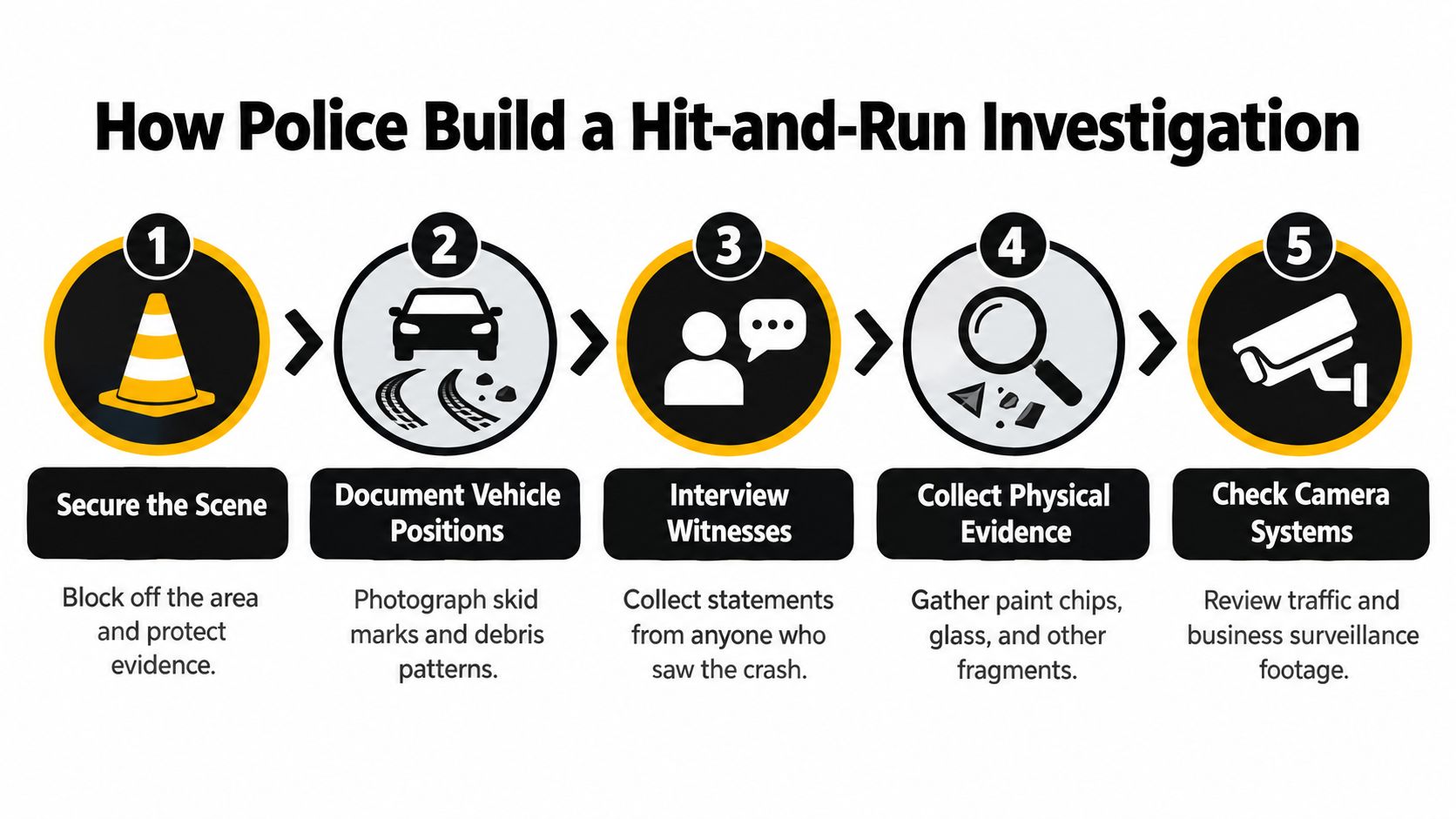
Officers typically secure the area first, then document vehicle positions, debris, tire marks, and damage patterns. They interview you and any witnesses separately, because differences in timing or description matter. A witness who only saw taillights can still help if their account matches the direction, time, and damage you reported.
From Fragments to a Suspect Vehicle
Next, investigators look outward. They may check nearby traffic or business cameras, search partial plate information, and compare paint transfer or broken parts left behind with a vehicle found later. A fragment alone rarely identifies a driver. The stronger cases connect several points, the time of the call, a camera image, matching damage, and a person who had access to that vehicle.
That distinction matters for fairness. Finding a damaged car isn't the same as proving who was driving it, that the driver knew a collision occurred, or that the driver left without meeting legal duties. Officers and prosecutors have to build each link, and gaps in any link can change what happens next.
The Texas Crash Report
In Texas, documentation follows a defined process. Texas law requires a written crash report to TxDOT within 10 days after qualifying crashes involving injury, death, or apparent property damage of at least $1,000 to one person. The resulting Texas Peace Officer's Crash Report, commonly called a CR-3, becomes a central reference for insurers and lawyers.
Keep the incident number, the CR-3 when available, your photographs, witness contact details, and medical records together. Don't treat the report as a final finding of fault. It's an investigative record, often based on early information, and it can be supplemented as video, vehicle inspections, or witness statements come in. In pedestrian, cyclist, and fatal cases, that complete file matters even more because the injured person may not be able to provide an account themselves.
Texas Charges, Investigations, and Potential Penalties
Leaving the scene isn't treated as a paperwork mistake. In Texas it's a statutory duty issue, separate from who caused the underlying collision.
For a qualifying crash, a driver is expected to stop as close as safely possible, remain at the scene, exchange identifying and insurance information, and provide reasonable assistance, including calling emergency services or arranging transportation when treatment is necessary or requested. A driver can therefore face investigation for leaving even if the initial impact itself is disputed.
How a Criminal Case Usually Develops
- Identification: Police connect a vehicle and then work to establish who was driving.
- Questioning and evidence review: Investigators test knowledge of the collision, location, injuries, and the decision to depart.
- Prosecutor review: A prosecutor decides whether the evidence supports a charge, needs more work, or doesn't support filing.
- Court process: If charged, the case can move through discovery, motions, negotiations, and possibly trial, which takes time and doesn't follow a guaranteed schedule.
The severity rises with the harm. For qualifying Texas collisions, leaving before completing applicable stop, information-exchange, assistance, and emergency-duty requirements can lead to criminal investigation, and cited penalties in serious-injury or death cases may reach third-degree-felony exposure, including up to $10,000 and two to ten years' imprisonment. That's potential exposure, not a promised sentence. The charge, the facts proved, and decisions by prosecutors and courts all affect the outcome.
If you believe you may have left a collision, don't delete messages, wash or repair the vehicle, discard damaged parts, or give a detailed statement before getting legal advice. Contact law enforcement promptly and follow instructions rather than trying private contact with the other party. You can review general criminal defense strategy information for Harris County cases to understand why early decisions matter.
Families sometimes face overlapping legal stress during a crisis. For example, our office also handles matters such as CPS Defense Attorney in Atascocita, providing defense against CPS investigations for Atascocita families, which is a separate area from a hit-and-run charge and shouldn't be confused with it.
How Criminal, Insurance, and Civil Cases Differ
A common point of confusion is assuming one outcome settles everything. An arrest doesn't pay medical bills. An insurance payment doesn't end a criminal case. A police report doesn't by itself award compensation.
Three Legal Pathways After a Hit-and-Run
| Pathway | Main Purpose | Key Questions | Possible Outcome |
|---|---|---|---|
| Criminal | Address a violation of leaving-the-scene duties | Who drove, did they know, did they stop and help | Charge, dismissal, negotiated resolution, or trial |
| Insurance | Pay benefits under a policy contract | What coverage applies, was notice timely, is contact proved | Payment, partial payment, or dispute |
| Civil | Compensate provable loss | Who was responsible, what harm and losses resulted | Settlement or court judgment |
Each track has a different decision-maker. Prosecutors control criminal filing decisions, adjusters administer policy claims, and in a civil case the parties, a judge, or a jury resolve compensation disputes. The proof focus differs too, which is why results can diverge without anyone acting inconsistently.
For example, a driver might avoid a criminal conviction because identity or knowledge couldn't be proved to the criminal standard, yet still face a civil claim where the questions and proof are framed differently. The reverse confusion also happens. A victim may receive help from their own policy and assume there's nothing else to investigate, when identifying the driver could open a direct claim.
A police report starts the paper trail, it doesn't finish any of the three tracks.
Insurance sits in the middle for many families because bills arrive before any court case ends. Texas Department of Insurance guidance states that UM/UIM coverage may apply when a hit-and-run driver cannot be found and may pay vehicle-repair and medical bills, subject to policy terms and a $250 repair deductible under that coverage. Keep victim recovery advice and defense strategy separate in your own planning, because statements or repairs that seem helpful in one track can create problems in another.
Insurance and Civil Recovery Options in Texas
Start with your own policy, not with assumptions about the missing driver. Liability coverage generally pays for damage the insured driver causes to someone else, so it doesn't ordinarily repair your vehicle after an unidentified driver flees. Your recovery may instead involve collision coverage or uninsured and underinsured motorist coverage, often called UM/UIM.
Read the declarations page first. It lists the coverages you bought and the limits that apply. Then report the crash promptly, give the insurer the incident number, and ask directly which coverage could apply, what proof is required, and how deductibles will be handled. If you're unsure how vehicle coverage categories differ, Policy Quail's comprehensive vs collision guide offers background you can compare against your own declarations page.
Building an Unidentified-Driver Claim
- Police reporting: Texas UM/UIM claims generally require reporting the crash to police, and Texas policies commonly include UM/UIM protection unless the policyholder rejected it in writing
- Consistent injury records: Describe symptoms the same way to medical providers, police, and your insurer, and don't minimize pain you're experiencing
- Loss documentation: Keep medical bills, prescriptions, repair estimates, rental records, and proof of missed work in one file
- Video and photos: Send copies, keep originals, and note when and where each image was taken
Disputes often focus on whether contact occurred, whether injuries came from this crash, or whether notice was timely. That's why delayed reporting or inconsistent descriptions can hurt even a truthful claim. This guidance is Texas-specific and policy-dependent, so don't assume a neighbor's claim worked under the same terms as yours.
If the driver is identified, a civil claim against that person becomes possible. You'll still need to prove responsibility and compensable loss, including medical costs, lost income, and property damage. Identification improves your options, it doesn't eliminate the need for documentation, and deadlines and proof requirements can apply under Texas law, so don't wait for the criminal case to finish before asking about civil timing.
Real-World Examples for Local Drivers and Families
Composite examples help because the same label, hit and run, covers very different evidence problems. None of these scenarios guarantees a result.
A Property-Damage Crash in Atascocita
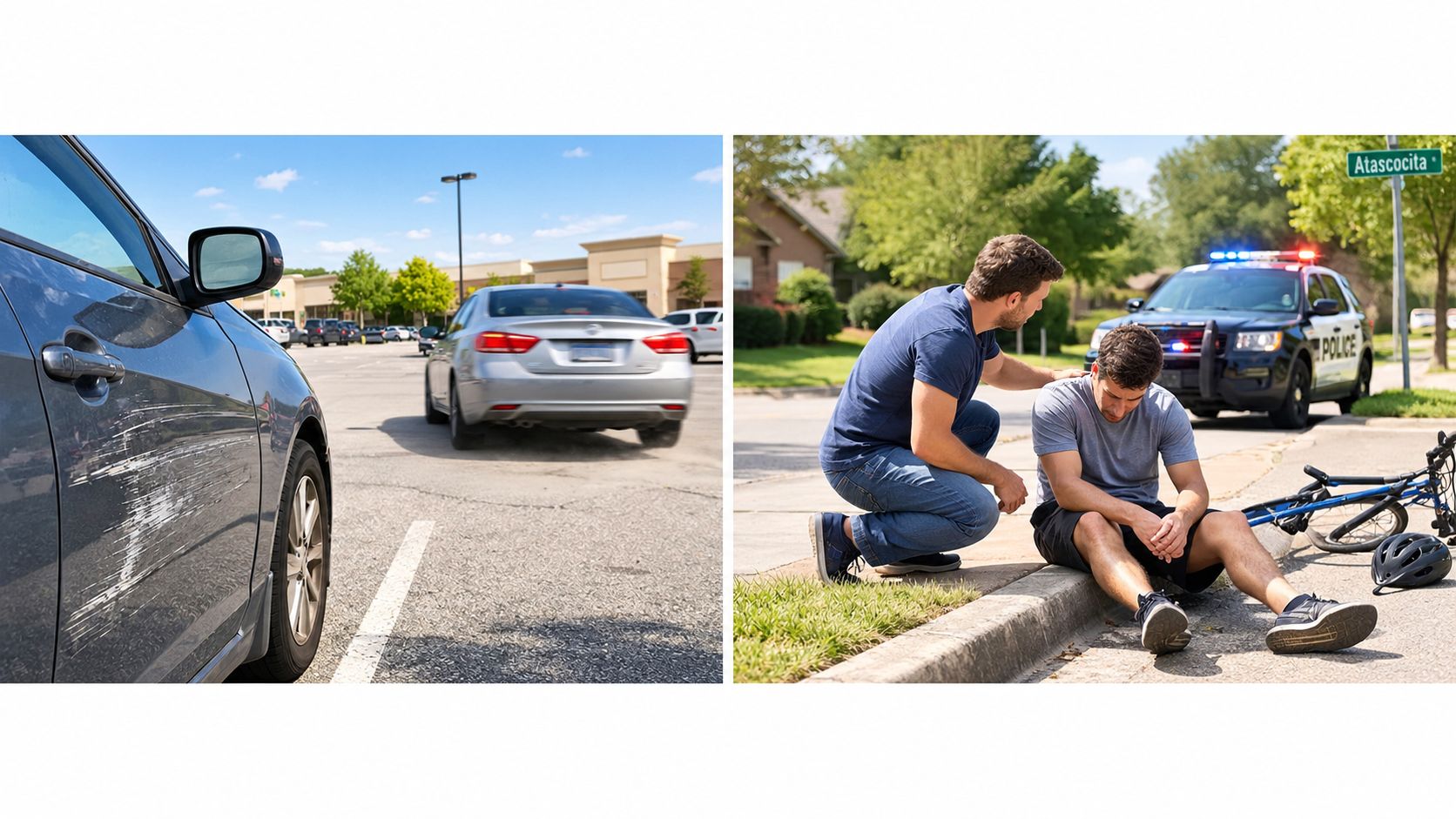
A parked car is sideswiped overnight and the owner finds a mirror on the ground in the morning. There's no witness and no note. The useful steps are photographs before anything is moved, a prompt police report, a check with neighbors for camera footage, and a call to the insurer to ask about collision or UM/UIM property-damage options. The misconception to avoid is that minor damage makes reporting pointless. Without a report, the insurance track may become harder.
A Pedestrian Struck at an Intersection
A person crossing a busy road in northeast Harris County is hit and taken to the hospital, unable to describe the vehicle. Family members now carry the evidence burden. One trusted relative should communicate with police, medical providers, the employer, and insurers, while preserving clothing, photographs, discharge papers, and witness contact details. Don't clean or discard items that may show impact or paint transfer until investigators advise you.
The risk for people outside vehicles is severe. NHTSA reported that 1,749 of 7,080 pedestrian fatalities in 2024, about 25%, involved hit-and-run drivers. A pedestrian also may not have vehicle insurance of their own to fall back on, which makes early legal guidance about available systems especially important. Riders face similar vulnerability, and information for two-wheeled road users is available through our Atascocita motorcycle accident resource page.
A Cyclist in Humble With a Partial Plate
A cyclist remembers only part of a plate and the vehicle's color, but a bystander's phone video captures the direction of travel. That combination gives police more to test than either detail alone. The cyclist should preserve the bicycle and helmet without repair, keep the original video file, and document road rash, fractures, or head-injury symptoms as treatment develops.
The video below offers a visual walkthrough you can review with family members who are helping you organize next steps.
When the Victim Dies or Cannot Work
A family handling hospitalization or death isn't only grieving, they're also fielding wage-loss questions, medical bills, and insurer calls. Appoint one contact person, keep a call log, and don't accept the idea that an early insurance denial ends the matter. A denial may reflect missing proof, a coverage interpretation, or an incomplete investigation, all of which deserve review.
Defenses and Misconceptions on the Other Side
From the accused driver's side, issues can include genuine uncertainty that a collision occurred, a claim that the driver tried to obtain information or render aid after leaving, witness accounts that conflict, vehicle damage that doesn't match, or an inability to establish who was driving. Investigators test each theory against video, damage patterns, timing, and statements. Legal sufficiency depends on the facts, and no one should contact witnesses or conceal evidence to improve a defense.
If you're a suspected driver, preserving the vehicle and getting legal advice before you explain yourself protects both the investigation and your rights.
Victims have misconceptions too. Police reporting doesn't automatically prove fault, preserved evidence doesn't become irrelevant just because time passes, and a suspect being found doesn't erase the need to prove losses. Both sides make better decisions when they separate what they know, what they believe, and what still needs proof.
When to Contact a Local Attorney
Call police for the incident and investigation, your insurer for coverage administration, and a lawyer when the tracks start to overlap or the stakes rise. You don't need to wait until every record is complete.
For victims, prompt consultation makes sense after serious injury or death, when fault is disputed, when the driver remains unidentified, when wages are lost, or when coverage is unclear. It's also wise before you accept an offer, sign a release, or respond to a demand that could affect later claims. If the driver is not identified, victims may need to rely on applicable uninsured-motorist or victim-compensation systems rather than a direct claim against the at-fault motorist, and those systems have their own proof expectations.
For an accused driver, contact a defense lawyer promptly after an arrest or notice of investigation. You're presumed innocent, and early advice helps you avoid actions that damage evidence or defense rights, such as repairing the vehicle too quickly or giving recorded explanations without counsel.
What to Bring to a Free Consultation
- Incident number and CR-3 if available, plus any letters from police or prosecutors
- Insurance declarations page and all claim correspondence
- Photos, dashcam files, and witness details in original form where possible
- Medical bills, wage records, and repair estimates that show your losses so far
Residents of Atascocita, Humble, and northeast Harris County can discuss criminal, insurance, or civil questions with the Law Office of Bryan Fagan – Atascocita TX Lawyers, which provides legal representation across family, criminal, and civil matters for local individuals and families. Bring what you have, even if it's incomplete. A clear review of gaps is more useful than waiting while video is overwritten or memories fade.
If you're sorting out what happens after a hit and run in Atascocita, Humble, or elsewhere in Harris County, the Law Office of Bryan Fagan – Atascocita TX Lawyers can review your police, insurance, and civil options and explain the next steps in plain English. Schedule a free consultation at our Atascocita office by visiting Law Office of Bryan Fagan – Atascocita TX Lawyers and bring your incident number, photos, and insurance information with you.