Texas Custody Laws for Unmarried Parents focus on establishing paternity, securing conservatorship, and meeting court deadlines.
This guide helps families in Atascocita, Humble, and northeast Harris County map out their first steps with confidence.
Understanding Texas Custody Laws for Unmarried Parents

Getting custody sorted for unmarried parents in Texas is much like laying the first brick in a new home. You need a solid base—paternity on paper, clear conservatorship orders, and a roadmap for visitation. Once that foundation is set, everything else falls into place more smoothly.
Building Your Legal Foundation
Texas assumes the birth mother is the legal parent. Fathers or other caregivers must take deliberate steps:
- Acknowledgment of Paternity filed with the Texas Vital Statistics Unit
- Filing a Suit Affecting the Parent-Child Relationship (SAPCR) in the local court
- Requesting a Standard Possession Order for routine visitation schedules
- Reviewing the Best Interest Factors that guide custody decisions
In Harris County, an Acknowledgment of Paternity often processes in just a few weeks. By completing these steps, both parents stand on equal footing when the court outlines parenting time.
Key Concepts and Local Context
National nonmarital birth rates peaked near 40–41% in the 2000s and haven’t dipped far since. Texas mirrors that trend, meaning hundreds of thousands of families each year face similar legal questions. For a deeper dive on fathers’ rights and responsibilities, see child custody for unmarried fathers.
Nonmarital Birth Rate Comparison
| Year | National Rate | Texas Rate |
|---|---|---|
| 2000 | 40% | 41% |
| 2010 | 39% | 40% |
| 2020 | 41% | 42% |
These numbers highlight the ongoing need for straightforward legal guidance in Texas courts—especially for families in Atascocita and Humble.
What You Will Learn
- How to establish paternity and file an Acknowledgment of Paternity
- The differences between joint and sole conservatorship in Harris County
- The ins and outs of the Standard Possession Schedule
- Formulas for calculating child support and handling special expenses
- Strategies for modifying or enforcing orders after your final decree
- When it makes sense to reach out to a local Atascocita or Humble attorney
Next Steps Along This Guide
In the upcoming sections, we break down each legal milestone with clear, practical explanations. You’ll see real Atascocita examples, timeline charts, and filing tips for the District Clerk’s Office. From gathering evidence to submitting paperwork, you’ll know exactly what comes next.
Scroll down to start with Establishing Paternity, the first critical pillar of your family’s legal structure.
Establishing Paternity and Parental Rights

In Texas, an unmarried mother automatically holds legal custody at birth. Fathers need to take deliberate steps to secure their parental rights. Think of it as choosing between two routes on a map—one is quick and straightforward, the other takes a bit longer but offers rock-solid protection.
Both paths arrive at the same destination: legal recognition as a parent. You just need to know the right forms, the right offices in Harris County, and the timing that keeps everything moving smoothly.
Filing an Acknowledgment of Paternity
Filing an Acknowledgment of Paternity is like planting your flag on the birth certificate. You skip the courtroom and gain presumptive conservatorship immediately.
- Required Forms: A signed Acknowledgment of Paternity by both parents plus valid photo ID
- Processing Time: About 4–6 weeks
- Where to File: Harris County Vital Statistics office in Humble or downtown Houston
When both parents agree, this route often avoids court fees and contested hearings—making it the fastest way for many dads in Atascocita.
Starting a SAPCR
A Suit Affecting the Parent-Child Relationship (SAPCR) is your backup plan when cooperation breaks down or dad’s name isn’t on the birth record. It’s a formal court case that establishes paternity and lays the groundwork for custody or visitation.
- File a SAPCR petition with the Harris County District Clerk
- Serve the other parent with citation
- Collect genetic test results or sworn affidavits
- Attend the court hearing to finalize paternity
Key Insight: Establishing paternity via SAPCR typically takes 2–4 months but gives you the court’s authority if the other parent objects.
Unmarried fathers in Texas have no automatic rights at birth. You must acknowledge paternity or ask a judge to declare it before you can seek custody or visitation. Learn more about how Texas custody laws affect unmarried parents
Case Study of a Local Father
John, a father from Atascocita, filed a SAPCR and secured regular visitation in just eight weeks. His secret? Prioritizing genetic testing and tracking hearing dates like appointments.
- Complete genetic tests within 30 days of service
- Hearings are often scheduled 15–20 days after your petition
- Final orders can follow about 30 days later
This timeline demonstrates how Texas custody laws for unmarried parents can work in your favor when you follow each step precisely. Learn more about establishing paternity in Texas in our guide
Comparing Paternity Options
| Option | Process Time | Court Involvement |
|---|---|---|
| Acknowledgment of Paternity | 4–6 weeks | None |
| SAPCR | 2–4 months | Required hearings |
- Cost of Acknowledgment: Under $25
- SAPCR Fees: Approximately $350 plus attorney costs
Atascocita Filing Tips
- Visit the Humble Vital Records office on weekdays before noon to beat the lines
- Download and fill out forms ahead of time—bring two copies for signing
- Pack valid photo ID (driver’s license or passport)
- Check Harris County’s website for the latest office hours
Accurate paternity records unlock your ability to request child support, custody, and visitation. Taking action early ensures Texas courts recognize you as a legal parent—protecting your relationship and your child’s future.
Types of Conservatorship and Possession Orders
Parenting after establishing paternity can feel like navigating uncharted seas. Joint conservatorship is akin to crewing on the same ship, while sole conservatorship puts one parent at the helm.
Both arrangements shape how parents share—or don’t share—major decisions. From schooling to medical choices, the structure you pick determines who steers the day-to-day course.
Differences Between Joint and Sole Conservatorship
Under joint conservatorship, both parents make the big calls together: enrolling in school, approving medical treatments, and deciding on a move. It demands clear communication but spreads responsibility evenly.
Sole conservatorship hands the bulk of legal authority to one parent, leaving the other with visitation rights defined by a possession order. Picture solo sailing—one captain, one chart.
Key Insight: Joint conservatorship demands communication but promotes shared responsibility.
-
Joint Conservatorship
- Parents collaborate on education plans, healthcare decisions, and extracurricular activities
- Both individuals hold Managing Conservator status under Texas law
- Best for partners who keep respectful, consistent cooperation
-
Sole Conservatorship
- One parent retains exclusive decision-making power
- Noncustodial parent follows a Standard Possession Order for access
- Often chosen when one parent’s lifestyle or availability raises concerns
Judges weigh factors like emotional bonds, stability, and each parent’s willingness to cooperate. Those points guide the court toward whichever setup serves the child’s best interest.
Sample Parenting Time Schedules
Possession orders evolve as children grow. This simplified table illustrates a common stair-step model in Harris County.
| Child Age | Typical Weekend Time | Weekday Contact |
|---|---|---|
| Infants (0–2 years) | 2 afternoons and 1 short evening | 1 overnight every other week |
| School Age (3–12 years) | Alternate weekends & 2-week summer blocks | Thursday dinner visits; weekends from Friday pm |
| Teens (13–17 years) | Friday after school to Sunday evening | Wednesday evening calls; summer rotation |
| Special Needs | Supervised or customized visits | Case-by-case schedule agreed by both parents |
Harris County Standard Possession Schedule
The Texas Family Code sets a default path, which Harris County largely follows:
- First Friday after school through Sunday evening
- Alternate Thursday evening from 6 pm to 9 pm
- Extended summer possession of six weeks for noncustodial parents
- Holiday rotation covering Thanksgiving, Christmas, spring break, and birthdays
Statistical Highlight: Approximately 90% of SAPCR filings in northeast Harris County accept this schedule.
Courts can tweak the default terms—swapping weekends, adding overnight stays, or carving out extra holidays—so families find the best fit.
Case Scenarios and Best Interest Balancing
Real-life examples from Atascocita and Humble courts show how judges balance factors like safety and consistency:
- A Humble father on night shifts won joint conservatorship but adjusted weekend time to fit his work hours.
- One parent’s serious health condition led to sole conservatorship, ensuring stable, hands-on care.
- Allegations of safety concerns resulted in supervised visits and a custom schedule.
These cases highlight the court’s focus on child safety, emotional connections, and predictable routines.
Read also our guide on conservatorship in Texas to understand all options: https://www.atascocitaattorneys.com/conservatorship-in-texas/
Tips for Drafting Effective Possession Orders
Clear, detailed orders cut down on conflicts and avoid repeat court trips. Keep these pointers in mind:
- Pinpoint exact pickup and drop-off times
- Sync terms with the school calendar and local holidays
- Add clauses for travel, emergencies, and communication methods
- Review and tweak the order annually as schedules shift
Solid, precise language lays the groundwork for stability—and puts your child’s best interest front and center.
Filing Custody and Visitation Orders and Court Timelines
Walking into the Harris County courthouse can feel like navigating a labyrinth. Yet, with a clear roadmap, each turn becomes predictable. Your first milestone is selecting the right SAPCR packet—whether you need to establish paternity, request conservatorship, or modify an existing order.
Once you know which forms you require—Original Petition, Civil Case Information Sheet, Citation—your next stop is the District Clerk’s office in downtown Houston. You’ll file your petition there, secure a case number, and then arrange personal service on the other parent. From start to finish, attention to detail matters.
- Identify the precise SAPCR packet you need
- File at the District Clerk’s office and receive a case number
- Serve the opposing party in person or via a registered process server
- File Proof of Service to confirm delivery
Court Filing Steps and Requirements
Before you head to the Clerk’s window, gather your documents:
| Item | Details |
|---|---|
| Office Hours | Monday–Friday, 8 am–5 pm |
| Filing Fee | Approximately $350 |
| Location | Harris County District Clerk, Downtown Houston |
| Identification | Valid photo ID |
It’s simple to grab the forms online or pick them up in person. Then follow these steps:
- Download or collect the correct SAPCR packet
- Fill in all fields—child’s name, birthdate, parent information
- Submit your completed forms and pay the filing fee
- Hire a process server or sheriff to serve the citation
- Return to the Clerk’s office with the affidavit of service
Typical Court Timelines
Just like baking a layered cake, family law cases need time to rise. Here’s a quick overview:
- Acknowledgment of Paternity cases often wrap up in 4–6 weeks.
- Uncontested SAPCR matters usually finish within 2–4 months.
- Contested SAPCR litigation can span six months or even several years, with temporary orders issued along the way.
Learn more about contested SAPCR timelines on the Texas statutes site: Discover more insights about SAPCR timelines
Key Insight
In contested cases, interim orders on child support or visitation provide stability while the court addresses the bigger questions.
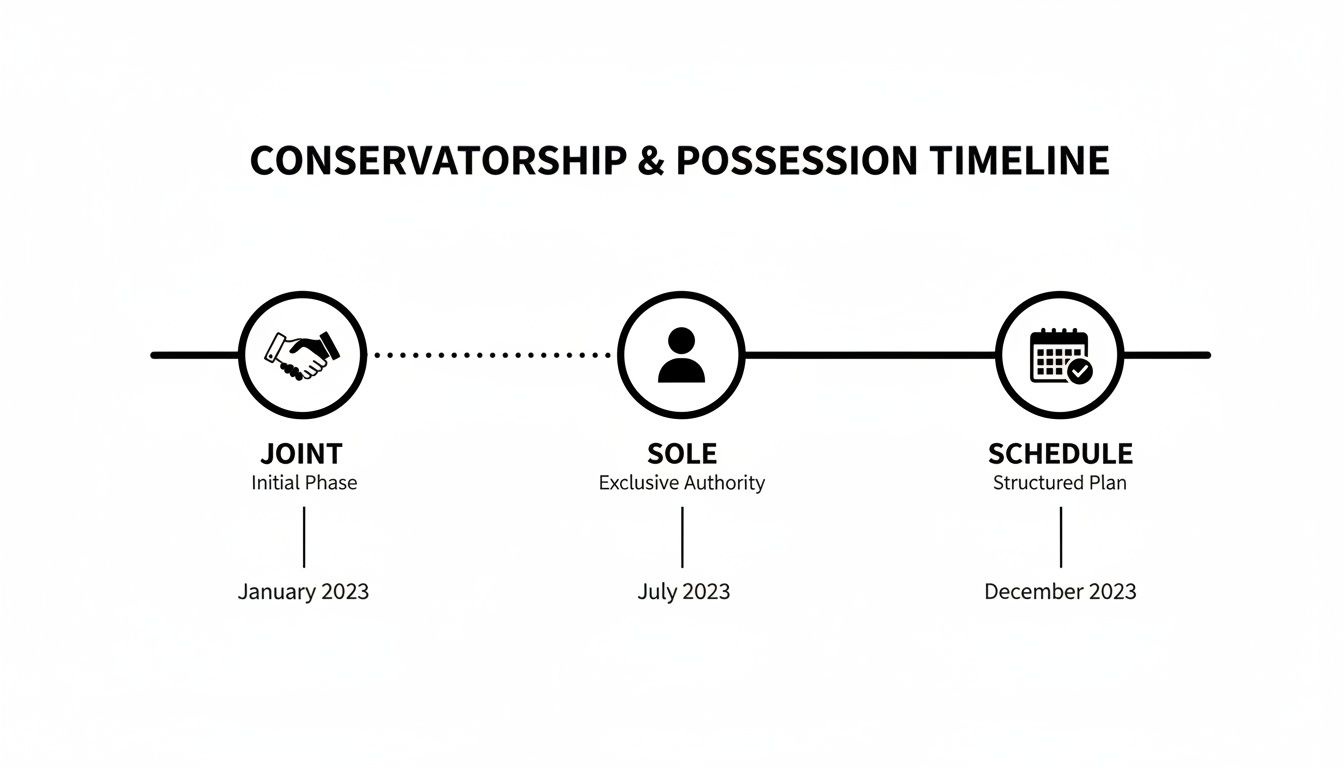
Below is an infographic visualizing key stages of conservatorship and possession in contested and uncontested cases.
Best Interest Factors Judges Review
Think of the court’s decision-making process as weaving a safety net for the child. Judges weigh multiple strands:
- The child’s emotional and physical needs
- Stability of home environment and community ties
- Each parent’s willingness to share custody
- Any history of family violence or safety concerns
- Sibling relationships and continuity of care
- The child’s preferences (if age 12 or older)
- Parents’ ability to manage education and healthcare
A well-prepared petition that addresses these factors can streamline your case.
Interim Hearings and Temporary Orders
Temporary orders act like scaffolding—supporting families until the main structure is in place. Typically, an interim hearing occurs within 30 days of filing. At that point, the judge may set:
- Temporary child support based on income estimates
- Supervised or unsupervised visitation arrangements
- Interim decision-making authority for medical care and education
- Protective orders if safety issues exist
Bringing clear pay stubs, school schedules, and medical records helps the court craft fair interim solutions. This foresight minimizes surprises and sets realistic expectations.
By mapping out these steps and timelines, Atascocita and Humble parents can save precious months. Early planning of service dates and hearings often trims delays—a small investment for smoother proceedings.
Our team is here to guide you through each filing and appearance. Contact us early to secure the best timeline for your family’s needs. Schedule your free visit today.
Calculating and Enforcing Child Support

Working out child support in Texas is a bit like fitting pieces into a household budget. The state uses a straightforward percentage-of-net-resources formula, yet it can still feel intricate when you’re juggling real expenses.
Under Texas law, a noncustodial parent pays 20% of net resources for one child, 25% for two, and 30% for three or more. On top of that, costs such as medical bills, daycare, and extracurricular activities can shift the numbers.
- Net resources: Income after taxes, health insurance premiums, and union dues
- Child count percentages: Start at 20% and climb by 5% for each additional child
- Special expenses: Uncovered medical treatments, childcare, school fees
Calculating Support Amounts
First, subtract mandatory deductions from gross income to find net resources. For example, if a parent earns $3,000 a month and pays $500 in taxes and premiums, that leaves $2,500 to work with.
Next, multiply that figure by the appropriate percentage. For one child, 20% of $2,500 equals $500 per month. Add a second child and it jumps to 25% ($625), then 30% ($750) for three or more.
| Children | Percentage of Net Resources | Monthly Support |
|---|---|---|
| 1 | 20% | $500 |
| 2 | 25% | $625 |
| 3+ | 30% | $750+ |
Texas law also factors in extras that a flat rate can’t cover—like uninsured medical needs or specialized tutoring. Those costs get split between parents in proportion to each one’s net resources, so support keeps pace with real-world needs.
In Humble, for example, a mom asked the court to include daycare after her work hours changed. The father agreed to chip in an extra $150 monthly for after-school care, on top of the regular support. This adjustment shows how Texas custody laws for unmarried parents bend to everyday family realities.
Enforcing Support Orders
When a parent falls behind, the Texas Office of the Attorney General (OAG) can step in. Common enforcement tools include:
- Wage garnishment taken straight from paychecks
- Intercepting state or federal tax refunds
- Suspending driver’s, professional, or recreational licenses
In tougher cases, courts may place liens on property or report the delinquency to credit bureaus. These steps push for prompt payments and keep the child’s welfare front and center.
“Taking swift enforcement steps helped a Humble family recover six months of past support in under eight weeks,” says a local attorney.
Modifying Child Support
Life rarely stands still, and support orders shouldn’t either. Major events—job loss, serious illness, or a change in custody—can all justify a modification.
To start the process, file a petition in Harris County family court and include proof of the new circumstances. The court will set a hearing date, review updated income details, and decide if the support amount needs adjusting.
- Gather recent pay stubs, medical invoices, or childcare receipts
- Complete Form 143 (Motion to Modify Child Support) and pay the filing fee
- Attend the modification hearing with all documentation
In Atascocita and Humble, parents who stay organized and meet deadlines often see quicker results. A knowledgeable local attorney can guide you through the paperwork and communicate with the OAG on your behalf.
By mastering how to calculate support, enforce orders, and request changes, unmarried parents in Texas secure a stable financial foundation for their children.
Learn more on our Child Custody service page.
Schedule your free consultation at our Atascocita office today.
Let our team protect your child’s future and financial security.
When to Seek Local Legal Support in Atascocita and Humble
Navigating custody disputes feels like steering a small boat through sudden squalls. When the wind picks up and the legal currents run strong, you need someone who knows the riverbed.
In Harris County—especially around Atascocita and Humble—Texas custody rules for unmarried parents tighten when paternity, visitation, or relocation issues surface. Recognizing the warning signs early can steer you away from costly detours and heartache.
Key Insight: When paternity questions or relocation plans emerge, local know-how can tilt the scales in your favor.
Common Triggers for Legal Help
- Challenging Best Interest Factors stalls progress without the right strategy
- Modification Petitions come with tight filings and strict deadlines
- Enforcement Disputes over child support or access need swift action
- Relocation Requests under the Texas Family Code require careful planning
A single call to a northeast Harris County family lawyer can replace guesswork with clarity. They handle paperwork and arguments, ensuring you’re ready for negotiations and court dates.
Consider a Humble mom wanting to move closer to family. She’ll need a detailed parenting plan to show minimal disruption. A local attorney knows which judge appreciates that level of detail and tailors motions accordingly.
How a Local Attorney Guides You
- Initial Consultation: Pinpoint your concerns and desired outcome
- Document Prep: Draft and file the Suit Affecting the Parent-Child Relationship
- Negotiation or Advocacy: Sit at the table or speak up in court
- Enforcement Steps: Work with Harris County and the Texas OAG when orders are ignored
This isn’t just filling out forms. It’s having an ally who understands courthouse hallways. Think of them as a neighbor who can anticipate twists, turning complex rules into simple next steps.
Statistical Highlight: Nearly 60% of contested custody cases in our region resolve more favorably with attorney involvement.
Read also our guide on child custody cases at The Law Office of Bryan Fagan for deeper insights: Learn more about child custody services
Why You Need a Local Advocate
A local attorney reads the courtroom like a map, spotting shortcuts other lawyers might miss. That inside track can mean fewer hearings, less stress, and a stronger focus on your child’s best interest.
Don’t let small questions become emergencies. Reach out now for a free consultation in Atascocita and start charting a secure path for your family.
FAQ
These answers tackle the questions most unmarried parents face under Texas custody laws. They’re concise, practical, and tailored for families in Atascocita and Humble.
Key Insight: Establishing paternity is the first step to unlocking custody and support under Texas custody laws for unmarried parents.
-
Do Unmarried Fathers Have Rights Without Paternity?
No. Without signing an Acknowledgment of Paternity or winning a SAPCR (Suit Affecting the Parent–Child Relationship), Texas courts won’t grant custody or visitation to an unmarried dad. -
How Long to Establish Paternity in Harris County?
An Acknowledgment of Paternity usually wraps up in 4–6 weeks. If the case goes to a contested SAPCR, you’re looking at six months or more, depending on the court’s calendar.
Best Interest Factors
-
What Guides Judges on Custody Decisions?
Judges weigh the child’s emotional ties, each parent’s stability, safety concerns, and the ability to provide a loving home. They also consider sibling bonds and the child’s preference if they’re 12 or older. -
Can You Change Custody or Support Later?
Yes. Show a material and substantial change—like job loss, relocation, or new needs—and you can ask the court to adjust orders. To prepare:- Keep detailed records of income, expenses, and life changes
- File your modification motion on time under Harris County rules
- Consult a local attorney for guidance
Additional Tips
Before planning an out-of-state move, review Texas relocation rules to avoid surprise objections. Try to schedule hearings during school breaks to minimize disruptions.
Our Atascocita office specializes in family law for unmarried parents and treats each case with personal attention. Ready to begin?
Call for trusted legal support in Atascocita and Humble. Schedule a free consultation with Law Office of Bryan Fagan – Atascocita TX Lawyers: https://www.atascocitaattorneys.com