 Skip to content
When a judge’s ruling in your Atascocita divorce or custody case just doesn't sit right, the idea of an appeal can feel like a lifeline. But it’s critical to understand that an appeal isn't a do-over. It’s a formal request for a higher court to check the trial judge’s work for a very specific type of mistake—what we in the legal world call a "legal error" or an "abuse of discretion."
You can't appeal simply because you are unhappy with the outcome. The system is designed to correct legal mistakes, not to offer a second opinion on a difficult judgment call. At The Law Office of Bryan Fagan, we want our neighbors in Atascocita and Humble to understand this process clearly, so you can make the best decision for your family.
Do You Have Grounds for a Texas Family Law Appeal?
Getting a final order from a Harris County family court that completely upends your life is a gut punch. Whether it's about who gets the kids, the division of your Humble home, or spousal support, that judge's signature carries immense power. It's completely natural to feel the result was unfair, but in the Texas appellate system, "unfair" isn't enough to win an appeal.
The entire process boils down to one crucial question: did the trial court commit a reversible error? This is a tough hill to climb. An appeal isn't your second shot at telling your story or bringing in that witness you wish you’d called. It's a laser-focused legal argument that the judge either misunderstood Texas law or made a decision so far outside the bounds of reason that it cannot be allowed to stand.
What are Legal Errors and an Abuse of Discretion?
A legal error is fairly straightforward. It happens when the judge misinterprets or misapplies a specific law from the Texas Family Code. For instance, imagine a judge in Atascocita takes your separate property inheritance, calls it community property, and splits it in your divorce. That's a clear-cut mistake based on established Texas law and would be a solid basis for an appeal.
An abuse of discretion is a bit more nuanced but just as critical. This occurs when a judge's ruling has no real support in the evidence that was presented in court. Let's say a judge drastically cuts back a parent’s time with their child, even though absolutely no evidence of family violence, neglect, or substance abuse was presented at the trial. That kind of decision, untethered to the facts, could be considered an abuse of discretion. The appellate court will comb through the trial record to see if the facts actually support what the judge decided.
A key takeaway for families in northeast Harris County is that appellate courts give significant deference to the trial judge. They were in the room, watching the witnesses and judging their credibility firsthand. Your appeal must be powerful enough to convince a panel of higher court judges that the error wasn't just a small mistake—it was so significant that it almost certainly led to the wrong result.
What is Not Grounds for an Appeal
It's just as important to recognize what won't get you anywhere on appeal. The single most common reason people want to file an appeal is because they simply disagree with the judge's decision. Unfortunately, that carries zero legal weight.
Other arguments that are almost certain to fail include:
- You felt the judge was friendlier to the other attorney.
- You now regret not presenting different evidence or witnesses.
- You believe the judge just picked the wrong side between two reasonable, but different, outcomes.
To make this distinction clearer, let’s look at a few scenarios.
Valid Grounds for Appeal vs. Simple Disagreement
| Scenario | Valid Grounds for Appeal (Legal Error) | Not Grounds for Appeal (Disagreement) |
|---|---|---|
| Property Division | The judge awarded your spouse a portion of an inheritance that Texas law defines as your separate property. | The judge awarded the marital home to your spouse, even though you believe you should have received it. |
| Child Custody | The judge named the other parent as the primary conservator despite documented evidence of child endangerment presented at trial. | You believe you would be the better parent, but the judge found both of you to be fit and made a reasonable choice. |
| Evidence | The judge refused to allow a crucial piece of evidence to be admitted based on an incorrect application of the Texas Rules of Evidence. | You wish you had found a more compelling expert witness to testify on your behalf. |
Ultimately, a successful appeal must point to a specific error, not a general feeling of injustice.
The vast majority of family law cases settle, so appeals aren't an everyday occurrence—but they are an essential safeguard when a real error happens. While statistics from resources like Clio.com show that family law success rates on appeal can be low—often around 10-15%—it’s precisely because that "abuse of discretion" standard is so hard to meet. Before you even think about appealing, you have to be sure you have an "appealable order," as the rules are very specific about which decisions can be challenged. Getting a basic grip by understanding appealable orders can save you a lot of time and heartache.
Your first step should always be a candid conversation with an experienced local attorney. Here at The Law Office of Bryan Fagan in Atascocita, we can review the court's final order and the trial record to give you a straight, realistic assessment of whether you truly have a case to move forward.
Understanding the Unforgiving Clock: Your Appeal Deadlines
When you get a bad ruling from a family court in Harris County, the clock starts ticking. Immediately. The Texas appeals process is built on a series of strict, non-negotiable deadlines. Missing one isn't a small stumble; it's often a fatal blow to your case, permanently shutting the door on your right to challenge the decision.
For families in Atascocita and Humble, this is the first and most brutal reality of appellate law. The system doesn't wait for you to process the emotional shock of a ruling. It demands immediate, precise action.
The 30-Day Sprint: Filing Your Notice of Appeal
The moment the judge signs that final order, a 30-day countdown begins. Within this window, you absolutely must file what's called a Notice of Appeal with the trial court clerk. Think of it as officially raising your hand and telling the entire court system, "I am challenging this ruling."
This isn't just a suggestion; it's the mandatory first step. If that 30-day period comes and goes without a Notice of Appeal on file, your right to an appeal is almost certainly gone forever. It doesn't matter how flawed the judge's decision was or how strong your arguments are. This is why you need to connect with an appellate attorney the moment you receive a final order you believe is wrong.
This is a high-stakes, front-loaded process. The work begins the second the judge's ruling comes down.
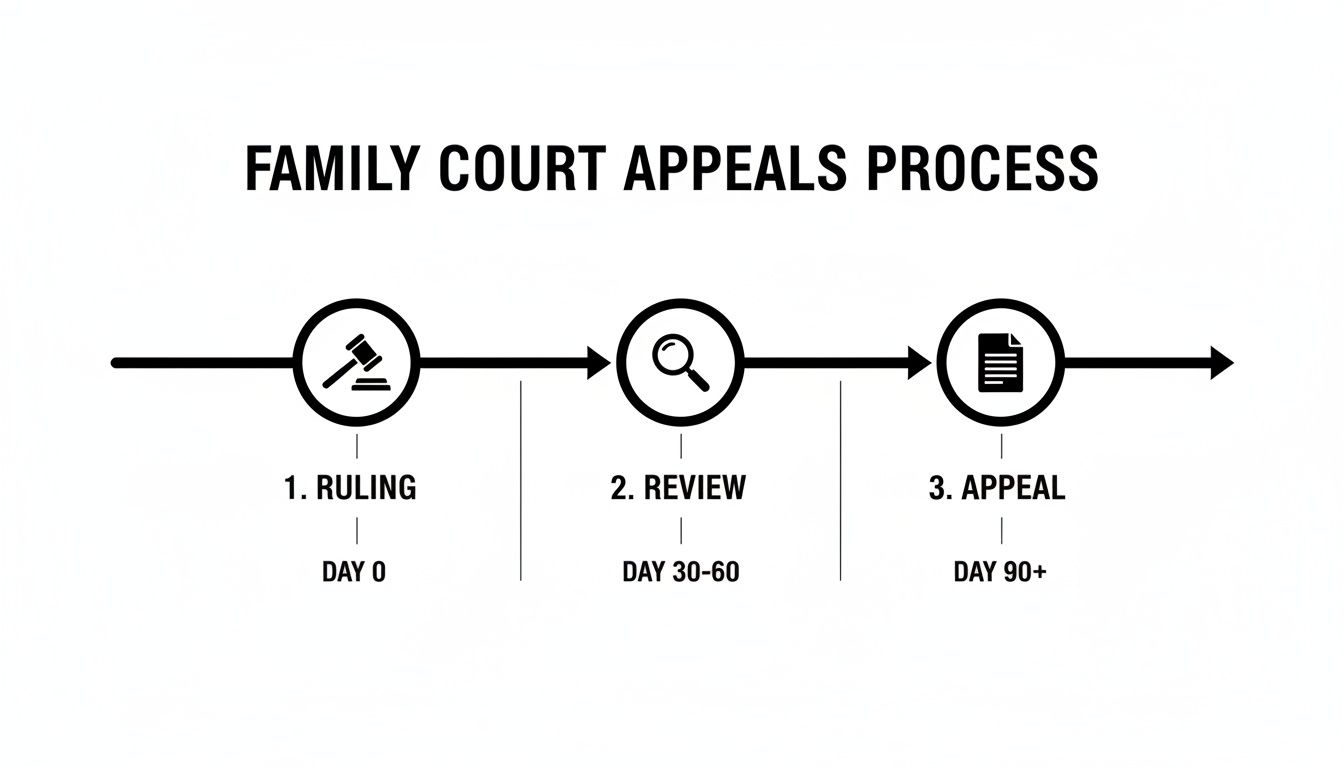
As you can see, the path forward starts with the initial ruling, moves into a critical review phase, and only then proceeds to the formal appeal.
A Powerful Strategy to Buy More Time
While that 30-day deadline is the default, Texas law offers a strategic maneuver that can give you more breathing room: filing a Motion for New Trial. This is a formal request you file with the very same judge who issued the order, essentially asking them to take a second look and correct their own errors.
Filing this motion accomplishes two critical things:
- It gives the trial judge a chance to fix the mistake. You're presenting the legal errors directly to the source, giving the court an opportunity to correct the judgment without forcing everyone into a costly, drawn-out appeal.
- It extends your appeal deadline. This is the big one. By timely filing a Motion for New Trial, you push the deadline for filing your Notice of Appeal from 30 days to 90 days from the date the judgment was signed.
That extension is priceless. It gives your appellate lawyer the crucial time needed to dig through the entire trial record, pinpoint every potential error, and craft the strongest possible arguments for your appeal.
But here's the catch: the Motion for New Trial has its own tight deadline. You have to file it within 30 days of the final judgment being signed. So, the decision to use this tool has to be made just as quickly as the initial decision to appeal.
Let’s say a judge in a Humble divorce case completely misinterprets the financial data and undervalues a family business. A Motion for New Trial lets your attorney point out that specific error. If the judge sees the mistake, the issue might be fixed right then and there. If not, you've still locked in your right to appeal and gained an extra 60 days to get ready for the fight.
The appellate timeline is a minefield. One wrong step can end your case. Working with an experienced attorney at The Law Office of Bryan Fagan in Atascocita is the surest way to protect your rights and hit every deadline. Don't let the clock run out on your chance for a just outcome. Schedule a free consultation with our team today to find out what your options are.
Why the Trial Record Is Your Entire Case
When you decide to appeal a family court decision in Texas, you have to understand a critical rule: the book on your case is already closed. The court of appeals won't hear new testimony or look at new evidence. They won't listen to a witness who wasn't at your original trial in the Harris County Civil Courthouse.
Their entire decision will be based exclusively on the official trial record.
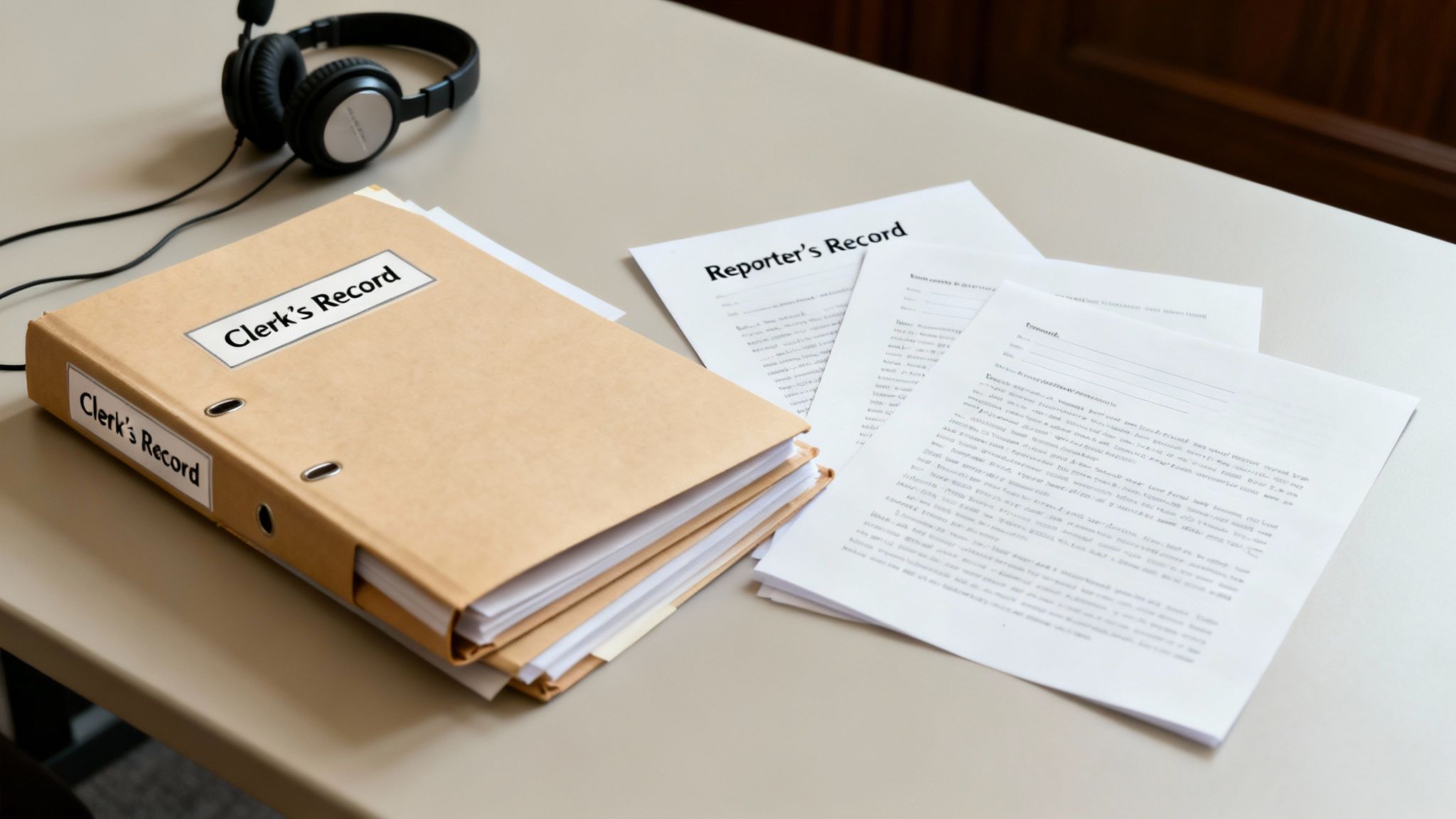
This record is your entire world on appeal. It's the complete collection of everything that was said, filed, and presented in your original case. Think of it as the game tape the appellate judges will review, play-by-play, to see if the trial judge made a reversible error.
If it isn't in that record, for all legal purposes, it never happened.
What Makes Up the Official Record
The trial record isn't just one big document. It's actually made of two distinct parts that, together, paint the full picture for the appellate court. Knowing what's in each is key.
-
The Clerk's Record: This is the complete paper trail of your case. It includes every single document filed with the Harris County District Clerk—the original petition, all the motions, discovery responses, and, of course, the final signed order. For families in Humble or Atascocita, your attorney will need to make a formal request to the District Clerk's office to get this compiled.
-
The Reporter's Record: This is the official, word-for-word transcript of everything spoken during your hearings or trial. It's created by the court reporter and captures all witness testimony, objections from attorneys, and rulings from the judge. This is often the most expensive and time-consuming part of the record to get, but it's absolutely essential.
These two components are the only things the court of appeals will consider. Your appellate attorney's job is to meticulously comb through this record, pinpoint the exact moments where a legal error occurred, and build a persuasive argument around them.
Preserving Error: The Most Important Rule You've Never Heard Of
Here’s a concept that trips up so many people who want to appeal: preserving error. To successfully argue that the trial judge made a mistake, your original trial attorney must have made a specific and timely objection right when the error was happening.
Imagine you're in a custody hearing, and the other side's lawyer starts asking a witness improper questions. If your lawyer doesn't immediately stand up and say, "Objection," while stating the legal reason, you have almost certainly lost your right to complain about it on appeal.
You cannot raise an issue for the first time on appeal. The law requires you to give the trial judge a chance to fix their own mistake in real-time. By objecting, your attorney puts the issue "on the record," which preserves it for the appellate court to review later.
This is why the quality of your trial lawyer is so deeply connected to your chances on appeal. A skilled trial attorney doesn't just know how to present a compelling case; they know how to protect the record for a potential appeal down the road. This is especially vital when you prepare for a custody hearing, where the stakes are incredibly high and every single statement matters.
Family law appeals across the country are getting more complex, with tight deadlines and high hurdles. In most states, you have just 30 days to file your notice of appeal for family court cases. That's a tiny window in a system that sees an estimated 900,000 divorces each year in the U.S. alone. Successful appeals demand that every piece of evidence and every objection was properly preserved in the record from the very start.
Ultimately, the record is unchangeable. What happened in that courtroom is what your appellate attorney has to work with. If you believe a serious error occurred in your Atascocita case, our team can perform a detailed review of your trial record to see if you have a viable path forward.
Building Your Case: The Art of the Appellate Brief
After the whirlwind of deadlines and gathering every last page of the trial record, we get to the core of the appeal. This is where the appellate brief comes in, and it is, without a doubt, the single most important document you will file. This isn't just a rehash of the trial; it’s a powerful, persuasive legal argument built to convince a panel of appellate judges that the trial court in Harris County got it wrong.
This is where an attorney’s role really shifts. They go from being a courtroom litigator to a legal scholar and storyteller. Their job is to take the dry, black-and-white transcript and turn it into a compelling narrative that highlights the specific legal mistakes that were made. The brief is where we meticulously lay out why the judge’s decision goes against Texas law and must be corrected.
Simply put, this document is your entire case on paper.
What a Winning Appellate Brief Looks Like
Appellate briefs have a very specific and rigid structure, laid out by the Texas Rules of Appellate Procedure. Each section has a job to do, and they all work together to build a fortress of an argument.
- Statement of the Case: This is the "how we got here" section. It gives the appellate court a quick, factual rundown of the case's journey, from the first filing in Atascocita all the way to this appeal.
- Issues Presented: Here, we frame the core of the appeal as a series of sharp, direct questions. Think of it like this: "Did the trial court err by classifying the husband's separate, inherited property as part of the community estate subject to division?"
- Statement of Facts: This is where the story of your case is told. It’s absolutely critical that every single fact mentioned is backed up by proof from the trial record. An attorney must be able to point to the exact page in the Clerk's Record or Reporter's Record for every assertion made. There's no room for guesswork.
- Argument and Authorities: This is the engine of the brief. We connect the legal mistakes (the "Issues Presented") to what actually happened in your case (the "Statement of Facts"). Then, we back it all up with citations to Texas statutes and, most importantly, previous appellate court decisions that support our position.
An appellate brief is not the place to introduce new evidence or make emotional pleas. It is a technical, logical document that stands or falls based on two things: its unwavering loyalty to the trial record and its deep roots in established Texas law.
The Heavy Lifting: Research and Persuasive Writing
Building a powerful argument means digging deep into legal research. Your lawyer needs to unearth prior cases—legal precedent—where appellate courts have corrected trial judges for making the exact same kind of errors. This can mean sifting through decades of Texas case law, which is an incredibly detailed and time-consuming process.
Newer tools, like an AI-powered legal case researcher, can help find relevant cases and statutes more efficiently. The ultimate goal is to demonstrate to the appellate judges that siding with you isn't a radical step, but rather the logical and consistent application of Texas law.
All that research is then woven into a clear and persuasive narrative. The writing has to be precise and professional, making it as easy as possible for the judges to follow the logic, see the error, and understand why it’s a big enough deal to reverse.
What to Expect from Oral Argument
In some appeals, the court schedules an oral argument. This isn't a new trial; it's a short, formal session where your attorney stands before the panel of (usually three) judges to answer their questions directly. It’s a chance to clarify points from the brief and address any concerns the judges might have.
It's important for families in Humble and the surrounding areas to have realistic expectations here. Oral argument is not granted in every case. Many times, the court decides it can rule based on the briefs alone. If an argument is granted, it means intensive preparation for your attorney, as the judges’ questions can be pointed and unpredictable.
Think of it this way: the brief is your primary weapon. Oral argument is the opportunity to defend it under fire. At The Law Office of Bryan Fagan, we pride ourselves on crafting formidable briefs and having the courtroom skill to argue them effectively when called upon.
What to Realistically Expect: Costs, Outcomes, and Timelines
Deciding to appeal a family court order is a serious commitment, and for families here in Atascocita and Humble, it’s crucial to have a clear-eyed view of what the process truly entails. An appeal is a significant investment of not just money, but also time and emotional energy. Before you jump in, let's break down what you can realistically expect.
The Potential Outcomes of Your Appeal
Winning an appeal doesn't always mean you get the exact result you were hoping for. The court of appeals has a few different ways it can resolve your case, and it’s important to understand what each one means for you and your family.
The three main outcomes are:
- Affirm: This is the most common outcome. It means the appellate court agrees with the trial judge’s decision. The original order stands, and your appeal was unsuccessful.
- Reverse: This is the big win. The appellate court finds that the trial judge made a "reversible error" and overturns the original decision. This could lead to a new judgment being issued by the appellate court itself, or it might set the stage for further proceedings.
- Remand: This is also a very common outcome. The appellate court finds an error but sends the case back down to the Harris County trial court with specific instructions. This might mean the trial judge needs to hold a new hearing or reconsider a specific part of the case based on the appellate court's guidance. It's a partial victory that sends you back to the starting line on a particular issue.
The Financial Reality of an Appeal
There’s no way to sugarcoat it—appeals are expensive. The costs are in a completely different league than what you likely experienced during your initial divorce or custody case. You need to be prepared for several major expenses.
Attorney's fees are the largest component. Appellate work is incredibly specialized, involving hundreds of hours of intensive legal research, meticulous record review, and highly technical brief writing.
Another major cost is simply getting the official trial record. The Reporter's Record, which is the word-for-word transcript of every hearing and the trial itself, can easily cost thousands of dollars alone. On top of that, you have court filing fees and other administrative costs that add up.
We believe in total transparency. Before we ever move forward with an appeal for our Atascocita clients, we have an honest and detailed conversation about the potential costs. Our goal is to ensure you can make a fully informed decision that aligns with your family’s financial reality.
The Timeline You Should Expect
If you're considering an appeal, patience isn't just a virtue; it's a necessity. The process is methodical and slow, so don't expect a quick resolution.
From the moment you file your Notice of Appeal, a Texas family law appeal can easily take a year or more to work its way through the system. Sometimes, it can take even longer.
The success rates can also be sobering. Generally, only a small percentage of family law appeals are successful, largely because appellate courts give a great deal of deference to the trial judge's decisions. Some research indicates that only about 20-30% of family law appeals are successful in overturning a trial court's decision. To learn more, you can discover additional insights on family court statistics.
This honest overview is meant to help you and your family make a strategic choice. An appeal is a powerful tool when used correctly, but it’s certainly not the right path for every situation.
Not Every Bad Outcome Calls for an Appeal
When a Harris County judge hands down a final order that feels wrong, your first instinct might be to appeal. But before you head down that long and expensive road, it's crucial to understand what an appeal is actually for.
An appeal is a very specific legal tool. Its job is to fix legal errors the judge made during the trial. It's not a do-over or a second chance to argue the facts. For many families in Atascocita and Humble, a different legal tool is often a much better fit—not to mention faster and more affordable.
Sometimes, the problem isn't what happened at the trial. It's what has happened since.
When Life Changes: The Motion to Modify
Life moves on after a court order is signed. The Texas Family Code gets this. That's why the most common alternative to an appeal is a Motion to Modify.
This is the right move when there has been a "material and substantial change in circumstances" since the original order was issued.
Think about these common real-world situations for families in our community:
- A parent in Humble lands a huge promotion, but the new job is in Austin.
- The parent the kids live with most of the time is diagnosed with a serious illness, making it difficult to keep up with the daily demands of parenting.
- A teenager's needs evolve, and the old visitation schedule just doesn't work with their school and extracurricular activities anymore.
In these cases, you’re not telling the court the judge messed up. You’re simply saying that the old order is obsolete and doesn't fit your family's new reality. A modification asks the court to create a new order that works for today.
When Orders Are Ignored: The Motion for Enforcement
What if the order is perfectly fine, but the other parent just isn't following it? This is where a Motion for Enforcement comes in.
If your ex consistently misses child support payments or denies your court-ordered time with the kids, an appeal is the wrong tool. An enforcement action is what you need.
An enforcement asks the judge to force the other party to comply. The court has real power here, with remedies like seizing tax refunds, garnishing wages for back child support, or ordering make-up visitation time. In serious cases, a judge can even find the other parent in contempt of court, which could mean fines or even jail time.
Choosing the right path forward is about smart legal strategy. What feels like an unfair result might be better solved with a modification or an enforcement. This is the kind of practical, goal-oriented thinking that also serves you well when you prepare for divorce mediation, where finding the most direct and effective solution is always the objective.
Your Top Questions About Texas Family Law Appeals
After a judge makes a final ruling in a family law case, it's natural to have questions, especially if you feel the outcome wasn't right. For our neighbors here in Atascocita and Humble, we've compiled straightforward answers to the questions we hear most often about the appeals process.
Can I Bring Up New Evidence on Appeal?
This is probably the biggest misconception about appeals, and the answer is a firm no. An appeal isn't a do-over or a new trial.
The court of appeals is limited to reviewing only the evidence and testimony that was presented to the original trial judge. Its job is to look for legal errors based on that specific record, not to hear new facts. If you've discovered crucial new information, a different path, like a Motion to Modify the order, might be the right tool for the job.
What's the Financial Reality of a Family Court Appeal?
Appealing a case is a significant financial commitment, and the costs can add up quickly. There's no single price tag, but you should be prepared for several key expenses:
- Attorney's Fees: This is the largest expense, covering the hours of intensive legal research, strategic analysis, and highly specialized writing that goes into the appellate briefs.
- The Official Record: You have to pay for the creation of the official record for the appellate court. The Reporter's Record, which is the word-for-word transcript of the trial, can easily cost thousands of dollars on its own.
- Court Filing Fees: These are the administrative costs required by the court system to initiate and process your appeal.
Before you decide to move forward, it's essential to have a frank conversation about the potential costs with your attorney.
Honestly, What Are the Odds of Winning an Appeal in Texas?
Let's be direct: winning a family law appeal is an uphill battle. Appellate courts operate on the assumption that the trial judge made the right call, a concept called "deference." This is especially true when it comes to decisions based on witness credibility or what's in the "best interest of the child."
Statistically, the success rate for reversing a family law decision is often in the 10-20% range.
To win, you can't just argue that the appellate court would have ruled differently. You have to prove the trial judge made a significant legal mistake—an "abuse of discretion" or "reversible error"—that almost certainly led to the wrong result.
Navigating this challenging process starts with having the right legal team in your corner. If you're looking for more advice on what to look for, our guide on how to choose a divorce attorney provides some helpful tips.
If you're in Atascocita, Humble, or anywhere in northeast Harris County and are concerned that a serious legal error impacted the outcome of your case, time is not on your side. Contact the Law Office of Bryan Fagan – Atascocita TX Lawyers for a free, confidential consultation. Our experienced team is here to listen, provide a realistic assessment of your situation, and help you map out the best course of action for your family's future.


