 Skip to content
A background check can bring an old arrest back into your life at the worst possible time. You apply for a job in Humble, look at an apartment near Atascocita, or start a licensing application, and suddenly a case that was dismissed years ago is sitting in front of a stranger.
That moment feels unfair because it is unfair. Many people in northeast Harris County were never convicted, yet they still carry the weight of an arrest record in everyday life.
If that's where you are right now, you're not alone, and you may have a real legal path forward. An expunction can offer a fresh start, but the process is technical, local, and full of details that matter. For Atascocita and Humble residents, understanding how Harris County handles these cases can make the system feel far less overwhelming.
A Past Mistake Should Not Define Your Future in Atascocita
A lot of people who call an expunction lawyer in Atascocita, Texas are not trying to erase a conviction. They're trying to stop a dismissed case, a no-file decision, or a not-guilty result from continuing to follow them around.
Think about a common local situation. A Humble resident gets arrested after a misunderstanding. Charges are later dismissed. Life moves on for a while. Then a new employer runs a background check, or an apartment complex in the Lake Houston area asks questions, and the same old arrest becomes a new problem.
That frustration is real. So is the embarrassment.
For some people, the online fallout makes things worse. If your name is still tied to old booking information, resources on addressing online mugshots impacting reputation can help you understand one part of the problem. But online cleanup and a legal record cleanup are not the same thing. An expunction deals with the official records held by government agencies.
Old records can create new consequences, even when the criminal case did not end in a conviction.
In our Atascocita community, these issues often come up during major life transitions:
- New jobs: Employers may ask about arrests that should no longer define you.
- Housing applications: Landlords in Humble, Kingwood, and surrounding areas may flag old cases.
- Professional goals: Licensing boards and credentialing processes can raise questions that feel invasive and discouraging.
- Family stability: Parents trying to move forward after a criminal case often want a cleaner record before dealing with custody, support, or other legal matters.
That last point matters. Criminal history can affect how people feel going into other legal processes too, whether they're handling divorce, parenting disputes, or estate planning. Texas law often overlaps in real life, even when the courts handle these issues separately.
If you've been carrying this worry, there's nothing unusual about that. Many individuals were never taught how expunction works, when they qualify, or what Harris County expects. You can learn the process step by step, and you don't have to figure it out by yourself.
What an Expunction Truly Means for Your Future
An expunction is more than a case being dismissed. It is a court-ordered legal remedy that aims to wipe the slate clean.
What the order actually does
Under Texas law, an expunction order requires the agencies listed in the petition to deal with the records in a very specific way. As explained by Cofer & Connelly's expunction overview, an Order of Expunction in Texas legally mandates that all government agencies listed in the petition must destroy or return the specific records and files related to the arrest, effectively removing the entry from the individual's official criminal record and allowing them to legally deny the arrest ever occurred.
That's why people often describe expunction as a hard reset. It doesn't just make the record harder to find. It orders destruction or return of the covered records.
Here's the simple distinction:
| Result | What it means |
|---|---|
| Dismissal alone | The case ended, but the arrest record may still exist |
| Expunction | The court orders listed agencies to destroy or return the records |
Why this matters in daily life
The biggest practical benefit is peace of mind. If your expunction is granted, Texas law gives you the ability to legally deny the arrest occurred for most purposes.
That can matter when you're filling out applications for:
- Employment
- Housing
- Loans
- School or training programs
Practical rule: A dismissal ends a case. An expunction addresses the record that the case left behind.
People in Atascocita sometimes confuse criminal record remedies with other parts of the court system. They are different. If your legal issue involves parenting, divorce, or support matters rather than criminal history, Harris County Family Courts: A Atascocita Resident's Guide explains how family law cases proceed in the Harris County courts serving Atascocita.
Expunction is not the same as sealing
Many individuals find this distinction confusing. An expunction removes the covered record from the agencies named in the case. A sealing remedy works differently. That difference affects who can see your record and what you can legally say later.
If you've heard terms like “sealed,” “cleared,” “removed,” and “expunged” used as if they mean the same thing, you're not the only one. In Texas, they do not mean the same thing, and choosing the wrong process can waste time and money.
Are You Eligible for an Expunction in Texas
Eligibility is the first question that matters. Texas does not give expunctions to everyone with a criminal record. The law is specific, and the facts of your case matter.
Situations that may qualify
Many Atascocita and Humble residents may be eligible if their case falls into one of these categories:
- Not guilty at trial: If a court acquitted you, expunction may be available.
- Charges dismissed: Some dismissed cases qualify, depending on how the case ended.
- No-billed by the grand jury: A grand jury's no-bill can support eligibility.
- Conviction overturned on appeal: If the conviction was overturned, expunction may be possible.
- Pardon: A pardon can also create eligibility in some circumstances.
- Arrest but no charges filed: This is one of the most common scenarios people ask about.

Waiting periods that often confuse people
If you were arrested but prosecutors never formally filed charges, Texas law imposes waiting periods before you can file.
According to this Houston expunction guide from The Texas Trial Attorney, the waiting periods are:
- Felonies: 3 years
- Class A or B misdemeanors: 1 year
- Class C misdemeanors: 180 days
Those dates matter. Filing too early can create delay and frustration.
Important limits people miss
Not every favorable outcome means automatic eligibility. Some misdemeanor expunction situations require that the case was dismissed with no court-ordered probation. Some eligibility rules also look at a person's recent felony history. The details are fact-specific, which is why many people need a careful records review before filing.
People also confuse expunction with deferred adjudication. If you completed deferred adjudication, that does not automatically mean expunction is available. If you need a plain-English explanation, this deferred adjudication overview is a helpful starting point.
A clean result in criminal court does not always mean the expunction door is open. The legal posture of the case matters.
A quick self-check
Ask yourself these questions:
- Was I acquitted, pardoned, no-billed, or left uncharged?
- If my case was dismissed, was there any court-ordered probation?
- Has the required waiting period passed?
- Do I know exactly how the case was resolved on paper?
If you don't know the answer to the fourth question, that's common. Many people remember what happened generally, but not the exact wording in the court record. For expunction purposes, the paperwork controls.
Expunction vs Nondisclosure The Critical Difference
This is the point where many people in Harris County go down the wrong path. They ask for an expunction when Texas law really points them toward nondisclosure.
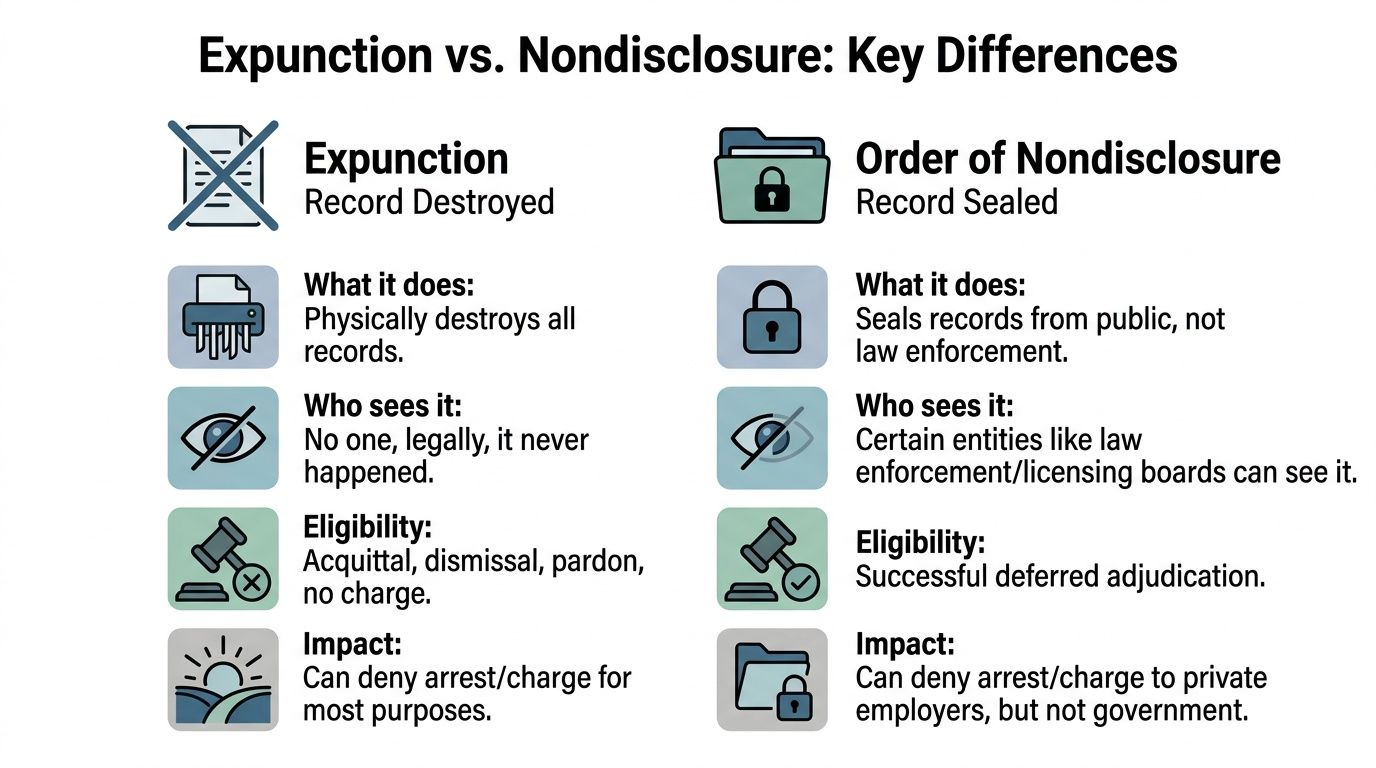
As explained in TexasLawHelp's guide on expunctions versus nondisclosures, public confusion is widespread, and nondisclosure remains the only viable path for many people with prior convictions or deferred adjudication in Texas.
Side-by-side comparison
| Question | Expunction | Nondisclosure |
|---|---|---|
| What happens to the record | Record destruction or return is ordered for listed agencies | Record is sealed from public view, not destroyed |
| Who usually fits | People with acquittals, dismissals, no-file outcomes, no-bills, pardons, or similar qualifying results | Many people who completed deferred adjudication and meet the statutory rules |
| Public access | The goal is removal from official records held by named agencies | Public access is restricted, but some entities may still see it |
| What you can say later | You may legally deny the arrest occurred in most situations | The legal effect is more limited |
A short video can help if you're trying to understand this difference in plain language.
Why this distinction matters so much
A lot of people hear “record clearing” and assume every remedy works the same way. It doesn't. If you completed deferred adjudication, your first question often shouldn't be “Can I expunge this?” It should be “Which remedy fits my case?”
That matters because nondisclosure also has exclusions. TexasLawHelp notes that some offenses involving family violence or sex offender registration are not eligible for nondisclosure. For some readers, that's a painful answer, but it's better to get a clear answer than to spend months chasing the wrong remedy.
Sealing and destruction are not interchangeable. The right remedy depends on how your case ended.
For Atascocita families, this distinction can also shape broader life planning. A person may be dealing with a criminal record issue while also trying to protect parenting rights, update estate documents, or move through a divorce. Clear legal advice matters because one misunderstanding in one area can affect confidence everywhere else.
Your Step-by-Step Guide to Filing in Harris County
You pull up your case online, see old arrest information tied to Harris County, and wonder where to even start. That feeling is common for people in Atascocita and Humble because the process sounds statewide, but the work happens locally, through Harris County courts, clerks, and agencies.
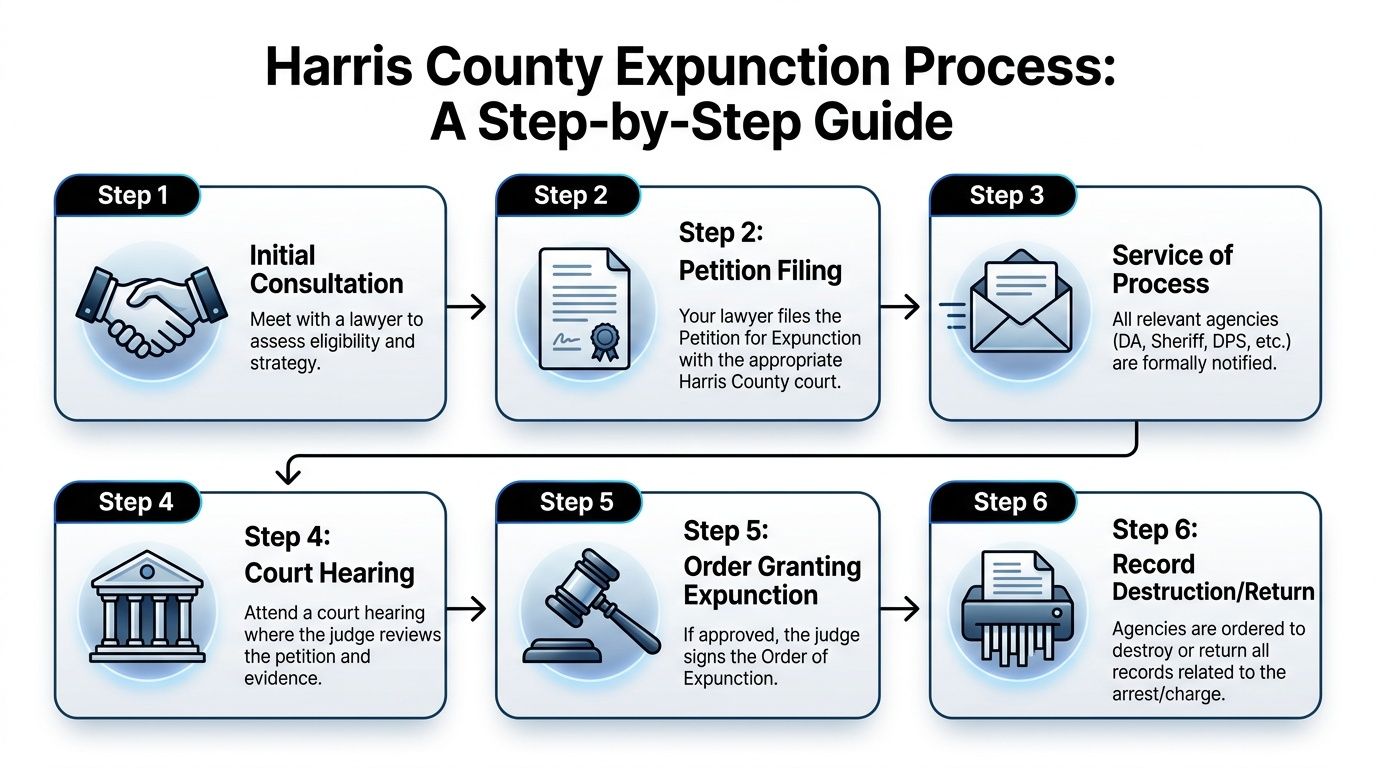
A Harris County expunction usually works like a paper trail cleanup. The court needs the right facts, the right agencies, and enough time to notify everyone who may hold a copy of the record. If one part is off, the case can slow down or come back with objections.
Step one through step three
Gather the exact case information
Start with the basics. You need the arrest date, the agency involved, the charge, the cause number if one exists, and the final outcome. For many local residents, that means pulling records connected to the Harris County District Clerk, the county clerk, the arresting agency, or the prosecutor's office. Small errors matter here. A wrong date or incomplete agency name can cause trouble later.Confirm that the outcome supports expunction
Before filing anything, make sure the ending of the case matches the law. Dismissals, no-billed cases, and arrests that never led to charges may qualify in some situations. If you are still trying to understand what happened earlier in the case, this guide on how charges get dropped gives helpful background on that part of the process.Prepare and file the Petition for Expunction in the proper Harris County court
The petition is the formal request asking the court to clear the record. It must identify the agencies that may hold records of the arrest. In Harris County, filing in the correct court and naming the agencies precisely can make the difference between a smooth case and a delayed one.
The notice and response stage
After filing, each listed agency must receive notice. That can include the arresting department, the district attorney or county attorney, the clerk's office, the Texas Department of Public Safety, and sometimes jail or records divisions.
Texas Law Help explains that an expunction petition must be filed in the district court for the county where the arrest occurred, and the petition must include identifying information about the agencies and records involved. Their Texas expunction guide from Texas Law Help is a useful statewide reference, but Harris County practice is where many people get stuck. The local challenge is not just knowing the rule. It is applying it to the right office, the right record set, and the right case history.
Some cases move without objection. Others do not.
If an agency believes the petition is too broad, missing information, or filed before a waiting period has passed, it can object. That is one reason Harris County filings need careful review before they ever reach a hearing date.
The hearing and final order
Once notice goes out and the case is set, the judge reviews the petition, any responses, and the supporting paperwork. In some Harris County courts, the hearing is brief if the file is clean and no one contests it. In others, the judge may ask direct questions about eligibility, dates, or the agencies listed.
If the court grants the petition, the signed order tells the named agencies what to do with the records covered by the expunction. The practical timeline varies by the court's docket, service on agencies, and whether anyone objects.
That is why local expectations matter. A resident of Atascocita may hear generic Texas advice online and assume the process is identical everywhere. It is not. Harris County has its own filing flow, court calendars, and clerk practices, and those details affect how long the case takes and how much follow-up is required.
One more point is easy to miss. Public reputation and legal cleanup are different jobs. Resources like ZenChange Marketing's attorney branding advice speak to how professionals present themselves online, but expunction deals with court records and government databases. If your goal is a true legal clean slate, the petition, service list, and final order have to be done correctly in Harris County.
Why a Local Atascocita Lawyer Is Your Best Advocate
The biggest expunction mistakes usually happen before anyone gets to court. People assume the process is simple because the idea is simple. Clear the record. In practice, the paperwork and agency list have to be precise.

The risk of an incomplete expunction
A formal petition must identify every government agency that holds a copy of the record. According to BHW Law's Texas expunction and nondisclosure guide, failure to serve even one agency can leave the record partially intact and undermine the legal effect of the expunction.
That's a serious problem. If one database, one clerk's office, or one law enforcement record repository is left out, the result may not give you the clean slate you thought you were getting.
Common trouble spots include:
- Missing agencies: A record may sit in more places than you expect.
- Wrong case details: Small errors in arrest dates, cause numbers, or agency names can create delays.
- Weak hearing preparation: If the State objects, you need a clear legal response.
- DIY filing assumptions: Forms found online don't tell you how local practice works.
Why local knowledge helps
A lawyer who regularly works with Harris County procedure understands the practical side of expunction cases. That includes how the local courts process petitions, what objections may come up, and how to present the case cleanly.
For readers trying to evaluate counsel carefully, how to find a good criminal defense attorney is a useful starting point. It helps frame the right questions to ask before trusting someone with a record-clearing case.
The Law Office of Bryan Fagan – Atascocita TX Lawyers handles criminal defense matters for people in Atascocita, Humble, and Harris County, along with family law, estate planning, and civil cases. That kind of local, full-service practice can be useful when a criminal record issue overlaps with the rest of a person's life.
A strong expunction case is not just about eligibility. It's about complete execution.
One more practical note. Trust matters in legal work, and so does communication. If you're curious how lawyers think about professional presence and client confidence, ZenChange Marketing's attorney branding advice offers an outside perspective on how attorneys present credibility and approachability to the public.
Take the First Step Toward a Clean Slate Today
If an old arrest is still disrupting your life in Atascocita, Humble, or elsewhere in northeast Harris County, you don't have to accept that as permanent. For the right case, expunction can offer something powerful. A legal way to clear the official record and move forward.
The key is knowing whether you qualify, choosing the right remedy, and handling the Harris County process carefully. Some people need expunction. Others need nondisclosure. Some need an honest answer that neither option is available. Clarity matters just as much as hope.
Criminal law issues also don't exist in isolation. A person trying to clean up a record may also be preparing for divorce, dealing with custody concerns, or updating estate planning documents for their family. Texas legal problems often overlap in real life, which is why practical, plain-English guidance matters so much.
If you've been putting this off because the process sounds intimidating, that's understandable. It's common to feel unsure where to begin. But the first step is usually much smaller than people think. It starts with reviewing the facts, the paperwork, and the timeline.
A record from the past shouldn't keep deciding your future.
If you're ready to talk through your options, schedule a free consultation with Law Office of Bryan Fagan – Atascocita TX Lawyers. Our Atascocita office works with residents of Atascocita, Humble, and surrounding Harris County communities who need clear answers about expunctions, criminal defense, family law, estate planning, and related legal concerns. A confidential conversation can help you understand whether expunction, nondisclosure, or another path fits your situation.


