When the handcuffs click, your mind is racing. It's a confusing, terrifying moment for anyone in our community, but what you do in the next few hours can make or break your entire case. The goal is to get the charges dropped, and that process starts right now. The two most critical things you can do are to invoke your right to remain silent and request an attorney immediately.
Your First Moves After an Arrest in Harris County
Whether you’re in Atascocita, Humble, or anywhere else in Harris County, the moments after an arrest feel like a whirlwind. This is a time of immense stress, but it's also when you have to be the most disciplined. Everything you say and do from this point forward lays the foundation for your defense.
Your most powerful shield is your right to remain silent. It's not just a line from TV shows; it's a constitutional protection designed for this exact situation. Police are trained interrogators, and even an innocent, off-the-cuff remark can be twisted and used against you later in a Harris County court.
Don't try to explain your side of the story or talk your way out of it. It won't work. Simply and calmly state, "I am invoking my right to remain silent. I want to speak with my attorney." Say it and stop talking.
Protecting Your Rights from the Start
Once you ask for a lawyer, the police are legally required to stop questioning you. This is a game-changer. It puts a stop to any potential missteps that could seriously damage your case.
During booking at the Harris County Jail, you'll need to provide basic information like your name and address. That's fine. But don't discuss the details of what happened with anyone—not the officers, not your cellmates, and definitely not over the jail phone. Those calls are always recorded.
The single most important thing you can do after being arrested is to clearly state that you want a lawyer. That one sentence shifts the power dynamic and gets a professional in your corner to protect you.
Your one phone call should be strategic. Don't waste it trying to explain the situation. Focus on what matters:
- Tell them where you are (most likely the Harris County Jail).
- Ask them to start working on getting you out on bail.
- Have them contact a criminal defense lawyer for you right away.
Keep it short, sweet, and to the point.
Common Mistakes to Avoid Immediately
In a high-stress situation like an arrest, it’s easy to make mistakes. One of the worst things we see clients do is post about the situation on social media. Prosecutors absolutely monitor social media accounts. A poorly-worded post, an ill-advised photo, or even a friend’s comment can be taken out of context and used against you. Just stay off of it.
It's also crucial to remember that this is just the beginning. For a broader overview of the immediate steps, some general guides on what to do when someone gets arrested can be helpful, and they all echo the same advice: stay quiet and get a lawyer. To fully grasp your protections, it's a good idea to understand what are your Miranda rights and how they apply in Texas.
By taking these deliberate actions, you're not admitting you did anything wrong. You are simply protecting your constitutional rights and giving your attorney the clean slate they need to build the strongest defense possible—and start working toward getting those charges dropped.
Proven Legal Strategies to Get Your Case Dismissed
Getting criminal charges dropped in Texas isn’t about luck. It’s about having a deliberate, well-executed legal strategy. As experienced local defense attorneys, we use a specific set of tools to scrutinize and challenge every piece of the prosecution's case. Our goal is to dismantle their arguments, often forcing a dismissal long before a trial ever begins.
We make it a point to translate complex legal maneuvers into plain English for our clients in Atascocita and Humble. You’ll understand exactly how we’re working to protect your rights and fight for the best possible outcome for you and your family.
Challenging the State's Evidence
The foundation of any criminal case is the evidence. If that evidence is weak, was handled improperly, or—most importantly—was obtained illegally, the entire case against you can crumble. This is often the most direct path to getting charges dropped.
One of the most powerful tools in our arsenal is the motion to suppress evidence. Let's say a Humble resident was pulled over for a minor traffic violation on FM 1960. If the officer then conducted an illegal search of the car without probable cause and found something, we would immediately file a motion to get that evidence thrown out. If the judge agrees the search was unconstitutional, the prosecutor might be left with no case at all.
A criminal case is like a chain, and each piece of evidence is a link. If we can prove just one link was forged through an illegal search or a broken chain of custody, the entire case can fall apart.
Evidence also has to be handled meticulously from the moment it’s collected. This is called the chain of custody. For instance, in a drug possession case in Atascocita, we dig into the details:
- Who collected the evidence at the scene?
- How was it stored and transported to the lab?
- Who had access to it at every single stage?
Any gap or inconsistency in this chain can make the evidence unreliable and completely inadmissible in a Harris County courtroom.
Questioning Witness Credibility and Probable Cause
A prosecutor's case often hinges on witness testimony. But witness statements aren't always what they seem. People can be mistaken, biased, or even have a personal motive to lie. A huge part of our job is to investigate the credibility of every single witness.
Think about an assault charge that started with an argument outside a restaurant in Humble. The accuser might paint our client as the aggressor, but what if our investigation uncovers a history of false accusations or a personal grudge? By exposing these credibility issues, we can create serious doubt and put immense pressure on the prosecutor to drop the case.
Beyond that, your arrest itself had to be based on probable cause. This means the police needed more than just a gut feeling; they needed concrete facts suggesting a crime was committed. If we can show the arrest was made without sufficient probable cause, any evidence they gathered afterward can be thrown out, often leading to a swift dismissal.
Leveraging Pre-Trial Negotiation and Affirmative Defenses
A lot of dismissals happen not in a dramatic courtroom showdown, but through smart, strategic negotiation. And the numbers back this up. In the U.S. federal court system, a significant 8.2% of all criminal cases were dismissed in 2022. This statistic highlights just how often charges are dropped because a proactive defense team exposed insufficient evidence, procedural errors, or witness issues during the pre-trial phase.
We use every weakness in the state’s case as leverage. An experienced local attorney who knows the tendencies of Harris County prosecutors can often present a compelling argument for why a case simply shouldn't move forward. In many cases, this involves challenging the prosecution's evidence, where understanding the critical role of a forensic pathologist expert witness in Texas Courts can be a key strategy to dismantle their narrative.
Sometimes, the best defense is a proactive one. An affirmative defense, like self-defense, isn't about denying you did something—it's about proving you were justified. If you were defending yourself or your family, we gather the evidence to prove it: witness statements, security footage, injury reports. We present this evidence to the prosecutor early to persuade them to drop the charges. This approach can be far more effective than simply waiting to see what happens, and for some, it can be a better option than alternatives. You can learn more about deferred adjudication in our article to see how different legal paths compare.
Using Pre-Trial Diversion Programs in Harris County
When you’re facing a criminal charge in Harris County, the thought of a trial can be overwhelming. The good news is, a conviction is far from a sure thing. For many people, especially first-time offenders, the best way to get charges dropped isn't a dramatic courtroom fight but enrolling in what’s called a pre-trial diversion program.
These programs are a lifeline, offering a path that avoids a formal conviction altogether. If you're in Atascocita, Humble, or anywhere in northeast Harris County, knowing how these programs work is one of the most important first steps you can take to protect your future.
What Exactly Is a Pre-Trial Diversion Program?
You can think of a pre-trial diversion as a formal agreement between you and the Harris County District Attorney's office. You agree to fulfill a specific set of conditions over a period of time. If you hold up your end of the bargain, the prosecutor agrees to dismiss your case completely. It's a powerful tool, and something we frequently negotiate for our clients.
The goal here is rehabilitation, not punishment. These programs are built for people who’ve made a mistake but aren’t considered a threat to public safety.
A pre-trial diversion program is one of the most powerful tools for preserving a clean record. It acknowledges that a single mistake shouldn't define the rest of your life, offering a clear path to a complete dismissal of the charges against you.
This chart illustrates a key concept in any criminal case: was the proper procedure followed? A procedural error by law enforcement can be a direct path to getting a case thrown out.
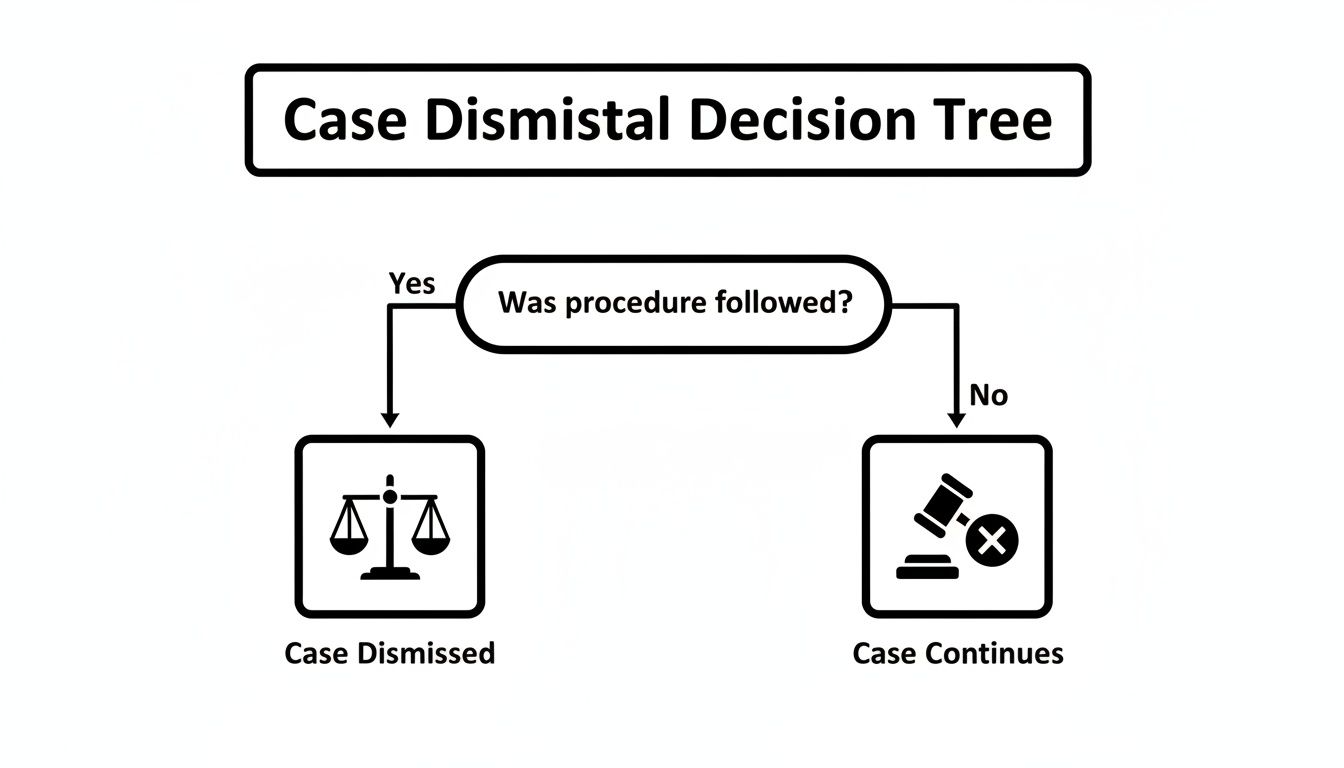
As you can see, a break in procedure can lead straight to a dismissal. But even when everything is done by the book, diversion programs open up another door to that same successful outcome.
Who Qualifies and What’s Involved?
Getting into a diversion program in Harris County isn't automatic; it depends entirely on the details of your case. Generally, these programs are reserved for:
- First-time offenders with a minimal or non-existent criminal history.
- People charged with non-violent misdemeanor offenses.
- Cases where the circumstances suggest rehabilitation makes more sense than a conviction.
Common charges that often qualify are first-time DWI, possession of a small amount of marijuana, and some lower-level theft offenses. The requirements are meant to be constructive, not just punitive, and usually include a mix of the following:
- Completing educational classes (like an alcohol awareness course)
- Putting in a certain number of community service hours
- Paying associated fines and court costs
- Undergoing regular drug tests
- Staying out of any new legal trouble while in the program
The reality is that prosecutors everywhere feel pressure to resolve cases efficiently. This can work to your advantage. Around the world, DAs often drop weaker cases to keep their conviction rates high—a dynamic that shows how a strong defense can force their hand. We apply the same logic right here in Harris County. Whether we're challenging the evidence from a traffic stop on Atascocita Shores Drive or negotiating with an overworked DA, we create opportunities for our clients, including getting them into these programs. You can find more details on global conviction rate trends on Wikipedia.
For instance, think of a young adult from Atascocita—maybe a student at Lone Star College-Kingwood—who gets charged with their first DWI after a bad decision. A conviction could derail their entire career and educational path. Instead, we can often negotiate their entry into a diversion program. They complete the required classes and community service, and in return, they earn a full dismissal. Their record stays clean, and their future remains intact. That’s the real-world impact of having a skilled, local attorney on your side.
Getting charges dropped can happen in a couple of primary ways. You can either fight the case head-on by challenging the evidence and procedures, or you can work with the system through a diversion program.
Paths to Dismissal in Harris County
| Strategy | Who It's For | Common Outcome | Key Action |
|---|---|---|---|
| Direct Challenge | Cases with weak evidence, procedural errors, or strong defenses (e.g., alibi). | Case dismissed by a judge or dropped by the prosecutor before trial. | Filing a Motion to Suppress Evidence; presenting exculpatory evidence. |
| Diversion Program | Primarily first-time, non-violent offenders eligible for rehabilitation. | Case dismissed by the prosecutor after you complete the program requirements. | Negotiating with the DA's office to secure your spot in the program. |
Both paths lead to the same goal: a dismissal. The right one for you depends entirely on the unique facts of your case and your personal history.
If you or a family member is facing criminal charges, don't just assume a conviction is unavoidable. Contact The Law Office of Bryan Fagan at our Atascocita office for a free consultation. We will sit down with you and figure out if a pre-trial diversion program is the right strategy to get your charges dropped.
The Attorney's Role in Negotiating with Prosecutors
Most people picture criminal defense as a dramatic courtroom showdown, like something out of a movie. The reality is that many cases are won or lost long before a trial ever begins, through quiet, persistent negotiation behind the scenes.
For our clients in Atascocita, Humble, and across northeast Harris County, this is often where the best results are found. It's where a proactive defense attorney can dismantle the prosecution's case piece by piece, often leading to a complete dismissal without the stress and risk of a jury trial.
How We Build Leverage to Get a Dismissal
The Harris County District Attorney's office is swamped. A single prosecutor might be juggling hundreds of cases at once. They simply don't have the time or resources to take every case to trial, especially if it has problems. This is where we step in.
Our job isn't just to ask for a dismissal; it's to make a dismissal the only logical option for the prosecutor. We do this by creating leverage. We dig into every report, every piece of evidence, and every witness statement, searching for the weak points—and we always find them. A shaky witness, a questionable police stop, or a broken chain of custody can turn a prosecutor's "slam dunk" into a case they'd rather not touch.
This involves several key moves:
- Filing Strategic Motions: We don't file motions just to create paperwork. A well-argued motion to suppress evidence sends a clear signal to the prosecutor: we've found a serious flaw in your case, and we're ready to fight it out in front of a judge. Suddenly, dropping the charge looks a lot more appealing than risking a loss in court.
- Presenting the Full Picture: We make sure the prosecutor sees you as a person, not just a case file. Are you a respected member of our Atascocita community? Do you have a steady job? Have you already started counseling? These mitigating factors can convince a prosecutor that a conviction serves no real purpose.
- Conducting Our Own Investigation: We don't just rely on what the police give us. Our team often uncovers exculpatory evidence—proof that points to your innocence—that was missed or ignored. This could be anything from tracking down an alibi witness to finding surveillance footage the police never bothered to pull.
This aggressive, front-loaded approach puts the pressure squarely on the prosecution.
A good negotiator knows how to make a dismissal the path of least resistance for a busy prosecutor. By exposing the holes in their case early on, we give them an easy off-ramp to drop the charges and move on to their stronger cases.
Real-World Negotiations in Harris County
So what does this look like in practice for our neighbors? For a client in Kingwood facing a low-level felony theft charge, we might show evidence that it was all a simple misunderstanding and highlight their clean record. The result? We could negotiate the charge down to a Class C misdemeanor, which is the equivalent of a traffic ticket.
In other situations, like a first-time DWI, we might secure a complete dismissal in exchange for our client proactively completing an alcohol awareness course. The prosecutor avoids a risky trial, and our client walks away with a clean record.
Interestingly, this approach is more effective than ever. The major global crime drop since the 1990s has given prosecutors more discretion as their caseloads shrink. For example, theft from persons has plummeted internationally, allowing DAs to focus their resources and be more willing to drop weaker cases. This dynamic creates opportunities for strong defense work right here in Harris County. When you combine this with recent data showing a drop in violent crime, Texas DAs are often more open to dismissing a shaky DWI or assault case when a defense attorney presents a compelling reason to do so. You can read more about the broader context of the global crime drop and how it impacts the justice system.
Ultimately, negotiation is an art. It demands a deep understanding of Texas law, a solid reputation with the DA's office, and a feel for the local legal landscape. It’s about building an undeniable case for dismissal before a jury is ever even considered.
If you are facing criminal charges, the negotiation phase is where your defense can make the biggest impact. Contact The Law Office of Bryan Fagan for a free, confidential consultation at our Atascocita office to discuss how our strategies can work to get your charges dropped.
Why a Local Atascocita Attorney Matters

When you're facing criminal charges in Harris County, the attorney you choose is arguably the most critical decision you'll make. Any lawyer with a Texas bar card can technically represent you, but there's a world of difference when your advocate is deeply rooted right here in the Atascocita community.
This isn't just about convenience. A local attorney brings a powerful, boots-on-the-ground advantage—a mix of familiarity, established relationships, and direct experience with the specific courts and people who will decide your fate. This insight often becomes the key to figuring out how to get charges dropped.
Knowing the Lay of the Land: The Harris County Courthouse
The Harris County justice system is its own complex world. The main criminal justice center downtown and the various satellite courts each operate with their own unique flow, unspoken rules, and distinct personalities.
Judges have their own specific preferences for how they manage their dockets. Prosecutors' offices have internal policies that shape how they approach cases. An out-of-town lawyer is forced to learn all this on the fly, but a local Atascocita attorney already knows the terrain. We are in these courtrooms every single day, defending your neighbors from Humble, Kingwood, and the surrounding areas.
This firsthand knowledge means we can often predict a prosecutor's next step or tailor an argument to what we know resonates with a specific judge. It's not about backroom deals; it’s about having the strategic intelligence you can only get from being there, day in and day out.
The Value of a Good Reputation and Local Connections
In law, your reputation is everything. A local attorney spends years, sometimes decades, building a professional reputation with the same prosecutors, judges, and court staff. When we walk into a courtroom to negotiate, that history of credibility walks in with us.
Prosecutors are human. They're often more open to a candid, productive discussion with a lawyer they know and trust—someone who won’t waste their time with baseless claims but will fight tooth and nail for their client.
A truly local attorney isn't just a professional you hire; we're your neighbors. We are invested in the well-being of our Atascocita and Humble communities because we live here. That personal stake changes everything.
This foundation of mutual respect can open doors to better plea offers, opportunities for diversion programs, or simply a more receptive ear when we're arguing for a complete dismissal of the charges.
Your Advocate is Your Neighbor
When you hire The Law Office of Bryan Fagan, you’re not just hiring legal expertise. You're partnering with a team that is part of the Atascocita community. We understand the local landscape because we live and work here, too. Our commitment is to protecting our neighbors—your rights, your family, and your future.
If you are weighing your choices, our guide on how to find a good criminal defense attorney offers more practical advice for making this crucial decision.
Our local focus is our greatest strength. It allows us to offer defense that is not only highly effective but also personal and compassionate. We aren't just fighting a case; we are defending a member of our own community.
If you or someone you care about is facing criminal charges, you don’t have to navigate the Harris County legal system by yourself. Schedule a confidential, free consultation at our Atascocita office. Let's talk about your case and show you exactly what a dedicated local attorney can do to protect what matters most.
Common Questions We Hear About Getting Charges Dropped in Texas
When you're facing criminal charges in Harris County, your mind is probably racing with urgent questions. The uncertainty is often the worst part. As lawyers who work with people from Atascocita, Humble, and all over the area, we've heard them all. Here are some straightforward answers to the questions that come up most often.
How Long Does It Take to Get a Case Dismissed?
This is usually the very first thing people ask, and the most honest answer is: it really depends.
Sometimes, a case can get tossed out quickly, maybe within a few weeks of the arrest. This usually happens when there's a huge, undeniable problem with the prosecution's case, like a blatantly illegal search or a complete lack of evidence. A well-timed motion to suppress could shut the case down early.
But that's not the norm. Most of the time, it's a longer road. We have to gather evidence, interview witnesses, file the right legal motions, and go back and forth with the prosecutor. This process can easily take several months. For more serious or complicated cases, it’s not unheard of for it to take a year or more to get the right outcome. The key is patience while we build the strongest possible defense for you.
What’s the Difference Between Dropped Charges and a "Not Guilty" Verdict?
Both are fantastic outcomes because they mean you walk away without a conviction, but they happen in very different ways.
- Dropped Charges: This is a decision made by the prosecutor to stop moving forward with the case. It all happens before a trial ever begins.
- Not Guilty Verdict: This is a decision made by a jury or a judge after a full trial. It means the prosecutor presented their entire case, and they still couldn't prove you were guilty beyond a reasonable doubt.
Getting your charges dropped is almost always the best-case scenario. It saves you from the emotional and financial toll of a trial and avoids the risk and uncertainty that comes with putting your fate in a jury's hands.
A key thing to remember: the police don't file charges. In Texas, police make arrests. It's the Harris County District Attorney's Office that reviews the evidence and officially decides whether to file and pursue criminal charges. This gap between arrest and filing is a critical window where a skilled attorney can often intervene.
If My Charges Are Dropped, Can They Be Re-Filed?
This is a really important question. If the prosecutor drops the charges "without prejudice," they often reserve the right to re-file them later, as long as the statute of limitations for that specific crime hasn't run out. This could happen if, for example, they find new evidence down the line.
However, if a judge dismisses a case "with prejudice," that's a final, permanent decision. The charges related to that incident can never be brought against you again. This is the gold standard of dismissals, and it’s what your attorney will always fight for.
The Charges Were Dropped, So Is My Arrest Record Clear?
No, and this is a crucial detail that catches many people by surprise. A dismissal is great—it means no conviction—but the record of your arrest doesn't just vanish. It will still be there, ready to pop up on background checks when you apply for a job, an apartment, or even a loan.
To truly wipe the slate clean, you have to take another legal step called an expunction. An expunction is a court order that forces all government agencies to physically destroy the records related to your arrest. Once your record is expunged, you can legally and honestly deny that the arrest ever happened. It’s the final, essential step to putting the whole ordeal behind you for good.
Facing criminal charges is a daunting experience, but you don't have to navigate it by yourself. The experienced team at The Law Office of Bryan Fagan – Atascocita TX Lawyers is here to give you clear answers and build a powerful defense designed to get your charges dropped. We are committed to serving our neighbors in Atascocita, Humble, and across northeast Harris County.
Schedule a free, confidential consultation with us today to go over the details of your case and see how we can help protect your future. Visit us online at https://www.atascocitaattorneys.com to get started.