Skip to content
A first criminal charge can make an ordinary week feel impossible. You may be trying to keep working, answer your family's questions, and understand court paperwork while searching terms like deferred adjudication vs pretrial diversion in Atascocita, TX. The two options can sound similar, but they begin at different points, require different decisions, and may produce very different record-clearing results.
For residents of Atascocita, Humble, and northeast Harris County, the early choice matters. One path requires a guilty or nolo contendere plea and court supervision. The other is generally a prosecutor-run agreement before a plea. Neither option is automatic, and neither should be accepted until you understand what happens if you complete the terms, violate them, or later apply for work, housing, licensing, or immigration benefits.
Facing Criminal Charges in Atascocita and Unsure What Comes Next
Suppose an Atascocita resident is arrested or cited for a first criminal charge. At the initial stage, the paperwork may mention court dates, conditions, or negotiations, but it may not explain the difference between the two most important potential resolutions. A lawyer or prosecutor may mention pretrial diversion, while another discussion may focus on deferred adjudication. To someone under stress, both can sound like ways to avoid a conviction.
They aren't interchangeable. Deferred adjudication is a judge-ordered, post-plea process. Pretrial diversion is generally a pre-plea agreement handled through the prosecutor's office. That distinction affects whether you must plead guilty or nolo contendere, who controls the terms, what happens after a violation, and how you may later pursue record clearing.
The immediate question isn't “Which program sounds easier?” The better questions are:
- Was a plea required? A plea can change your legal position if the agreement later fails.
- Who controls the outcome? A judge and court supervision operate differently from a prosecutor's diversion agreement.
- What happens to the record? A dismissal doesn't automatically mean every arrest and case record disappears.
- What happens if you violate a condition? The consequences can be different and may affect the original charge.
- Will immigration or licensing concerns change the analysis? A plea-based resolution requires special care for some clients.
Practical rule: Don't accept a result based only on the word “dismissed.” Ask what record remains and what additional legal process may be available afterward.
A resident in Humble may care about a background check for a new job. A parent in Atascocita may worry about housing, professional licensing, or the effect of a case on family stability. Those concerns belong in the defense conversation from the beginning, not after supervision ends. Early legal advice can also matter because diversion negotiations may be more useful before the case advances into a plea-based posture.
Understanding Deferred Adjudication Under Texas Law
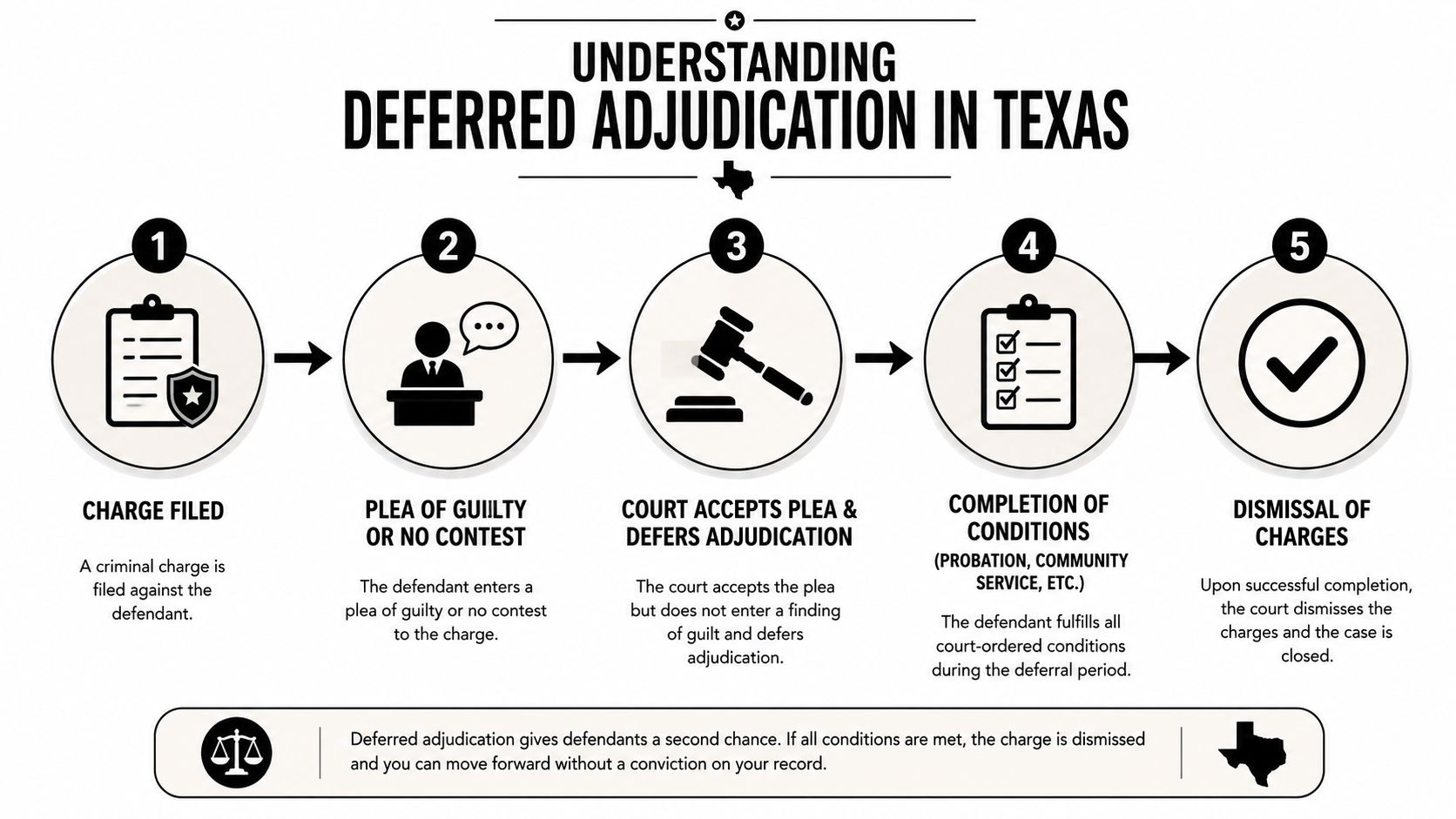
A deferred adjudication agreement changes the case only after the defendant pleads guilty or nolo contendere. The judge reviews the evidence, determines that it substantiates guilt, and decides under Article 42A.101 whether postponing a final finding serves the interests of both society and the defendant. The court then defers adjudication and places the defendant on community supervision. This Texas deferred adjudication overview for Atascocita residents explains the court-based process in more detail.
Deferred adjudication is a special form of community supervision. The defendant accepts responsibility through the plea, but the court does not enter a final conviction at that stage. If supervision is completed and the case is later dismissed, Texas administrative rules generally do not treat the person as convicted for that purpose. The distinction from pre-plea diversion remains important because the plea can affect later defense options and record-clearing analysis.
The supervision period and court conditions
Texas law generally limits deferred adjudication to 10 years for felonies and 2 years for misdemeanors. Those limits appear in Article 42A.102 of the Texas Code of Criminal Procedure. The judge sets the conditions and may discharge the defendant early when doing so serves the interests of society and the defendant.
Conditions depend on the charge and the court's order. They may include regular reporting, counseling, classes, community service, testing, payments, and compliance with all laws. Supervision is court-ordered, not informal. The judge must advise the defendant, orally or in writing, about the consequences of violating those conditions under the Texas criminal procedure statute.
Successful completion can lead to dismissal without a final adjudication of guilt. The arrest and case records may still remain available, however. That distinction affects future employment and housing checks in Atascocita. Depending on the charge and eligibility, the next legal step may be an order of nondisclosure, while full expunction may not be available. Deferred adjudication can therefore protect against a final conviction without automatically clearing the record.
The risk of a violation
A violation may lead to arrest and detention, followed by a hearing on whether the court should adjudicate guilt on the original charge. Under Article 42A.108, the court may retain jurisdiction after supervision expires if the state files a motion to proceed and a capias issues before expiration.
Before accepting this resolution, review every condition, the evidence behind the original charge, and the consequences of giving up a trial. A missed requirement can place the original case back before the court. Deferred adjudication may prevent a final conviction, but it is not the same as a record-free dismissal or a risk-free outcome.
How Pretrial Diversion Works in Harris County
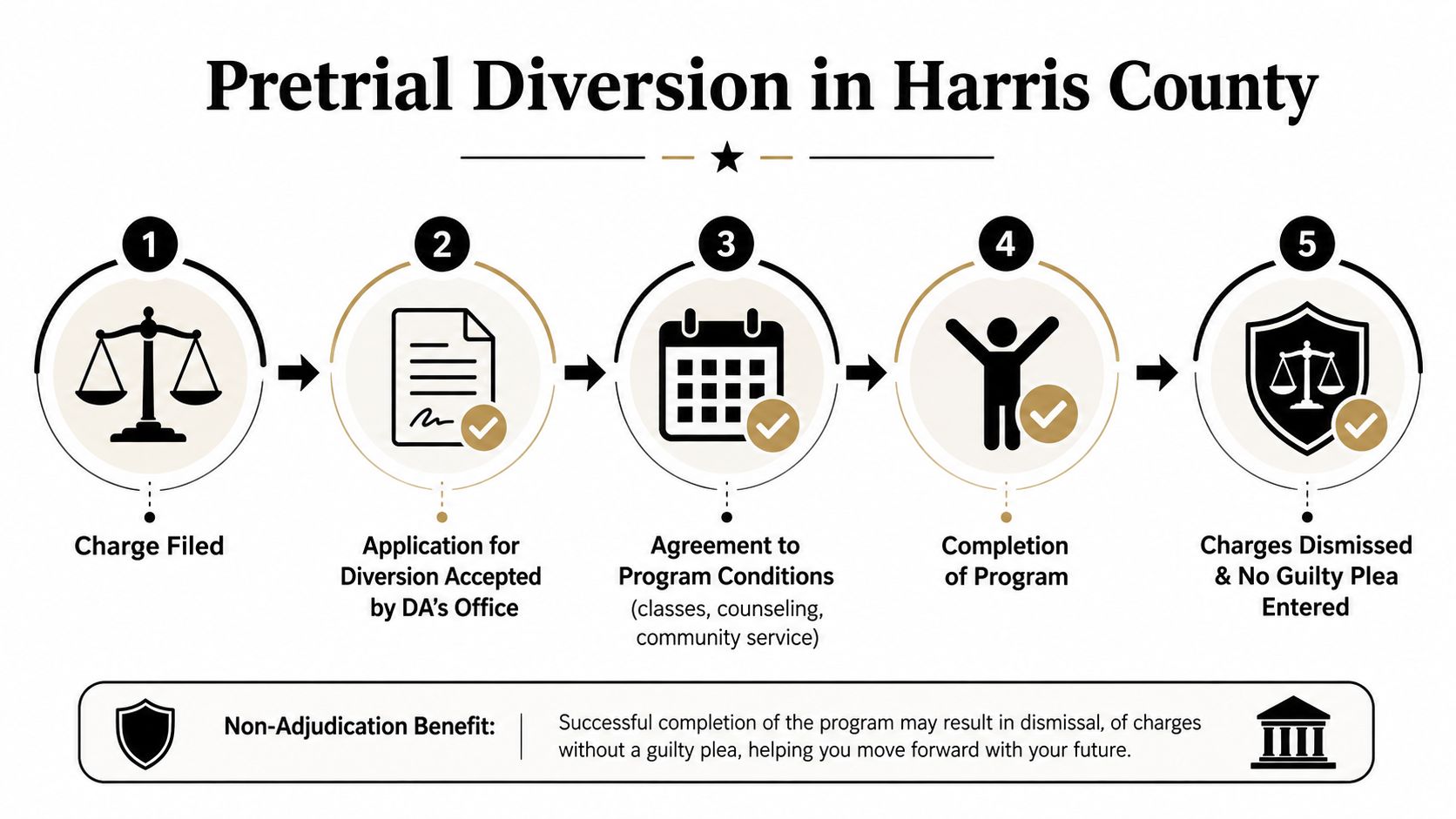
Pretrial diversion generally operates before a plea-based adjudication. Instead of asking a judge to accept a plea and defer guilt, the defense seeks an agreement with the prosecutor's office. The agreement may require structured conditions, and successful completion can lead to dismissal under the program terms.
Harris County programs can vary by offense and local policy. Publicly described pretrial intervention and diversion programs in Harris County may last from 1 year to 2 years, showing that these programs can be structured and substantial even though they are designed to avoid the plea stage. Texas misdemeanor law also allows judges to defer some fine-only cases for up to 180 days without entering guilt, a separate statutory mechanism that shouldn't be confused with every prosecutor-run diversion program. The statutory distinction appears in Article 45A.302.
Eligibility depends on the charge and local policy
Diversion isn't available in every case. Prosecutors may consider factors such as the nature of the allegation, prior history, public safety concerns, the strength of the evidence, and whether the person appears likely to complete the conditions. First-time or lower-level cases may be considered more favorably in some programs, but there is no universal promise that a first charge qualifies.
Program conditions can include:
- Community service: The agreement may require documented service completed by specified deadlines.
- Counseling or education: A prosecutor may require classes, counseling, or an assessment connected to the alleged conduct.
- Restitution: If another person suffered a compensable loss, repayment may become part of the agreement.
- Reporting and compliance: The participant may need to report, provide documentation, and avoid new violations.
The agreement must be read as a contract with consequences. Missing a deadline or failing a condition can cause the prosecutor to withdraw the diversion benefit or resume prosecution, depending on the agreement. The defense should review those terms before signing, not after a problem occurs.
Why early representation matters
A diversion request is usually strongest when counsel can present a complete picture before the case moves further into formal plea negotiations. Police reports, video, witness information, employment or family responsibilities, and mitigation may all affect how the prosecutor evaluates the request. The defense also needs to assess whether the evidence should be challenged rather than traded for a program.
Residents comparing criminal procedure with other Harris County court systems may find Harris County Family Courts: A Atascocita Resident's Guide useful for its limited explanation of how family law cases proceed in the Harris County courts serving Atascocita. Family courts and criminal courts are different systems, but local court procedure always matters.
The main advantage of true pretrial diversion is its timing. Because the case is handled before a plea-based finding, successful completion may create a stronger route toward expunction, depending on the offense and county rules. That possibility makes diversion worth investigating before accepting deferred adjudication.
Key Differences Between Deferred Adjudication and Pretrial Diversion
The clearest way to compare these options is to focus on the decisions made before the case is resolved. Deferred adjudication requires a plea and judicial action. Pretrial diversion usually avoids a plea and depends on an agreement with the prosecutor. The labels may appear close, but the legal posture is not.
| Factor | Deferred Adjudication | Pretrial Diversion |
|---|---|---|
| Timing | Occurs after a guilty or nolo contendere plea | Generally occurs before a plea-based adjudication |
| Decision-maker | Judge orders the deferment and community supervision | Prosecutor's office typically offers and administers the agreement |
| Plea requirement | Guilty or nolo contendere plea is required | No guilty plea is generally entered |
| Finding and court role | Judge hears evidence, finds it substantiates guilt, and defers guilt | Case is diverted before a conviction-eligible court finding |
| Supervision length | Generally up to 10 years for felonies and 2 years for misdemeanors under Texas law, as explained in Texas statutory guidance on deferred adjudication | Harris County programs publicly described as lasting from 1 year to 2 years, depending on the program and offense |
| Successful completion | Proceedings can be dismissed without a final adjudication of guilt | Charges may be dismissed under the diversion agreement |
| Violation | The court may proceed toward adjudication of guilt on the original charge after the required hearing | The prosecutor may terminate or decline to honor the agreement, subject to its terms |
| Record-clearing direction | Often points toward nondisclosure eligibility, with arrest and case information potentially remaining | May support expunction, depending on charge and local rules |
| Strategic concern | You accept plea-related risk to avoid a final conviction | You preserve a stronger pre-plea position, but the prosecutor must offer the program |
How to evaluate each path
Start with the plea question. If the proposed resolution requires a guilty or nolo contendere plea, ask what happens if supervision fails and whether immigration or licensing consequences require specialized advice. A plea can be strategically reasonable, but it shouldn't be treated as a minor administrative step.
Next, identify who controls the case after acceptance. With deferred adjudication, the judge's order and community supervision conditions control the relationship. With diversion, the written agreement and prosecutor's policy may define the participant's obligations. Read the violation provisions carefully. The consequences aren't interchangeable.
Then examine the record result. Successful completion of both paths may avoid a final conviction, but that doesn't mean both produce a clean slate. Deferred adjudication commonly leaves a record that may need nondisclosure. Pretrial diversion may create a basis for expunction, but eligibility still depends on the specific charge, disposition, and applicable rules.
The practical sequence
- Collect the charging documents. The exact offense, court, and procedural posture affect available options.
- Review the evidence. A weak case may call for litigation or dismissal efforts rather than a plea.
- Check diversion policy. Harris County program availability can depend on charge type and local practice.
- Compare written terms. Look at supervision, deadlines, fees, reporting, testing, and violation provisions.
- Plan record clearing before signing. Ask whether the likely result is expunction, nondisclosure, or neither.
A useful question for counsel: “If I complete this agreement, what can a private employer, landlord, licensing agency, or government agency still see?”
Record Clearing Outcomes and Long-Term Consequences
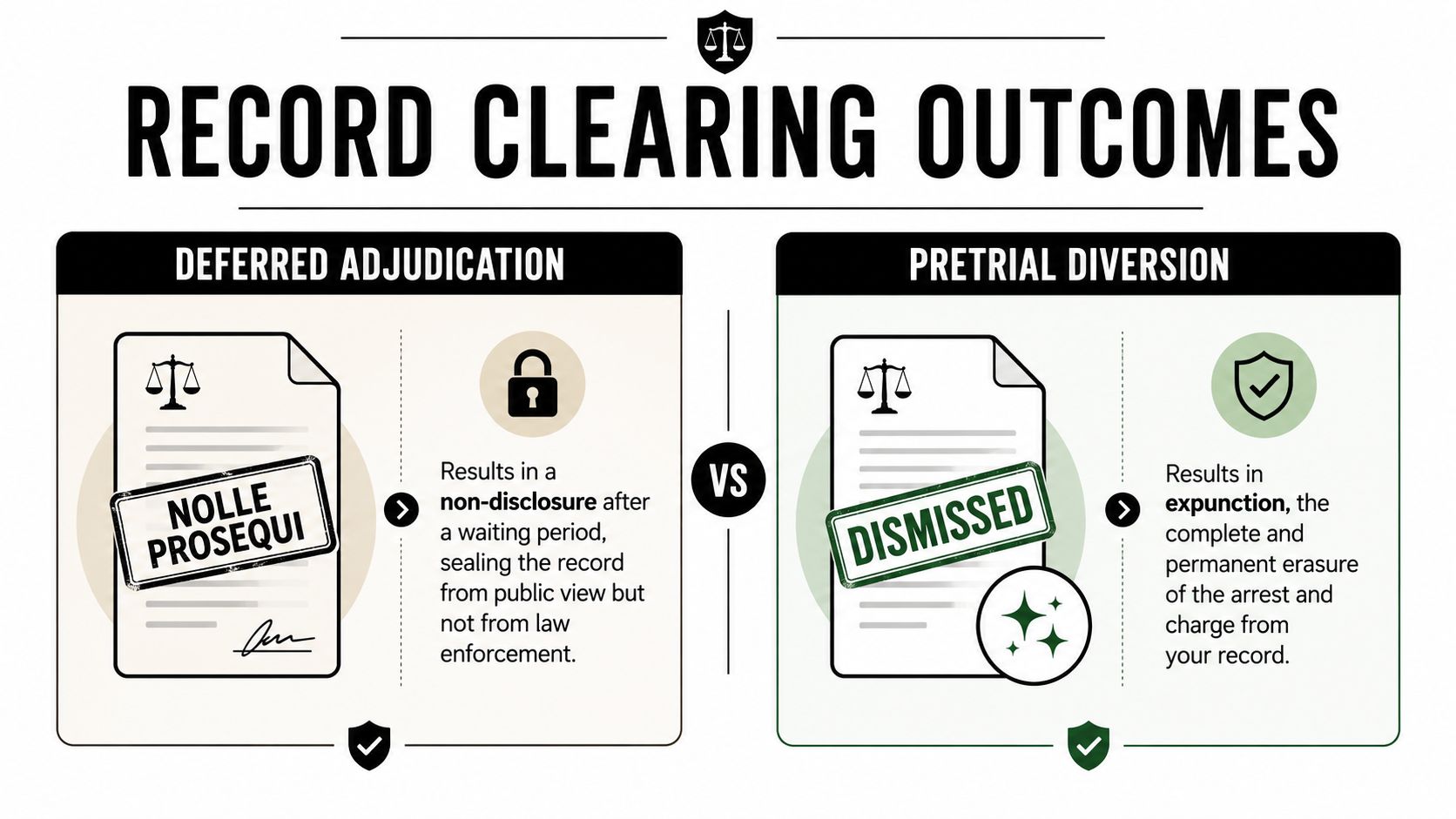
The outcome after supervision may matter more than the label on the agreement. Expunction and nondisclosure aren't the same form of relief. Expunction is intended to remove qualifying arrest and case records from the record. Nondisclosure restricts public access but doesn't erase the information for every authorized government or licensing purpose.
Successful pretrial diversion may support full expunction, because the case was handled before a plea-based adjudication. The result still depends on the charge and local program rules. A dismissal alone doesn't guarantee expunction, and a person should have eligibility reviewed before assuming the record can be destroyed.
Deferred adjudication generally points in a different direction. Even after successful completion and dismissal, arrest and case information may remain. A qualifying person may seek an order of nondisclosure, which can seal the record from general public view while leaving access for law enforcement and certain authorized entities. The Atascocita expunction lawyer resource explains why the specific disposition and charge must be reviewed before choosing a record-clearing strategy.
What employers and landlords may encounter
A public background check can treat a dismissed case, a sealed case, and an expunged case differently. An employer may ask about arrests or charges, while a housing provider may use a screening service that reports records pulled from multiple sources. Professional licensing boards can have separate disclosure rules, and some government agencies may retain authorized access to nondisclosed information.
That doesn't mean deferred adjudication is always a poor choice. Avoiding a final conviction can protect important opportunities. It does mean the client should compare a potentially stronger expunction path with the practical availability of diversion, the strength of the evidence, and the risks of a plea.
Search visibility can create another concern after a case has been reported online. For general reputation-management background, readers may review this resource on how to remove court records from Google. Online search cleanup doesn't replace expunction or nondisclosure, because legal record relief must be handled through the applicable court and agency process.
Immigration requires separate caution
A plea can carry consequences beyond the Texas criminal case for some noncitizens. Deferred adjudication's plea requirement makes an immigration-focused review especially important before acceptance. Pretrial diversion may avoid that plea, but local program language and the underlying facts still need to be evaluated by counsel familiar with immigration consequences.
The safest approach is to make record clearing part of the initial negotiation. Don't wait until the case is dismissed to ask what will happen next. The resolution, the charge, the court paperwork, and the agreement's wording can all shape the options available later.
Which Option Is Right for Your Situation
A resident of Atascocita or Humble may have several lawful ways to resolve a charge, but the right choice depends on the evidence, charge level, prior history, program availability, personal obligations, and the record result needed later. Start by identifying the long-term objective. A dismissal followed by expunction can offer stronger protection for employment and housing than a plea-based result that may qualify only for nondisclosure.
For a first-time, lower-level misdemeanor, pretrial diversion may be a practical option if the written conditions are manageable. Review every requirement before agreeing, including counseling, community service, restitution, reporting, and deadlines. Successful completion may lead to dismissal and support a later expunction, but the agreement should be examined before enrollment.
A felony allegation with meaningful mitigating facts calls for closer analysis. Harris County diversion may not be available, while felony deferred adjudication can involve supervision lasting up to 10 years under Texas law. Deferred adjudication may prevent a final conviction, yet its supervision demands and violation risks can affect the client for years. The plea, court paperwork, and later record-clearing eligibility all deserve review before acceptance.
Four questions that should guide the decision
- Is the evidence weak? Problems with the stop, identification, search, witness account, or other proof may support fighting the charge instead of accepting either program.
- Does immigration matter? Obtain immigration-focused advice before entering a plea or agreeing to a resolution.
- Can the client complete supervision? Transportation, work schedules, treatment, finances, and family responsibilities can make a technically favorable program difficult to finish.
- Which record result is required? A person seeking a professional license, new housing, or sensitive employment may place greater value on an expunction path than on avoiding a final conviction.
Deferred adjudication may be the available alternative when diversion is unavailable, the prosecutor will not offer a pre-plea resolution, or avoiding a conviction is the attainable goal. A difficult case still requires an evidence review. The client should understand the plea, conditions, violation consequences, and expected access to the record before treating that resolution as inevitable.
A local defense lawyer can explain how the Harris County prosecutor's office and assigned court handle the charge and proposed terms. Legal labels do not answer every practical question. The wording of the agreement and the procedural stage can change the record-clearing options. Readers seeking broader professional background can browse legal marketing topics, but that material cannot replace advice based on the actual case.

Steps to Take Right Now to Protect Your Future
Start by gathering the citation, bond paperwork, charging documents, court notices, and any release conditions. Write down your timeline while the events are fresh, identify possible witnesses, and preserve messages, video, photographs, or other information that may help your lawyer evaluate the case.
Don't discuss the facts with law enforcement, prosecutors, or people connected to the allegation without legal advice. Ask counsel specifically whether you may qualify for Harris County pretrial diversion, what deferred adjudication would require, and whether the expected result could support expunction or only nondisclosure.
You can also review the differences between using appointed representation and retaining counsel through this guide to public defenders versus private attorneys. During a consultation, bring your documents and ask about deadlines, plea consequences, supervision conditions, violation risks, and future record access.
Law Office of Bryan Fagan – Atascocita TX Lawyers handles criminal defense matters for residents of Atascocita, Humble, and Harris County, including the review of diversion and deferred-adjudication options. Schedule a free consultation to discuss your charge, protect your rights, and identify the record-clearing strategy that best fits your future.
The Law Office of Bryan Fagan – Atascocita TX Lawyers can review your charging documents, assess whether pretrial diversion or deferred adjudication is available, and explain the long-term record consequences in plain English. Contact the Atascocita office to schedule a free consultation before entering a plea or signing an agreement.