Skip to content

You're sitting at home in Atascocita after an arrest, trying to understand what happens next. Your phone is full of messages, your family wants answers, and you're worried about work, transportation, or a professional license. The first court date may feel like the entire case, but the decisions made before and between hearings often shape the result more than anything said in a courtroom.
A sound criminal defense strategy gives those decisions order. It protects your rights, identifies weaknesses in the prosecution's case, preserves evidence, and weighs dismissal, diversion, negotiation, and trial against the consequences for your future. For residents of Humble and northeast Harris County, the strategy must also account for Texas procedures, local eligibility rules, court deadlines, and the way prosecutors use digital evidence.
What a Criminal Defense Strategy Actually Means
Consider a hypothetical Atascocita resident charged after a late-night traffic stop. The person may believe the defense question is simple: plead guilty or fight the case. A careful lawyer asks more questions first. Why did the officer make the stop? Was the detention extended? Did the officer request testing or search a vehicle? Were statements recorded accurately? What do body-camera footage, phone records, and witness accounts show? Is there a license issue separate from the criminal charge?
That investigation is criminal defense strategy in practice. It begins with the earliest contact with law enforcement and continues through the final resolution. The plan may involve challenging the stop, limiting statements, reviewing laboratory or electronic evidence, negotiating conditions, seeking diversion, preparing mitigation, or taking the case to trial. Trial preparation matters even when a negotiated resolution is likely because the defense must understand what the prosecution can prove.
Strategy is more than a courtroom argument
A defense lawyer evaluates several connected questions:
- Evidence strength: What evidence exists, how was it obtained, and what is missing?
- Procedural protection: Did officers and investigators follow constitutional and statutory requirements?
- Exposure: What penalties, collateral consequences, and supervision conditions are possible?
- Personal circumstances: How might employment, family responsibilities, immigration concerns, housing, education, or licensing affect the decision?
- Local options: Does the charge fit a Harris County or other local diversion pathway, and do eligibility restrictions apply?
The right plan for a first-time DWI may look very different from the plan for an assault allegation, theft charge, or felony case involving electronic records. A person's prior record, the alleged conduct, the available witnesses, and the reliability of the evidence all matter.
The modern system also rewards early legal involvement. The constitutional right to appointed counsel in serious state criminal cases was established through the U.S. Supreme Court's unanimous decision in Gideon v. Wainwright on March 18, 1963, building on the federal right recognized in Johnson v. Zerbst. The decision helped make lawyer involvement a procedural safeguard rather than a private advantage. EBSCO's history of Gideon v. Wainwright describes that shift and its influence on modern criminal procedure.
Practical rule: Don't wait for the first court appearance to start thinking about your defense. Early facts disappear, digital records change, and deadlines can run while you're still trying to understand the accusation.
Common Defense Approaches Under Texas Law
Texas criminal defense rarely turns on a single slogan. An attorney compares possible defenses against the evidence and the legal elements the prosecution must prove. A theory that sounds persuasive in conversation may fail if the records, witnesses, or statute don't support it.
The evidence may not establish the charge
An insufficiency defense focuses on the prosecution's burden. If the evidence doesn't prove an essential element beyond a reasonable doubt, the charge may be challenged through motions, negotiation, or trial. For example, a theft case may depend on whether the state can establish ownership, intent, and the required conduct. Missing records, contradictory testimony, or an unreliable identification can alter the analysis.
An alibi defense requires more than saying the accused was elsewhere. Work records, phone location information, surveillance video, receipts, and credible witnesses may support the claim. The lawyer must check whether the timing excludes the accused and whether the records are authentic and complete.
Mistaken identity often arises when a witness had limited visibility, a stressful encounter, or an incomplete description. Identification procedures, lighting, distance, prior familiarity, and later exposure to photographs or social media can all matter. The defense may challenge both the procedure and the confidence expressed by the witness.
Justification and police conduct can change the case
A self-defense theory depends on the facts surrounding the perceived threat, the accused's response, and the surrounding circumstances. Photos, medical records, 911 calls, witness accounts, messages, and surveillance footage can help establish who initiated conduct and what the accused reasonably perceived.
Entrapment is narrower than many people assume. It generally requires more than an officer providing an opportunity to commit an offense. The defense must examine inducement and the accused's predisposition under the facts and applicable Texas law. A lawyer should test this theory carefully before presenting it as the central defense.
Suppression motions can be especially powerful. They may target Fourth, Fifth, and Sixth Amendment violations, including unlawful searches, coerced statements, and identification problems. The National Legal Aid and Defender Association performance guidelines treat suppression litigation as a core pretrial tactic involving tangible evidence, statements, and identification testimony.
For DWI-related questions, technical evidence and testing procedures may require a specialized perspective. A lawyer reviewing breath, blood, or accident evidence may find DUI defense for attorneys useful as a technical resource, though the facts of each Texas case still control.
The family-law resource The Divorce Process in Atascocita: What to Expect provides a separate step-by-step look at filing for divorce in Atascocita and Harris County. That subject differs from criminal defense, but overlapping family stress can affect how a defense lawyer documents responsibilities and practical consequences.
Procedural Stages and What to Expect
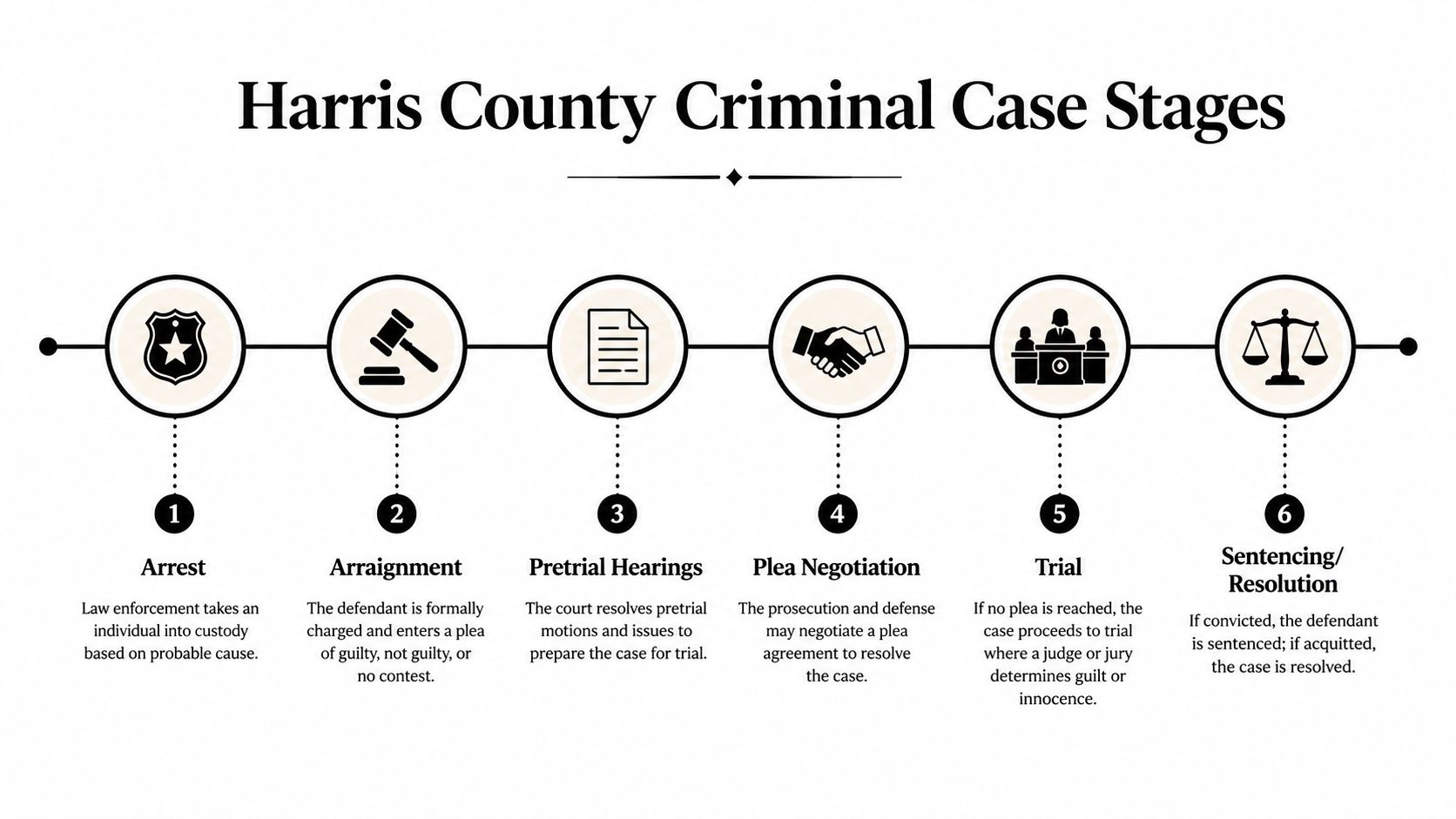
A Harris County criminal case can feel confusing because several processes may operate at the same time. The criminal prosecution is separate from administrative consequences, bond requirements, discovery deadlines, and collateral problems involving employment or licensing.
Start with the first decisions
After arrest, avoid discussing the facts with anyone except your attorney. Don't consent to searches without legal advice, destroy messages, contact an alleged victim in a way that could be misunderstood, or post about the case. Gather the charging paperwork, bond documents, release conditions, and every notice received from a government agency.
Arraignment may involve the formal charge, the defendant's appearance, and required procedural matters. It isn't always the most important event, but missing it can create avoidable problems. A plain-language explanation of what happens at an arraignment hearing can help you understand the general purpose of that appearance.
Track deadlines and discovery
A Texas DWI arrest can create a separate driver's-license issue. A first refusal of a breath or blood test generally carries a 180-day administrative suspension, while a refusal connected to a prior alcohol- or drug-related enforcement contact within 10 years can generally lead to a 2-year suspension. The refusal may also be used as evidence at trial. These consequences are separate from the criminal case, as explained by the Texas implied-consent overview.
The immediate deadline is critical. A driver has 15 days after receiving the suspension notice to request an administrative hearing. If the request isn't timely, the suspension may take effect automatically on the 40th day after notice, according to this Texas administrative hearing explanation.
In the federal Western District of Texas, local criminal rules require discovery for a pretrial release or detention hearing by the start of that hearing, discovery for other pretrial hearings at least 48 hours before the hearing, and trial discovery within 14 days after arraignment, subject to the rule's stated timing provision. The Western District of Texas criminal rules show why counsel must identify the court and governing rules early.
The case may then move through investigation, pretrial motions, negotiation, trial preparation, and sentencing or another resolution. Your lawyer should explain what each setting is for, what decision is required, and what information is still missing.
For a visual overview of case flow, this video provides general background:
Public court information can also create employment, housing, and reputation concerns even when a case ends without a conviction. Questions about professional digital reputation protection are separate from defense representation, but they can become part of the broader planning conversation.
Why Plea Bargaining Dominates Real Outcomes
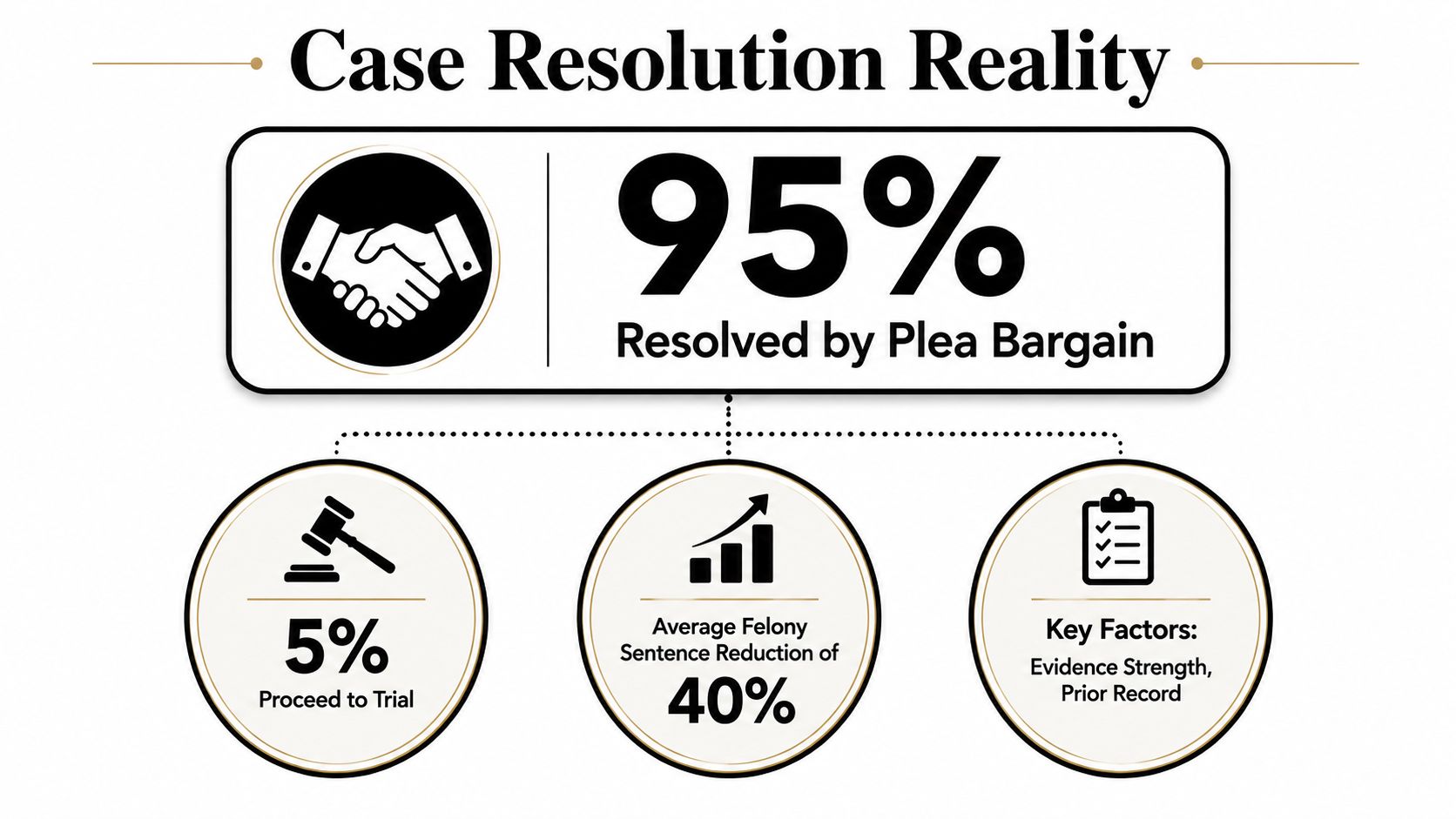
Many people picture criminal defense as a trial lawyer cross-examining witnesses before a jury. Trials remain essential, but they don't resolve most criminal cases. Research summarized by Vera on plea bargaining found that guilty pleas produced 97% of convictions in large urban state courts in 2009 and 90% of convictions in federal court in 2014. Scholars cited in that research estimate that more than 90% of those pleas result from plea bargaining rather than a straight plea.
The same source reports that custodial sentences imposed after trial averaged 64% longer than sentences imposed through pleas. That difference doesn't mean every plea is favorable or that trial is wrong. It means the choice must be evaluated as a risk decision, based on evidence, defenses, sentencing exposure, personal goals, and the strength of the negotiated terms.
Negotiation starts before the offer
A lawyer can't negotiate effectively by reacting only to the prosecutor's first proposal. Counsel needs to test the evidence, identify suppression issues, investigate witnesses, and assemble mitigation. That record may include restitution efforts, treatment or counseling where relevant, employment history, family responsibilities, community ties, medical circumstances, and evidence of early remediation.
Disclosure matters because the defense can't assess its position while operating in the dark. A formal economic model discussed in research on reducing unjust convictions through disclosure finds that regimes requiring some disclosure are more likely to convict guilty defendants and less likely to convict innocent defendants than regimes with no disclosure. In a plea-driven system, information asymmetry affects both fairness and bargaining power.
Federal plea negotiations also have an important public-information limitation. Reporting on binding federal plea bargains and hidden departures notes that the U.S. Sentencing Commission doesn't collect data on certain binding federal plea bargains. Proposed federal sentencing changes for 2026 also draw attention to noneconomic harm, vulnerability, early remediation, and self-reporting. Where applicable, mitigation may therefore be more useful than rushing to accept the first deal.
When trial deserves serious consideration
Trial may be appropriate when the evidence is unreliable, a key constitutional issue could exclude essential proof, the offer carries unacceptable consequences, or the client maintains a defense that a jury should decide. The decision requires preparation, not bravado. A lawyer should explain likely testimony, exhibits, admissibility disputes, jury risks, sentencing consequences, and the possibility that negotiation influence changes as litigation develops.
A dismissal strategy may involve investigation, evidentiary challenges, or diversion screening. The firm's information on how to get charges dropped addresses that subject separately. Other local legal questions, such as Grandparents' Rights in Atascocita, concern custody and visitation rights for grandparents in Harris County and should not be confused with criminal procedure.
Digital Evidence and Modern Defense Challenges
A text thread can become the prosecution's timeline. A social-media post can become an alleged admission. GPS data, cloud records, license-plate information, surveillance video, photographs, and device extractions may provide a detailed account of where people went and what they communicated. They may also be incomplete, misinterpreted, missing surrounding context, or disconnected from the person the state claims used the device.
Preserve before you analyze
The safest first step is usually preservation, not cleanup. Don't delete texts, alter photographs, reset a phone, change accounts, or ask friends to remove posts. Keep the device in its existing condition, avoid unnecessary access, and tell your lawyer whether the phone is shared, replaced, lost, or subject to a warrant or consent request.
Counsel may need to examine:
- Metadata: Creation times, modification history, geolocation information, and the source of a file.
- Completeness: Whether the state has the full conversation, full video, or only selected screenshots.
- Authentication: Who created the record, how it was collected, and whether the account or device can be connected to the accused.
- Context: Whether sarcasm, quotation, editing, reposting, or a prior conversation changes the apparent meaning.
- Chain of custody: Who handled the evidence and whether the extraction or transfer process is documented.
Digital forensics can be more important than adding another traditional witness when the case depends on device location, deleted data, account ownership, timestamps, or video quality. A forensic expert may identify a technical flaw that a fact witness can't explain. That doesn't make expert testimony automatic. The cost, admissibility, clarity, and value of the proposed analysis must be weighed against the rest of the case.
Recent coverage of criminal law trends involving digital evidence emphasizes AI-assisted analysis, large electronic discovery, and digital forensics. Those developments reinforce a practical point for Atascocita and Humble residents: evidence integrity is now part of defense strategy from the beginning, not an issue reserved for cross-examination.
Protecting accounts and personal information also matters outside the courtroom. General information about 2026 identity theft prevention tools may help with broader account-security concerns, but it isn't a substitute for legal advice about preserving potentially relevant evidence.
How to Work Effectively With Your Defense Attorney
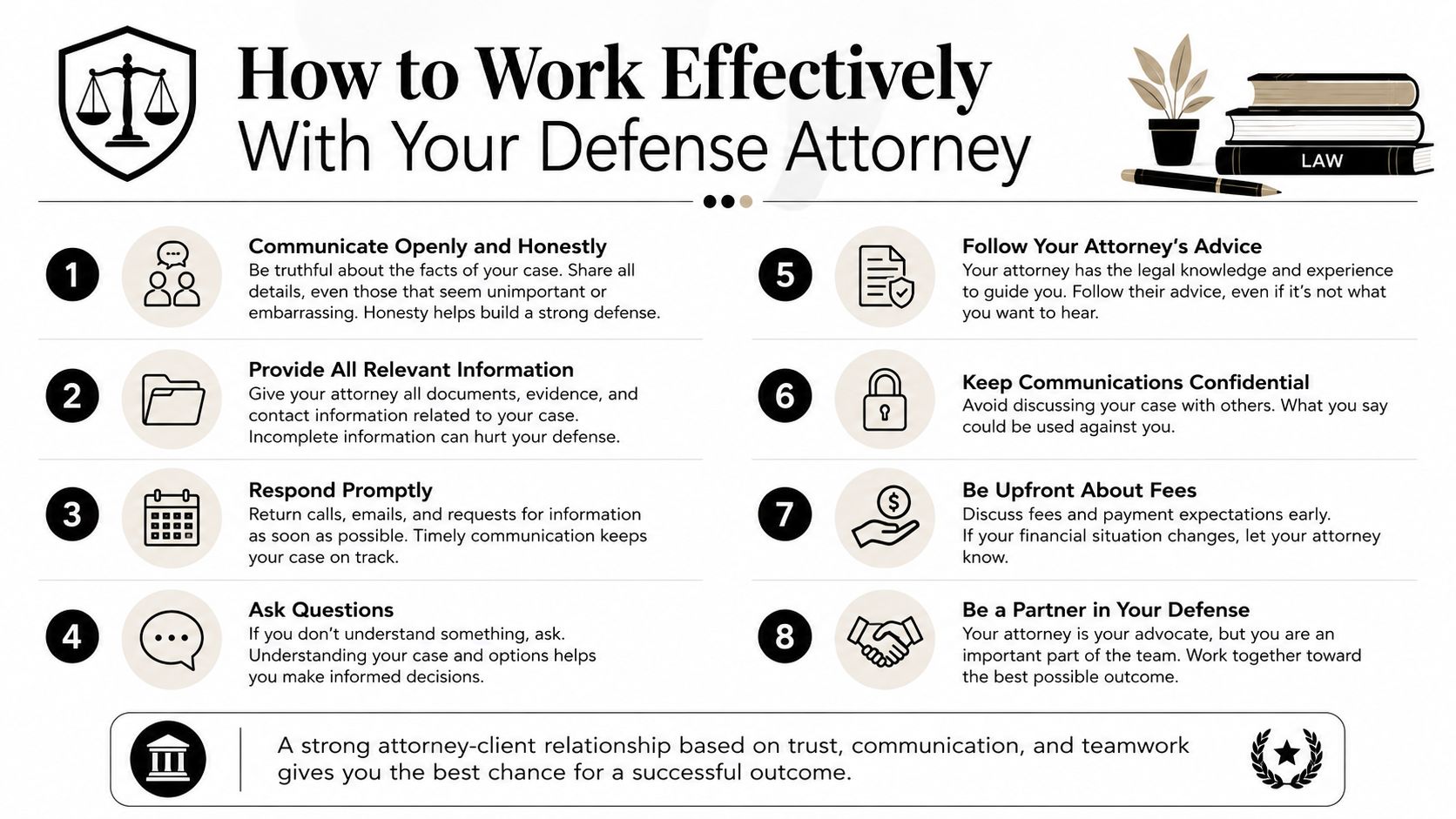
Your lawyer can investigate and advocate, but only you know many of the facts that determine what should be investigated first. The relationship works best when you provide a complete account, respond promptly, and follow advice even when the advice feels uncomfortable.
Prepare for the first meeting
Bring the citation, booking paperwork, bond conditions, release documents, suspension notice, court notices, and any paperwork from an agency or probation department. Make a list of witnesses, relevant locations, medical or employment information, prior lawyer contacts, and important dates. Don't edit your timeline to make it sound better. An attorney needs the difficult facts early, before the state uses them as surprises.
Use this working process:
- Tell the complete story privately. Explain what happened before, during, and after the incident, including facts you think hurt you.
- Preserve digital material. Keep original devices and records. Don't delete, forward, or modify potentially relevant communications.
- Follow release conditions. Avoid prohibited contact, missed check-ins, unauthorized travel, and new arrests.
- Route communications through counsel. Don't discuss the case with police, alleged victims, witnesses, friends, coworkers, or social-media audiences without legal guidance.
- Ask for a decision map. Request a clear explanation of the next setting, the available options, the risks, and what information counsel still needs.
Local knowledge changes preparation
An attorney familiar with Atascocita, Humble, and northeast Harris County can assess local court practices, prosecutor expectations, bond conditions, and diversion screening alongside the statewide legal rules. Local eligibility details can be decisive. Harris County's misdemeanor marijuana diversion policy, for example, excludes people on bond, deferred adjudication, or probation in Harris County or elsewhere for any offense other than a Class C misdemeanor. Early screening must therefore include bond and supervision status, not just the charge.
The choice between appointed representation and private counsel also depends on eligibility, complexity, communication needs, and available resources. A general comparison of public defender versus private attorney can help frame that discussion.
Take the Next Step to Protect Your Future
A criminal accusation can affect more than the case number. It may create pressure at home, interfere with work, complicate custody discussions, or raise licensing and immigration concerns. Some residents also need help with related CPS defense, family-law issues, estate planning, or civil disputes that become more difficult while a criminal matter is pending.
The most useful first step is a private review of the facts and deadlines. For a DWI, that may mean addressing the administrative-license timeline. For a digital-evidence case, it may mean preserving devices and accounts before information changes. For a Harris County misdemeanor, it may mean checking diversion eligibility before an avoidable restriction closes that option.
Bring every document you have, but don't wait until you've assembled a perfect file. Explain what happened, identify the next court date, and tell the attorney about any contact from police, prosecutors, probation, licensing agencies, or an alleged victim. Your lawyer can then separate urgent action from longer-term investigation and help you choose among negotiation, motions, diversion, dismissal efforts, and trial preparation.
Residents of Atascocita, Humble, and northeast Harris County deserve advice grounded in the actual court, charge, evidence, and personal consequences involved. A free consultation can give you a clearer understanding of what to do next and what mistakes to avoid while the case is still developing.
The Law Office of Bryan Fagan – Atascocita TX Lawyers provides criminal defense guidance for DWI, assault, theft, and misdemeanor and felony charges, while also helping families with related CPS and family-law concerns. Visit Law Office of Bryan Fagan – Atascocita TX Lawyers to schedule a free consultation at the Atascocita office and discuss your defense strategy before a critical deadline passes.