A waiver of service is a signed, notarized document that tells the court you received notice of a lawsuit and agree to skip formal delivery by a process server, but it doesn't mean you agree to the terms of the case or give up your right to fight for custody, property, or support. In Texas family cases, signing the right waiver can simplify notice, while signing the wrong document without understanding it can create serious problems.
You may be looking at the form at your kitchen table in Atascocita, Humble, or another northeast Harris County community, wondering whether your signature will end your ability to respond. Perhaps your spouse handed you divorce papers and said, “Just sign this so nobody has to come to the house.” Perhaps the other parent in a custody case sent a waiver through a lawyer. Feeling uneasy is understandable.
The most important distinction is between waiving formal service and waiving substantive rights. The first concerns how the court gives you notice. The second would affect decisions about children, property, support, or other legal issues. A properly limited waiver addresses the first issue. It isn't, by itself, a settlement agreement or an admission that the other party should receive everything requested.
Receiving a Waiver Form and What It Really Means
You are at home in Humble when your spouse's lawyer sends a waiver form after filing for divorce. The form looks official, the wording feels intimidating, and someone may urge you to sign quickly. Your immediate concern is understandable: does your signature approve the divorce, the parenting plan, or the proposed property division?
The form usually addresses notice, not consent. Signing a waiver generally tells the court that you received the filed petition and do not require a sheriff, constable, or private process server to deliver the citation personally. It does not, by itself, decide custody, child support, spousal maintenance, or the division of marital property. The signature changes the method of delivery, much like choosing to pick up an important package instead of requiring a courier to bring it to your door.
Practical rule: Do not treat a waiver as “just paperwork.” Confirm that it only waives formal service and does not contain broader language about the case.
Signing may be reasonable when you have received the complete court papers, understand what has been filed, and feel comfortable avoiding personal delivery at home or work. The choice can help the case proceed without a process server visiting you. It does not require you to give up your voice. You may still obtain legal advice, file a response, attend hearings, and oppose requests that do not protect your interests.
What you still control
You decide whether to sign, when to sign, and whether to speak with a lawyer first. Ask for a complete copy of the filed petition and every document attached to it. Ask whether the form is a limited waiver of service, a global waiver, or another document that includes additional terms.
Review the petition before signing. It may request orders concerning conservatorship, possession, child support, spousal maintenance, exclusive use of a home, or responsibility for debts. A waiver does not automatically grant those requests, yet you need to know what the other party is asking before choosing your response.
For an overview of immediate choices after receiving divorce papers, see what to do after being served divorce papers in Atascocita. The same concern applies to families in Atascocita and Humble: waiving formal service is different from waiving substantive rights. Recognizing that difference can help you respond deliberately instead of signing out of fear.
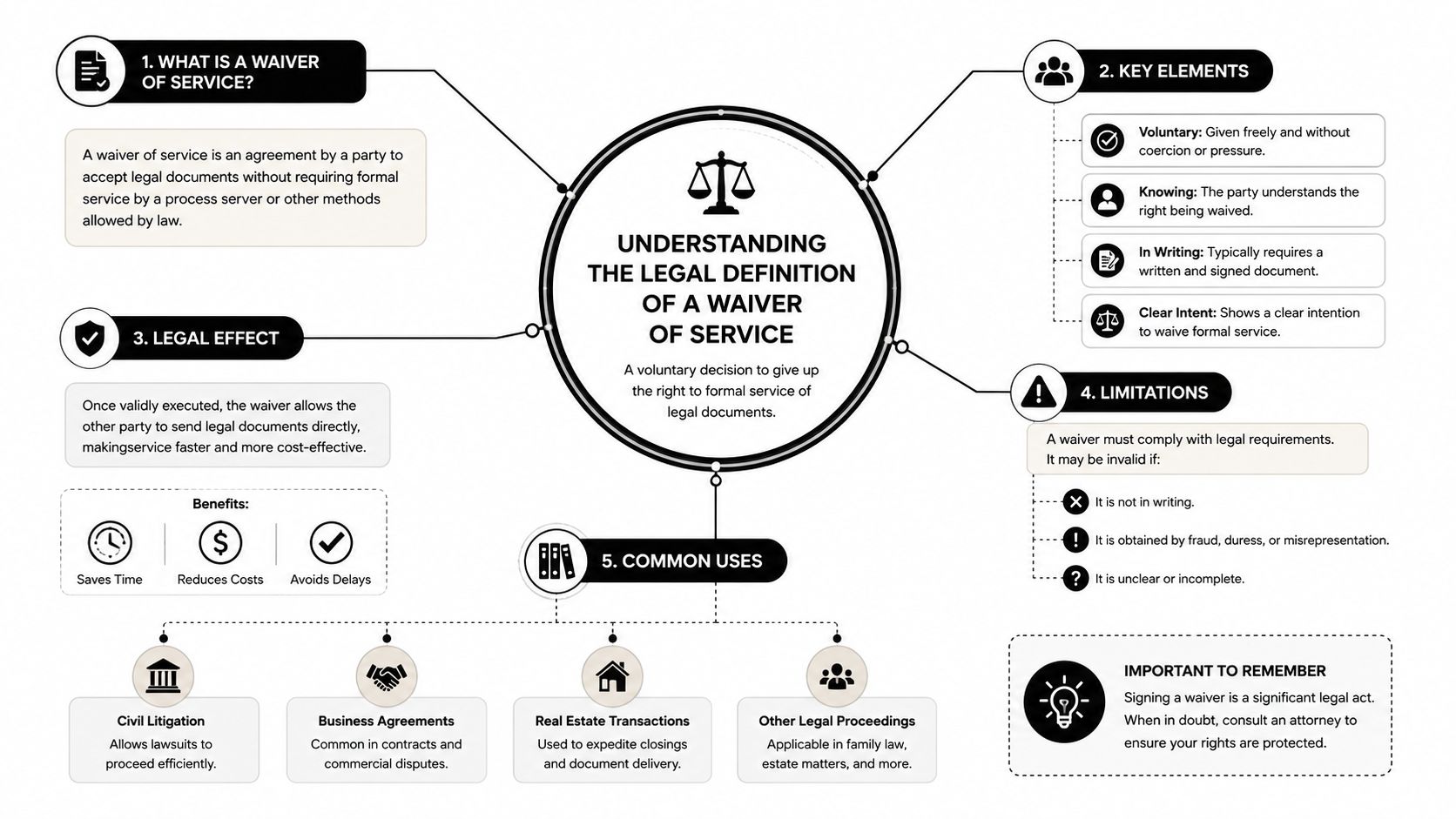
Understanding the Legal Definition of a Waiver of Service
A waiver changes how you receive notice of a lawsuit. Instead of requiring an authorized person to deliver citation and pleadings to you, you sign a sworn document acknowledging that you received the filed papers and will not require formal personal delivery. That choice concerns the method of service. It does not, by itself, decide property, custody, support, or other substantive issues in your case.
Texas Rule of Civil Procedure 119 allows a defendant to accept service or waive issuance and service through a written memorandum signed after the lawsuit has been filed. The memorandum must be sworn before a proper officer other than an attorney involved in the case and filed with the court papers. Once properly executed, it has the same force and effect as though citation had been issued and served under the law. You can review the rule in the Texas Rules of Civil Procedure.
Texas family cases also have a specific statute. Under Texas Family Code § 6.4035, a party may waive issuance or service only after the suit is filed. The waiver must acknowledge receipt of the filed petition and include the signer's mailing address. Texas materials require the waiver to be signed before a notary public, and the statute states that the Texas Rules of Civil Procedure do not apply to a waiver executed under that family-law section. The Texas Family Code provision on waivers contains the statutory language.
The basic legal mechanics
A family-law waiver generally follows this sequence:
- The petitioner files the case. The petition must be on file before the respondent signs.
- The respondent receives and reviews the petition. The waiver should identify or acknowledge the filed document.
- The respondent signs before a notary. The notary confirms identity and administers the required oath.
- The signed waiver is filed with the court. Filing puts the document in the case record so the court can rely on it for notice purposes.
A form tool can organize intake information and reduce completion errors. It cannot determine whether signing protects your position, especially if the petition requests contested relief. For organizing case intake documents, some attorneys use online form tools such as those available through best survey and form builder. The legal meaning still depends on the actual Texas filing and the language of the waiver.
For a local procedural overview, The Divorce Process in Atascocita: What to Expect discusses divorce filing in Atascocita and Harris County.
Waiving Service Versus Formal Service by a Process Server
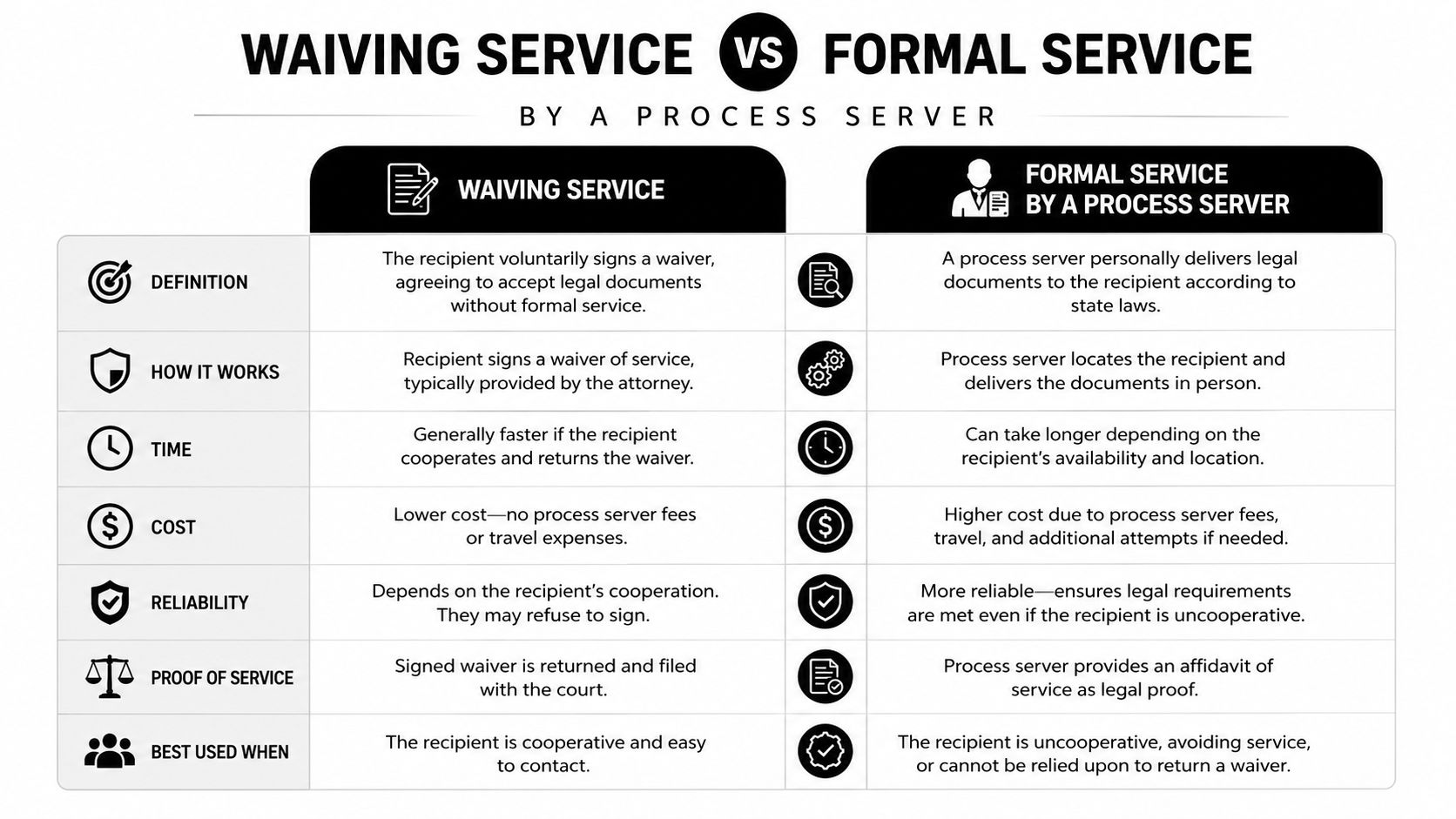
A parent in Humble receives divorce or custody papers from the other parent and is asked to sign a waiver. The first fear is often, “If I sign this, am I agreeing to the proposed custody schedule, property division, or support terms?” The answer depends on the document's wording, but the central distinction is straightforward: waiving formal service concerns how you receive notice, not whether you accept the relief requested in the case.
Texas Rule 4 describes a written waiver as an alternative to personal delivery of citation in the situations covered by that rule. In practice, a waiver lets the respondent acknowledge receipt of the case information and give up the need for a process server to make personal delivery. The federal Rule 4 text provides the federal framework for that written notice procedure, although the exact requirements for a Texas family-law case depend on the form and the court record.
Formal service follows a different route. A constable, sheriff, or private process server delivers the citation and pleadings, then files or returns proof showing that delivery occurred. The visit may happen at a residence, workplace, or another permitted location. It can feel intrusive, but it creates a documented delivery event when the respondent will not cooperate, cannot be reached, or disputes receiving the papers.
A waiver can reduce confrontation and avoid the practical disruption of an unexpected visit. It also requires care. The respondent should confirm which petition or pleading the waiver identifies, read whether the waiver is limited or global, sign it correctly before a notary when required, and make sure the filed document is part of the court record.
The choice is about the delivery method. It does not, by itself, decide conservatorship, possession, property, debt, child support, medical support, or spousal maintenance. Those issues still require an agreement, a response, or a court decision. A person who signs a properly limited waiver can continue participating in the case and contest the petitioner's requested terms.
For local procedural context, Harris County Family Courts: A Atascocita Resident's Guide discusses family-law cases in the Harris County courts serving Atascocita.
Common Misconceptions About Signing a Waiver
A person in Humble may sign a waiver and later worry that hiring a lawyer is no longer allowed. Signing a properly limited waiver does not end that option. It acknowledges notice and permits the case to proceed without personal delivery of citation. The signature addresses how notice is delivered, not whether you accept the other party's requested outcome.
A waiver is not an answer, a mediated settlement agreement, a final divorce decree, a custody order, or a property division agreement. Each document has a different purpose and may create different legal consequences.
What the signature doesn't automatically do
Signing a properly limited waiver doesn't automatically:
- Approve the divorce terms: You have not necessarily accepted the other party's proposed division of property or debts.
- Give up custody rights: You may still seek conservatorship, possession, and decision-making arrangements that protect your children.
- Eliminate support issues: Child support, medical support, and spousal maintenance may still require an agreement or court determination.
- Prevent legal representation: You may hire a lawyer after signing and request advice about the case.
- Stop you from responding: You may file an answer or another appropriate response and participate in hearings.
A parent in Atascocita might sign a narrow waiver after hearing that “nothing will change.” That promise may never appear in the court file. Informal assurances do not replace a written agreement or court order.
Read the petition and the waiver together. Check what the petition requests, whether the waiver is limited or broad, and which deadlines apply. A signature can acknowledge the case without accepting its result.
A waiver can acknowledge the case without accepting the result.
Why the wording matters
Some forms contain only service language. Others include broader acknowledgments, appearances, agreements, or waivers of additional procedural protections. The title alone does not answer the question. Read each paragraph, attachment, and handwritten addition before signing.
Federal civil procedure illustrates the limited function of a properly filed waiver. Under Federal Rule of Civil Procedure 4, the action proceeds as though the summons and complaint were served on the date the waiver was filed, and proof of service is not required. The federal rule on waiver mechanics demonstrates how a waiver can change procedure without deciding the substance of the dispute.
If the form mentions a settlement, agreed parenting plan, property agreement, or broad release, pause before signing. Those provisions may affect rights far beyond service.
How to Properly Execute and File a Waiver in Harris County
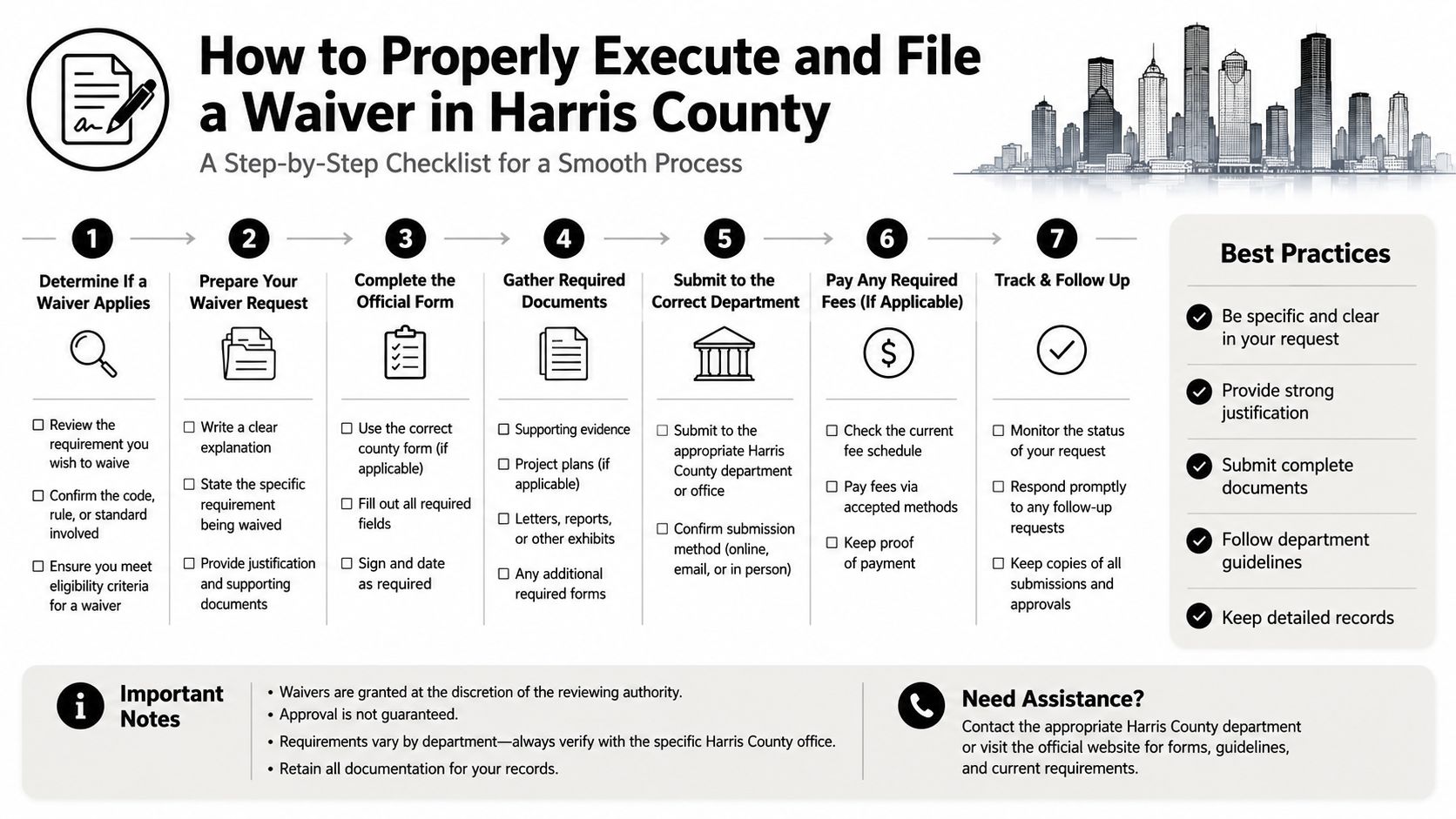
A waiver can fail because of a small technical mistake. That may lead the petitioner to arrange formal service, creating more disruption and expense. The safest approach is to treat execution and filing as a checklist, not as a casual signature.
Start with the filing
First, confirm that the divorce or SAPCR petition has already been filed. Texas Family Code § 6.4035 permits the waiver only after the suit is filed. The respondent should receive or review the filed petition, not merely an unfinished draft prepared for filing.
For a SAPCR matter, Texas legal-help materials warn not to sign until at least one day after filing. That timing precaution is especially important for parents completing forms without lawyers. Keep a copy of the petition, waiver, and any attachments for your records.
Complete the signature correctly
The respondent should sign the waiver in front of a notary public. The notary must be able to verify the signer's identity and complete the acknowledgment or oath section. A digitized signature may not satisfy the Texas family-law requirement, so don't paste an image of a signature into the document or rely on an electronic mark unless a lawyer confirms that the specific procedure is legally acceptable.
Check the mailing address carefully. The family-law statute requires the waiver to include the signer's mailing address. Make sure the name matches the person named in the case and that every page requiring initials or signatures is completed.
File it with the correct case
After notarization, file the original or legally acceptable version with the court handling the case in Harris County. The filing should be connected to the existing cause number and court record. Keep proof of filing, because signing before a notary isn't the final procedural step.
Common problems include:
- Early signing: The petition wasn't filed before the respondent signed.
- Missing notary completion: The signature appears, but the oath or acknowledgment is incomplete.
- Digitized signature: A copied or pasted signature is used where an original signature is required.
- Missing address: The waiver doesn't include the respondent's mailing address.
- Wrong case information: The cause number, parties, or court information doesn't match.
- Unfiled document: The signed waiver remains with a lawyer or party and never reaches the court record.
The Texas guidance on filing a divorce in Harris County can help Atascocita residents understand the local filing setting, but it can't replace reviewing the exact waiver in your case.
Federal procedure also shows why cooperation is encouraged. Under the federal framework, a domestic waiver request must generally give at least 30 days to return the form, and a defendant who waives service generally receives 60 days from mailing to answer the complaint. If the request is sent outside the United States, the corresponding periods are 60 days to return the form and 90 days to answer. Those federal periods come from Federal Rule of Civil Procedure 4 materials, and Texas family cases can follow different rules, so don't assume a federal deadline applies to your Harris County matter.
Risks of Global Waivers and When to Refuse Service Waiver
Not every waiver has the same scope. A specific waiver generally focuses on the respondent's decision to accept notice without formal delivery. A global waiver may contain broader language that waives additional notices, appearances, or procedural protections.
That difference matters in a contested divorce or custody case. If the petition raises concerns about hidden assets, business interests, retirement accounts, relocation, family violence, or disputed parenting time, a broad document deserves legal review before you sign it. A person who wants a quiet process can still ask for a narrowly drafted waiver rather than accepting every provision placed in front of them.
Situations requiring caution
Refusing a waiver may be sensible when:
- The other party won't provide the complete petition: You can't evaluate what you're being asked to acknowledge.
- The form contains settlement language: A service document shouldn't become a property or custody agreement.
- Communication is hostile or coercive: Pressure can make it difficult to provide informed consent.
- You suspect concealed property: Obtain advice before making procedural admissions or signing broader language.
- Safety is a concern: A lawyer can help evaluate notice and participation options without relying on direct contact.
Refusing a waiver doesn't make the case disappear. It may lead to formal service, and you still need to respond to the lawsuit and court notices. Missing a hearing or deadline can create separate problems, so review what happens if you miss a court date in Harris County Family Court if scheduling or notice is already a concern.
The federal rule provides a cost incentive when a defendant refuses a proper waiver request without good cause and the plaintiff later incurs formal service expenses. That federal mechanism is described in Federal Rule of Civil Procedure 4. Texas family cases aren't identical to federal civil cases, so a lawyer should assess how the rule applies to your situation.
Next Steps for Atascocita and Humble Families Facing a Waiver Decision
A waiver of service is mainly about how you receive notice, not whether you accept the other party's demands. Before signing, confirm that the petition was filed, read the entire document, complete the notarization correctly, and make sure the waiver is filed with the Harris County court. You still have the right to counsel and the ability to contest custody, property, support, and other issues.
If you're in Atascocita, Humble, or northeast Harris County, schedule a free consultation before signing a waiver you don't understand. The divorce process guide for Atascocita can provide general local context, while an attorney can apply the law to your petition and the wording of your form. You don't have to handle this decision alone.
The Law Office of Bryan Fagan – Atascocita TX Lawyers helps residents review divorce and custody documents, understand service options, and protect their legal position before they sign. Visit Law Office of Bryan Fagan – Atascocita TX Lawyers to schedule a free consultation at the Atascocita office and discuss your waiver with a local family-law attorney.