Skip to content
You're in the school pickup line in Atascocita, looking at a custody order that seemed clear when it was signed. The other parent reads the holiday language differently. Pickup time changes depending on the week. A text argument follows, and suddenly a routine exchange feels like a legal dispute.
For parents in Atascocita, Humble, and northeast Harris County, the first question isn't whether the order feels unfair. It's whether the order is unclear, outdated, or being violated. Those problems call for different legal remedies. Choosing the wrong one can waste time and leave the core issue unresolved.
What Clarification of a Custody Order Actually Means in Texas
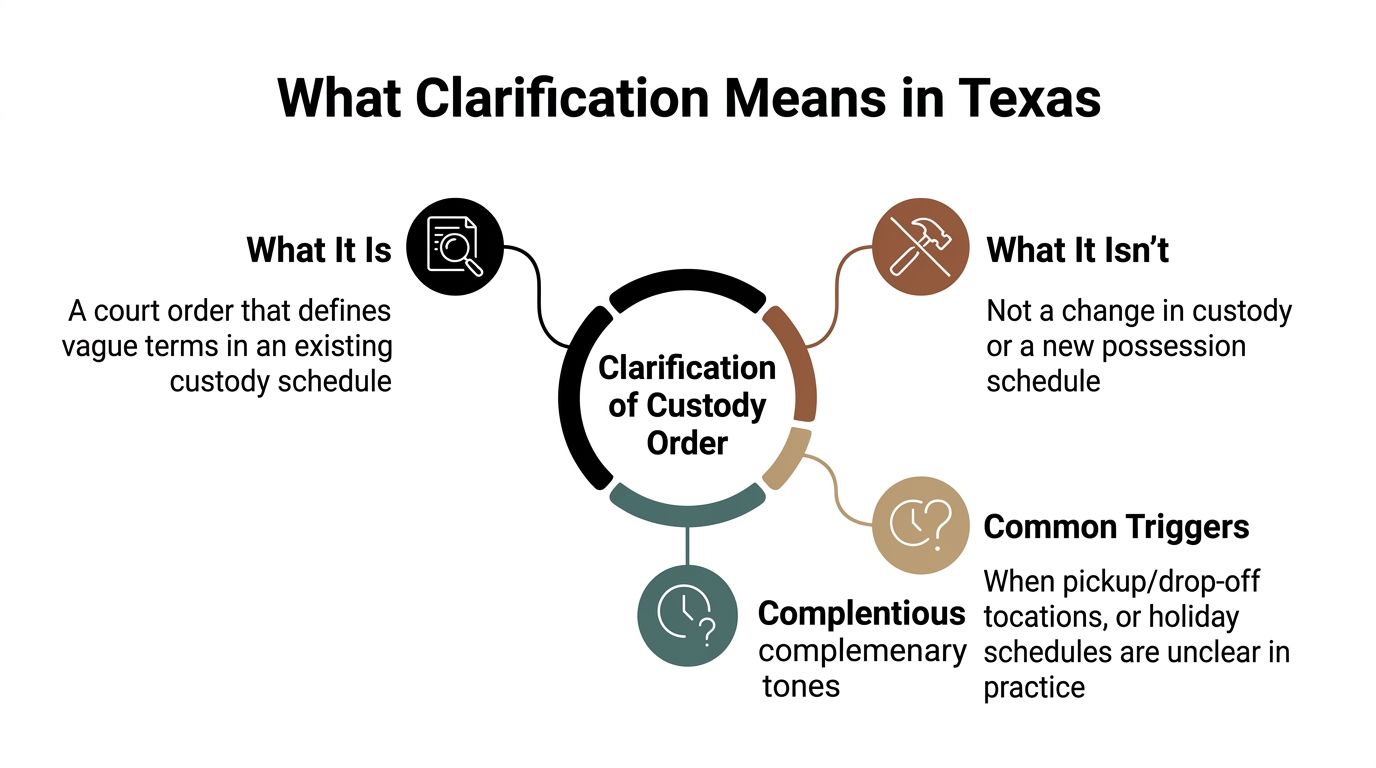
A clarification of a custody order is a narrow request asking the court to make vague language specific enough to enforce. It doesn't give the judge permission to rewrite the parenting plan, change possession rights, or create a new schedule. Texas law permits clarification when an order isn't specific enough to support contempt enforcement, and the clarification must remain limited to making the existing language more precise. The original order remains final under the statutory framework. Texas Family Code Section 157.421 describes that limited function.
Consider a parent in Humble whose order says the child will be exchanged at “the usual location,” but the parents never agreed on what that means. Or an Atascocita order that provides holiday possession but doesn't identify the precise exchange time. Those situations may involve ambiguity. The parent isn't necessarily asking for more time. They're asking the court to identify what the existing order already requires.
The question that controls the case
Ask yourself: Do I want the court to explain the order, or do I want the court to change the result?
A clarification may address:
- A vague exchange term: The order says where possession begins but doesn't identify the location clearly.
- An incomplete holiday provision: The order identifies a holiday but leaves the start or end time uncertain.
- A confusing access requirement: The language can reasonably be read in more than one way.
A clarification generally can't grant a parent additional weekends, remove a holiday, change a residence restriction, or adjust decision-making authority. Those requests concern substance, not wording.
Practical rule: If the proposed language would give either parent a different legal right than the original order provided, you're probably discussing modification rather than clarification.
Most parents who contact a local family lawyer aren't looking for punishment. They want to know when pickup happens, where the exchange occurs, and what they're supposed to do next. Texas treats clarification as a procedural remedy, but the details matter because an order must be clear enough to enforce before a contempt claim can succeed.
Clarification vs Modification vs Enforcement
The three remedies sound similar because they all involve an existing custody order. Their purposes are different. Clarification explains an unclear command. Modification changes the arrangement. Enforcement addresses a clear violation.
| Remedy | What it fixes | Typical trigger |
|---|---|---|
| Clarification | Ambiguous wording in an existing order | A holiday exchange time or location is unclear |
| Modification | A schedule or right that no longer fits the family's circumstances | A parent relocates to Conroe and the current schedule no longer works |
| Enforcement | A clear requirement that a parent refuses to follow | A parent keeps the child past the ordered return time |
Use the remedy that matches the problem
Clarification: Suppose the order says Thanksgiving possession begins “at school dismissal,” but the child's school calendar and release practices make the exchange uncertain. If you want the court to identify the precise time or location without changing who has the holiday, clarification may fit.
Modification: A parent moves to Conroe, the child's school changes, or the family's practical circumstances have materially changed. If you need a new transportation arrangement, different weekends, or a revised holiday schedule, you're asking for a modification. The court must consider the legal requirements for changing the existing order, not merely define its words.
Enforcement: The order clearly says the child returns at a particular time, and the other parent refuses. That's an enforcement problem. The remedy asks the court to address noncompliance with a command that was already clear.
Self-represented parents often combine these categories because the emotional experience feels the same. The legal analysis isn't the same. Filing a clarification when you want a new schedule can leave the central request unanswered. Filing enforcement when the order is too vague to support contempt can create a separate problem.
A parent considering divorce-related representation in the area can review Divorce Lawyer in Atascocita, TX for information about divorce representation for clients in Atascocita and Harris County.
Filing a Motion to Clarify in Harris County
Atascocita families file custody clarification matters through the Harris County family court system, even though Atascocita is in northeast Harris County. The Harris County District Clerk lists family courts at the Civil Courthouse, 201 Caroline St., Houston, TX 77002. A motion generally belongs in the same court that entered the original custody or visitation order.

A practical filing map
Locate the original case. Find the cause number and identify the court that signed the existing order. Filing in the wrong court can delay the request or send you back to the correct venue.
Prepare the motion. State the exact provision that is ambiguous. Explain why the wording creates uncertainty and identify the specific language you want the court to adopt.
Prepare a proposed order. Don't ask the judge to “make the order clear” without offering workable language. A proposed order should identify the time, location, method, or other detail that resolves the ambiguity.
Complete service and attend the hearing. The other parent must receive proper notice under the applicable procedure. The court then considers the motion at a hearing and decides whether the requested language is a true clarification.
The Harris County Domestic Relations Office provides parenting-time resources and forms for self-represented litigants, including a request for order review. Those resources can help a parent organize the filing, but they don't replace legal analysis when the line between clarification and modification is disputed.
You should also understand the hearing process before appearing. Review what happens at a family court hearing in Harris County, Texas so you know what documents, notice, and courtroom expectations may matter.
The filing should stay focused. Don't use a clarification motion to tell the court the other parent is difficult, unfair, or irresponsible unless those facts directly explain the ambiguity or relate to a separate legal remedy.
What the Court Needs to See in Your Motion
If you cannot point to the exact words causing the dispute, do not file a clarification motion yet. Texas Law Help identifies three required showings: the provision is ambiguous, the ambiguity is nonsubstantive, and the clarified language would be enforceable by contempt. Texas Law Help's explanation of asking the court to clarify visitation orders also addresses service, the hearing, and the specific order the court may issue.

The three showings
Ambiguity means the language is unclear. Quote the provision and identify the competing interpretations. A claim that the other parent refuses to cooperate does not prove ambiguity. Show how the order fails to state a time, place, sequence, or other detail needed for compliance.
Nonsubstantive means the clarification preserves the existing deal. Naming a public exchange location differs from moving exchanges to another day. Setting an exact holiday start time differs from awarding one parent additional holiday possession. The requested wording must explain the order, not rewrite it.
Contempt enforceability means the final wording must be definite. The judge must be able to identify exactly what each parent was required to do. A proposed clarification that uses vague terms leaves the same dispute in place and cannot support enforcement.
Evidence that makes the request understandable
Bring the signed order and mark the precise language at issue. Add relevant text messages, emails, calendars, or other communications showing how the wording produced conflicting interpretations. Arrange those materials by date and label them. An unindexed stack of screenshots makes the judge work harder to understand your request.
Your proposed order needs specific language. State the exchange time, location, holiday period, or communication method you want the judge to adopt. For broader custody documentation, review this guide to evidence needed for a custody case in Harris County, Texas.
Texas Law Help states that the request generally must be filed no later than six months after the visitation order expires. Check that deadline before filing, especially if the disputed period has already passed.
At the hearing, the judge may clarify the order, deny the motion because the language is already clear, or find that the requested change is substantive and belongs in a modification case. A clarification applies going forward. It does not turn past conduct into a new order or alter the finality of the original judgment.
When the Real Problem Is an Older Order, Not Ambiguity
Some Atascocita parents have an order signed years ago that no longer matches how Texas possession schedules are commonly structured. Recent Texas-focused materials state that the Expanded Standard Possession Order has become the default for many parents living within 50 miles, while existing orders don't change automatically when the default changes. This Texas ESPO guide addresses that distinction.
That creates a frequent trap. A parent sees a schedule that feels outdated and assumes the wording needs clarification. But if the language is perfectly clear, the problem isn't ambiguity. The parent wants a different schedule, which points toward modification.
Test the request before filing
Ask three questions:
- Can I identify the exact unclear words? If not, the issue may not be clarification.
- Would my proposed language preserve the existing possession rights? If it gives new time or removes existing time, modification is more likely.
- Has family life changed since the order? A relocation, school change, work schedule, or evolving child needs may support a modification analysis.
A teenager in Atascocita may now have Friday night football games that the older order never addressed. If the order clearly awards Friday possession, but the parent wants a different arrangement so the child can participate, the request is not just to define an unclear term. It asks the court to balance current circumstances and adopt a new schedule.
An older order doesn't become ambiguous merely because a newer default schedule exists.
The key distinction is simple. Clarification defines existing rights. Modification changes the arrangement to fit legally relevant circumstances. Existing orders remain operative unless a court changes them. Don't assume a newer default automatically rewrites your signed order.
Timelines, Costs, and When to Call a Local Attorney
A Harris County clarification matter may take several weeks to a few months from filing to hearing, depending on the court's docket and whether the other parent contests the request. A contested response usually creates more work because the court must resolve not only the wording issue but also the disagreement over whether clarification is the correct remedy.
The District Clerk's office charges filing fees, and qualifying parents may seek a fee waiver. Confirm the current requirements and amount directly with the clerk before filing because court costs and procedures can change.
Know when self-representation stops making sense
Call a custody lawyer promptly if:
- The other parent contests the motion: A disagreement about facts or proposed language can turn a narrow request into a complicated hearing.
- You want a different schedule: That signals possible modification, not mere clarification.
- Relocation is involved: A move can affect jurisdiction, transportation, school arrangements, and possession.
- Safety is part of the dispute: Allegations involving violence, neglect, substance use, or immediate danger require careful legal handling.
- The order is from another state: Texas jurisdiction depends on formal rules, including the home-state framework.
For custody matters, the UCCJEA provisions in Texas Family Code Chapter 152 define custody determinations to include legal custody, physical custody, and visitation. Texas is generally the child's home state when the child lived there for at least six consecutive months immediately before the case was filed, as explained by Texas Law Help's interstate custody resource. That rule can affect whether a Texas court can make or revisit custody orders.
Atascocita and Humble families benefit from counsel familiar with the Harris County family courts, local filing practices, and the difference between a narrow clarification and a substantive modification. If you're researching how legal services are presented online while comparing firms, Outrank's law firm SEO guide 2025 offers general marketing context, but it shouldn't substitute for evaluating the legal fit for your custody problem.
For a practical decision about whether counsel is warranted, review when to hire a custody lawyer in Atascocita, TX. A consultation before filing can prevent you from paying to pursue the wrong remedy.
Next Steps for Atascocita Families
The rule is direct: clarification is for ambiguous language, not for wishing the order said something different. If the existing words are unclear, a Motion to Clarify may fit. If the schedule no longer works, consider modification. If the other parent violates a clear command, consider enforcement.
Take these steps this week:
- Pull the signed order. Read the disputed provision slowly and mark the exact words causing confusion.
- Create a written record. List each exchange, message, missed handoff, or conflicting interpretation that demonstrates the problem.
- Speak with a local family attorney. Get legal guidance before paying a filing fee or choosing between clarification, modification, and enforcement.
The Law Office of Bryan Fagan – Atascocita TX Lawyers works with families throughout Atascocita, Humble, and northeast Harris County on custody and related family-law concerns. Schedule a free consultation at the Atascocita office so an attorney can review the order and help you choose a legally appropriate next step.
The Law Office of Bryan Fagan – Atascocita TX Lawyers can review your custody order, identify whether the issue calls for clarification, modification, or enforcement, and help you prepare for the Harris County process. Visit the firm to schedule a free consultation for your Atascocita, Humble, or northeast Harris County family matter.