If you're sitting at the kitchen table in Atascocita trying to sort out a child's legal fatherhood, you're probably not thinking about legal theory. You're thinking about what happens next, whether the other parent will agree, and whether you need one case or three. In Texas, a Suit to Adjudicate Parentage can do far more than answer a biology question, it can set the legal foundation for custody, visitation, child support, and even a birth certificate change in the same proceeding Texas Attorney General paternity guidance.
That's why this issue matters so much in Harris County, Atascocita, and nearby Humble. A parentage case can protect a child's rights and give a parent clear legal standing, but the path you choose depends on whether both parents agree, whether a presumed father already exists, and whether deadlines are already running. A mistake at the beginning can ripple through every later order.
What a Parentage Suit Does for Your Family
A lot of parents come in thinking parentage law is only about proving who the biological father is. That view is too narrow for Texas. In practice, a Suit to Adjudicate Parentage can resolve legal fatherhood and the related family-law issues in one filing, which is why it often becomes the most efficient route for families in Atascocita and northeast Harris County.

Biology and legal parentage are not the same thing
A DNA result can answer a scientific question, but Texas treats legal parentage as a status with consequences. The Attorney General explains that once paternity is established, a parent can use that determination to add a father to a birth certificate, but that happens in two steps, first establish paternity, then file the correct birth-certificate paperwork with the Texas Vital Statistics office Attorney General birth-certificate guidance.
That distinction matters because many families in Atascocita already know who the child's father is in a practical sense, but they still do not have enforceable rights on paper. Without the legal status, a parent may struggle with custody, possession, support, or medical decisions.
Practical rule: if the issue is more than “who is the father,” a parentage suit can organize the rest of the child's legal life.
For unmarried parents, this filing can turn uncertainty into enforceable structure. The result is not just a label, it is a legal foundation that courts can use later. Texas custody law for unmarried parents often comes into play at the same time, because a parentage ruling and conservatorship issues tend to move together in real cases Texas custody laws for unmarried parents Texas access paternity overview.
One case can lead to several orders
The downstream impact is often overlooked. A parentage order can set the stage for conservatorship, visitation, child support, and related support issues in the same proceeding, which is why these cases matter so much in Harris County family courts Texas Attorney General court-ordered paternity.
That practical effect becomes even more important when a presumed father is already involved or a prior acknowledgment has been signed. In those cases, the court is not starting from zero. It has to sort out which legal status controls, whether the existing paperwork can be challenged, and what orders should follow once parentage is settled.
Choosing Between Voluntary Acknowledgment and Court Filing
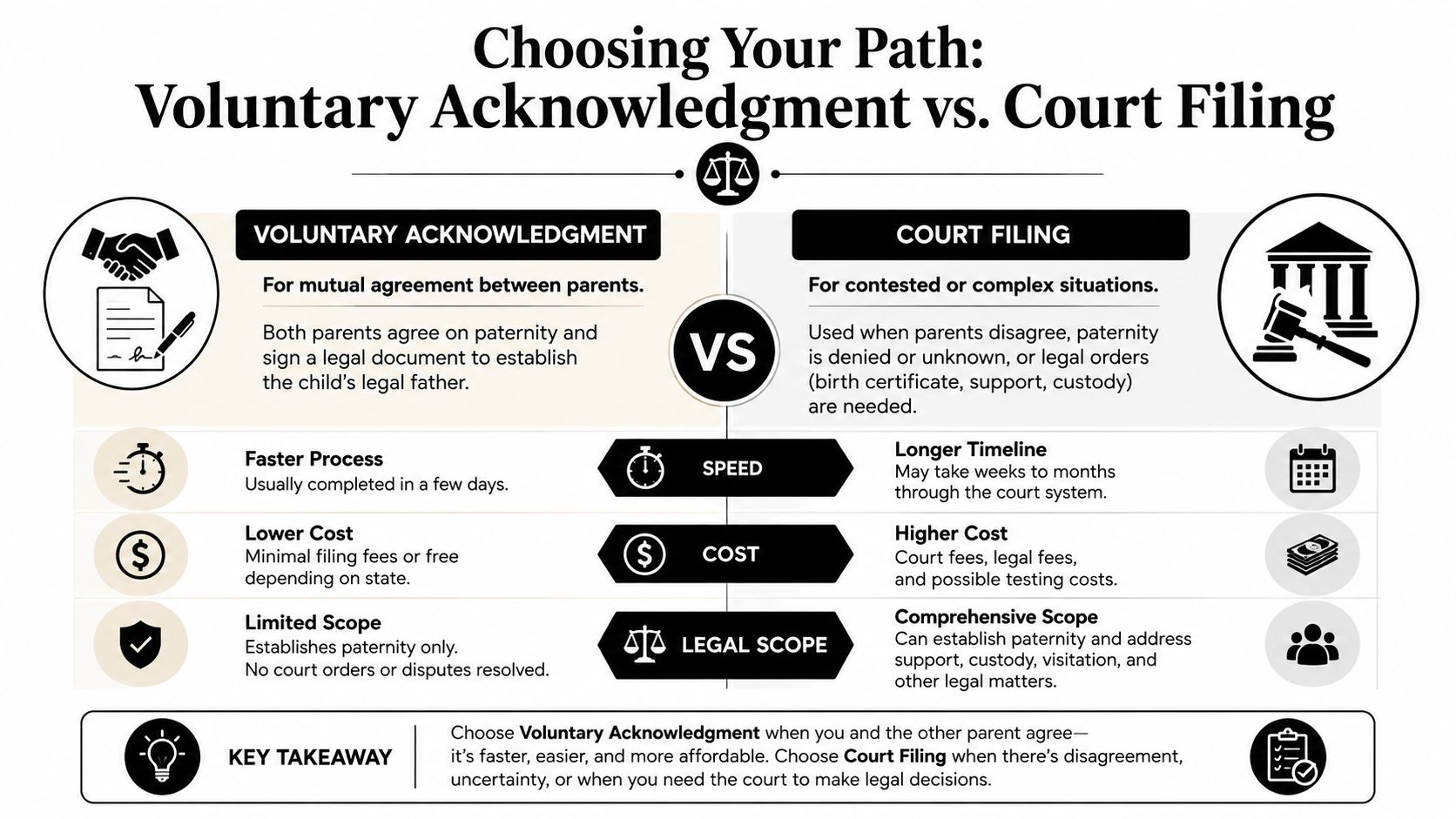
A parentage case in Atascocita often starts with a hard practical question, does everyone agree on who the legal father is, or is someone already on the birth record, presumed to be the father, or disputing the relationship altogether? The answer changes the path. A voluntary Acknowledgment of Paternity, or AOP, can work when the parents are in agreement. Court filing is the better route when there is disagreement, uncertainty, or an existing legal status that has to be sorted out first.
When an AOP makes sense
The Texas Attorney General says the AOP is the most common way to establish paternity, and it can be signed at any time before or after birth with an AOP-certified entity Texas Attorney General paternity guidance. For cooperative parents, that route is usually the simplest. It is a free legal document, and once it is properly filed, it has the same legal effect as a court adjudication of parentage Texas Attorney General paternity guidance.
That matters because a valid AOP can do more than name a father. It can clear the way for later custody, support, and birth certificate changes without forcing the family into a lawsuit. When both parents are on the same page, that saves time and reduces conflict.
For families looking for a focused starting point, Paternity Lawyer in Atascocita covers how legal paternity affects related rights and orders in Harris County.
When court filing is the better choice
Court filing makes more sense when the facts are not settled. If a presumed father is already involved, if a prior acknowledgment has been signed, or if one parent will not agree, the court has to decide which legal status controls before the rest of the case can move forward. That is especially important in parentage cases, because the order often becomes the foundation for conservatorship, possession, support, and later changes to the birth record.
A signed AOP also has timing consequences. It can generally be rescinded within 60 days of signing, but after that, challenges are narrow and usually require grounds like fraud, duress, or material mistake of fact Texas Attorney General paternity guidance. If there is real doubt, or if another legal father may already exist, a court filing gives the judge a way to sort out the conflict and issue orders that fit the actual family situation.
An AOP should be signed only when everyone understands what it does. After the rescission period passes, it can carry lasting legal consequences.
Parents sometimes worry that court is the more expensive path, and that concern is understandable. In a disputed case, though, court is often the only way to get a durable order that addresses parentage, custody, support, and related issues in one proceeding. If divorce or other family-law matters are already pending, some families also speak with Divorce Lawyer in Atascocita, TX, especially when those issues are moving at the same time.
Filing Your Petition in Harris County
A parentage case often starts with a hard practical question, where should the petition be filed, and who must be notified first. In Harris County, the filing has to line up with where the child lives and with the court's local rules, because a mistake at the front end can slow the rest of the case down. For Atascocita families, that usually means filing in the Harris County system and making sure the paperwork matches the facts already in play, especially if a presumed father or an earlier acknowledgment is part of the picture.

The filing sequence that keeps a case on track
The filing process is not complicated in theory, but every step has a consequence:
- Gather the right forms. The main document is the petition to establish parentage, and some cases also need sworn statements or related paperwork the clerk may require.
- Confirm the child's county of residence. Texas practice starts with the county where the child lives, so venue needs to be correct before the petition goes in.
- Pay the fee or request fee relief. If the filing fee would be a hardship, a Statement of Inability to Afford Payment of Court Costs may be filed instead.
- Review Harris County standing orders. Family cases in Harris County can trigger local standing orders, so those requirements should be checked before filing.
- Arrange service or consent. If the other parent will not sign an agreement, the petition usually has to be formally served.
A petition is only the first step, but it sets the rest of the case in motion. If the filing is aimed at getting custody, support, or a corrected birth record later, the way the petition is framed matters from the start. For a plain-English overview of what happens once a family case gets a hearing date, see what happens at a family court hearing in Harris County, Texas.
Deadlines and timing rules you can't ignore
Texas lets a parentage suit be filed before birth, and it also allows filing later when the child does not have a presumed, acknowledged, or adjudicated father. That flexibility helps some families, but it does not solve every timing problem.
When a presumed father already exists, the filing window can become much tighter, and in many cases the clock runs from the child's birth. That is where people get stuck. If a family waits too long, the court may have fewer options for sorting out who the legal parent is and what orders should follow. The best course is to file promptly when the legal status of the father is unclear, because the parentage order can become the basis for conservatorship, possession, support, and later birth certificate changes in the same proceeding.
How DNA Testing Works in Contested Cases
When parents disagree, the case usually turns on genetic testing. In Texas, the Attorney General explains that the parents and child are swabbed in court, at a clinic, or at a Child Support office, and the lab then returns the results for the case file. The process is less dramatic than many parents expect, but it still carries serious legal weight.
What the testing does, and what it doesn't do
DNA testing answers a biological question. It does not, by itself, change a birth certificate or create enforceable parental rights. Texas still requires a legal order or a valid filed acknowledgment before the father can be added to the birth certificate or treated as the legal parent, as the state guidance explains.
That separation catches people off guard. A test result may settle the science, but Texas still treats legal parentage as a separate step. If a parent wants custody, visitation, support, or medical-support orders, the court has to enter the parentage ruling first.
Practical insight: bring the DNA result into the legal process, do not treat it as the finish line.
Why the 99% benchmark matters
Texas family-law guidance says DNA testing showing a 99% or greater probability creates a presumption of paternity under Texas procedure. That benchmark matters because it can reduce factual fighting and move the case toward an order more efficiently.
The legal effect is strong, but it still ends in a court order. That order is what lets the judge sign off on the parentage finding and then address the related family-law issues in the same case.
For parents who want a closer look at the steps involved, how to establish paternity in Texas gives a useful framework. In cases complicated by a prior acknowledgment or a presumed father, the genetics are only one part of the strategy.
What Happens After Parentage Is Established
Once the court enters the parentage order, the case starts producing real-world results. The judge can address custody, visitation, and child support in the same proceeding, which matters for families that need one clear legal order instead of piecing together separate filings. A properly entered order can also set the stage for later birth-certificate changes through the correct administrative process.
The legal ripple effect
Parentage reaches far beyond a name on a form. It determines who has standing to ask for conservatorship, who can seek possession and access, who may owe support, and how legal-parent consequences get assigned in the future. It can also affect inheritance questions and other rights that many parents do not think about until a dispute comes up.
Sometimes that is the result a parent wants. Sometimes it is the result one parent is trying to avoid. Texas guidance also recognizes that a parentage suit can be used to establish that someone is not the legal father, which can keep the wrong person from being tied to the child's legal status Texas Law Help unknown fathers guide.
Existing legal fatherhood changes the case
The case becomes more complicated if a presumed father, an acknowledged father, or an adjudicated father is already part of the picture. At that point, the court is not just deciding biology, it is sorting out which legal status controls and who has the right to challenge it. That changes who can file, what proof matters, and how much time the parties may have.
Procedure matters here. A missed hearing in IV-D court can lead to a father being named even when he may not be the biological parent, and that kind of result can be hard to unwind later. Parents dealing with that kind of uncertainty often need more than legal papers. They need practical support while the case is pending, and a family support organizations list can be a useful place to start.
Common Mistakes That Delay or Derail Your Case
The problems that slow a parentage case in Harris County are usually procedural, not dramatic. A petition filed in the wrong place, a missed local order, or a parent signing an acknowledgment without understanding the legal effect can change the entire case and create custody or support problems that are harder to fix later.
The errors that cause the most trouble
- Wrong county filing. Filing in the wrong county can delay service, hearing settings, and the court's first review of the case.
- Ignoring local procedures. Harris County standing orders can apply as soon as the case is filed, and missing them can create trouble before the other side even answers.
- Treating an AOP like a temporary form. A signed AOP is not something a parent can usually set aside whenever the paperwork becomes inconvenient. After the 60-day rescission window, a challenge is much narrower and usually requires a legal ground such as fraud, duress, or mistake.
- Confusing DNA with legal status. A DNA result may answer the biological question, but it does not by itself change the birth certificate or create enforceable parental rights.
- Waiting too long when a presumed father exists. If a presumed father is already in the picture, delay can make the case harder to file and harder to unwind later. Timing matters because the court may have to sort out whether an existing legal fatherhood status already controls.
A parentage case gets more complicated when a prior acknowledgment, a presumed father, or an adjudicated father is already part of the record. In that situation, the court is not starting from scratch. It has to decide which legal status controls, who has standing to challenge it, and whether the existing order or acknowledgment must be addressed before anything else can move forward.
If the case already involves a presumed father, prior acknowledgment, or a missed hearing issue, do not assume the paperwork can be cleaned up later.
Parents in Atascocita and Humble often ask whether they can handle a parentage issue on their own if the other side has counsel. Some can manage the early paperwork, but once custody, support, or an existing legal father is involved, one missed deadline or an incomplete filing can create consequences that are expensive to correct. The safest approach is to get the petition, the deadlines, and the legal status questions right at the beginning.
Schedule Your Free Consultation in Atascocita
If you're dealing with paternity questions in Atascocita, Humble, or anywhere in northeast Harris County, the safest move is to get advice before signing forms or missing a deadline. A parentage case can shape custody, support, and your child's legal record, so it deserves careful handling from the beginning.
Bring any AOP, birth certificate, prior court order, or DNA paperwork you already have. Those documents often reveal the fastest path forward and help identify whether a voluntary acknowledgment, a court filing, or a deadline issue is controlling your case.
The Law Office of Bryan Fagan – Atascocita TX Lawyers helps families in Atascocita and Harris County work through parentage, custody, divorce, and related family-law issues with local guidance. If you need help deciding whether to sign an AOP, file a petition, or respond to an existing parentage issue, schedule a free consultation at the Atascocita office and get clear next steps for your situation.