When you’re an unmarried parent in Texas, the law starts with a very clear—and often surprising—rule: the mother automatically has sole legal and physical custody of the child from the moment of birth.
For fathers, the story is different. You have no legal parental rights until you officially establish paternity, and just being on the birth certificate isn't enough to secure your role in your child's life.
Navigating Your Rights As An Unmarried Parent in Texas
For families in Atascocita, Humble, and across northeast Harris County, understanding Texas custody laws for unmarried parents is the critical first step toward building a stable, predictable future for your child. The legal path for unmarried parents is completely different than it is for married couples. It requires you to take specific, intentional legal action to secure your rights and be the parent your child deserves.
This situation is far more common than most people realize. In Texas, a striking 41% of all babies are born to unmarried mothers. This statistic underscores why it’s so vital for our community to understand these laws in a state with such diverse family structures. You can learn more about these trends from these parental rights statistics in Texas.
The Legal Starting Line for Unmarried Mothers and Fathers
From day one, the law creates two very different realities. For mothers, your rights are immediate and all-encompassing. For fathers, the journey to becoming a legal parent has yet to begin.
Before any court orders are in place, the legal default for unmarried parents in Texas looks like this:
Default Legal Status of Unmarried Parents at Birth
| Parent | Legal Custody (Conservatorship) | Physical Custody Rights | Child Support Obligation |
|---|---|---|---|
| Mother | Automatic Sole Managing Conservator (sole decision-making authority) | Full and exclusive right to physical possession of the child. | Can seek child support from the father once paternity is established. |
| Father | None. No legal right to make decisions for the child. | None. No legally enforceable right to see or have the child. | Legally obligated to pay support once paternity is established. |
This initial setup means that until a court says otherwise, the mother holds all the cards.
Here’s what this means in the real world for families in our community:
-
For Mothers: You are immediately the sole managing conservator. This gives you the exclusive right to make decisions about your child's education, healthcare, and upbringing. You also have the sole right to decide where the child lives.
-
For Fathers: Until you legally establish paternity, you have no enforceable right to visitation (what Texas law calls "possession and access") or to have a say in your child’s life. Any informal agreement you have with the mother isn't legally binding and can be changed or revoked by her at any moment.
One of the biggest misconceptions we hear from clients in our Atascocita office is that being named on the birth certificate automatically grants a father custody rights. It absolutely does not. While it's an important acknowledgment, it is no substitute for a formal court order or a signed Acknowledgement of Paternity.
This legal framework is designed to create stability for the child from birth, but it places the burden on parents—especially fathers—to be proactive. If you don't take the right legal steps, you risk having no legal say in your child’s life.
The good news? Texas law provides clear pathways to establish these rights and ensure both parents can be a meaningful part of their child's life. This guide will walk you through that process, starting with the single most important step: establishing paternity.
Establishing Paternity is Your First Crucial Step
If you're an unmarried father in Atascocita or Humble, this is the single most important thing you need to understand: you must legally establish paternity. Think of it as the foundation of a house. Without it, you can't build anything else—no custody rights, no visitation schedule, nothing a court can enforce.
Until you take this step, Texas law essentially sees you as a legal stranger to your child. The mother has 100% of the rights, and you, unfortunately, have zero. It’s a harsh reality, but it’s the legal starting point for every unmarried dad in our state.
Taking this formal step is what changes your status from just a biological father to a legal father. It's the key that unlocks the courthouse door, allowing you to ask a judge for conservatorship (the Texas term for custody) and a possession schedule for your child.
This simple flowchart shows exactly how Texas views the situation by default, right after a child is born.
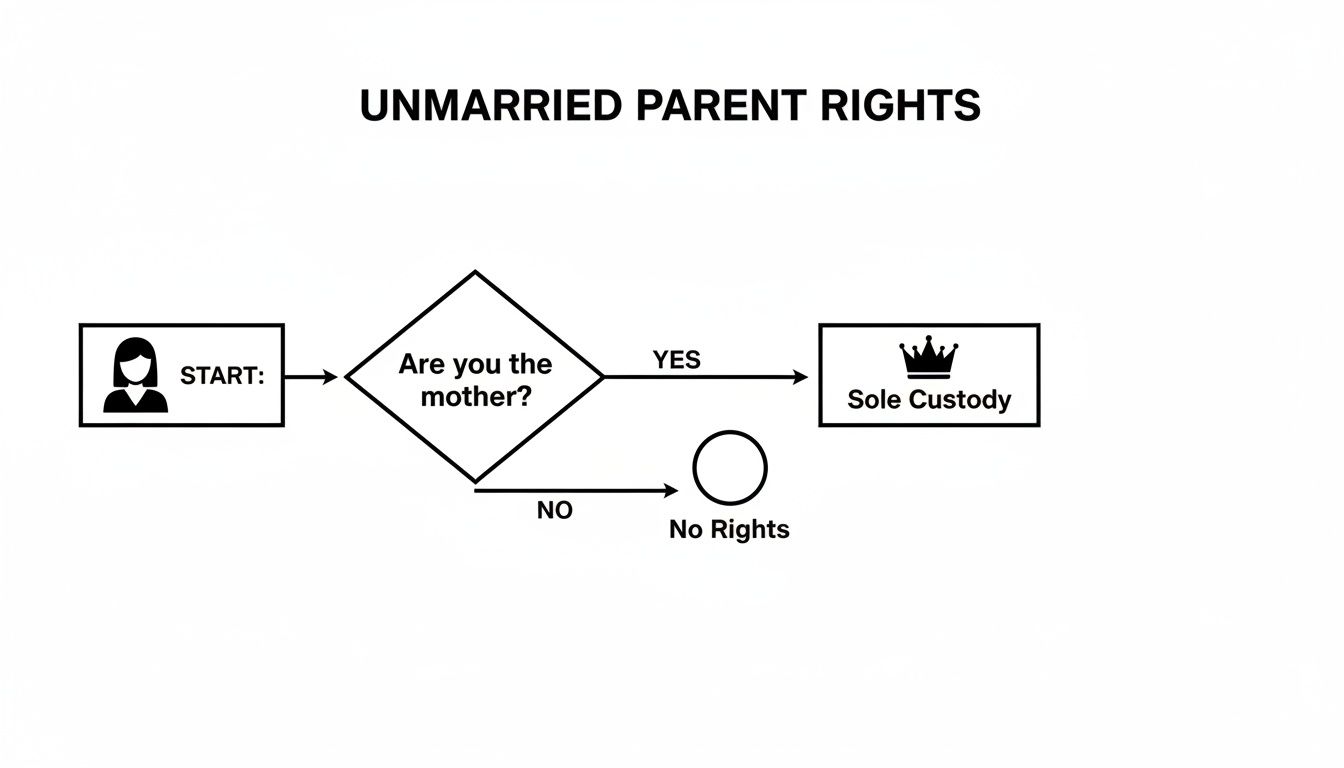
As you can see, the law gives the mother immediate sole custody from day one. The father’s path to having any rights only begins after taking legal action.
Two Paths to Establish Legal Fatherhood
So, how do you get this done? In Texas, you have two main options. The right one for you usually depends on whether you and the mother are on the same page.
- Voluntary Acknowledgement of Paternity (AOP): This is the simplest path. If both you and the mother agree that you're the dad, you can both sign a legal form called an AOP, which is often available at the hospital right after the baby is born. Once it's signed and filed with the state, you are officially the legal father.
- Suit to Adjudicate Parentage: If there’s any disagreement, or if one parent won't sign the AOP, the next step is filing a lawsuit in a Harris County family court. This sounds more intimidating than it often is. It's the formal process for asking a judge to make a legal determination.
Filing a suit is a standard procedure and is often necessary to protect your relationship with your child. The court will almost always order a DNA test for scientific confirmation. Once the results are in, the judge issues an order declaring you the legal father.
I can't tell you how many fathers I've met in our Atascocita community who are shocked to learn that just having their name on the birth certificate means nothing legally. Without a signed AOP or a court order, that name gives you no enforceable right to see your child.
Why a Formal Order is Essential
Let's imagine you and the mother have a great handshake deal. You see your child every weekend and help with expenses. Everything is fine, so why get the courts involved?
Here’s why: an informal agreement is not legally binding. It’s not worth the paper it isn't written on.
If you two have a falling out, the mother can legally cut off all contact tomorrow, and there’s nothing you can do about it immediately. You'd have no legal recourse. A court order protects everyone by laying out clear, enforceable rules that must be followed. You can get a more detailed breakdown by reading our guide on how to establish paternity in Texas.
Bottom line: establishing paternity isn't optional. It’s the non-negotiable first step that gives you the legal standing to fight for your rights and be the father your child deserves.
Understanding Conservatorship and Custody
Once paternity is legally established, the entire conversation shifts. For unmarried parents here in Atascocita and Humble, it's no longer about who the parents are, but rather what their roles and responsibilities will be moving forward.
Here’s something that trips people up: in a Texas courtroom, you won't hear lawyers and judges talking much about "custody." The official term we use is conservatorship. This legal framework lays out each parent's specific rights and duties for their child.

Think of conservatorship as the official job description for being a legal parent. It’s the blueprint that defines who makes the big decisions and which parent’s home will be the child’s main residence. Getting a firm grip on these concepts is absolutely essential, as they will shape your co-parenting relationship for years to come.
Joint Managing Conservatorship is the Texas Standard
Harris County judges, like most across Texas, begin with one fundamental belief: kids do best when both parents are actively involved in their lives. This is the cornerstone of Texas family law and a value we share at our firm.
Because of this, the most common outcome by a long shot is a Joint Managing Conservatorship (JMC). Now, this doesn't automatically mean a 50/50 split of the child's time. What it really means is that both parents share the rights and duties of raising their child. The court expects you to operate as a team on the important stuff.
"Under a Joint Managing Conservatorship, you and the other parent are co-captains of your child's team. The court expects you to communicate and make major decisions together, ensuring your child benefits from both parents' input and support."
The whole point is to keep two loving, capable parents on equal legal footing. This fosters the kind of stability and cooperation that children need to thrive. And it's more relevant than ever—with 41% of Texas births occurring to unmarried mothers, JMC is the modern standard, not some rare exception.
The Difference Between Primary and Possessory
Even when parents are named Joint Managing Conservators, there’s still a practical distinction to be made. One parent is usually designated as the "primary" managing conservator. This is the parent who has the exclusive right to decide where the child lives, although it's typically restricted to a certain geographic area, like Harris County and its surrounding counties. The primary parent is also the one who generally receives child support payments.
The other parent is known as the possessory conservator. Don't let the name fool you; they are still a joint conservator with a major say in most decisions.
Under a JMC, both parents typically share these crucial rights and duties:
- Educational Decisions: You both have the right to talk to teachers and see school records. Big calls, like choosing a school district (such as Humble ISD), are often made together.
- Medical Decisions: Both parents can consent to routine, non-invasive medical care and have full access to the child's medical and dental records.
- Moral and Religious Upbringing: You both retain the right to guide your child's moral and religious training.
This shared authority is the very heart of a JMC. For a more detailed breakdown of how these roles function, you can learn more about conservatorship in Texas in our detailed guide.
When Sole Managing Conservatorship is Awarded
While a JMC is the starting point for every case, there are serious situations where a judge will decide it simply isn't in the child's best interest. In these circumstances, the court can appoint one parent as the Sole Managing Conservator (SMC).
This is a very different arrangement. An SMC has the exclusive power to make most of the major decisions for the child without having to consult the other parent. It's an uncommon outcome, usually reserved for cases involving a clear history of:
- Family violence or child abuse
- Significant drug or alcohol problems
- Extreme conflict that makes co-parenting impossible
- A long-term absence of one parent from the child's life
Being named the SMC gives that parent the final say on everything from where the child lives to their schooling and medical treatments. The other parent becomes the Possessory Conservator, with a set visitation schedule but very limited decision-making authority. For any family in Atascocita facing a custody dispute, understanding these critical differences helps set realistic expectations for what might happen in court.
Creating a Practical Visitation Schedule
Once the court determines each parent's rights—what we call conservatorship—the next big piece of the puzzle is the visitation schedule. In Texas, the legal term for this is "possession and access." This part of the court order dictates your day-to-day life with your child here in Atascocita or Humble. A predictable schedule is one of the best gifts you can give your child; it provides the stability and routine they need to feel safe and secure.
The court’s main objective is to ensure the child has regular and ongoing time with both parents. To achieve this, Harris County judges often start with a blueprint called the Texas Standard Possession Order (SPO). Think of the SPO as a time-tested template built to give both parents meaningful, predictable time with their kids.

Breaking Down the Standard Possession Order
The SPO is the go-to schedule for kids over the age of three. It's considered the default because it's fair and gives everyone a clear, easy-to-follow structure. While it can look a little intimidating at first glance, it really just boils down to a few key parts.
For the non-primary parent (the possessory conservator), the SPO usually maps out time like this:
- Weekends: Possession of the child on the first, third, and fifth weekends of any given month.
- Holidays: A rotating schedule for major holidays like Thanksgiving and Christmas. This ensures each parent gets to celebrate with the child in alternating years.
- Summer Vacation: A solid block of time during the summer, typically 30 days, which can often be broken up into smaller visits if needed.
For instance, a father living in Atascocita can schedule his summer time to align with the Humble ISD school calendar. This predictability helps everyone—parents and children alike—plan their lives without last-minute chaos.
"A well-defined possession order is the roadmap for your co-parenting journey. It removes the guesswork and potential for conflict by clearly defining when and where the child will be with each parent, allowing everyone to focus on what truly matters—the child's well-being."
Customizing a Schedule That Works for Your Family
While the SPO is the standard starting point, Texas law recognizes that no two families are alike. You and the other parent are actually encouraged to create a custom schedule that fits your real lives. Perhaps one parent works nights, or your child has extracurricular activities that a standard schedule would disrupt.
You have the freedom to agree on any schedule you believe serves your child's best interests. If you can work together to create a plan, a Harris County judge will almost certainly approve it and make it a formal, enforceable court order. Taking this cooperative route can build a much healthier co-parenting relationship because it’s based on your agreement, not a one-size-fits-all court mandate. To dig deeper into shared parenting arrangements, you can learn more by reading about how joint custody works in the state of Texas.
Special Considerations for Children Under Three
It’s important to know that the Standard Possession Order is specifically designed for children who are three years old or older. For babies and toddlers, the courts understand their needs are completely different. Long stretches away from their primary caregiver can be very difficult for young children.
For kids under three, judges will craft a custom schedule tailored to the child's specific developmental stage. These orders often look a little different and might include:
- Shorter, but more frequent, visits for the non-primary parent.
- A "step-up" plan where visits get longer and more frequent as the child gets older.
- No overnight visits until the child reaches a certain age or milestone.
The goal is to help the child build a strong, loving bond with both parents while maintaining the absolute stability that's so crucial for their development. Whether you stick with the SPO or design your own plan, the end goal is always the same: creating a predictable, supportive, and loving environment where your child can flourish.
Calculating Child Support for Unmarried Parents
Let's talk about the financial side of co-parenting. In Texas, the law is very clear: both parents, whether married or not, have a fundamental duty to support their child financially. It doesn't matter what your relationship is like with the other parent; this responsibility is non-negotiable.
It's easy to think of child support as a penalty, but it's not. A better way to look at it is as a structured, shared investment in your child's future. A court order simply makes that shared responsibility official, ensuring your child has the consistent financial backing they need to grow up healthy and secure.
How Texas Runs the Numbers on Child Support
Judges in Harris County don't just pull a child support figure out of thin air. Texas has a standardized formula to keep things consistent and fair for families across the state, from Atascocita to Humble and beyond. The calculation is based on a percentage of the "net monthly resources" of the parent who doesn't have the exclusive right to decide where the child lives (often called the non-primary parent).
The formula is straightforward and depends on how many children the support order covers.
- 1 Child: 20% of net resources
- 2 Children: 25% of net resources
- 3 Children: 30% of net resources
- 4 Children: 35% of net resources
- 5+ Children: 40% of net resources
So, what are "net resources"? Think of it as take-home pay, but a bit broader. It includes almost everything—your salary, wages, commissions, overtime, income from a side business, even rental income—after subtracting a few key items like social security taxes and federal income tax.
A Major Update to the Income Cap
For a long time, the state capped the amount of income that could be used in this formula. But as we all know, the cost of raising children keeps going up. In response, Texas lawmakers recently made a significant change. A major update to Texas family law has bumped the child support income cap all the way up to $11,700 in net monthly resources.
That's a 27% jump from the old cap of $9,200—the biggest increase we've seen in over two decades. As you can see in these insights into new Texas family laws, this adjustment is a big deal and finally brings the guidelines more in line with today's economic realities.
For higher-earning parents, this means the potential child support obligation is significantly higher. With the new cap, the maximum guideline support for one child can now reach $2,340 per month ($11,700 x 20%). The goal is to ensure children can benefit from both parents' financial success, even when that success is substantial.
Crucial point: A child support order can't happen until paternity is legally established. In the eyes of Texas law, legal parentage and the financial duty to support a child are two sides of the same coin.
What Child Support is Actually For
Child support is designed to cover a child’s fundamental needs. This obviously includes the big three—housing, food, and clothing—but it goes beyond that.
One of the most important parts of any child support order is health insurance. A Texas court will order one of the parents, usually the one paying support, to provide and pay for the child's health insurance. This is a non-negotiable part of the order, ensuring your child always has access to the medical and dental care they need to stay healthy.
Getting a handle on these financial rules is a critical step toward building a stable and predictable co-parenting relationship. Here at The Law Office of Bryan Fagan, our Atascocita team can walk you through how these laws apply to your unique situation, making sure any child support order is both fair and accurate.
Get Help from an Atascocita Family Law Attorney
Trying to make sense of Texas custody laws for unmarried parents can feel overwhelming, especially when all you want is to protect your child. The journey from establishing paternity to creating a stable parenting plan is filled with legal hurdles that will define your family’s future. The good news is, you don’t have to walk this path alone.
At The Law Office of Bryan Fagan, we've dedicated our practice to helping families right here in Atascocita, Humble, and the surrounding northeast Harris County communities. We understand the specific challenges unmarried parents face because we handle these cases every single day.
We’re a Local Firm, and Your Family is Our Focus
Being part of this community means we do more than just file paperwork. We sit down with you, listen to your story, and help you define what a successful outcome looks like for your family. We believe the best decisions are made by clients who feel informed, understood, and supported.
Our team can guide you through every step:
- Establishing Paternity: We’ll help you take that crucial first step to solidify a father’s legal rights and responsibilities.
- Securing Fair Court Orders: Our goal is to craft conservatorship and possession orders that are practical and protect your precious relationship with your child.
- Creating Stable Parenting Plans: We work to build co-parenting agreements that bring predictability to your life and minimize future conflict.
Let us bring the legal clarity and compassionate support you deserve during this tough time. We're here to answer your questions and fight for what matters most: your child’s best interest and your rights as their parent.
We invite you to come in for a free, no-obligation consultation at our Atascocita office. It's a chance to talk through your situation with a local family law attorney who genuinely wants to help you find the best path forward for you and your child.
Common Questions We Hear About Unmarried Parent Custody
Going through the family court process brings up a ton of questions. As family lawyers serving the Atascocita community, we hear many of the same worries from unmarried parents. Here are some straightforward answers to the questions we get asked most often, designed to help you understand your next steps.
Does Signing the Birth Certificate Make Me the Legal Father?
No, it does not, and this is probably the biggest and most painful misunderstanding we see. Simply putting your name on the birth certificate does not give an unmarried father any legal rights to custody or even visitation in Texas.
It’s a good first step—it creates a presumption that you're the dad. But it isn't the same as a court order. To get real, enforceable rights, you must either properly file a voluntary Acknowledgement of Paternity (AOP) with the state, or go to court and get a judge to sign an order in a case called a Suit to Adjudicate Parentage.
It’s a shock for many dads in our Humble and Atascocita communities to find out that without that AOP or a court order, they can’t legally demand to see their child. A formal order is the only thing that truly protects your rights as a father.
Can My Child's Mom Just Move Away?
This is a huge fear for many dads, and the answer hinges on one thing: is there a court order in place? If you do not have a custody order, the mother is considered the sole legal parent by default. That means she can generally move wherever she wants with the child, and there's little you can do to stop her.
This is exactly why getting a court order is so critical for unmarried fathers. A standard custody order from a Harris County court will almost always include a geographic restriction. This clause usually says the primary parent can't move the child’s home outside of Harris County and its neighboring counties unless you agree in writing or a judge gives permission. It’s your best protection for maintaining a consistent, close relationship with your child.
We Agree on Everything. Do We Really Need a Court Order?
Yes. One hundred percent, yes. A verbal agreement is great while you’re getting along, but it is not legally enforceable. When a disagreement pops up later—and it often does—that handshake deal you made means nothing in the eyes of the law. It offers zero protection for either parent.
To truly protect both parents' rights and give your child the stability they deserve, you need to put your agreement in writing. This document, called an Agreed Order, gets signed by a judge and becomes an official court command that both of you must follow. Our Atascocita family law attorneys can help you draft an order that makes your agreement official and secures your family's future.
Figuring out the ins and outs of texas custody laws for unmarried parents takes experience. Here at The Law Office of Bryan Fagan – Atascocita TX Lawyers, we're ready to provide the clear advice and strong representation you need. You can schedule a free, no-pressure consultation with us today by visiting our Atascocita family law website.