Skip to content
Approximately 466,000 divorced people were receiving survivor benefits on a former spouse's Social Security record as of December 2024, but military SBP coverage for a spouse ends when the divorce becomes final unless the right federal steps are taken within one year. That catches a lot of families off guard in Atascocita, because a divorce decree can divide property on paper while the survivor benefit problem sits in the background.
A newly divorced military retiree in Atascocita often thinks the hardest part is over once the judge signs the decree. Then a former spouse calls about survivor coverage, and the retiree learns the election didn't continue automatically. That's where the problem starts, because the deadline for preserving coverage is short and the paperwork has to match the court order.
Understanding the Survivor Benefit Plan and Its Role in Divorce
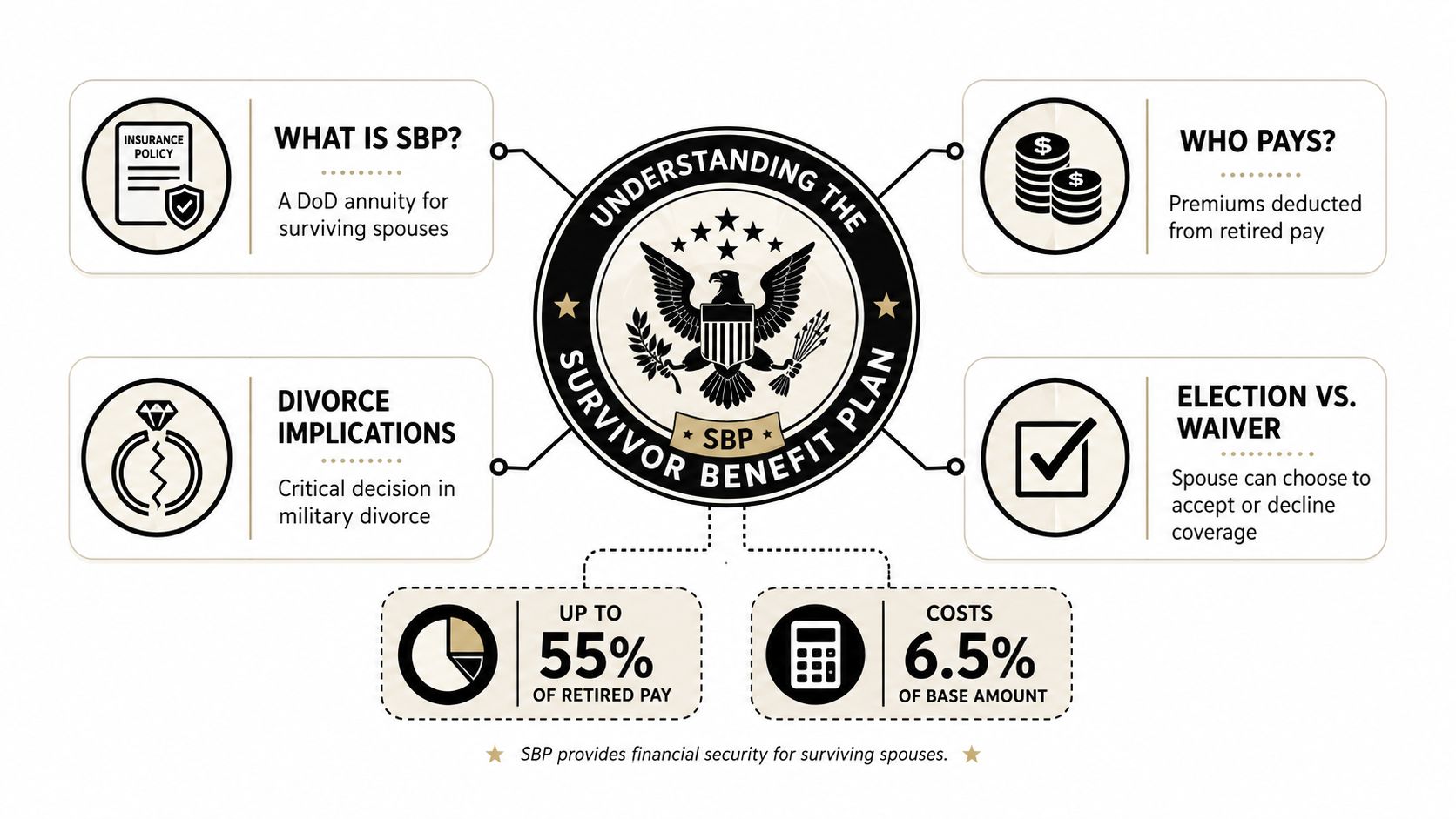
A retiree in Atascocita may look at the Survivor Benefit Plan, or SBP, and think of it as a simple promise to protect a spouse after death. In practice, it's more specific than that. SBP is a DFAS-administered annuity that can pay a surviving beneficiary a monthly amount tied to the retiree's elected base amount, and the benefit is generally 55% of that elected base amount. The premium side matters too, because the cost is tied to the base amount the retiree selected.
What the key SBP terms mean in plain English
The easiest way to understand SBP is to break it into three parts.
- Base amount: the amount used to calculate the survivor benefit and the premium.
- Annuity: the monthly payment made to the survivor after the retiree's death.
- Premium: the cost deducted to keep the coverage in force.
A spouse who was covered during the marriage may assume that coverage keeps going after divorce. It doesn't. For military retirees, spouse coverage ends at divorce, and former-spouse coverage has to be handled through the proper federal election or court process. That distinction is why divorce planning in northeast Harris County needs to be careful from the start.
A useful local example is a couple in Atascocita who spent years planning around one retirement check. After divorce, they discover that retirement income and survivor income are different problems. The first affects monthly support now. The second affects what happens if the retiree dies years later.
A practical retirement-division resource like Closer Innovation Labs Corp. beneficiary forms can help readers see how beneficiary paperwork works in other settings, but military SBP has its own federal rules and deadlines. For a broader property-division discussion in a Texas divorce, see the firm's division of retirement accounts in Atascocita divorce page.
Practical rule: if divorce is on the table, don't assume the survivor benefit follows the same path as property division. The federal election has to be handled on its own terms.
How Divorce Affects SBP Coverage and Eligibility
The moment a divorce becomes final is the moment SBP problems usually begin. Military guidance says SBP spouse coverage ends when the divorce is final, and a former spouse is not automatically covered. That means the coverage you thought existed during marriage can disappear unless someone takes the correct action on time.
The one-year clock starts with the decree
If the retiree wants to keep SBP coverage for a former spouse, DFAS requires written notice within one year of the divorce decree and submission of DD Form 2656-1 with the divorce decree and settlement agreement. DFAS also says the premiums are retroactive to the month after the divorce decree, even if the election is made later within that one-year period. That retroactive feature matters because a delayed decision can still carry a cost.
If the divorce decree orders former-spouse coverage, the former spouse usually must file a deemed election with DFAS within one year of the court order. If that deadline is missed, DFAS won't honor the award even if the decree required coverage. In plain terms, the court order and the DFAS filing are two different things, and both matter.
A Texas family in Humble may think the judge's signature solves everything. It doesn't. The court can order rights, but the federal system still needs the proper notice. That's why a military divorce should be handled with the decree and the DFAS calendar in mind at the same time.
For readers comparing military retirement issues with broader service-related cases, retirement benefits guide for NJP proceedings offers a useful look at how retirement rights can be protected in another military context. The rules differ, but the lesson is the same, paperwork timing controls outcomes.
Why the base amount matters during divorce
SBP isn't a vague promise, it's a math problem attached to a legal deadline. The benefit is calculated from the elected base amount, and the premium follows that selection too. When couples negotiate divorce in Atascocita or Harris County, they're often dividing a current pension and a future survivor stream at the same time.
The Texas family law side also matters. An attorney handling a divorce in this area has to look at the retirement division, the survivor designation, and whether the settlement language matches what DFAS will accept. That's where Military Retired Pay Division Divorce Atascocita TX becomes relevant for families trying to align Texas property division with federal retirement rules. If a couple also needs long-term planning, an Estate Planning Attorney in Atascocita can help with wills, trusts, and estate plans for Atascocita families.
Important distinction: the divorce decree can require action, but it doesn't send the DFAS paperwork for you.
Texas Family Law and Federal SBP Rules Working Together
A Texas divorce decree can divide military retirement rights, but it does not make the federal survivor paperwork happen by itself. Texas treats benefits earned during marriage as community property, and Texas practice often uses a QDRO-type order to enforce the division. Federal SBP rules still control whether a former spouse keeps survivor coverage after the divorce is final.
Why a Texas order isn't enough by itself
A decree often feels like the finish line because it states who gets what. For SBP, that feeling can be misleading. Even when a Texas court orders former-spouse SBP coverage, DFAS still requires the former spouse to file a deemed election within one year of the court order. If that deadline passes, DFAS will not enforce the award, even if the decree clearly says the coverage should continue.
That timing problem explains many military divorce disputes in Atascocita. A couple may settle the property division correctly, use the right survivor language, and still lose the benefit if the federal filing never gets submitted. The legal right and the administrative right have to line up during the same filing window, or the protection can disappear.
SBP and Social Security side by side
Civilian survivor rules can help show why SBP causes confusion. Social Security usually requires a divorce that lasted at least 10 years, the surviving ex-spouse must generally be 60 or older or 50 if disabled, and remarriage rules also matter. Social Security's December 2024 cited data showed about 466,000 people receiving survivor benefits on a deceased former spouse's earnings record, and 96% of them were women. Claiming at 60 yields 71.5% of the deceased ex-spouse's benefit, while waiting until full retirement age for survivors can raise it to 100%. In the SSA's December 2025 statistical tables, there were 12,371 divorced spouses receiving spousal benefits, with an average monthly benefit of $461.11.
| Feature | SBP (Military) | Social Security (Civilian / Concurrent) |
|---|---|---|
| Who controls eligibility | Federal military election and DFAS rules | Social Security eligibility rules |
| Divorce effect | Spouse coverage ends at divorce unless converted properly | Ex-spouse survivor rights may continue if the marriage and age rules are met |
| Timing risk | One-year federal deadline for election or deemed election | Age and marriage rules control when benefits can be claimed |
| Benefit level | Generally 55% of the designated base amount | Can be 71.5% at age 60 or 100% at full survivor age |
The Texas divorce process and the federal benefit process have to be read together. A local attorney handling a military divorce in Atascocita or Harris County has to check the settlement language, the retirement division, and the DFAS filing path at the same time. The attorney at Divorce Lawyer in Atascocita, TX can help clients sort out those moving parts before the federal deadline closes.
Texas courts divide property, but DFAS pays benefits only when the federal steps are done correctly.
Practical Steps for Military Divorces in Atascocita and Harris County
The safest approach is simple, but it has to be followed in order. Start by checking the current SBP election, then read the divorce paperwork for any language about survivor coverage, and then confirm what still needs to be filed with DFAS. Silence in the decree does not create a survivor right.
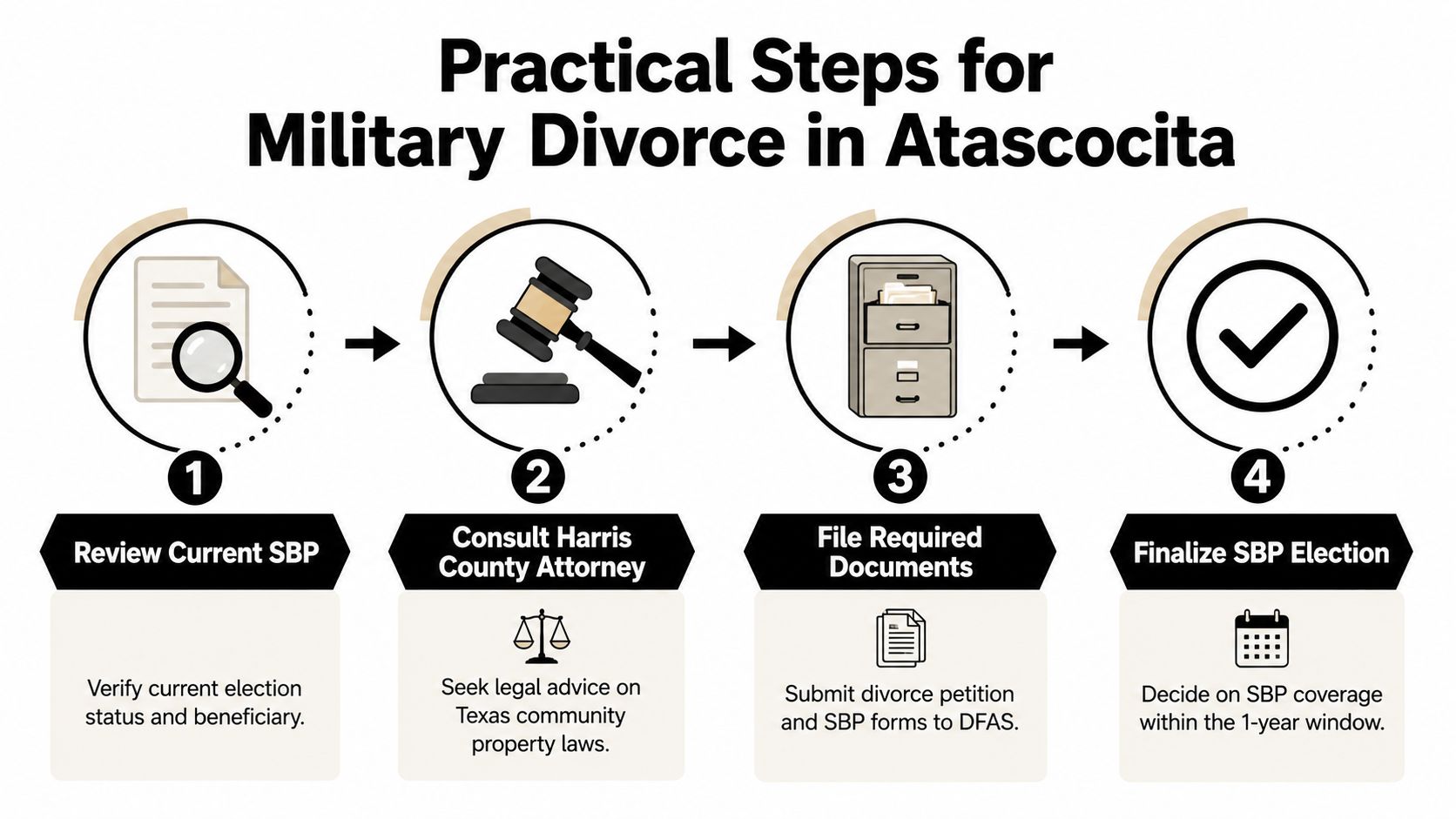
A practical filing sequence
- Review the current SBP election. Confirm whether spouse coverage still exists on paper and who is named.
- Check the decree and settlement language. Look for specific former-spouse SBP terms, not general retirement language.
- File the required DFAS documents. If coverage is supposed to continue, the retiree must submit the written notice and DD Form 2656-1 with the decree and settlement agreement.
- Watch the one-year deadline. If the former spouse needs to protect the award, the deemed election has to be filed within the same one-year window.
A clean way to stay organized is to build a calendar around the decree date, not around when emotions settle down. The federal deadline is tied to the date of divorce or the court order, not the date when the parties finally get around to gathering documents.
For families trying to handle an uncontested split, uncontested divorce assistance may help with the paperwork side, but military SBP still needs legal review because the federal election rules are unforgiving. The forms may look administrative, yet the consequences are long-term.
| Deadline or step | What has to happen | If it's missed |
|---|---|---|
| Divorce decree entered | Survivor language should be reviewed immediately | Coverage can end without replacement action |
| Within one year of decree | Retiree files written notice and DD Form 2656-1 with supporting documents | Former-spouse election may not be preserved |
| Within one year of court order | Former spouse files deemed election if decree orders coverage | DFAS won't honor the award |
If the case is moving quickly in northeast Harris County, that doesn't change the need for careful filing. A divorce can be final in court and still incomplete on the military benefits side.
Common Mistakes That Cost Former Spouses Their SBP Benefits
The first mistake is thinking a good divorce decree automatically creates SBP coverage. It doesn't. The decree can order the result, but DFAS still needs the correct filing before the deadline. If nobody completes that step, the benefit can disappear even when the court clearly wanted it preserved.
Three assumptions that cause real harm
- “The judge already ordered it, so I'm covered.” A court order and DFAS enforcement are different systems. If the deemed election isn't filed within the required time, the order may be worthless for payment purposes.
- “Remarriage always ends everything.” Under the federal SBP rules described in military divorce guidance, remarriage before age 55 can suspend coverage during the remarriage period. That's different from assuming all remarriage automatically destroys the right forever.
- “I can file later when things calm down.” The one-year window is strict. Waiting until the paperwork feels convenient is exactly how people lose rights they thought were protected.
A realistic Atascocita scenario goes like this. A former spouse reads the decree, sees the SBP language, and assumes the law will take care of the rest. Months later, the retiree's records still haven't been updated, and the filing window has closed. The problem wasn't bad intent. It was delayed action.
Bottom line: SBP compliance isn't about hoping the order is enough. It's about getting the right document to the right agency on time.
Another common confusion comes from mixing SBP with other survivor rules. Social Security and military SBP have different eligibility paths, different deadlines, and different consequences. If you treat them like the same benefit, you can make the wrong move in both systems.
When to Consult a Local Atascocita Attorney About SBP and Divorce
A military divorce in Atascocita, Humble, or northeast Harris County can look settled on paper while the Survivor Benefit Plan still sits unresolved. That is where families get into trouble. Federal SBP rules, Texas property division, and the wording in the decree have to line up, or the benefit can be lost after the paperwork is signed.
The problem usually shows up only when the retiree account is supposed to reflect the new order and nothing has been filed with the right agency. A decree can say one thing, but DFAS only follows what is properly submitted under the federal process. That gap is easy to miss if you are treating SBP like an ordinary divorce issue.
Military legal assistance offices can explain the general rules, but they do not represent someone in a civil divorce or handle DFAS advocacy the way a private lawyer can. That matters because SBP is not just about knowing the rule. It is about making sure the decree, the election, and the deadline all fit together.
Local families often start with a military divorce lawyer in Atascocita when retirement benefits, SBP coverage, or a former-spouse claim are part of the case. In a military divorce, a Divorce Lawyer in Atascocita, TX resource can also help explain how Harris County procedure interacts with federal benefit rules, especially when one mistake in the paperwork can affect more than one issue at once.
The Law Office of Bryan Fagan, Atascocita TX Lawyers, helps families sort through divorce, custody, property division, estate planning, and related civil matters with a local focus. In this setting, that often means checking the decree language, the DFAS deadline, and the retirement paperwork together, the way you would check all the parts of a lock before trying to close the door.
When survivor benefits are involved, guessing is a poor substitute for review. A short delay can turn a protected right into a missed opportunity, and the hardest part is that the fix was often available at the start.
If you are dealing with a military divorce in Atascocita or Humble and SBP is part of the picture, the Law Office of Bryan Fagan, Atascocita TX Lawyers can help review the decree, the DFAS deadline, and the retirement paperwork before mistakes become permanent. Visit Law Office of Bryan Fagan, Atascocita TX Lawyers to schedule a free consultation and get clear guidance for your situation.