Skip to content

A missed call can turn into a week of silence fast. One parent works nights near the ship channel, the other is handling school pickup in Atascocita, and the child keeps waiting for a conversation that never happens because the timing never lines up. In Harris County, that kind of frustration is exactly why families ask for an electronic communication with child order. It gives the court a way to turn shaky, informal contact into something predictable and enforceable.
When Phone Calls Are Not Enough for Atascocita Families
A Humble mom may be doing the right thing by trying to keep the child connected to the other parent, but the calls keep getting missed. A dad who drives to a refinery or works a hospital shift may be free only when the child is already asleep. When communication depends on goodwill and luck, the child often ends up caught in the middle.
Why informal contact breaks down
In real life, phone calls do not fail because parents do not care. They fail because schedules collide, children get tired, and co-parenting tension gets in the way. A parent may ignore calls, delay video chats, or argue about the best time to connect. That is where a court order matters.
Texas has treated electronic communication with a child as a distinct custody-related concept since 2007, and the law gives judges a real framework for ordering it as part of possession and access. In the Atascocita and Humble area, that matters for parents who need contact that is more stable than a casual agreement. If you are trying to understand the basic family-law backdrop, Harris County Family Courts: A Atascocita Resident's Guide is a useful local reference for how cases move through the courts serving this area.
Practical rule: if the relationship depends on one parent answering the phone whenever they feel like it, the child's contact is already fragile.
What this order really does
An electronic communication order does not replace parenting time. It supplements physical possession, which is why it can be useful for shift workers, parents separated by distance, and families dealing with conflict. TexasLawHelp explains that parents can seek this relief in an original custody case or later in a modification case, and the court can order it when it serves the child's best interest.
That distinction matters in Harris County courtrooms. Judges are not asking whether virtual contact is convenient for adults. They are asking whether structured communication will help the child stay connected without disrupting school, bedtime, or the rest of the parenting schedule. For some families, that structure is the difference between a child who hears from both parents and a child who only sees one side of the family when a dispute flares up.
What Texas Law Says About Electronic Communication Orders
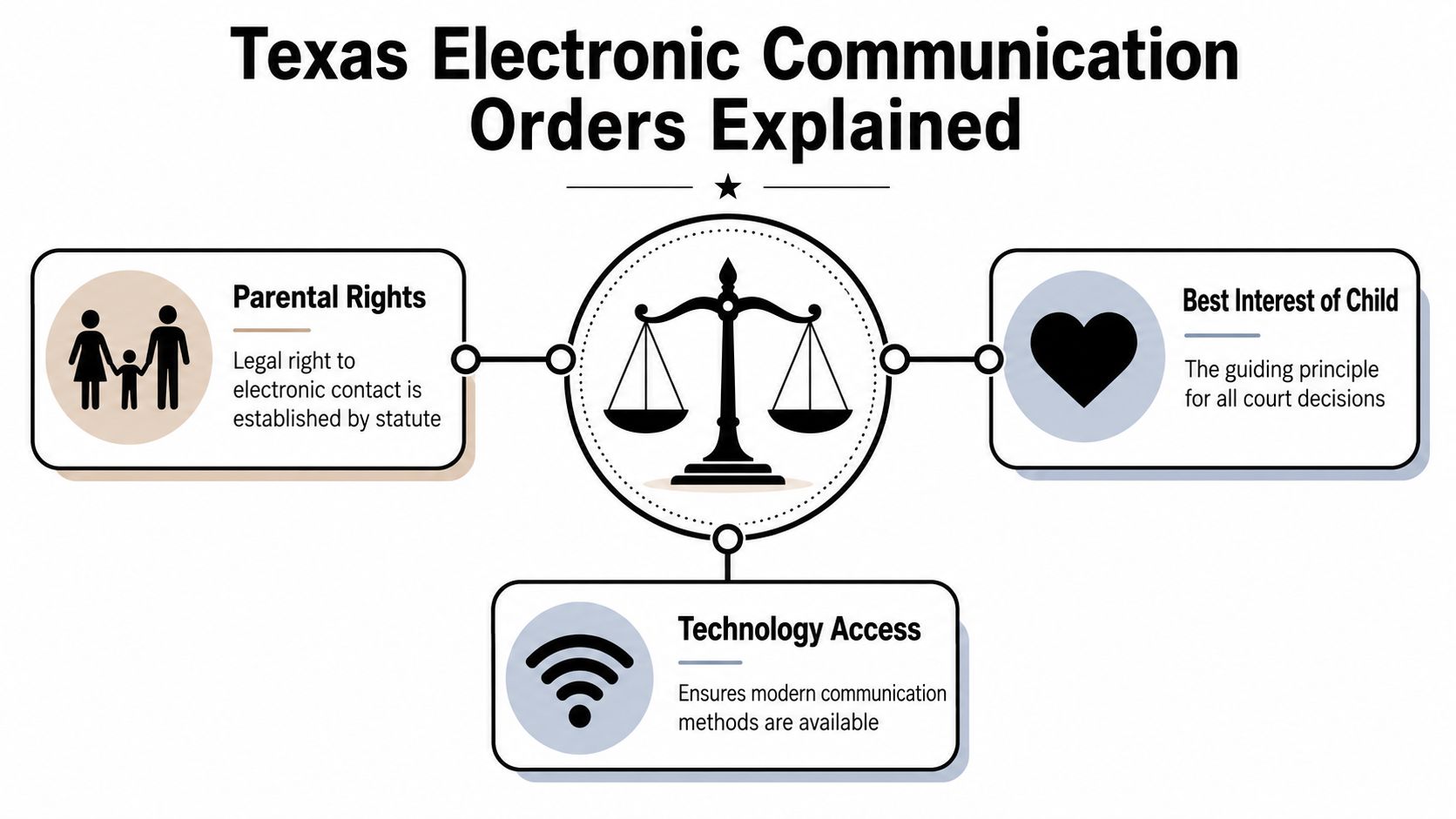
Texas Family Code § 153.015 gives courts a legal tool for ordered contact, and it has done so since 2007. The statute defines electronic communication broadly, covering communication using wired or wireless technology through the Internet or other electronic media, and it specifically names telephone, email, instant messaging, videoconferencing, and webcam communication. That broad wording gives Harris County judges room to fit the order to a family's real routine, instead of forcing everyone into the same setup. The legal text is available in the statute itself at Texas Family Code § 153.015.
The legal idea behind the order
The court is not inventing a separate right from scratch. It is using a statute that already treats electronic contact as part of the custody structure, which is why these orders can fit naturally into possession and access cases in Harris County. The order can be customized to a child's age, the family's schedule, and each parent's access to technology.
For Atascocita parents asking whether a judge can require this kind of contact, the answer is grounded in the law and in how the court structures parenting time. A useful local discussion of that issue is Can a Parent Refuse to Communicate With Co-Parent in Texas?. Once the order is signed, it is not a polite suggestion. It becomes part of the court's possession and access framework, and the parents are expected to follow it.
How it fits with physical parenting time
Electronic contact supplements in-person time, it does not replace it. That point matters for parents who worry that a video-call order will take away weekend visits, holiday time, or school-break access. The statute is designed to keep the parent-child relationship active when face-to-face time is limited, while leaving the rest of the schedule in place.
TexasLawHelp notes that parents usually have to ask for this relief in an original custody suit or in a modification suit. That is why the topic often comes up alongside conservatorship, possession, and access. A carefully drafted order gives Harris County judges concrete details to enforce, including how often the contact happens, how long each session lasts, and when it should take place. For many Atascocita and Humble families, especially those dealing with shift work, military service, or high-conflict co-parenting, that kind of clarity is what makes the order workable.
Situations Where Harris County Judges Grant These Orders
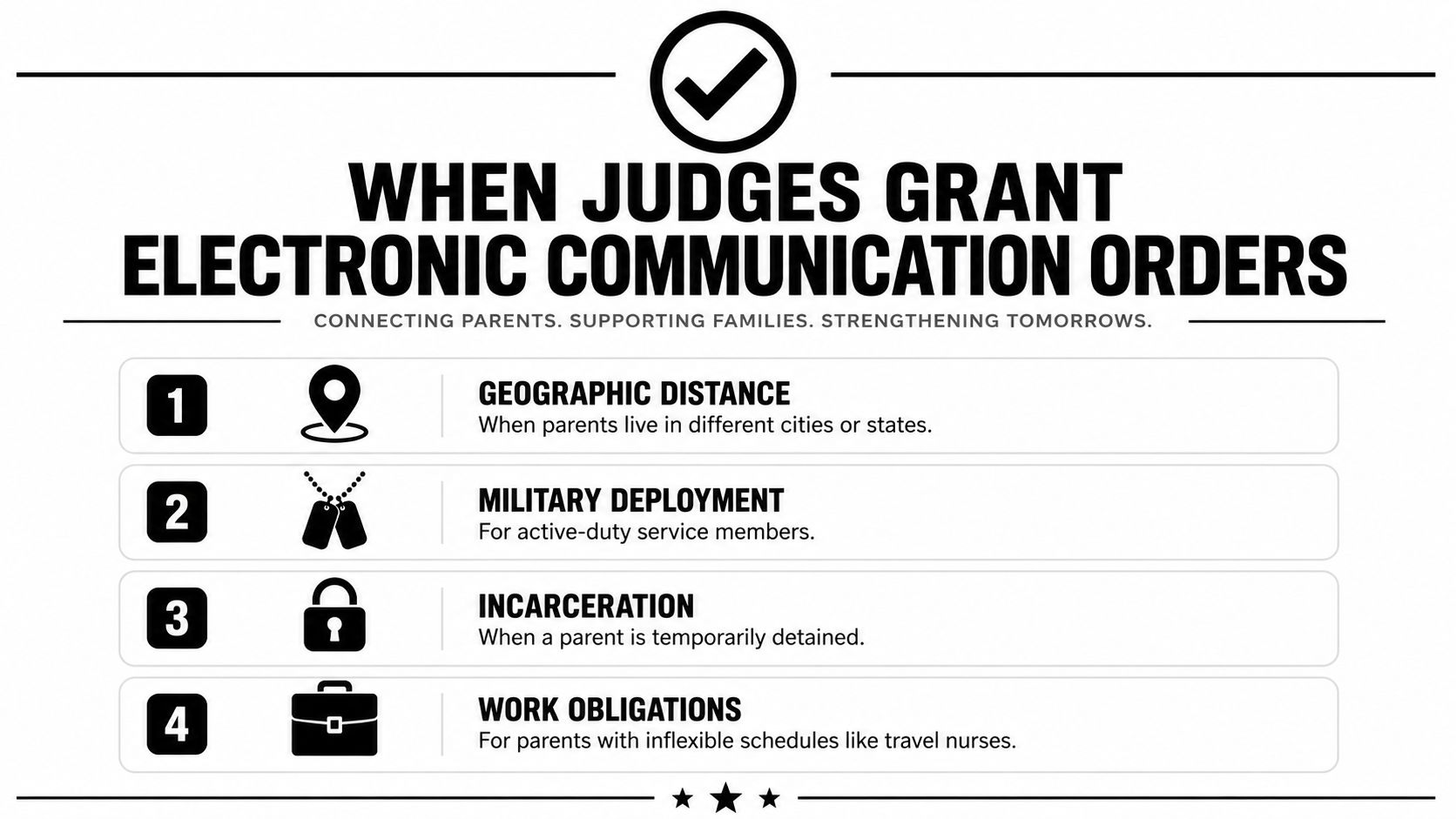
Harris County judges tend to look for a practical reason to make communication more structured, not just a general desire for more contact. In Atascocita and Humble, the most common examples usually involve distance, work patterns, military service, or conflict that keeps parents from coordinating on their own. The law's flexibility helps judges match the order to the family, rather than forcing every child into the same schedule.
Common scenarios that fit the order
A parent deployed with the military may need a reliable video schedule because they cannot stop by after school. A shift worker may need a set call window because their hours change week to week. A parent who lives farther away may need virtual contact to bridge the gap between visits. And in a tense co-parenting case, a specific order can reduce arguments over when a child should answer the phone.
Texas practice also recognizes that the details matter. Guidance notes that many courts prefer every other day or at least 3 times per week, and that sessions are often limited to up to 30 minutes each time. Those details give children predictability, which is often the missing piece when adults are arguing over contact. TexasLawHelp also says courts may look at whether the communication is reasonable, whether both homes have the needed devices, and whether the proposed time would interfere with school or bedtime.
Courts usually care less about the label and more about whether the schedule actually works for the child.
Age, devices, and daily routines
A younger child might need shorter, simpler calls. An older child may handle a more flexible schedule. A judge can also consider whether each parent has the necessary technology and whether the child's routine would be interrupted by late-night calls or constant pings during homework time. That is why an order that looks good on paper can still fail in practice if it ignores school, bedtimes, or a parent's actual work schedule.
For families who are also dealing with online conflict, it can help to review how judges view social media in custody cases, because the same habits that make co-parenting harder online often show up in communication disputes too. The core question stays the same. Does the proposed order make the child's life calmer and more stable?
How to Request an Electronic Communication Order in Harris County
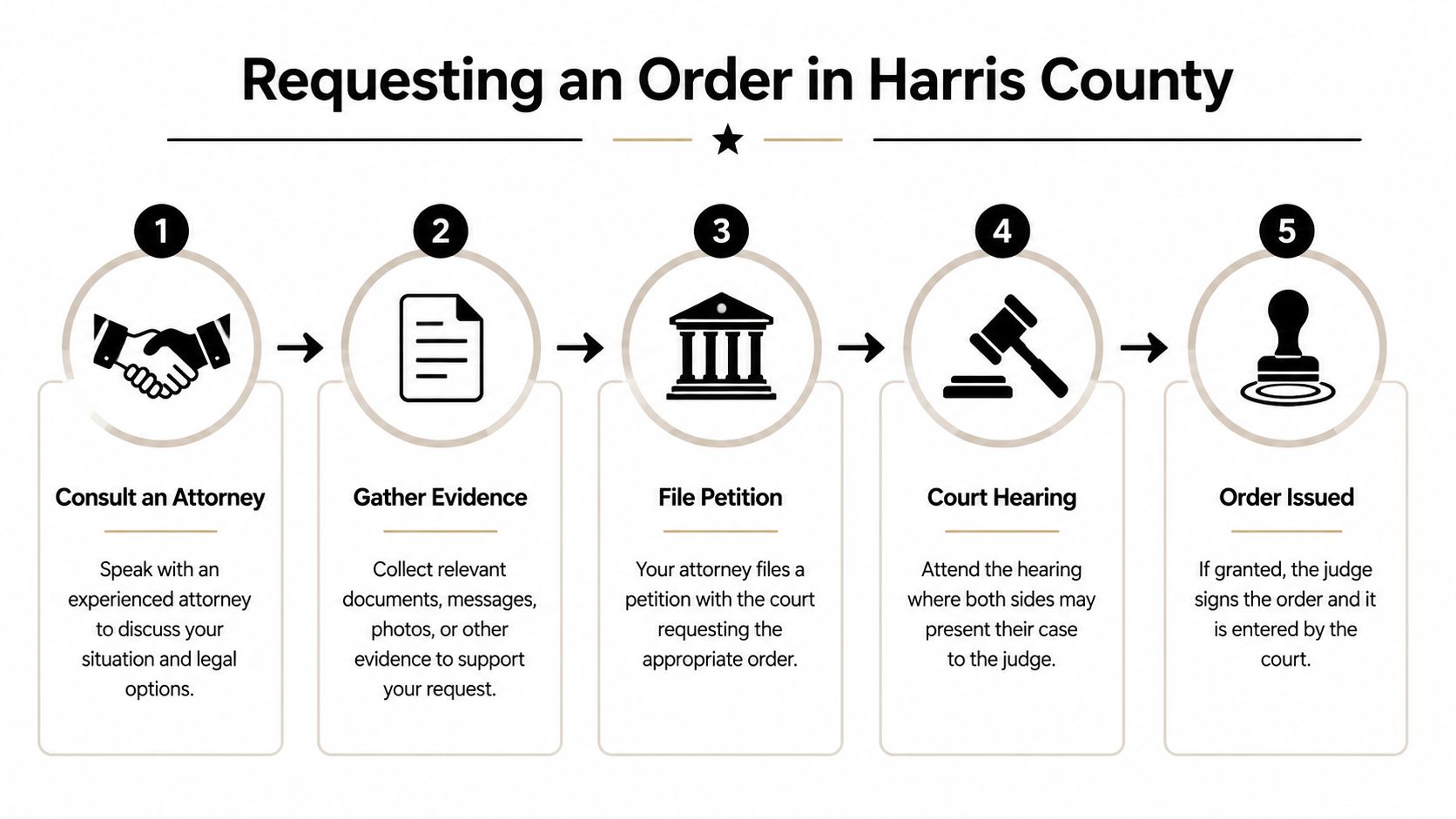
Texas does not automatically add virtual contact to every custody case. A parent has to ask for it, either in an original SAPCR or in a modification case. That means the request needs to be in the paperwork, supported by facts, and presented in a way the judge can enforce.
The basic path
The starting point is usually a consultation with a family lawyer who can look at the existing order or draft the request from scratch. From there, parents gather the evidence that shows why structured electronic contact would help. Missed-call logs, text messages showing repeated scheduling problems, work schedules, deployment paperwork, and school routine conflicts are all the kind of real-world information that helps a court see the issue clearly.
The next step is filing the petition or requested modification in Harris County. If the current order does not mention electronic communication, the other parent is not required to allow it on their own. TexasLawHelp is clear on that point. A parent may want the contact, but without a court order, the right is not automatic.
What helps at the hearing
Judges respond better to a proposed plan than to a vague request. If you can tell the court when communication should happen, how long it should last, and what technology will be used, the request becomes much easier to evaluate. That is especially true in Atascocita cases where work shifts, traffic, school pickup times, and extracurricular schedules all collide.
A helpful order usually answers questions like these:
- When will the contact happen? Give the judge a realistic day and time.
- How long will each session last? Keep it child-focused and manageable.
- What device or platform will be used? Be specific if the family uses phone, FaceTime, or another platform.
- What happens if school or bedtime gets in the way? Build in flexibility or limits.
One local practice resource, Electronic communication with your child, explains the need to request this relief formally, and that point is exactly where many parents get tripped up. A good request is not about sounding emotional. It is about showing the judge a workable plan that protects the child's routine.
Sample Order Language and Parenting Plan Clauses
Well-drafted language makes a huge difference because the order is only as useful as the words on the page. In Harris County, the safest orders are specific enough to leave little room for argument, but flexible enough to survive real life. That balance matters for Atascocita parents who are trying to co-parent across school schedules, shift work, and long days on the road.
Clauses that are easy to enforce
A communication clause often sets the frequency, duration, and general time window. It may say the parent may have contact every other day or 3 times per week, and that each session lasts up to 30 minutes. A good clause may also avoid school hours and bedtime so the child is not pulled out of class or kept awake by a late call. If a family uses a specific app or platform, the order can name that too.
| Provision Type | Sample Language | Purpose |
|---|---|---|
| Frequency | “The parent may communicate with the child every other day.” | Creates a predictable schedule |
| Duration | “Each communication will last up to 30 minutes.” | Keeps calls age-appropriate and manageable |
| Timing | “Communication will occur outside school hours and bedtime.” | Protects the child's routine |
| Technology | “Communication may occur by telephone, videoconference, or webcam.” | Clarifies the approved method |
| Compliance | “Each parent shall make the child available at the ordered time.” | Reduces disputes over access |
A clause like this gives everyone something concrete to follow. It also gives the court a clear standard if one parent starts blocking contact later on.
Special wording in family violence cases
Texas law treats these cases differently. The Texas Family Violence Benchbook states that a SAPCR court may allow electronic communication with a parent who committed family violence only if the parties agree, and any written order must include the communication terms in bold-faced capital letters along with any required safety restrictions under Tex. Fam. Code § 153.015(e). That language is not decorative. It is there because the court needs the restrictions to stand out.
If the order is vague, enforcement becomes harder. If the order is precise, both parents know exactly what the judge expected.
In practice, the cleanest orders read like instructions, not arguments. That is why many parents ask a lawyer to draft the wording instead of trying to do it from memory after a stressful hearing. For families also navigating support issues, the local page for Child Support Attorney in Atascocita can be a useful companion resource when parenting and financial orders are moving together in the same case.
Enforcement and Modification Options for Atascocita Parents
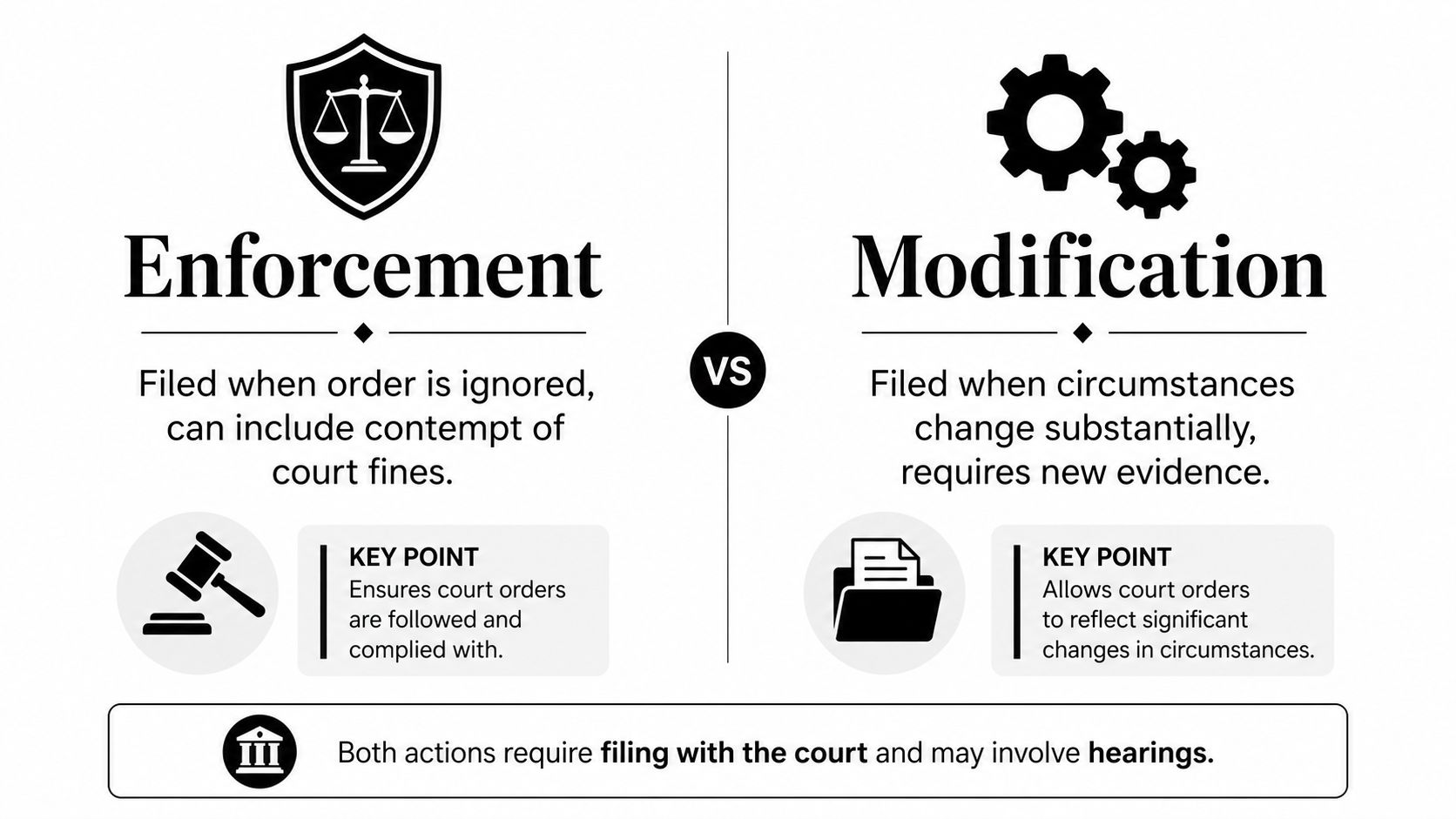
When a court order exists, the next question is simple. What happens if the other parent ignores it? Harris County parents usually have two different paths, enforcement and modification, and the right choice depends on whether the problem is noncompliance or a real change in circumstances.
Enforcement when the order is being ignored
If one parent keeps cancelling calls, refusing to hand over the child, or otherwise blocking the ordered contact, enforcement may be the right move. TexasLawHelp notes that electronic access can be enforced if a parent refuses to comply with a written order. In practical terms, that usually means documenting the missed sessions, the excuses given, and the dates the violations happened.
A clear log can help a judge see the pattern. Save texts. Keep screenshots. Note whether the child was unavailable because of school, extracurricular activity, or a direct refusal by the other parent. The more organized the record, the easier it is to prove the problem.
Modification when life has changed
Modification makes sense when the original order no longer fits. A parent's work schedule may have changed. A child may be older now and able to handle different timing. A family may have moved, making the old schedule unrealistic. In those situations, the court is not being asked to punish anyone. It is being asked to update the order so it works again.
The difference is important. Enforcement says, “Follow the order you already have.” Modification says, “The order no longer matches the family's situation.” That distinction keeps families from filing the wrong motion and wasting time.
For parents dealing with repeated violations, what to do if an ex violates a custody order is a helpful local reference. It lines up with the same practical reality Harris County families face. Courts need proof, and parents need to decide whether they want to force compliance or ask for a better order.
Local Resources and Next Steps for Your Family
An electronic communication order can help a child stay connected to both parents when distance, work, or conflict makes normal phone calls unreliable. Texas law gives Harris County judges a structure for ordering that contact, and the order becomes most useful when it is specific, realistic, and adapted to the child's routine. For Atascocita and Humble parents, that often means thinking carefully about school, bedtime, work shifts, and the practical limits of each household.
The next step is to look at your current order and ask one question. Does it already cover electronic communication, or does it need to be requested, clarified, enforced, or modified? If the answer is unclear, that usually means the language needs a lawyer's review before a small issue turns into a bigger conflict.
A local family lawyer can help you sort out the wording, gather the right evidence, and present a plan that fits Harris County practice. If your case also involves divorce, support, or broader custody questions, the issues often overlap, so one careful strategy can save you from piecemeal fixes later.
For families in northeast Harris County, the most important thing is not to wait until the relationship is already strained beyond repair. A well-drafted order can keep communication steady before frustration turns into an enforcement fight.
If you're dealing with missed calls, blocked video chats, or a custody order that doesn't protect your time with your child, the Law Office of Bryan Fagan – Atascocita TX Lawyers can help you sort out the next step. Visit Law Office of Bryan Fagan – Atascocita TX Lawyers to schedule a free consultation and talk through an electronic communication order that fits your family's routine, your work schedule, and your child's best interests.