Skip to content

You were supposed to meet at the Starbucks off FM 1960. You arrived on time. Your child's backpack was in the car. Then the text came in. “We're not coming.” Or maybe your ex showed up late again, refused the exchange, kept your child past the return time, or started making up new rules that aren't in the order.
If you're dealing with that in Atascocita, Humble, or elsewhere in northeast Harris County, you're not overreacting. A custody order is a court order. When the other parent keeps violating it, the problem is not just frustration. The problem is lost parenting time, instability for your child, and a pattern that can get worse if nobody addresses it the right way.
The good news is that there is a clear path forward. The hard part is choosing the right path. In some cases, enforcement is the answer. In others, the smarter move is to seek modification or emergency relief because the issue is no longer a one-time violation. It's a deeper problem affecting your child's safety or stability.
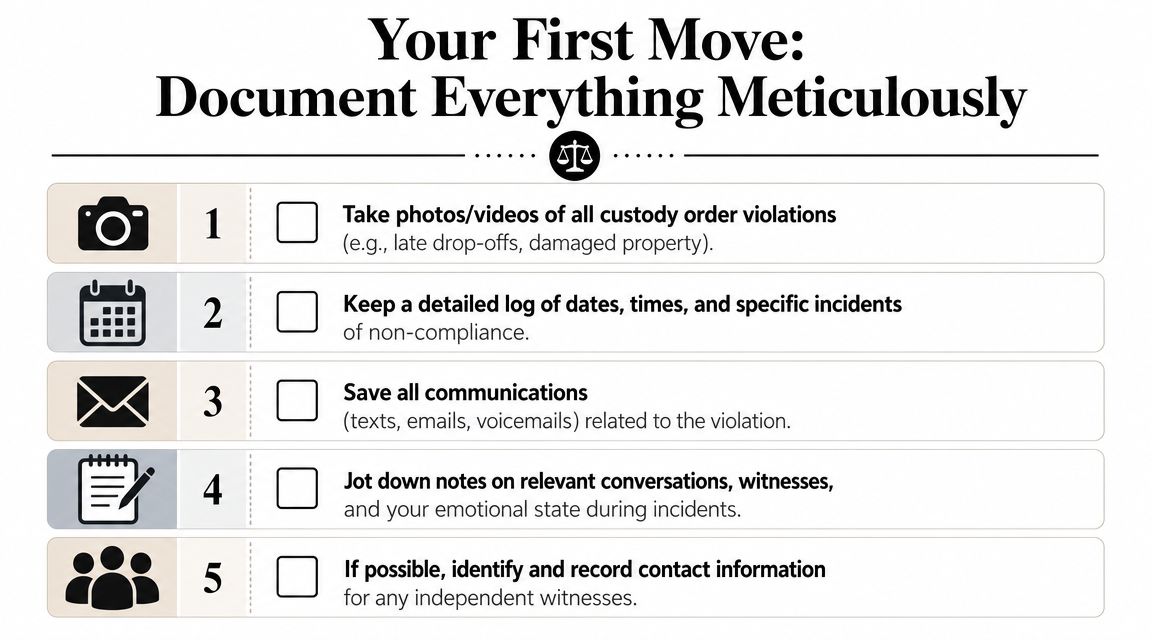
Your First Move Document Everything Meticulously
When parents search for what to do if ex violates custody order Atascocita Texas, they usually want to act immediately. That urge makes sense. But your first job is not to argue, threaten, or retaliate. Your first job is to build a record.
Under Texas Law Help's explanation of Texas Family Code § 157.002, a motion to enforce must identify the exact provisions violated, explain the noncompliance, and state the relief requested. For each alleged violation, it also must include the date, place, and, if applicable, time of the failure to comply. Texas courts don't treat enforcement like a general complaint about bad co-parenting. They expect specifics.
What your log should include
For each incident, write down:
- The exact date your exchange or possession period was supposed to happen
- The time listed in the order and the time the violation occurred
- The location for the exchange, whether that was a school, residence, parking lot, or public place in Atascocita or Humble
- What you did to comply with the order, including that you showed up ready for the exchange
- What the other parent did or failed to do
- How they communicated it, such as text, email, voicemail, or app message
- Any witness information, if another adult saw what happened
That level of detail matters because Texas Law Help also notes that the moving parent must show they were present at the correct location, date, and time stated in the order. If your order says pickup is at 6:00 p.m. at a specific place, and you can prove you were there, your case becomes much stronger.
What evidence to preserve
Your notes alone usually aren't enough. Save the evidence that supports them.
- Texts and emails: Screenshot them and keep them organized by date.
- Voicemails: Download or preserve them before they disappear.
- Photos and videos: If they help show the missed exchange, late drop-off, or related issue, save them.
- Calendar entries: Mark every violation as it happens.
- Call logs: These can help show attempted communication.
Practical rule: If it happened, record it the same day. Details fade fast, and courts care about accuracy.
Be careful with recordings. Some parents want to record pickup disputes or phone calls, but they should understand the legal rules first. If you're wondering whether you can legally record conversations, review the rules before you hit record.
What not to do while gathering proof
Don't turn documentation into a confrontation. Keep your messages short, neutral, and child-focused. Don't send long emotional texts explaining why the other parent is unfair. Don't post about the dispute on social media either. If you need a refresher on how online posts can affect a custody case, read how judges view social media in custody cases in Texas.
A clean record usually beats a dramatic one. Judges in Harris County want to see who followed the order, who stayed calm, and who brought proof.
Assess the Situation for Immediate Safety Concerns
Not every violation is an emergency. Some are infuriating but not dangerous. Others require immediate action because the child may be at risk.
The first question is simple. Is your child safe right now?
When the issue is serious enough to act immediately
If you believe your child is in danger, don't wait for a regular enforcement hearing to solve it. That can include situations where:
- The child may be taken and not returned
- The other parent is making credible threats
- There are signs of abuse, neglect, or dangerous impairment
- You don't know where your child is and the other parent won't respond
- A violation involves a direct safety concern, not just a scheduling dispute
In those situations, it may be appropriate to contact law enforcement to request a welfare check or create a police report. If you are in the Atascocita area, that often means dealing with the Harris County Sheriff's Office. A police report does not replace family court, but it can preserve a contemporaneous record of what happened.
When the issue is frustrating but not urgent
A late exchange, a refusal to switch weekends, or a one-time missed pickup usually falls into a different category. That's still a violation if it breaches the order, but your goal should be to keep the situation from spiraling.
Use communication that creates a clear record:
- Stick to written messages when possible
- Keep each message brief
- State the order, the time, and the location
- Avoid insults, accusations, and threats
- Don't debate old grievances in the middle of a live exchange
A helpful model is: “I am at the exchange location listed in the order. It is 6:00 p.m. I am here for pickup.”
If the other parent is escalating, your calm message may matter more in court than their angry response.
A practical line between conflict and danger
Parents often struggle because the facts feel mixed. Maybe the other parent is violating the order and also behaving erratically. Maybe they are interfering constantly, and now you fear something worse is coming. Trust the distinction between annoying, destabilizing, and unsafe.
If the facts point to unsafe, treat it like unsafe. If the facts point to chronic interference, start thinking beyond a single enforcement motion. That strategic choice matters.
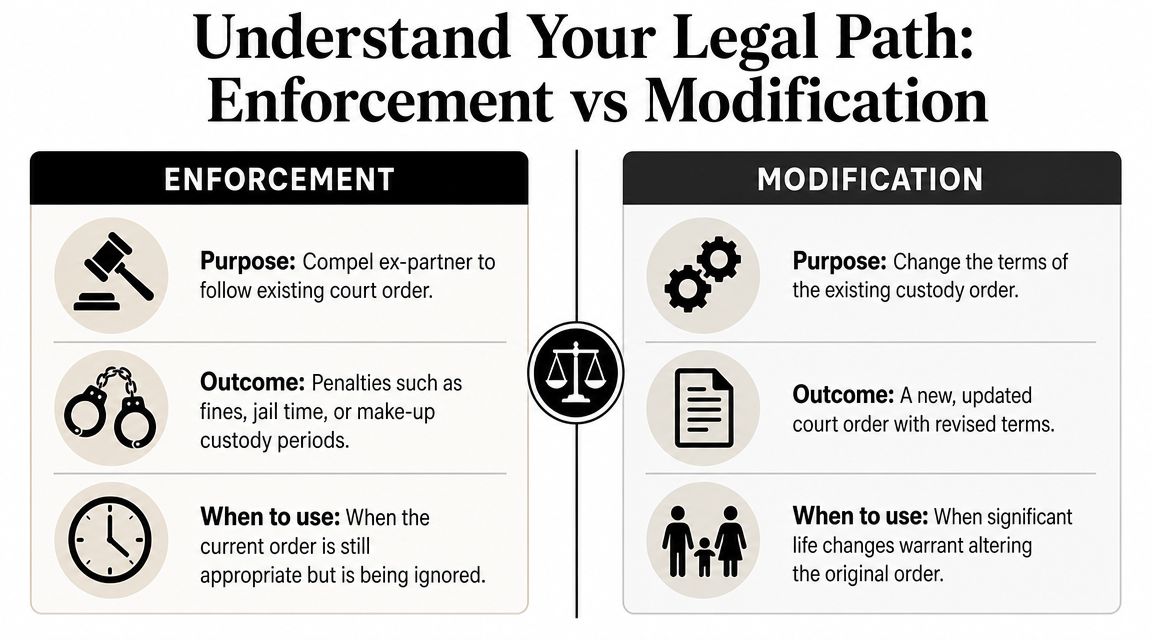
Understand Your Legal Path Enforcement vs Modification
Most parents assume there is one legal answer when an ex won't follow the custody order. There isn't. The right move depends on what the violation reveals.
If the current order still works and the other parent is ignoring it, enforcement may be the correct tool. If the current arrangement no longer protects your child's routine or safety, a modification may be better. If there is an immediate threat, emergency relief may be necessary.
When enforcement fits
An enforcement case asks the court to make the other parent follow the existing order. You are not asking the judge to redesign custody. You are saying, in effect, “This order is valid. It is clear. The other parent violated it. The court needs to enforce it.”
Enforcement often fits when:
| Situation | Better fit |
|---|---|
| Missed exchanges under a clear schedule | Enforcement |
| Denied weekend possession | Enforcement |
| Late return of the child under an existing order | Enforcement |
| Repeated refusal to follow communication or exchange terms | Often enforcement first |
This route is often effective when the order is specific and the main problem is noncompliance.
When modification makes more sense
Sometimes the violation is only the symptom. The underlying problem is that the current structure isn't working anymore.
The concern noted in this discussion of Texas custody-order violations is one many parents in Harris County run into. Existing articles often mention contempt or modification in passing, but they rarely explain when a parent should pivot away from enforcement because the underlying issue is relocation risk, child safety, or chronic interference that is changing the child's stability rather than a one-off violation.
That distinction matters. Modification may be the stronger strategy when:
- The other parent keeps interfering in a way that shows the current schedule is breaking down
- There is a relocation risk
- The child's stability is changing because of repeated conflict
- You need a different parenting structure, not just punishment for old misconduct
If that sounds like your situation, review how to change a custody agreement in Texas. In many cases, a long pattern of violations tells the court more than a single denied weekend ever could.
When emergency relief belongs in the conversation
Emergency relief is narrower and more urgent. It is not the routine answer to ordinary co-parenting conflict. It becomes relevant when the facts involve endangerment, immediate risk, or a serious threat that can't wait for standard scheduling.
A useful question is this: are you trying to force compliance with the current order, or are you trying to protect your child from something the current order no longer addresses?
That question often decides the case strategy.
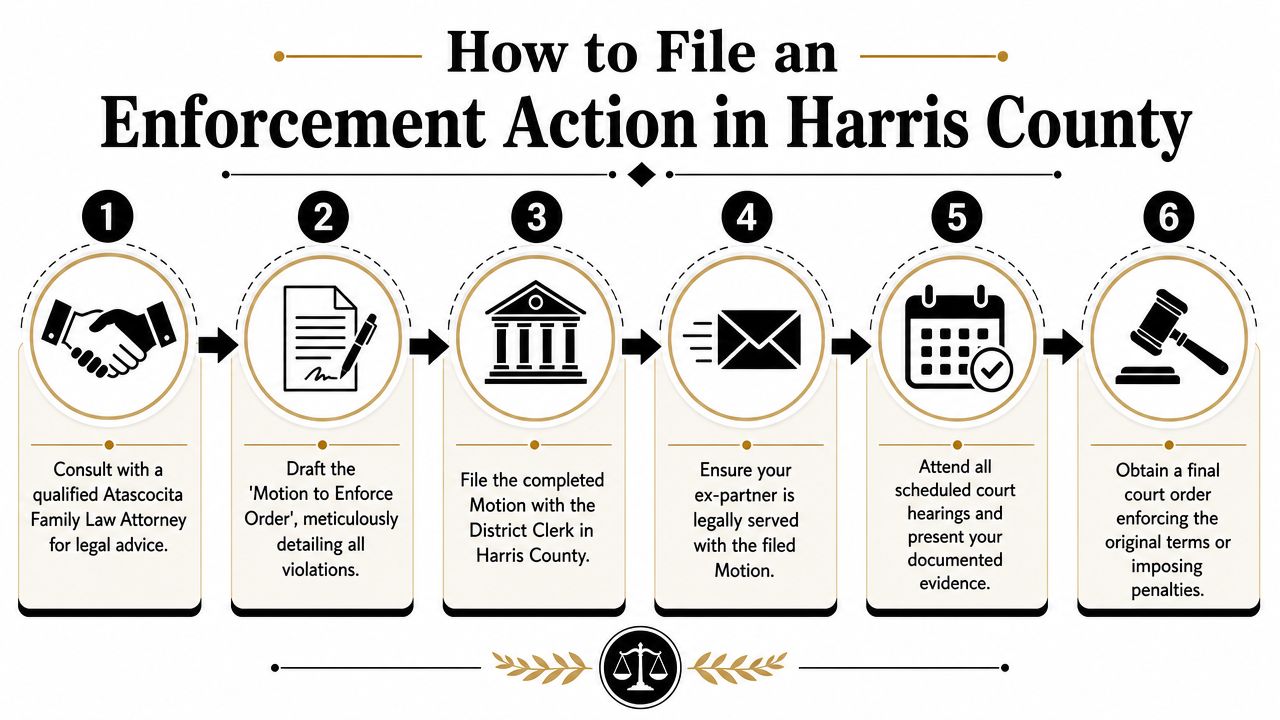
How to File an Enforcement Action in Harris County
If enforcement is the right move, the process is more technical than many parents expect. A strong case is not just “I told the judge what happened.” It is a properly drafted, properly filed, properly served action backed by organized proof.
The basic filing sequence
Here is how enforcement usually works in Harris County:
Review the order carefully
The exact language controls the case. If the order is vague, enforcement can become much harder.Draft the motion for enforcement
The motion should identify the violated provisions and list each alleged violation clearly.File in the correct court
That is generally the court that issued your custody order.Serve the other parent properly
Service is not optional. If service is defective, your case can stall.Prepare for hearing
Bring organized evidence, not a pile of screenshots with no timeline.Appear and present facts
The judge will want specifics, consistency, and proof.
What the motion needs to do
The motion needs to match your evidence. If your records are vague, your filing usually becomes weak. If your records are clean, the motion can be precise.
A practical enforcement file often includes:
- A copy of the current order
- A violation chart or timeline
- Messages tied to each incident
- Proof you appeared at the exchange location
- A proposed request for relief
What parents often get wrong
The most common mistakes are strategic, not emotional.
- They ask for enforcement when the primary issue is modification
- They rely on broad complaints instead of incident-by-incident proof
- They fail to organize evidence around the wording of the order
- They think a police report alone will win the case
- They keep changing the facts because they are upset
Judges usually respond better to a simple timeline than to a dramatic story.
If your exchanges happen around Atascocita, Humble, or school pickup points in northeast Harris County, include those locations exactly as they happened. Specificity helps the court see a real event, not just a general allegation.
Potential Court Ordered Consequences for the Violation
Many parents file enforcement expecting the judge to “teach the other parent a lesson.” That is not the best way to think about the process. Courts usually start with remedies designed to correct the problem and restore compliance.
Texas enforcement remedies can be significant. Courts may order make-up visitation, fines, modification of the custody arrangement, and, in extreme cases, jail time for contempt, as discussed in this overview of consequences for violating a Texas custody order. The available remedies are intentionally graduated from corrective to punitive.
What the court may actually do
A judge may respond in different ways depending on the seriousness and pattern of the violations.
Make-up parenting time
This is often the most practical remedy when you lost court-ordered possession.Fines or contempt-related penalties
These become more likely when the violations are repeated or deliberate.Modification of the arrangement
In some cases, the pattern itself supports a different structure.Jail time in extreme contempt situations
This is not the routine result, but it is within the court's authority in severe cases.
What works and what usually doesn't
What works is matching the requested remedy to the problem. If the other parent denied a specific period of possession, asking for make-up time is often sensible. If the violations have become chronic and are destabilizing the child's life, asking only for punishment may miss the larger issue.
What usually doesn't work is trying self-help first. Withholding your own compliance, refusing to return the child, or inventing a new exchange schedule can damage your position. The practical legal response is usually documentation followed by a motion for enforcement, with the court escalating consequences if the pattern continues.
Set realistic expectations
Not every valid enforcement case ends with dramatic sanctions. Some produce warnings, more precise directives, or make-up time. That can still be a meaningful outcome if it restores your parenting time and puts the other parent on notice that the order matters.
The strongest position is usually the parent who stayed steady, followed the order, and let the court handle the violation.
Why You Need a Local Atascocita Family Law Attorney
Custody enforcement cases look simple from the outside. One parent violated the order, so the judge fixes it. In practice, they are often technical, emotional, and strategic all at once. The difficult question is not just whether a violation happened. It is whether enforcement is the right remedy, whether the order is specific enough, and whether the facts point toward modification or emergency relief instead.

Local knowledge changes case strategy
A lawyer who regularly handles family cases involving Atascocita, Humble, Kingwood, and the Harris County courts can help you make decisions earlier and with less guesswork.
That includes:
- Evaluating whether your order is enforceable as written
- Spotting when your facts support modification instead of a simple contempt request
- Organizing evidence around what the judge needs to see
- Reducing avoidable mistakes in filing, service, and hearing preparation
A local resource such as a custody enforcement lawyer in Atascocita can help with that evaluation and with preparing the motion and hearing strategy.
Legal help is also about judgment
The emotional pressure in these cases is real. Parents often come in after weeks or months of missed weekends, broken promises, hostile texts, and children caught in the middle. A good attorney's role is not just to file paperwork. It is to separate what feels urgent from what is legally useful.
That can mean telling a parent to file fast. It can also mean telling a parent not to file enforcement yet because the better remedy is a modification case with a stronger long-term outcome. The Law Office of Bryan Fagan – Atascocita TX Lawyers handles family-law matters involving custody enforcement, modification, and related court filings for local families.
If you'd like a broader explanation of how these cases work, this video is a helpful starting point.
The right legal move is not always the most aggressive one. It is the one that best protects your child and gives the court a practical solution.
You do not have to sort that out by yourself while also managing pickups, school schedules, and daily life in northeast Harris County.
If your ex is violating a custody order and you need clear advice on what to do next, schedule a free consultation with Law Office of Bryan Fagan – Atascocita TX Lawyers. Our office helps parents in Atascocita, Humble, and across Harris County evaluate whether enforcement, modification, or emergency action is the right next step, then move forward with a practical plan.