Skip to content

A lot of families in Atascocita and Humble come to the same realization. The mortgage is manageable, the kids are getting older, maybe retirement doesn't feel so far away anymore, and one question keeps coming back. If something happens to us, will everything be easy for the people we love?
For some neighbors, that question starts after helping a parent through probate in Harris County. For others, it begins after a remarriage, a new baby, a child with special needs, or the purchase of a home they want to keep in the family. The details are different, but the concern is the same. You want a plan that works in real life, not just on paper.
A trust can do that. It isn't only a document for wealthy families or business owners. In plain English, a trust is a legal tool that helps you decide how property will be managed during your life and passed along after your death, with clearer instructions and more control. For many families in northeast Harris County, that means more privacy, less court involvement, and fewer opportunities for conflict when emotions are already high.
The part many local guides skip is what happens next. Creating the trust is important, but trust administration matters just as much. Someone has to serve as trustee. Someone has to follow the terms, keep records, make decisions, and deal with family questions. That's where a trust attorney in Atascocita, Texas can make the process feel manageable.
Planning Your Legacy in Atascocita
A couple in Atascocita might spend years building a steady life. They buy a home, save for retirement, help with college, and maybe care for aging parents at the same time. Then one evening at the kitchen table, they realize they have wills from years ago, outdated beneficiary forms, and no real plan for what happens if one of them becomes ill or passes away first.
That moment is more common than people think.
Estate planning often brings up emotions people don't expect. You may feel protective, uncertain, even guilty for putting it off. That's normal. Most families aren't avoiding the topic because they don't care. They're avoiding it because legal documents can feel intimidating, and it's hard to know where to start.
What local families usually want
In conversations with families around Atascocita, Humble, and the surrounding parts of northeast Harris County, the goals tend to sound familiar:
- Keep things orderly: Parents want bills paid, property managed, and children supported without confusion.
- Protect relationships: Families want to reduce the chance of arguments between siblings, stepchildren, or other relatives.
- Make hard times easier: If a loved one is grieving, they shouldn't also have to guess what you wanted.
- Stay practical: People want a plan that fits real assets like a home, savings, business interests, or family land.
A good estate plan doesn't only answer who gets what. It also answers who handles the work, how they do it, and what protections they have while doing it.
Trust planning fits especially well when a family wants continuity. If a parent becomes incapacitated, the trustee can step in according to the terms of the trust. If the trust is designed carefully and funded properly, the transition is often smoother than leaving everything to be sorted out later.
Why local context matters
Life in Atascocita and Humble has its own rhythm. Families here often balance work, school schedules, long-term caregiving, and property concerns all at once. Some are part of blended families. Some own businesses. Some are caring for relatives across more than one household. Those details affect how a trust should be written and how it should be managed.
That same local perspective matters in other legal areas too. A family facing a separation may need coordinated planning for support, property, and future guardianship issues. Someone responding to criminal charges may also need to think about protecting financial authority and household decision-making during the case. Civil disputes can affect titles, assets, and records that later become part of an estate. Legal problems don't stay neatly in one box, and families usually need advice that reflects that reality.
Why You Need a Specialized Trust Attorney
Not every attorney handles trusts with the same depth. The easiest comparison is medicine. If you have a routine issue, a general doctor may be enough. If you need a heart procedure, you want the doctor who works with that problem every day. Trust planning works much the same way.
A trust attorney doesn't just fill in names on a form. A trust attorney looks at family dynamics, property ownership, successor trustees, incapacity planning, and the practical question of how the plan will function later.
The difference between a will and trust focus
A will and a trust can work together, but they don't do the same job. According to guidance on Texas trust planning and Harris County probate timelines, a trust attorney in Texas handles specialized drafting for tools such as revocable living trusts, special needs trusts, and spendthrift provisions, and those structures can legally bypass Harris County probate. That same source notes that probate in Harris County averages 12 to 18 months for simple wills and can extend to 2+ years with contested assets.
That matters because delay changes family behavior. A surviving spouse may need access to accounts. An adult child serving as fiduciary may need authority now, not after months of court procedure. A business owner may need a continuity plan that doesn't pause while paperwork moves through the system.
For Atascocita families looking at Estate Planning Attorney in Atascocita, the basic menu often includes wills, trusts, and estate plans for Atascocita families. The true legal work is deciding which combination fits your household.
What specialized trust work actually includes
A dedicated trust attorney usually helps with issues like these:
- Choosing the right structure: One family may need flexibility. Another may need stronger asset protection or planning for a vulnerable beneficiary.
- Using precise language: Small drafting mistakes can create major problems later, especially with blended families or uneven distributions.
- Coordinating with Texas law: Community property issues, beneficiary designations, and trustee powers all need to line up.
- Planning for administration: The trust should tell the trustee what to do when real life gets messy.
Practical rule: If your biggest concern is what happens after you die, a will may be part of the answer. If your concern includes incapacity, ongoing management, privacy, and smoother administration, a trust often deserves a closer look.
Why local familiarity helps
A lawyer who regularly works with Harris County estate matters can often spot practical trouble before it starts. That may include how to title a house, how to choose the right trustee, or how to structure distributions so one child isn't left carrying the burden for everyone else.
That same local familiarity also matters when life overlaps with other legal issues. Divorce can change inheritance plans. Custody concerns can shape who should manage money for minor children. Civil litigation may affect asset ownership. The legal documents should reflect the family's full picture, not just one narrow issue.
Common Types of Trusts for Texas Families
Families in Atascocita don't all need the same trust. Some want flexibility. Some want stronger protection. Others need a plan for a loved one who can't safely receive money outright. The goal isn't to pick the most complicated option. It's to pick the one that fits your life.
Local demand reflects how many families are thinking about these issues. Atascocita trust listings on LawInfo show over 14 distinct estate planning and trust law firms actively listed in the immediate Atascocita area alone, which points to a strong local need for trust and estate guidance.
Here's a simple visual overview many families find helpful:
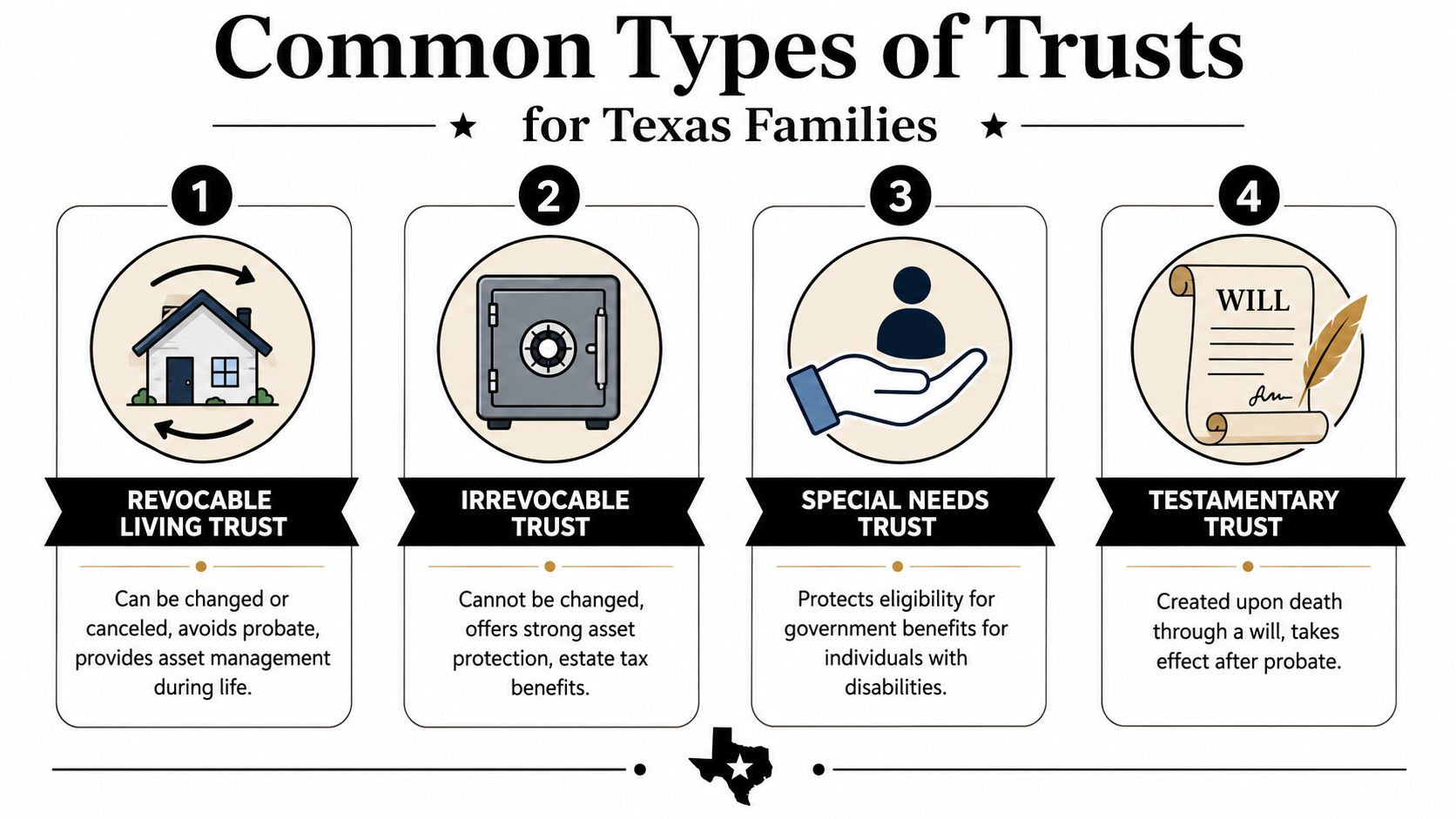
A side by side look
| Trust type | Best fit for | Main strength | Important limitation |
|---|---|---|---|
| Revocable living trust | Parents, retirees, and homeowners who want flexibility | You can change it during your lifetime | It still has to be properly funded |
| Irrevocable trust | Families focused on stronger protection and long-term planning | Harder for others to reach assets once transferred | You usually give up the ability to change it freely |
| Special needs trust | Parents or relatives caring for a loved one with disabilities | Can support the beneficiary without disrupting certain benefit programs | Requires careful drafting and administration |
| Testamentary trust | People who want trust terms created through a will | Useful for children or staged inheritances | It takes effect after death and works through the will process |
Revocable living trust
This is the trust many people picture first. You create it during your lifetime, keep control while you're alive, and usually serve as your own initial trustee. If you become incapacitated or pass away, the successor trustee steps in.
A revocable trust often fits:
- Retirees in Atascocita: They want someone they trust to manage the home and accounts if health changes suddenly.
- Parents in Humble: They want assets managed for children without immediate lump-sum distributions.
- Families with privacy concerns: They'd rather avoid having so much handled in a public court setting.
Irrevocable trust
An irrevocable trust usually works best when a family is willing to trade flexibility for stronger long-term protection. Once assets go in, the terms are much harder to change.
This may fit a family that wants to separate certain assets from day-to-day personal ownership or create a more controlled structure for future generations. It isn't for everyone, but when it fits, it can be powerful.
A trust isn't "better" because it's more restrictive. It's better only if the restrictions solve a real problem for your family.
Special needs trust and testamentary trust
A special needs trust is often used when a parent or grandparent wants to provide support to a loved one with disabilities in a way that preserves important public benefits. The drafting has to be careful, because a well-meaning gift can create unintended consequences if structured poorly.
A testamentary trust is created under a will and takes effect after death. Families sometimes use it when they want children to receive support at certain ages or under trustee supervision. It can be a useful option, but it doesn't offer the same lifetime management features as a trust created and funded while you're living.
Establishing and Funding Your Trust Step by Step
A trust becomes manageable when you break it into pieces. Most families don't struggle with the idea of a trust. They struggle with the process. Once you know the sequence, it feels far less overwhelming.
This workflow helps:
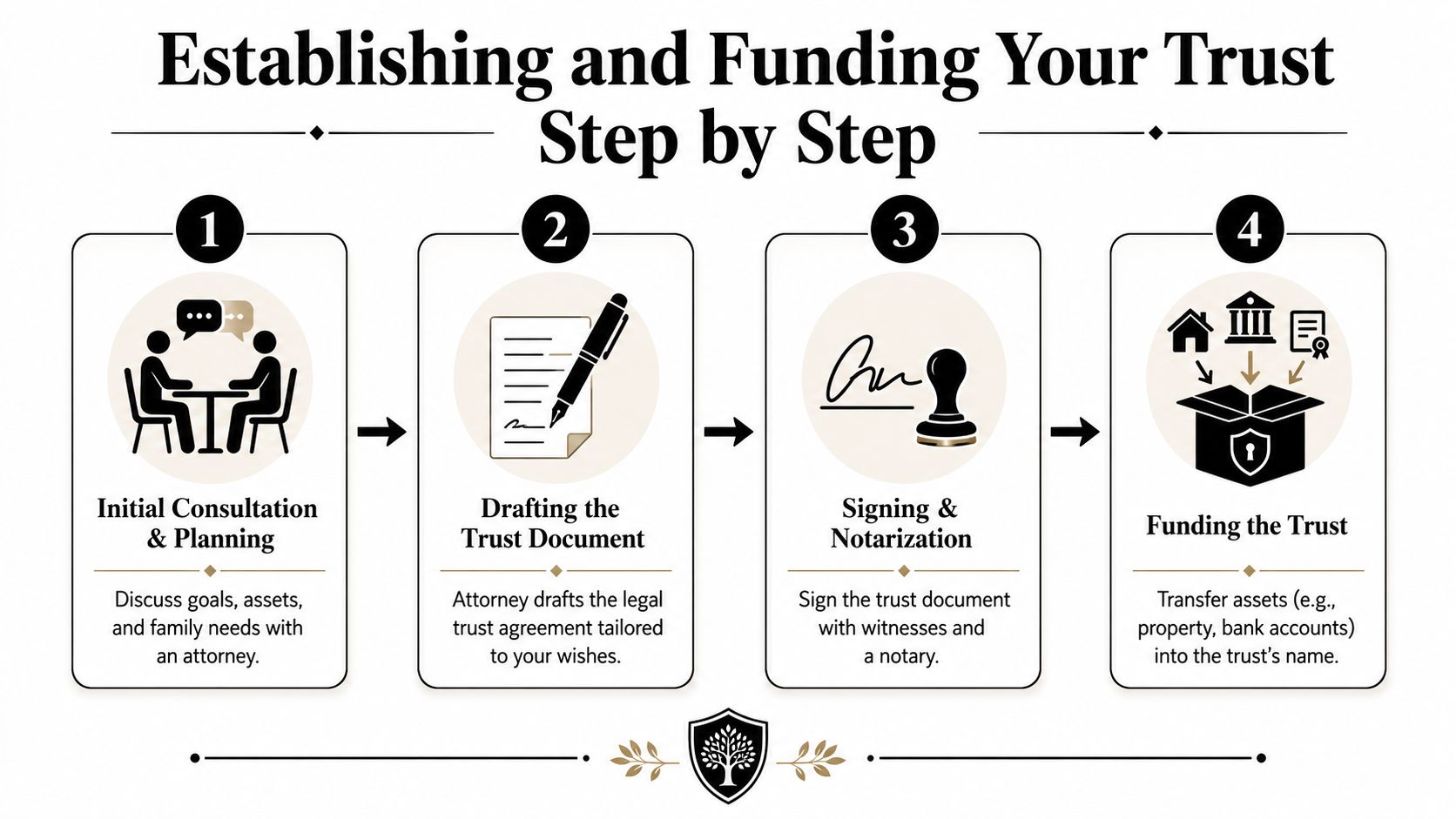
Step 1 through Step 2
The process usually starts with a planning meeting. You and the attorney talk through your goals, your family, your assets, and who should act if you can't. At this point, practical questions surface. Who should serve as trustee? Should children inherit outright or in stages? What happens if a beneficiary is in debt, divorcing, or not financially mature?
Then comes drafting. The attorney turns those goals into legal language. A trust document should be clear enough to guide someone years later, during a stressful time, when you're no longer there to explain what you meant.
Two details matter here:
- Your instructions must match your life: A trust for a blended family needs different language than a trust for a married couple with one child.
- The trustee's powers must be usable: If the trustee can't act efficiently, the plan may create friction instead of relief.
Step 3 through Step 4
After drafting, you sign the trust and related documents. That includes formal execution requirements and, where needed, notarization. This part is important, but it still isn't the finish line.
The final step is funding the trust. That's where many plans fail. A trust can be beautifully written and still do very little if assets never move into it.
Funding often means:
- Retitling real estate: A home in Atascocita may need a deed transferring ownership into the trust.
- Updating accounts: Certain financial accounts may need to be changed into the name of the trust, depending on the asset and the planning strategy.
- Reviewing beneficiary designations: Some assets pass by beneficiary form instead of by will or trust, so the whole plan needs to work together.
If the trust is the container, funding is what puts your property inside it. An unfunded trust often leaves families dealing with the same problems they thought they had already solved.
A practical checklist for local families
Before you leave the process, make sure you can answer these questions:
- Who is the trustee now, and who takes over next?
- Which assets are already in the trust?
- Which assets still need title or beneficiary review?
- Does the trustee know where the documents are kept?
- Have recent life events changed the plan?
These same step-by-step habits help in other legal matters too. Divorce often requires a full review of beneficiaries and estate documents. Custody planning may affect trustee choices for minor children. Civil cases can raise ownership questions that should be resolved before assets are placed into a trust. Good planning stays connected to the rest of your legal life.
Understanding Trust Attorney Fees in the Houston Area
Cost is one of the first questions families ask, and it should be. Estate planning is personal, but it's also a financial decision. People want to know what they're paying for and whether the investment makes sense.
According to Simply Trust's Texas trust cost calculator, attorneys in Texas charge approximately $413 per hour for trust-related legal services, and the total cost for creating an individual revocable living trust plan is $4,130 to $6,195.
What families are really paying for
A trust plan isn't just a stack of papers. You're paying for judgment, drafting, issue spotting, and coordination. In many cases, that includes discussing family dynamics, naming backup decision-makers, addressing incapacity, and making sure the trust works with deeds and beneficiary designations.
Some firms use hourly billing. Others may structure planning work differently. What matters most is clarity. You should understand whether the quoted work includes only drafting, or also signing guidance, funding support, and related estate planning documents.
How to think about value
It helps to compare the cost of planning with the cost of avoidable confusion later. A poorly planned estate can leave a spouse, child, or sibling trying to interpret outdated instructions while handling grief, bills, and family pressure at the same time.
Ask direct questions when discussing fees:
- What's included: Does the work cover only the trust, or related planning documents too?
- What requires extra work: Deed preparation, business interests, and complex family structures may need added attention.
- How funding support works: Many families need help moving assets into the trust.
A careful discussion about fees is part of good legal service. It doesn't make the process transactional. It makes it transparent.
Your Role as Trustee in Harris County
Many people agree to serve as trustee before they fully understand what the role involves. Then the trust becomes active, and the anxiety sets in. Do I have to know everything? Am I personally on the hook if I make a mistake? Can I hire help?
Texas law gives trustees more support than many people realize.

What a trustee actually does
A trustee is a fiduciary. In plain language, that means the trustee must act for the benefit of the trust and its beneficiaries, not for personal convenience. The trustee may need to gather records, manage accounts, communicate with beneficiaries, follow the trust terms, and keep property from being neglected.
That doesn't mean the trustee has to become an accountant, litigator, and title specialist overnight.
According to Texas Property Code analysis addressing trustee authority to retain counsel, Texas Property Code §114.064 gives a trustee explicit authority to retain and compensate attorneys and other agents reasonably necessary for trust administration, and the trust estate can pay those legal fees without personal liability for the trustee.
Why that protection matters
This is one of the most important practical protections in trust administration. If you're serving as trustee in Atascocita, Humble, or elsewhere in Harris County, you don't have to handle every legal and financial issue alone. If the trust needs legal guidance, tax support, or professional administration help, the law allows the trustee to bring in that help when it's reasonably necessary.
That changes the job in a meaningful way.
- You are responsible for decisions, not for knowing every technical answer personally.
- You can document why legal help is needed.
- The trust can bear the cost when the work is reasonably necessary for administration.
Serving as trustee doesn't mean doing everything yourself. It means making careful, loyal, well-documented decisions for the trust.
Common points of confusion
Trustees often get stuck on a few recurring questions:
"The trust doesn't specifically say I can hire a lawyer. Can I still do it?"
Texas law may provide that authority even when the document isn't detailed on the point."Do beneficiaries have to approve every professional I hire?"
The trustee's job is to act within legal authority and the trust terms, not to wait for unanimous family agreement on every administrative step."What if family members challenge my actions later?"
Careful records, consistent communication, and timely legal advice usually matter more than trying to satisfy every relative in the moment.
Trust administration can also overlap with family conflict, business disputes, or even questions tied to criminal accusations affecting a beneficiary or fiduciary. When those issues appear, early legal advice can help a trustee keep the administration focused and compliant.
Secure Your Family's Future with a Local Partner
A well-built trust can do more than transfer property. It can reduce confusion, protect privacy, support loved ones over time, and give a trustee practical authority when life gets difficult. For many families in Atascocita and Humble, that peace of mind is the primary reason to plan.
The legal side matters, but so does the human side. Families need documents that reflect remarriages, children from different relationships, aging parents, retirement goals, and the realities of owning property in Harris County. They also need guidance after the trust is signed, because administration questions don't wait for a convenient time.
One local option is the Law Office of Bryan Fagan, which maintains a dedicated office in Atascocita with the contact number 281-519-3083 for trust and estate administration, as noted on its Atascocita area listing for trust administration matters. For families who want to speak with someone nearby, that physical presence matters.
A local conversation can help answer practical questions like these:
- Should you use a trust or a will, or both?
- Who should serve as trustee if your first choice can't act?
- How should a home, business interest, or investment account be handled?
- What should change after divorce, remarriage, or the birth of a child?
The same office also serves residents dealing with other legal concerns in northeast Harris County. Family law issues such as divorce and custody can affect estate decisions. Criminal charges can create immediate concerns about authority, finances, and family stability. Civil disputes can affect asset ownership and long-term planning. Those overlapping issues are one reason local, full-service legal guidance is often valuable.

If you've been putting this off, that's understandable. Individuals often delay until life forces the issue. But planning works best before there's a crisis, before family members are guessing, and before a trustee is trying to piece everything together under pressure.
The right next step is usually simple. Sit down with a lawyer, talk through your family situation, and get a clear recommendation you can understand. No pressure. Just clarity.
If you're ready to talk through wills, trusts, trustee duties, probate concerns, or how estate planning fits with divorce, custody, criminal defense, or civil disputes, schedule a free consultation with Law Office of Bryan Fagan – Atascocita TX Lawyers. You can also call the Atascocita office at 281-519-3083 to discuss your situation with a local team serving Atascocita, Humble, and northeast Harris County.