Skip to content

Some evenings in Eagle Springs, the hardest part isn't the argument. It's the quiet afterward. The kids are in their rooms, the house is still, and you're sitting at the kitchen table searching for a divorce attorney near Eagle Springs Atascocita, hoping the internet will make something feel clearer.
If that's where you are, you're not alone. Many people in Atascocita and Humble start with the same questions. Where do I file? Do I have to go downtown? How long will this take? What happens to the house, the schedule with the children, and the bank accounts?
A divorce doesn't just change a relationship. It changes routines, finances, and the way a family moves through daily life. That's why it helps to look at the process one step at a time, with local details that apply to your situation in northeast Harris County.
Starting the Conversation About Divorce in Atascocita
You may be sitting in your driveway in Eagle Springs after work, hands still on the steering wheel, trying to decide whether to say the word "divorce" to anyone at all. That moment is more common than people realize. Life often looks normal from the outside while someone inside the family is privately trying to understand what filing would mean here in Atascocita.
Divorce brings two kinds of pressure at once. One is personal. The other is procedural. You may be worried about your children, your home, and how daily life will work. At the same time, Texas law sets filing rules that do not wait for you to feel ready.

A good first question is simple: can you file in Harris County yet? In Texas, a spouse generally must have lived in the state for the last six months and in Harris County for the last 90 days before filing for divorce. Those rules work like a waiting line marker. If you have not been in the right place long enough, the court is not ready to take the case.
That timing issue matters for families who recently moved to Atascocita, relocated from another part of Houston, or came to Texas from out of state. Filing too soon can mean starting over, losing time, and paying for work that has to be redone. A short planning conversation with a lawyer can clear that up before any petition is prepared.
Many people also benefit from doing a little homework before the first legal step. Gather recent bank statements, mortgage information, pay stubs, retirement account balances, and a rough list of monthly expenses. If you want a practical starting point, this guide on how to prepare for divorce financially can help you organize the numbers before the court process begins.
Small preparation lowers stress. It also makes the first meeting with counsel far more productive.
Navigating the Texas Divorce Process from Atascocita
A common Atascocita scenario looks like this. You live in Eagle Springs, the kids have school and activities nearby, and your daily life stays rooted on this side of town. Then the divorce paperwork starts, and you learn the case is usually filed through Harris County courts in downtown Houston, not at a neighborhood office around the corner. That surprise matters because it affects where documents are filed, where hearings may be set, and how you plan for time away from work or child care.
Where your case is filed
For Eagle Springs and the rest of Atascocita, divorce cases are generally filed in Harris County district court. In practical terms, that usually means your case is handled through the Harris County Civil Courthouse system in downtown Houston.
That can feel inconvenient at first. But it helps to know it early. Court procedure follows county lines, not subdivision boundaries, so an Atascocita address does not mean a local Atascocita courthouse for divorce.
The first formal step
The case begins when one spouse files an Original Petition for Divorce. Filing the petition is like opening a file folder with the court. It does not decide who gets the house, where the children will spend weekends, or who pays which bill. It starts the formal process and gives the court a case to manage.
If you want a more local, filing-specific explanation, this guide on how to file for divorce in Atascocita, Texas walks through the basics in a way many residents find easier to follow.
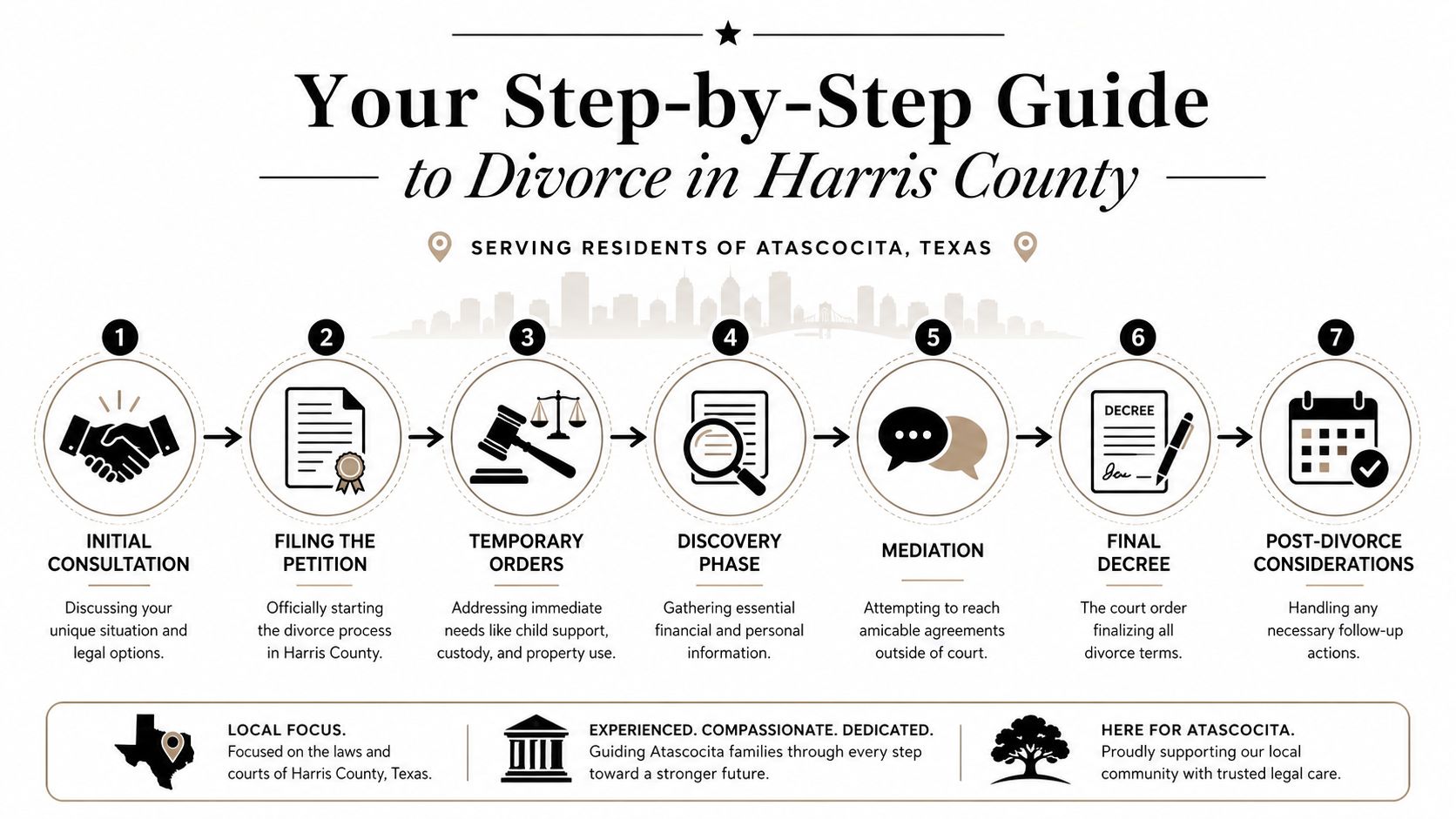
From there, the process usually unfolds in stages:
Initial planning
You identify immediate concerns, such as parenting schedules, access to bank accounts, or whether one spouse plans to stay in the home.Petition is filed with the court
The Harris County case is opened.The other spouse is formally notified
This usually happens through service of process, unless the other spouse signs a waiver.Temporary issues are addressed if needed
Some families need short-term court orders about children, bills, possession of the house, or use of vehicles while the case is pending.Information is exchanged
Each side gathers and shares records about finances, property, debts, and other disputed issues.Settlement talks or mediation take place
Many Harris County divorce cases are resolved by agreement before trial.The final paperwork is completed
If the parties settle, the agreement is written into a decree. If they do not, a judge decides the unresolved issues.
The waiting period and the real timeline
Texas law includes a waiting period before a divorce can be finalized. As Texas Law Help explains in its article on divorce in Texas, the court usually cannot finalize the divorce until at least 60 days have passed after the petition is filed.
So even an agreed divorce has a built-in pause.
For Atascocita families, the more realistic question is not whether the case can end quickly, but what has to happen during that waiting period. If paperwork is complete, service is handled promptly, and both spouses reach agreement, the case may move on the shorter side. If there are disputes about children, property, or missing financial records, the timeline often stretches well beyond the minimum.
For a visual overview, this short video gives a helpful high-level explanation of the process many families move through in Texas:
What usually happens between filing and finish
Most of the substantive work happens after filing and before the final decree. That period often feels slow because the court is turning daily family routines into written rules everyone must follow.
| Stage | What it usually addresses |
|---|---|
| Temporary orders | Short-term rules for parenting time, support, bill payment, or use of property while the case is pending |
| Discovery | Collecting documents and clarifying what property, debt, income, and other facts are actually in dispute |
| Mediation | A structured settlement meeting aimed at resolving disagreements without trial |
| Final hearing or trial | Presenting a full agreement to the court or asking the judge to decide the remaining issues |
One point that gets overlooked is follow-through after the decree is signed. For example, beneficiary changes and policy reviews often need attention after the case ends. This guide on navigating life insurance after divorce is a useful reminder that the legal finish line is not always the end of the practical work.
A calm, step-by-step approach helps. For many Atascocita residents, divorce feels less overwhelming once they understand which courthouse handles the case, what the filing does, and why the timeline depends on more than the date the petition hits the clerk's desk.
Understanding Key Issues in Your Divorce
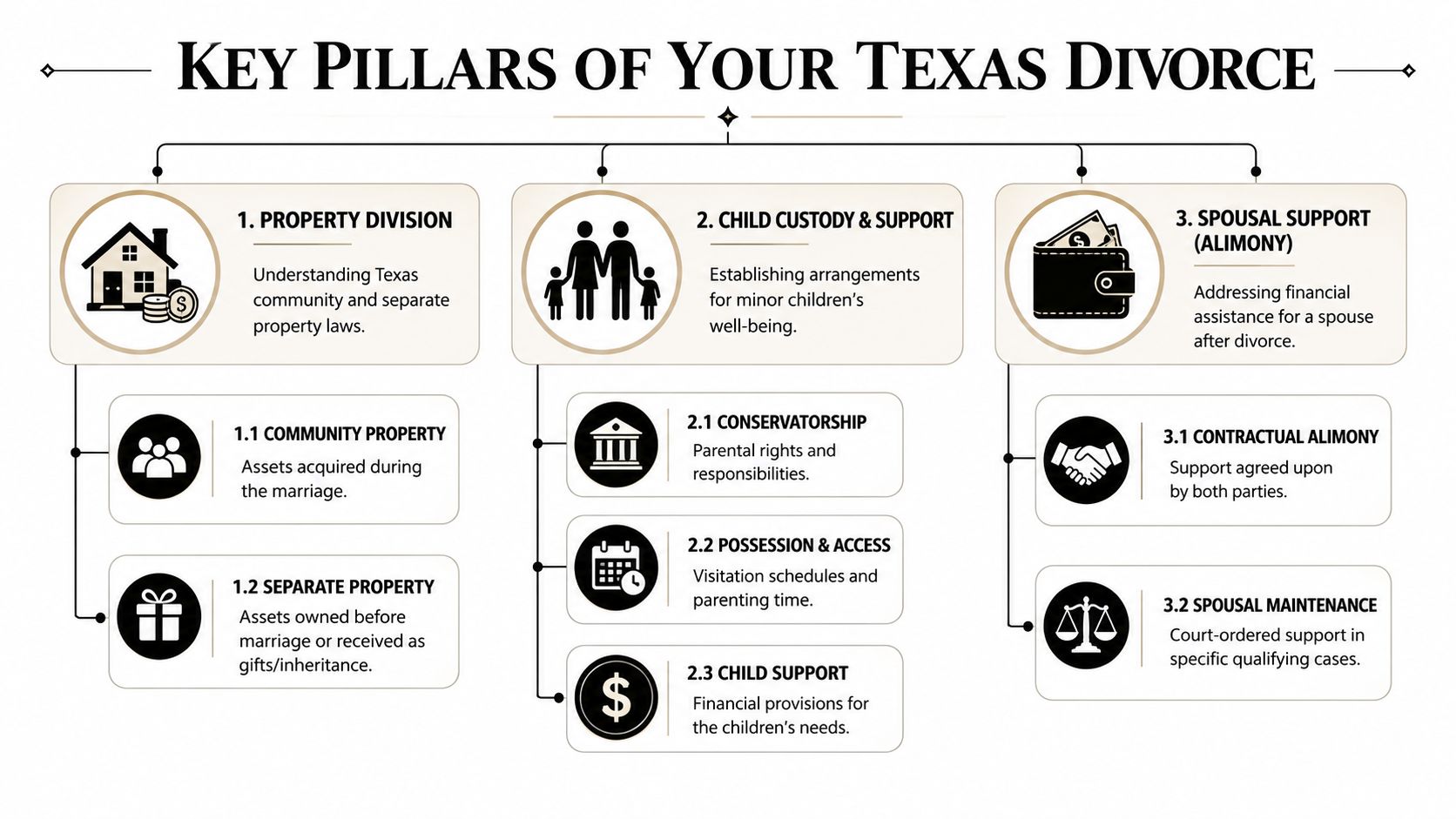
Once the process begins, most divorce cases revolve around three areas. Property, children, and support. If you understand those categories, you'll have a much easier time making sense of meetings, emails, and court paperwork.
Property division
Texas uses community property rules. In plain English, that usually means property acquired during the marriage may be part of the marital estate, while some assets may remain separate, such as certain property owned before marriage or received by gift or inheritance.
Many people think “community property” automatically means a perfect split. That isn't the best way to think about it. A Texas court is focused on a division it considers fair under the circumstances, and those circumstances can get complicated quickly when retirement accounts, a home, debt, or a family business are involved.
If you want a simpler foundation before looking at account statements and inventories, this local explanation of what community property means in Texas is a good starting point.
For higher-asset families in Atascocita, this issue gets more serious. Some local divorce discussions note that 30% of Texas divorces involve assets exceeding $1 million that require specialized valuation beyond standard property division, and they point out that business equity, stock portfolios, and professional practices can require deeper analysis in Harris County courts, as described in this overview of high-asset divorce concerns in Atascocita.
Children and parenting arrangements
When parents divorce, the legal language can sound colder than the actual situation. The court uses terms like conservatorship and possession and access, but parents usually experience these issues as simpler questions.
Who makes decisions for the children? Where will they sleep on school nights? How will holidays work? What happens if one parent lives near Eagle Springs and the other is closer to Humble or another part of Harris County?
A useful way to think about it is this:
- Conservatorship deals with rights and decision-making.
- Possession and access deals with the parenting schedule.
- Child support deals with financial responsibility.
Parents often do better when they separate the emotional history of the marriage from the practical needs of the children.
That's not easy, but it helps. A parenting plan works best when it's clear enough to follow on an ordinary Tuesday, not just in a courtroom.
Support after the divorce
Support can mean different things. Child support is for the children's needs. Spousal support may arise through agreement or, in some situations, court-ordered maintenance.
Support questions don't end the day the decree is signed. Beneficiary designations, policy ownership, and long-term financial protection can also need attention. If that issue is on your radar, this resource on navigating life insurance after divorce gives a practical overview of what people often need to review afterward.
A divorce attorney near Eagle Springs Atascocita should be helping you connect these pieces, not treating them as unrelated checkboxes. Property decisions affect support. Parenting schedules affect budgets. Every major choice tends to touch the others.
How to Choose the Right Local Divorce Attorney
Choosing a lawyer isn't just about finding someone who knows Texas law. You need someone who understands how your case moves in Harris County and who can explain the process in a way that lowers confusion instead of adding to it.
Start with fit, not slogans. If your consultation leaves you more anxious and less informed, that tells you something.
Questions worth asking in a consultation
A good consultation should leave you with clearer footing. Consider asking questions like these:
Local court experience
How familiar are you with divorce procedure in Harris County for Atascocita residents?Approach to conflict
Do you usually push for negotiated resolution when possible, and how do you prepare if the case becomes contested?Communication style
Who answers routine questions, and how will updates be shared when something important happens?Children and complex property
Have you handled cases involving custody disputes, business interests, or uneven access to financial information?Next steps
What should I gather now so we can avoid delays later?
Understanding cost without guessing
Legal fees are one of the biggest sources of stress in any divorce. It helps to know the basic structure going in. The cost of a contested divorce in Atascocita can range from $10,000 to over $30,000. Local attorneys typically require an initial retainer of $2,500 to $10,000 and bill at hourly rates between $300 and $600. Cases involving children are often more expensive, averaging $15,000 to $30,000 due to custody disputes, based on this local overview of what a divorce lawyer may cost in Atascocita.
That doesn't mean every case lands at the same number. It means the level of conflict, the number of disputed issues, and whether children are involved can significantly change the cost.
Ask how the lawyer expects costs to rise. Discovery fights, temporary hearings, and trial preparation usually matter more than the label on the case.
What local representation should feel like
The right attorney should help you make decisions with a steady head. That includes family law, but many clients also need broader issue-spotting. A divorce can overlap with estate planning updates, civil disputes over property, or even criminal concerns if allegations arise during separation. A firm that handles family, criminal, and civil matters can sometimes identify connected problems early, even if your immediate focus is divorce.
Why Eagle Springs and Atascocita Families Trust Our Firm
A parent in Eagle Springs may be trying to answer school emails, get dinner started, and decide whether filing first would help or hurt. In that moment, trust usually comes from something simple. Clear advice, returned calls, and a lawyer who understands how a Harris County divorce affects daily life in Atascocita.

Local families often want more than a lawyer who knows Texas divorce statutes. They want someone who can explain the process in practical terms. Which Harris County court will handle the filing. What usually happens during the waiting period. When a temporary-orders hearing may become part of the case. How agreements on children or property can shorten the path to a final decree.
The Law Office of Bryan Fagan – Atascocita TX Lawyers handles family law, criminal defense, estate planning, probate, and civil litigation for individuals and families in northeast Harris County. For readers comparing service options, Contested Divorce Attorney in Atascocita explains how high-conflict divorce cases are handled in Harris County courts.
That broader legal background can matter. Divorce sometimes connects to issues outside the petition itself, such as protective-order concerns, probate questions after a family death, or disputes over who controls property and accounts. Spotting those side issues early is a little like checking the whole house after finding one leak. It helps prevent a small problem from spreading into several.
Families also tend to trust firms that treat their case like a real household problem, not just a file number. For an Atascocita parent, that may mean planning around school pickup, work commutes, extracurricular schedules, and exchanges that have to happen without adding more tension for the children.
A good consultation should leave you with a map. You should understand where your case would likely be filed, what the next few steps may look like, and what decisions need attention first. That kind of clarity helps people replace panic with a plan.
Frequently Asked Questions for Atascocita Residents
Do I have to go to downtown Houston for court
Usually, Atascocita divorce cases are handled through Harris County courts downtown. Whether you personally need to appear every time depends on the stage of the case, the judge's procedures, and whether issues are resolved by agreement.
Can my spouse and I use the same attorney
No. Texas law explicitly prohibits one attorney from representing both parties in a divorce case due to inherent conflicts of interest. This rule ensures that each spouse receives independent legal advice and dedicated representation focused on their individual best interests, as explained in this discussion of divorce representation rules in Atascocita.
That doesn't mean every divorce has to be hostile. It means one lawyer can't ethically advise both spouses in the same case.
What's the difference between an uncontested and contested divorce
An uncontested divorce generally means the spouses are able to reach agreement on all major issues. A contested divorce means there is disagreement on one or more important points, such as children, property, debt, or support. The more issues that remain unresolved, the more court involvement the case usually requires.
If we agree on most things, do we still need legal advice
Often, yes. Even cooperative spouses can overlook important details in the decree, especially with retirement accounts, real property, parenting language, and post-divorce obligations. A review now can prevent expensive disputes later.
What if I'm worried my spouse knows more about the finances than I do
That's common. Many people enter divorce without a full picture of accounts, debts, business interests, or investment holdings. The legal process includes ways to gather information and clarify what exists before final decisions are made.
Should I wait to talk to a lawyer until I'm sure I want a divorce
Not necessarily. A consultation doesn't force you to file. It can help you understand timing, documents, risks, and options so you can make a thoughtful decision instead of reacting under pressure.
If you're looking for calm, local guidance, schedule a free consultation with Law Office of Bryan Fagan – Atascocita TX Lawyers. We help people in Atascocita, Eagle Springs, Humble, and across northeast Harris County understand their options, protect their rights, and move through difficult legal decisions with clear advice and steady support.