Skip to content
Deciding to file for divorce is one of the most difficult and personal choices a person can make. If you are a resident of Atascocita, Humble, or the surrounding communities in northeast Harris County, you are likely feeling a mix of uncertainty, stress, and concern for your family's future. We understand what you're going through. The legal process, while complex, follows a clear path here in Harris County, and knowing what to expect can bring a sense of stability during an unstable time.
The journey begins with meeting Texas residency requirements, filing an Original Petition for Divorce, and ensuring your spouse is officially notified. From there, you will navigate the local court procedures for dividing your property, finances, and parenting responsibilities. This guide is designed to walk you through these steps with clarity and compassion.
Your Community-Focused Guide to Divorce in Atascocita
Divorce is never easy, but being informed is the first step toward regaining control. For those of us in the Atascocita and Humble areas, the legal journey has its own local rules and procedures. This guide will walk you through the process, step-by-step, not as a dense legal textbook, but as a supportive conversation with a local attorney who has helped countless families in our community find their way forward.
Our goal is to replace the feeling of being overwhelmed with a sense of understanding and empowerment. You need the right information to protect your family and secure your future. Let's get you prepared.
The Divorce Roadmap
When we sit down with a new client in our Atascocita office, we often start by outlining the basic journey. It helps to see that even a complicated process has a beginning, a middle, and an end. In Harris County, a divorce generally moves through three main phases: preparing your documents, officially filing with the court, and then finalizing all the necessary agreements.
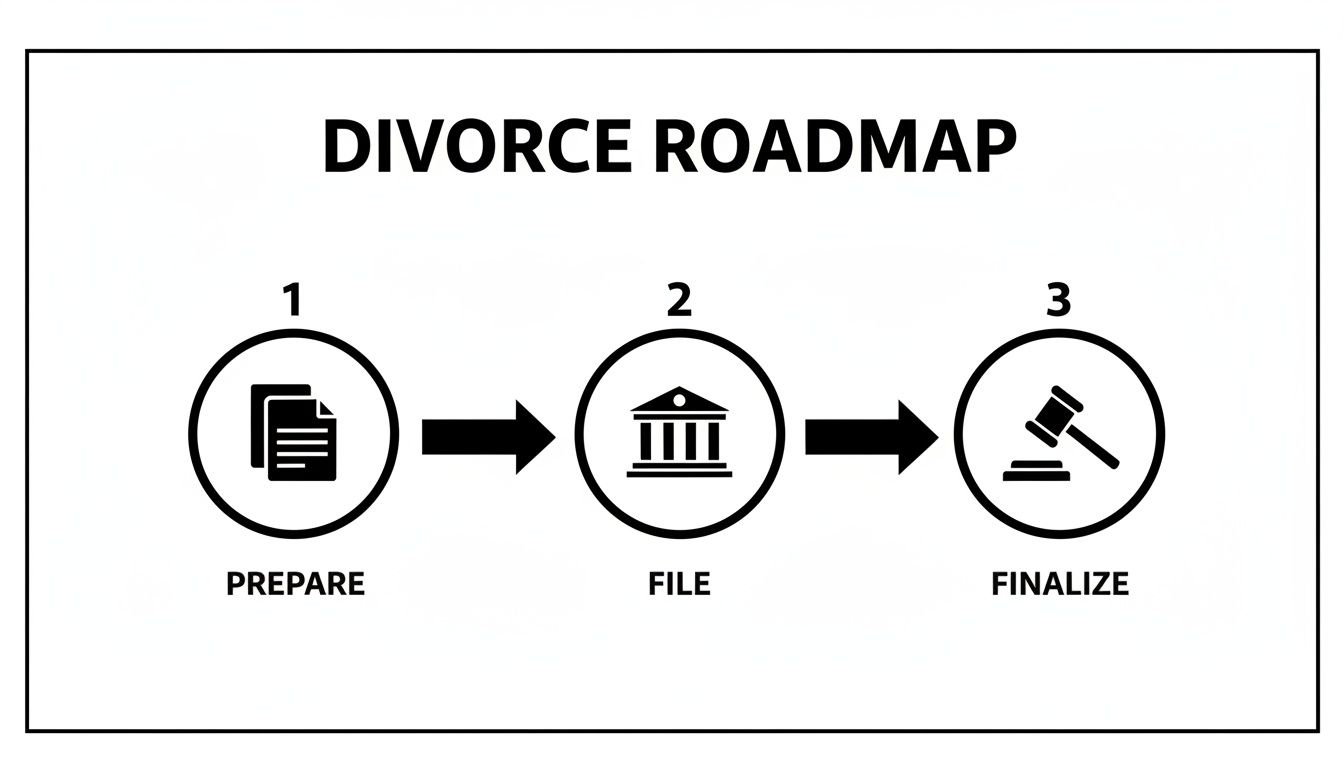
This visual breaks down the process simply. Each of these stages involves its own set of important tasks, from gathering financial records to attending court-ordered mediation. We will explain each one in the sections that follow.
We are going to cover the critical topics that come up in nearly every Atascocita divorce case, so you can feel ready for what lies ahead.
- Understanding the Legal Path: A major factor is whether your divorce will be uncontested (you both agree on all terms) or contested (there is at least one disagreement). This choice dramatically impacts the timeline, cost, and stress involved. We will help you understand which path your case is likely to take.
- Managing Your Assets and Children: How does Texas community property law affect your home in Eagle Springs, your 401(k), and your shared debts? What are realistic expectations for child custody arrangements in Harris County? We’ll explain the specifics in plain English.
- Navigating Court Requirements: We will get practical and discuss the exact forms you need, the costs associated with filing, and the procedures you must follow with the Harris County District Clerk.
Divorce isn't just a legal transaction; it's a profound life transition. Having a clear, supportive plan is the best way to work toward a fair outcome that provides stability for you and your children.
We know this can feel isolating, but you do not have to figure it all out on your own. At The Law Office of Bryan Fagan – Atascocita TX Lawyers, we are here to provide clear, compassionate guidance grounded in our experience serving this community. To discuss your specific situation, we invite you to schedule a free, no-obligation consultation at our Atascocita office.
Preparing for Your Divorce Before You File
Before the first legal document is ever filed, the groundwork you lay can make a significant difference. We have seen it time and again with clients here in Atascocita—those who take the time to prepare thoughtfully are better equipped to navigate the process with confidence and reduced stress. Think of this as your pre-filing strategy session.

First Things First: Are You Eligible to File in Harris County?
Before you can file, you must ensure that Texas has the authority, or jurisdiction, to grant your divorce. The state has very specific residency rules that are not just suggestions, but legal requirements.
- Either you or your spouse must have lived in Texas for the last six months.
- And, either you or your spouse must have lived here in Harris County for the last 90 days before you file.
So, if you live in Atascocita, Humble, Eagle Springs, or The Groves, your case will be heard in the Harris County District Courts. This is the very first box you must be able to check.
Uncontested vs. Contested: What Kind of Divorce Will This Be?
It is also incredibly helpful to determine which path your divorce is likely to take. From our experience, divorces generally fall into one of two categories.
An uncontested divorce is the goal for many families. This is where you and your spouse agree on all major issues—how to divide your property and retirement accounts, where the children will live, and how child support will be handled. This path is faster, less expensive, and significantly less stressful.
A contested divorce simply means you and your spouse disagree on at least one key issue. It does not automatically mean you are headed for a dramatic courtroom battle. Most "contested" cases are ultimately settled through negotiation or mediation. The state’s mandatory 60-day waiting period is often a crucial window for working through these disagreements with legal guidance. You can learn more about the Texas waiting period for divorce and how to use that time effectively in our related articles.
Start Assembling Your Financial Story
Now for the practical work. Texas is a community property state, which means nearly everything you and your spouse acquired during the marriage—assets and debts alike—is considered part of the marital estate. A judge’s task is to divide this estate in a "just and right" manner.
To achieve a fair division, you need a complete and honest picture of your financial life. While this step can feel daunting, it is one of the most powerful things you can do to protect your interests.
Start by gathering the essential paperwork that tells the story of your marriage's finances. This isn't just about preparing for lawyers; it's about empowering yourself with knowledge.
Below is a checklist of the documents we advise our clients to gather before starting the formal process.
Essential Pre-Filing Document Checklist for Your Atascocita Divorce
| Document Category | Specific Examples | Why It's Important |
|---|---|---|
| Income & Employment | Pay stubs, W-2s, and federal tax returns for the past 3 years. | Establishes each spouse's earning capacity for calculating support and assessing financial needs. |
| Assets & Investments | Bank statements (checking, savings), 401(k) and IRA statements, stock/brokerage account records. | Provides a full inventory of the community estate that needs to be divided. |
| Real Estate | Deeds, mortgage statements, property tax records, and recent appraisals if available. | Crucial for valuing and dividing the marital home or other properties in the Atascocita area. |
| Debts & Liabilities | Credit card statements, auto loan documents, student loan records, personal loan agreements. | Ensures all community debts are identified and fairly allocated between spouses. |
| Personal Records | Children's birth certificates, social security cards, prenuptial or postnuptial agreements. | Verifies identities and establishes any pre-existing agreements that affect the divorce. |
Taking a full inventory of your finances is the bedrock of a fair settlement. It moves you from a place of uncertainty to one of clarity, allowing you to begin picturing your life after the divorce.
This early preparation gives you a real advantage. When you walk into the legal process organized and informed, you are already ahead of the curve. This foundational work builds a solid platform for the entire divorce. If you feel stuck or just want to make sure you're on the right track, our team is here to help. Schedule a free, confidential consultation at our Atascocita office to get your questions answered.
Filing the Petition: Making the Divorce Official
You have made the decision and gathered your preliminary documents. Now it is time to take the first formal legal step. This is the moment your divorce becomes an actual case in the Texas court system. It all starts by preparing and filing a specific set of documents with the Harris County District Clerk.
We know this part can seem intimidating, but think of it as a series of manageable tasks. Let’s walk through exactly what you need to file, how much it costs, and what happens right after.
Your First Legal Document: The Original Petition
The entire process begins with a document called the Original Petition for Divorce. This is your formal request to the court, asking it to dissolve your marriage. It lays out the basic information about you, your spouse, any children you share, and states the legal reason—or grounds—for the divorce.
While you can find templates for this document online, we offer a word of caution based on our years of experience: one-size-fits-all forms are often too generic to address the real-life complexities of a marriage, such as a family business, unique retirement accounts, or a specific custody schedule your children need. A simple mistake on this initial form can create serious delays and expensive problems down the road.
Many of our clients are women who initiate the divorce, a trend reflected in national statistics. We often see cases where a standard petition was initially considered, which would not have been enough to protect their specific financial and parental interests. Customizing the petition is key.
Along with the Petition, you'll also need a Civil Case Information Sheet and a form for the Bureau of Vital Statistics. Getting this initial paperwork right is a huge part of learning how to file for divorce in Atascocita, Texas, and it sets the stage for everything that follows.
Handling Court Fees and Costs
Filing a lawsuit always involves administrative fees, and divorce is no different. When you file your petition with the Harris County District Clerk, you will have to pay a filing fee. This fee is typically around $300, but it can change, so it's always wise to check the District Clerk's website for the most current amount.
What if you truly cannot afford this fee? Texas law provides a solution. You can file a Statement of Inability to Afford Payment of Court Costs. This is a sworn statement where you detail your income, assets, and list any government benefits you receive. If the judge approves your request, your court costs will be waived.
Notifying Your Spouse: The Importance of "Service"
Once your petition is filed and the clerk assigns you a case number, the next step is absolutely critical. You must legally notify your spouse that you have filed for divorce. This formal notification is called service of process, or simply "serving" the papers. This is not just a courtesy; it is a constitutional right that guarantees your spouse a fair opportunity to respond.
You generally have two ways to accomplish this:
- Personal Service: This is the most common method. A sheriff, constable, or a private process server will physically hand-deliver a copy of the filed petition and a formal notice from the court (called a citation) to your spouse. This is the standard option, especially if communication is strained.
- Waiver of Service: If your divorce is amicable, your spouse can sign a Waiver of Service. By signing this document before a notary, they formally acknowledge they have received the divorce papers and waive the need for formal service. This is a faster, cheaper, and less confrontational option we often see in uncontested divorces in our Atascocita and Humble communities.
The details of filing can get complicated quickly. For a closer look at the local procedures, you can get more specifics from our guide on filing a divorce in Harris County.
Properly filing the petition and completing service officially starts the clock on the mandatory waiting period for your divorce. If you have questions about which forms are right for your situation or the best way to handle service, our team at The Law Office of Bryan Fagan – Atascocita TX Lawyers is ready to help. Schedule a free consultation at our Atascocita office, and we’ll make sure you get these first critical steps right.
Navigating Custody, Property Division, and Support
Once the initial divorce papers are filed, the focus shifts to what matters most: your children, your home, and your financial stability. This is where we begin to untangle the life you and your spouse built together. For most of our clients in Atascocita, this is the most challenging part of the journey. Let’s tackle the three key areas: custody, property, and support.

Creating a Stable Future for Your Children
Here in Texas, the courts always begin from one place: the belief that children do best when both parents are actively involved in their lives. This is why Harris County judges nearly always favor what's called a Joint Managing Conservatorship.
This legal term may sound complex, but it simply means that you and your co-parent will share the rights and responsibilities of raising your children. You will make major decisions together—like those regarding your child's education, non-emergency medical care, and other significant life choices. It does not, however, automatically mean a 50/50 possession schedule.
One parent is typically named the "primary" conservator. This parent establishes the child’s main residence (usually within a specific area like Harris County or an adjoining county) and is the one who receives child support payments. The other parent, the non-primary conservator, has a visitation schedule and is responsible for paying that support.
The "Standard Possession Order" is the default schedule you will see in most Texas divorce decrees. It provides a predictable calendar for the non-primary parent that includes:
- Visits on the first, third, and fifth weekends of a month.
- Alternating major holidays like Thanksgiving and Christmas.
- An extended period of time in the summer, usually 30 days.
Every family's situation is different. The Standard Possession Order is just a starting point. We often help clients in Atascocita and Humble create custom schedules that work better for their real lives, like accommodating a parent's non-traditional work hours or a child's active sports schedule.
Dividing Your Property the Texas Way
This is a major concern for most people. Texas is a community property state, a fact that will shape how every asset you have acquired is handled. In simple terms, almost anything earned, bought, or obtained by either spouse during the marriage belongs to the marital estate and is presumed to be owned by both of you.
This covers more than you might think:
- The family home, whether it’s in Eagle Springs or Walden on Lake Houston.
- All vehicles, from the family SUV to a weekend boat.
- Bank accounts, even if they are only in one person’s name.
- Retirement funds like 401(k)s and IRAs that grew during the marriage.
A judge’s role is to divide this community property in a manner that is "just and right." While this often results in a 50/50 split, it is not a rigid rule. A judge can award a larger share to one spouse for specific reasons, such as fault in the breakdown of the marriage or a significant difference in earning potential. For a more detailed explanation, we encourage you to read our guide on what is community property in Texas.
Understanding Financial Support Systems
In a Texas divorce, financial support generally falls into two categories: child support and spousal support.
Child support is fairly straightforward, as it is calculated using a formula from the Texas Family Code. It is based on the paying parent's net monthly income and the number of children requiring support. For one child, it is 20% of net resources; for two children, 25%, and so on. The law caps the income considered for this formula, which is periodically updated.
Spousal support (sometimes called alimony or spousal maintenance) is much rarer in Texas and is never guaranteed. To be eligible, you typically must have been married for at least 10 years and be unable to meet your own basic financial needs. The main exception to this 10-year rule is in cases involving family violence.
Sorting out custody, property, and support is the real heart of the divorce process. It's where emotions are highest and where having clear, experienced guidance matters most. If you’re feeling overwhelmed by how these rules might play out in your own life, give The Law Office of Bryan Fagan – Atascocita TX Lawyers a call to set up a free consultation today.
Finalizing Your Divorce in Harris County
You have filed the petition, navigated the initial steps, and now you are on the home stretch. Reaching the final phase of a divorce is a significant milestone. For our clients here in Atascocita, it often brings a sense of relief, but it is absolutely critical to finish strong and ensure every detail is handled correctly. This is where all your agreements become legally binding.
Once the Original Petition for Divorce is filed, Texas law imposes a mandatory 60-day waiting period. While it might feel like an unnecessary delay, this "cooling-off" period is actually a valuable window of opportunity. It gives you and your spouse a chance to breathe, negotiate the finer points, and finalize the terms of your settlement before going in front of a judge.
The Centerpiece of Your Settlement: The Final Decree of Divorce
The single most important document in your entire divorce is the Final Decree of Divorce. This is not a standard court form; it is a highly customized legal document that serves as the final rulebook for your post-divorce life. It details every single aspect of your separation.
A well-drafted decree needs to be airtight, leaving no room for future arguments. It must clearly outline:
- Property Division: How every asset is divided, from the family home in The Groves to retirement funds and investment accounts.
- Debt Allocation: Who is responsible for paying each debt, including credit card balances, car notes, and the mortgage.
- Child Custody: The full conservatorship and possession order, laying out the rights, duties, and schedule for each parent.
- Support Obligations: The precise terms for child support and health insurance coverage.
- Spousal Support: Any agreements regarding spousal maintenance, including amounts and duration of payments.
We have seen it countless times—a vague or poorly written decree is a recipe for disaster, leading to expensive and stressful court battles years later. Getting this document right is arguably the most critical part of protecting your future, and it is where an experienced attorney’s guidance is truly indispensable.
Reaching Agreement Through Mediation and Parenting Classes
Before you can have a final trial in Harris County, most judges will order you and your spouse to attend mediation. This is a confidential meeting where a neutral professional—the mediator—helps you, your spouse, and your attorneys work through disagreements to find common ground. It is an incredibly successful process; the vast majority of local cases are settled in mediation, avoiding the cost and stress of a trial.
Mediation gives you control. Instead of letting a judge make decisions about your life and your children, you and your spouse craft the solutions yourselves. It's a powerful way to create custom agreements that work for your unique family situation.
If you have minor children, Harris County also requires both parents to complete a parenting class. These courses are designed to help you and your co-parent learn effective strategies for raising children after a divorce. Once you finish, you will receive a certificate that must be filed with the court before a judge will finalize your divorce.
The Final Court Appearance: The Prove-Up Hearing
After you have a signed Final Decree of Divorce and have filed your parenting class certificates, the very last step is a brief court appearance known as a prove-up. This is not a trial; it is a simple, informal hearing that usually takes only 5-10 minutes.
At the prove-up, your attorney will ask you a short series of scripted questions under oath. You will confirm basic facts, like meeting the residency requirements, and state that the agreements in your decree are fair. The judge reviews the decree, asks if there is any chance of reconciliation, and if all the paperwork is in order, signs it on the spot.
The moment the judge signs the decree, your divorce is final.
Navigating this final stage can feel like walking through a legal maze. But with a clear plan and the right guidance, it is a straightforward path. An experienced Atascocita attorney can ensure your decree is drafted to protect your interests and that you move through these final steps smoothly. To make sure your final documents give you the security you need, schedule a free consultation with us at our Atascocita office.
Common Questions About Divorce in Atascocita
Even with a roadmap, you're going to have questions. It’s only natural. We hear the same concerns from our neighbors in Atascocita and Humble every day, and we believe in giving direct, practical answers without legal jargon. Here’s a look at some of the most common questions we get.
How Much Does It Cost to File for Divorce in Atascocita, TX?
One of the first things people want to know is, "What's this going to cost me?" The initial court filing fee in Harris County is a fixed cost, typically landing somewhere between $300 and $350. This is the administrative fee to get your case officially on the court's calendar.
From there, the total expense truly depends on the path your divorce takes.
- An uncontested divorce, where you and your spouse agree on everything from the start, is always the most affordable route. With legal help to ensure the final paperwork is solid, you might only spend a few thousand dollars.
- A contested divorce, however, is a different story. If you need to negotiate or litigate issues like custody, division of a family business, or spousal support, the costs can climb. These cases can easily range from $10,000 to $25,000 or more, depending on the level of conflict and time spent in court.
We believe you deserve complete transparency about costs. At The Law Office of Bryan Fagan, we are always upfront about potential expenses and focus on finding the most efficient and effective strategy for your family and your budget.
Do I Have to Go to Court for My Texas Divorce?
Most people picture a dramatic courtroom battle, but that’s rarely how divorce plays out in real life. The truth is, the vast majority of Texas divorces—well over 95% of them—are settled without a full-blown trial.
If you and your spouse can reach a complete agreement, your only court appearance will likely be a short, informal hearing called a "prove-up." It’s surprisingly low-key. You'll spend about 5 to 10 minutes answering a few straightforward questions for the judge, who then signs your Final Decree of Divorce. That's it.
If you have disagreements, you might attend a temporary orders hearing or mediation. But the primary role of a good family lawyer is to achieve a favorable settlement through smart negotiation, saving you the emotional and financial drain of a trial.
How Long Does a Divorce Take in Harris County?
Texas law has a mandatory 60-day waiting period. This clock starts the day after you file your Original Petition for Divorce, meaning the absolute fastest anyone can get divorced is 61 days. In reality, this only happens in the simplest, most amicable cases where both parties are ready to sign on day 61.
For most families in the Atascocita area, a more realistic timeline is four to six months. This gives everyone enough time to exchange financial information, negotiate key issues, attend mediation if necessary, and properly draft the final decree.
If your divorce is highly contested, especially over complex assets or a difficult custody battle, it could take a year or even longer. The family courts in Harris County are incredibly busy, which can also cause delays. An experienced local attorney understands how the system works and can help keep your case moving as efficiently as possible while setting realistic expectations.
Can I Stay in My Atascocita Home During the Divorce?
This is often one of the most pressing and emotional questions we hear. Legally, neither spouse can simply kick the other out of the marital home. That house is typically community property, and until a judge says otherwise, you both have a right to live there.
Of course, living together during a divorce can be incredibly tense and difficult. If you cannot agree on who stays and who goes, one of you can ask the court for a Temporary Orders Hearing.
At this hearing, a judge will listen to both sides and decide who gets exclusive use of the home while the divorce is pending. The judge’s primary concern is often the stability of the children, so the parent who has historically been the primary caregiver is frequently allowed to remain in the home.
Remember, this is just a temporary solution. The final decision about who gets the house long-term—or if it needs to be sold—will be settled in your Final Decree of Divorce. We can help you file for these orders right away to bring much-needed stability to your family from the very beginning.
Navigating a divorce is tough, but getting clear, honest answers is the first step toward regaining control. The team at The Law Office of Bryan Fagan – Atascocita TX Lawyers is here to provide that clarity and support. If you live in Atascocita, Humble, or anywhere in our northeast Harris County community, we invite you to schedule a free, no-obligation consultation to discuss your situation. Let us help you find the best path forward for you and your family. Contact us today.