When a loved one passes away, their final wishes are often laid out in a trust—a private document created to pass on their legacy smoothly. But what happens next? That’s where a trust administration lawyer in Atascocita, Texas, steps in. At The Law Office of Bryan Fagan, we guide the person in charge (the trustee) through the entire process, making sure every requirement under Texas law is met. It’s all about honoring your loved one’s intentions and taking care of the beneficiaries, without the public spotlight of a court proceeding.
Navigating Your Family's Legacy in Atascocita

The days and weeks after losing a family member are a blur of emotion and endless to-do lists. For families right here in Atascocita, Humble, and across northeast Harris County, the responsibility of settling an estate can feel overwhelming. This is exactly the moment when a well-drafted trust shows its true value, and when compassionate local guidance matters most.
A Private Path Forward
A trust gives your family a private, and often much faster, way to handle things compared to the traditional probate process. Probate cases are public record, playing out in the Harris County courts for anyone to see. Trust administration, on the other hand, is handled privately, following the precise instructions your loved one left behind. This not only protects your family’s privacy but can also wrap up the estate in a fraction of the time.
We see our role as providing a clear, compassionate roadmap for this journey. We know you’re not just distributing assets—you are carrying out the final, deeply personal wishes of someone you loved. Think of us as your local Atascocita guide, here to translate complex legal duties into a series of clear, manageable steps.
Trust administration is more than a legal process; it's an act of stewardship. It’s about carefully and respectfully managing a legacy to ensure it reaches the right hands, exactly as intended.
At The Law Office of Bryan Fagan – Atascocita TX Lawyers, we’re here to help you:
- Clarify Your Fiduciary Duties: We'll break down exactly what Texas law requires of you as a trustee, so you know what to do and when.
- Safeguard Family Assets: Our guidance ensures that property, investments, and funds are managed properly before being distributed.
- Achieve Peace of Mind: Let us handle the legal heavy lifting. This allows you to focus on what truly matters—your family.
This guide is designed to walk you through what trust administration really looks like for Atascocita residents, showing why an experienced trust administration lawyer in Atascocita, Texas, is so critical. By understanding the road ahead, you can move forward with confidence, knowing you're protecting the legacy your loved one worked so hard to build.
Understanding Your Duties as a Trustee in Texas
When you're named a trustee, you’re being handed a profound level of trust. It’s more than just a title; you’ve essentially been appointed the guardian of a loved one's legacy. Your job is to manage their assets and ensure they reach the right people—the beneficiaries—exactly as intended. Under Texas law, this isn't a casual favor; it’s a fiduciary duty, the highest legal standard of care one person can owe another.
This means you are legally required to put the interests of the beneficiaries and the trust itself ahead of your own, always. For folks here in Atascocita, Humble, and Kingwood, this could mean managing anything from a family home to a local small business. Every single decision, big or small, has to be made with complete loyalty and careful attention.
The Foundation of Your Role: Loyalty and Prudence
Think of the Texas Trust Code as your rulebook. It lays out the core principles that must guide every action you take. Two duties stand above the rest as the absolute foundation of your responsibilities.
First is the Duty of Loyalty. This is non-negotiable. You must manage the trust exclusively for the benefit of the beneficiaries. It means no self-dealing—you can't sell a trust property to yourself, for instance, or lend trust funds to a business you own. Your loyalty has to be 100% with the trust, without any conflicts of interest.
Second is the Duty of Prudence. The law expects you to manage the trust’s assets as any reasonably "prudent person" would manage their own affairs. This isn't about being an investment genius, but it is about making sensible, sound decisions to protect the trust's property, invest wisely, and handle its finances with skill and care. It’s all about responsible stewardship.
Getting this right is critical. We've seen a troubling rise in trust disputes in Texas, climbing 18% between 2022 and 2026. Here in Harris County, where probate courts see about 28,000 new applications a year, a shocking 35% of trust-related cases stem from poor administration. The good news? When managed correctly, administration time can be cut by up to 70%, bringing a process that often takes 15 months down to less than 5.
Day-to-Day Responsibilities for an Atascocita Trustee
Beyond those foundational principles, being a trustee involves a lot of practical, hands-on work. Your best friends in this process will be meticulous record-keeping and open, honest communication. These two things alone can prevent most family disagreements before they even start.
A trustee’s duty is to be transparent and fair. Clear, consistent communication with beneficiaries isn’t just good practice—it's a legal requirement that builds trust and prevents misunderstandings.
To give you a clearer picture, let's break down some of the key legal duties you'll be handling.
Key Trustee Responsibilities Under Texas Law
This table summarizes the main legal obligations you'll need to fulfill. Think of it as a step-by-step checklist to ensure you're staying on the right side of Texas law and honoring the trust's creator.
| Fiduciary Duty | What It Means for an Atascocita Trustee | Common Pitfall to Avoid |
|---|---|---|
| Duty to Account | You must keep detailed, accurate records of every transaction—all income, expenses, and distributions—and share regular reports with the beneficiaries. | Mixing trust money with your personal funds. This is a huge red flag and can lead to serious legal trouble. |
| Duty to Be Impartial | Unless the trust document says otherwise, you can't play favorites. You must treat all beneficiaries fairly and equitably. | Giving a distribution to one sibling while holding back another's without a valid reason outlined in the trust. |
| Duty to Enforce Claims | It's your job to collect any money owed to the trust. This could be anything from an unpaid loan to back rent from a property in Atascocita or Humble. | Ignoring a debt because pursuing it feels awkward or confrontational. You have a legal duty to act. |
| Duty to Defend the Trust | If someone files a lawsuit challenging the trust, you are required to take reasonable steps to defend it in court. | Failing to hire a lawyer to respond to a legal challenge, which could put all the trust assets at risk. |
Successfully navigating these duties takes diligence. Many estate plans are built around a revocable living trust, and understanding how they work is key. You can learn more about the pros and cons of this common estate planning tool in our detailed guide.
Working with an experienced trust administration lawyer in Atascocita, Texas, can make all the difference. We can guide you through every step, ensuring you fulfill your duties correctly and carry out your loved one’s wishes with integrity and confidence.
The Texas Trust Administration Process Step-by-Step
Stepping into the role of a trustee can feel like being handed a map to a complex new territory. For our neighbors here in Atascocita and across Harris County, the legal requirements can seem overwhelming. That’s why we’ve laid out a clear, practical roadmap to guide you through the journey.
Think of it less as one giant task and more as a series of manageable steps. A methodical, step-by-step approach is your best friend here, helping you move from the initial paperwork to the final distribution of assets with confidence.
Step 1: Locate and Review the Trust Documents
Your very first job is to get your hands on the original, signed trust agreement and any related papers, like amendments or a pour-over will. This document is the instruction manual your loved one left behind, and it guides every single decision you'll make.
Read it carefully—then read it again. You're looking for the specific terms, the named beneficiaries, and the grantor's ultimate wishes. Is there a specific timeline? Are there special conditions? A skilled trust administration lawyer in Atascocita, Texas, can sit down with you and translate the complex legalese into plain English.
Step 2: Formally Notify Beneficiaries and Heirs
Open and honest communication is the cornerstone of a smooth administration. Texas law requires you to formally notify every beneficiary named in the trust. This isn't just a casual heads-up; it’s a formal notice that confirms your role as trustee and tells them what to expect in the coming months.
This step does more than just check a legal box. It builds trust from the very beginning and helps manage everyone's expectations. When you establish clear lines of communication, you can head off misunderstandings and potential disputes before they even start.
Step 3: Marshal and Inventory All Trust Assets
Now it’s time to shift your focus to the assets. You need to identify, locate, and take legal control of everything the trust owns. This is a detailed process that involves creating a complete inventory of every asset, from bank accounts and investments to real estate and personal property.
For a local Atascocita trustee, this stage often involves:
- Financial Accounts: Contacting banks and brokerage firms to retitle accounts into the name of the trust.
- Real Estate: Getting a formal appraisal for properties in areas like Humble or near Lake Houston to determine their fair market value as of the date of death.
- Personal Property: Making a detailed list of valuable items like cars, jewelry, or artwork.
This meticulous inventory is the foundation for everything that comes next. If you're new to this, it can be helpful to understand how trusts are built in the first place. You can learn more about how to create a trust in Texas to see the other side of the process.
This simple graphic breaks down the three core duties of any trustee: Loyalty, Prudence, and Communication. They are the principles that should guide every action you take.
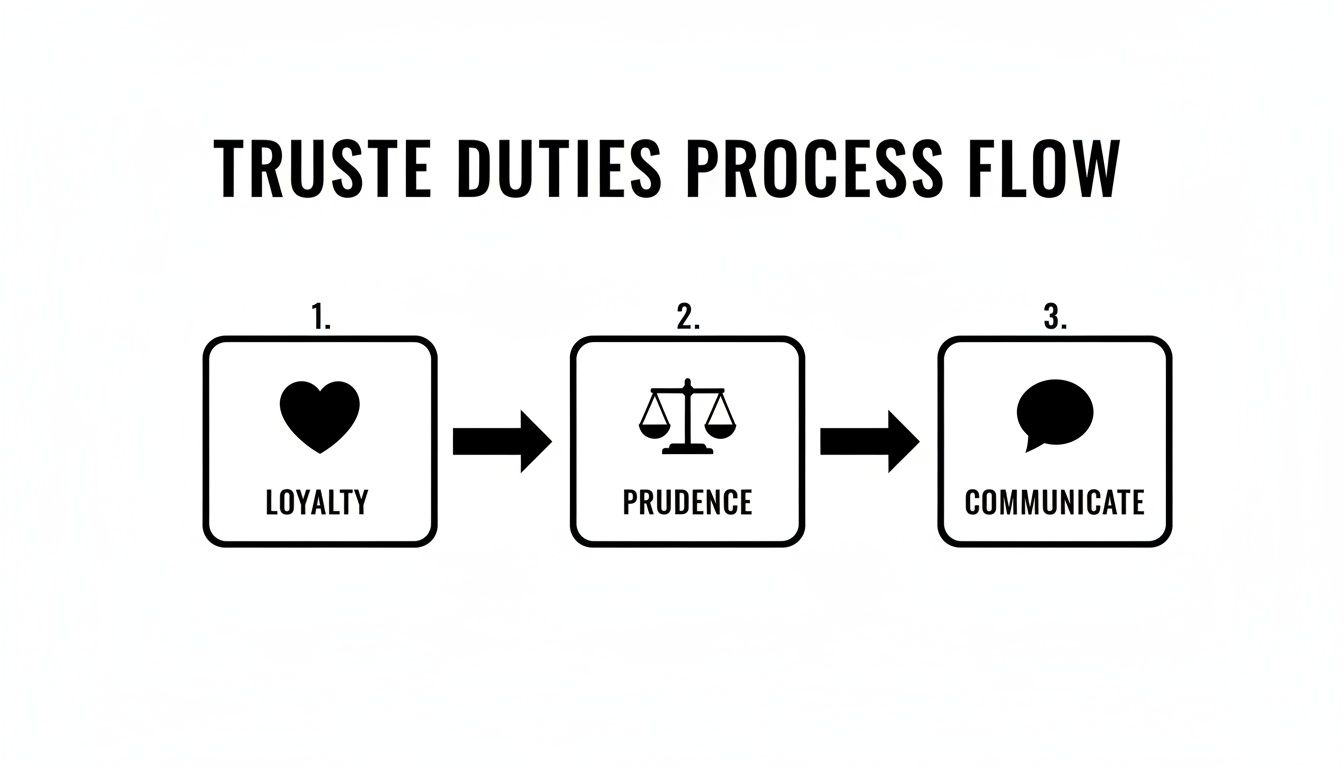
Essentially, your role is built on always acting in the beneficiaries' best interests, managing the assets wisely, and keeping everyone in the loop.
Step 4: Pay Debts, Taxes, and Expenses
Before a single dollar can go to the beneficiaries, you have to settle all of the trust’s financial obligations. This is a critical responsibility that protects both the trust and its beneficiaries from any future claims.
You'll need to follow these steps:
- Get a Tax ID Number (EIN) for the trust directly from the IRS.
- Identify and Pay Creditors by reviewing the deceased's records. Sometimes, Texas law requires you to publish a formal notice to potential creditors.
- File All Necessary Tax Returns, including the deceased's final personal income tax return and the trust's own income tax returns (Form 1041).
- Pay Administrative Expenses like legal fees, accounting costs, or property maintenance directly from trust funds.
Pro Tip: Document every single payment. Meticulous records give the beneficiaries a clear accounting and provide proof that you handled all financial duties responsibly.
Step 5: Distribute Assets and Terminate the Trust
Once all the bills are paid and the taxes are settled, you’ve reached the final step: distributing the remaining assets to the beneficiaries exactly as the trust instructs. This might mean cutting checks, retitling property deeds, or transferring investment accounts into their names.
After everything has been distributed, you must provide a final accounting to the beneficiaries that shows all the financial activity that took place. Once they approve it, you can take the last legal steps to formally terminate the trust, bringing your duties to a successful close.
Probate vs Trust Administration in Harris County
When a loved one passes away in Atascocita, their estate must be settled. The real question is how. Families are usually faced with two very different paths: the court-driven process of probate or the private process of trust administration.
Think of it this way: both paths get you to the same destination—distributing assets to the right people—but one is a winding, public road with toll booths and traffic jams, while the other is a direct, private route. Understanding which is which is a cornerstone of smart estate planning for Texas families.
Probate is the traditional, court-supervised route. It’s a public affair, which means every document, from the will to a detailed inventory of your family’s assets, becomes public record at the Harris County courthouse. It’s a process known for being slow, often expensive, and turning a private family matter into something anyone can look up.
Trust administration is designed to be the complete opposite. It’s handled privately by a person you choose (the trustee), following the exact instructions you left behind in your trust. For families here in Humble, Atascocita, and the surrounding areas, it’s almost always a faster, more dignified, and more cost-effective way to honor a loved one’s wishes.
The Core Differences That Matter Most
The biggest difference between probate and trust administration boils down to one thing: court involvement. Probate puts a judge in the driver's seat for nearly every step, which is precisely why it takes so long. A trust, on the other hand, is specifically designed to operate outside the courtroom, keeping control in the hands of your family.
This isn't just a minor detail; it has huge implications for families right here in our community. Without a trust, nearly 60% of estates in Harris County end up in the probate system. The data is clear: probate can easily drag on for 6 to 24 months and eat up 3% to 7% of the estate's total value in fees.
For a $500,000 estate in our area, that’s $15,000 to $35,000 in legal and court costs, all while the assets are frozen and exposed to potential creditor claims.
To really see the contrast, let's compare them side-by-side.
At a Glance: Probate vs. Trust Administration in Harris County
This table gives you a clear, straightforward comparison of what each process looks like for a family in the Atascocita area.
| Feature | Probate Process | Trust Administration |
|---|---|---|
| Privacy | Public Record. All filings, including the will and asset lists, are accessible to the public at the Harris County courthouse. | Completely Private. The trust document and all transactions remain confidential among the trustee and beneficiaries. |
| Timeline | Lengthy. Can take anywhere from six months to over a year, with court dates and legal deadlines slowing things down. | Efficient. Often completed in a matter of months, as there is no need to wait for court approvals. |
| Cost | More Expensive. Involves court filing fees, attorney's fees, and other administrative costs that can add up quickly. | More Cost-Effective. While there are legal fees, they are typically lower because the process is simpler and avoids court costs. |
| Control | Court-Supervised. A judge must approve key actions, limiting the family's control over the process. | Trustee-Controlled. The successor trustee you appointed has the authority to manage and distribute assets as directed. |
This comparison shows why so many Atascocita families are choosing to plan with trusts. The benefits of privacy and efficiency are simply too significant to ignore.
The greatest gift of a trust is peace of mind. It allows a family to grieve and heal without the added stress of a public, drawn-out court battle over their loved one's legacy.
Ultimately, opting for a trust is about creating a smoother, more secure transition for the people you care about most. It protects their privacy, shields assets, and makes sure your wishes are followed quickly and correctly. For many people, learning how to stay out of the probate system is the number one goal. You can explore the specific strategies involved by reading our guide on how to avoid probate in Texas.
An experienced trust administration lawyer in Atascocita, Texas, can make all the difference in ensuring this process is handled properly from day one.
Tackling the Common Headaches of Trust Administration
Even with a perfectly written trust, the process of administering it rarely goes off without a hitch. If you're the trustee, these bumps in the road can feel incredibly personal and stressful, especially when you're dealing with family members during an already difficult time. The good news? With the right guidance from an Atascocita trust administration lawyer, these common hurdles are more than manageable.
The key is to anticipate potential problems and have a strategy ready. Whether you're trying to figure out confusing wording or acting as a referee between siblings, a proactive approach can stop small misunderstandings from spiraling into bitter disputes. Your job is to stay focused on what the person who created the trust wanted and what's best for the beneficiaries.
When the Trust's Instructions Aren't Clear
One of the first places trouble can pop up is within the pages of the trust document itself. What did your loved one actually mean by a certain phrase? Language that seemed straightforward when it was written years ago can suddenly become hazy. Maybe an asset mentioned in the trust was sold, or a beneficiary's life has taken a completely different turn.
When you hit a patch of unclear language, the absolute worst thing you can do is guess. A wrong move could be seen as a breach of your duties. The first and only step is to get a legal opinion. An attorney can help interpret the grantor's intent based on the whole document and Texas law, protecting you and ensuring you honor their real wishes.
Managing Disagreements Between Beneficiaries
Let’s be honest: grief and money can be a recipe for conflict. It's not at all unusual for disagreements to surface among beneficiaries. One heir might feel another is getting special treatment, or they might argue over what to do with a shared asset, like the family vacation spot on Lake Houston.
Often, these disputes are fueled more by old family dynamics and emotions than by the legal facts. To navigate this, your best tools are unwavering impartiality and crystal-clear communication.
- Keep Meticulous Records: When you provide regular, detailed financial reports, there’s no room for anyone to second-guess your actions.
- Get Everyone Talking: Sometimes, a facilitated meeting where everyone can air their concerns is all it takes to get things back on track.
- Stick to the Script: Gently remind everyone that your job is to follow the instructions in the trust—not to pick sides or solve old family squabbles.
As the trustee, your loyalty is to the trust document, not to the demands of any one beneficiary. Acting as a neutral administrator is your best shield against disputes.
Dealing with Debts and Taxes
On top of managing family dynamics, a trustee has to handle the trust's financial obligations. This means tracking down any legitimate debts and paying them from the trust's assets before anyone gets a dime. You'll also be on the hook for filing the deceased's final income tax return and any necessary trust income tax returns (Form 1041). These aren't suggestions; they're serious legal duties.
The need for skilled legal help has never been greater, especially right here in our community. The Houston metro area, including Atascocita, is growing fast. Harris County's population jumped 8.5% between 2016 and 2026. With median home values now pushing past $300,000, more families are dealing with estates that have real financial complexity. This has led to a 25% spike in probate filings, which really highlights why it’s so critical to manage a trust correctly and stay out of court. You can see more about local Texas estate trends on Lawyers.com.
Working with an experienced lawyer ensures every creditor is properly notified and every tax deadline is met. It’s the single best way to protect the trust—and yourself—from legal and financial trouble down the road.
Your Local Atascocita Partner in Trust Administration

Stepping into the role of a trustee is a serious commitment, but you don't have to figure it all out on your own. While this guide gives you a solid foundation, having an experienced local attorney by your side can make all the difference. At the Law Office of Bryan Fagan, we're not just a law firm with an Atascocita address; we're your neighbors, deeply connected to this community and the surrounding areas like Humble and Kingwood.
We get it. We live here, we work here, and we understand the challenges families in our area face during these emotional times. It’s this firsthand, local perspective that shapes how we approach every single case.
An Advocate Who's on Your Side
Our entire practice is built on a simple idea: combine a deep understanding of Texas estate law with a real commitment to making this process as smooth as possible for you. To us, you're not a case file. You're a neighbor, and we treat you that way from the moment you walk through our door.
Our goal is straightforward: to give you clear, practical legal support so you can honor your loved one’s final wishes with confidence. We take on the legal heavy lifting, letting you focus on what truly matters—your family.
When you work with us, you're getting a dedicated partner who will:
- Truly listen: We'll sit down with you to understand your unique family situation, your concerns, and what you hope to achieve.
- Explain everything clearly: We break down the complicated legal jargon into plain English, so you always know what’s happening and feel in control.
- Protect the trust: We work to anticipate and solve problems before they start, from handling creditor notices to answering tough questions from beneficiaries, always protecting the assets your loved one left behind.
Let's Find a Clear Path Forward Together
If you’re a trustee looking for a trust administration lawyer in Atascocita, Texas, who brings both legal know-how and a genuine, personal approach, we're here for you. We firmly believe that managing a loved one's legacy should be a process filled with clarity, not confusion. Let's talk about your specific needs and map out a clear plan to move forward.
The Law Office of Bryan Fagan – Atascocita TX Lawyers is ready to give you the support you need. Contact our Atascocita office today to schedule a free, no-obligation consultation and take that first, crucial step toward peace of mind.
Your Top Trust Administration Questions Answered
When a family in Atascocita is faced with administering a trust, a lot of questions come up. It's a new and often overwhelming process. Here are some of the most common questions we hear from clients, along with straightforward answers to help you understand what lies ahead.
How Long Does Trust Administration Take in Harris County?
This is usually the first thing people want to know. While every situation is unique, a good rule of thumb for a typical trust administration in Harris County is anywhere from six to twelve months. A very simple trust with only a few bank accounts and cooperative beneficiaries might wrap up in just a few months.
However, things can get more complicated. If the trust holds a family business, includes multiple pieces of real estate that need to be sold, or has significant debts to settle, the timeline will naturally be longer. Working with a trust administration lawyer in Atascocita, Texas, is the best way to keep the process moving forward and sidestep delays that can frustrate everyone involved.
Can a Trustee Be Held Personally Liable for Mistakes?
Yes, and this is a big one. As a trustee, you have what's called a fiduciary duty, which is the highest standard of care recognized under Texas law. Simply put, you are legally required to act in the best interests of the beneficiaries, period.
Even honest mistakes can land you in hot water. Things like mixing trust funds with your own, failing to keep meticulous records of every transaction, or even appearing to favor one beneficiary over another can expose you to personal financial liability. This isn't meant to scare you, but to highlight why getting professional guidance is so critical. It protects you just as much as it protects the beneficiaries.
A trustee’s role is one of immense responsibility. Acting with integrity, transparency, and strict adherence to Texas law is not just expected—it's legally required to protect all parties involved.
What Are the Costs of Hiring a Trust Administration Lawyer?
The cost of legal help really depends on the complexity of the trust. An estate with a few simple bank accounts is going to be far more straightforward—and therefore less costly to administer—than one involving business interests, multiple properties, and potential family disagreements.
Most experienced firms, including ours, offer a free initial consultation. This is your chance to sit down with an attorney, lay out the details of the trust, and get a clear, transparent picture of the potential costs. Think of it as an investment. A little guidance upfront can save you from making incredibly expensive errors or getting tangled in family disputes down the road.
At The Law Office of Bryan Fagan – Atascocita TX Lawyers, we understand you're navigating a difficult time. Our job is to provide the clear legal support and compassionate guidance you need to fulfill your duties as a trustee with confidence. To talk through your specific situation, please reach out to our Atascocita office for a free, no-obligation consultation.
Schedule Your Free Consultation at The Law Office of Bryan Fagan – Atascocita TX Lawyers