A retired Humble ISD teacher may own a home in Eagle Springs, savings, and family property outside Harris County, yet still worry that a future nursing-facility stay could consume the legacy intended for children and grandchildren. A small-business owner near FM 1960 may have a different concern, such as a lawsuit reaching personal assets. In both situations, an irrevocable trust in Atascocita, Texas may help, but only if the family understands what it gives up.
An irrevocable trust isn't another bank account or a folder of estate documents. Once assets are transferred correctly, the trust becomes the legal owner, and the trustee manages those assets under written instructions. That separation can affect Medicaid planning, creditor protection, probate, beneficiary rights, and family control. It also creates obligations that can't be handled responsibly with a generic online form.
What an Irrevocable Trust Means for Atascocita Families
An irrevocable trust is a legal arrangement in which a grantor transfers property to a trust for named beneficiaries, while a trustee manages the property. The practical change is ownership. After proper funding, the grantor no longer owns the transferred principal personally, and the trustee holds legal title for the trust.
Think of the difference between depositing money into a checking account and transferring a house into a trust. You generally control your checking account directly and can change how you use the money. With an irrevocable trust, the property follows the trust document, not the grantor's personal instructions whenever circumstances change.
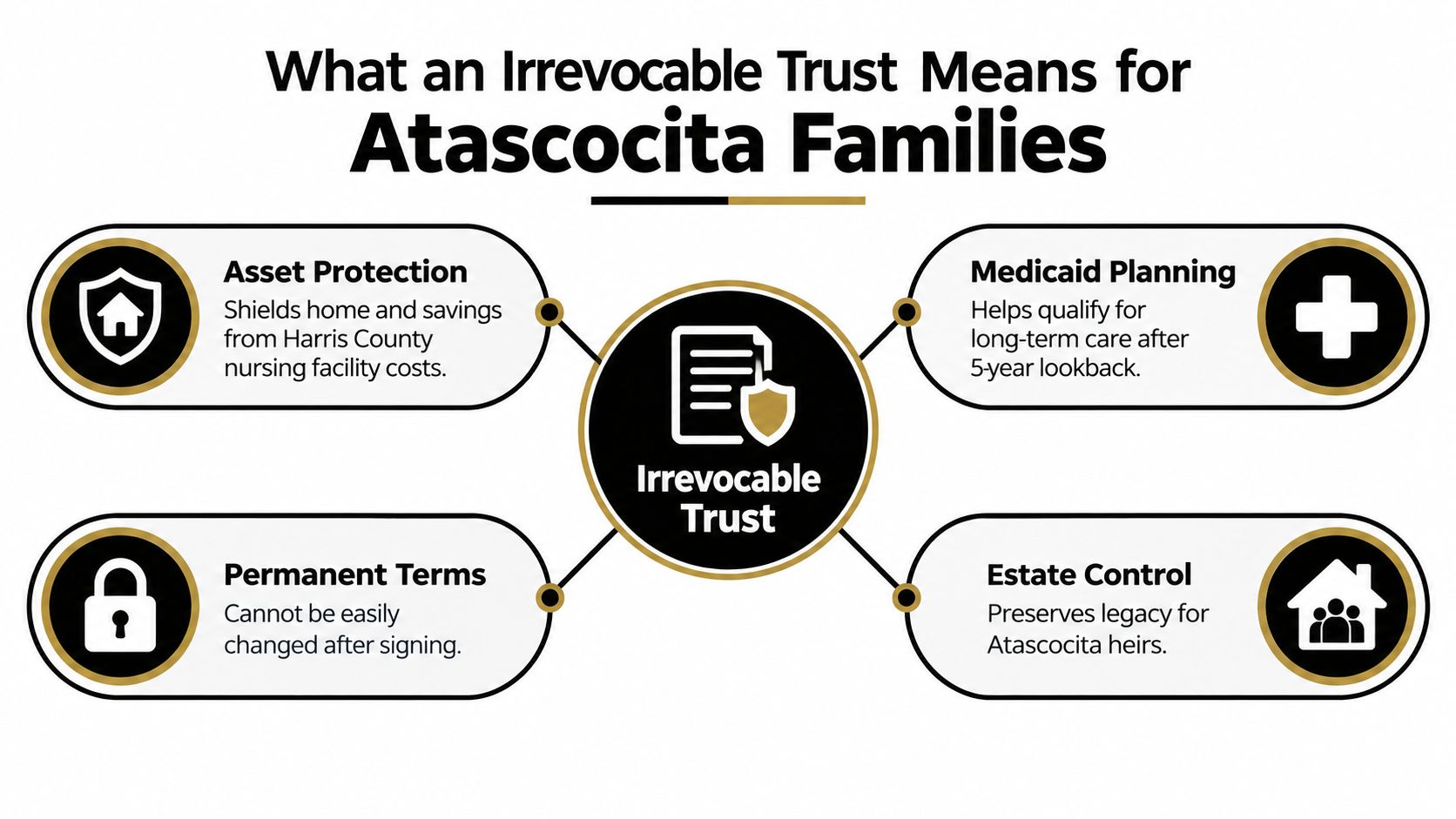
The central trade-off
Texas law treats revocability as the default. Under Texas Property Code Section 112.051, a settlor may revoke a trust unless the trust instrument expressly makes it irrevocable. That means the trust doesn't become irrevocable merely because someone calls it permanent or transfers property into it. The document must use clear language that removes the power to revoke.
For a family in Walden on Lake Houston, the decision may involve the homestead, investments, or a future inheritance for grandchildren attending Atascocita High School. For another family, it may involve business interests or land in Liberty County. The common question is whether giving up direct ownership serves a greater purpose.
Practical rule: An irrevocable trust works through separation. If you retain unrestricted ownership and control, the protection you expect may not exist.
Removing property from the grantor's name can change how courts, Medicaid eligibility workers, and creditors evaluate that property. It doesn't create absolute immunity, and transfers made improperly or fraudulently can create serious problems. The trustee must also follow the document and Texas law, rather than treating the trust property as the grantor's personal account.
The rest of the decision follows from this foundation. Protection comes from giving up control, so families should identify the intended protection before signing anything.
How Irrevocable Trusts Differ From Revocable Trusts
The choice often becomes clearer when the two structures are placed side by side. A revocable trust generally preserves flexibility and functions much like a will substitute. An irrevocable trust makes the trust an independent owner, which can support stronger protection but limits the grantor's access and authority.
| Feature | Revocable Trust | Irrevocable Trust |
|---|---|---|
| Control | The grantor usually keeps substantial control and can change or revoke the trust. | The grantor gives up the power to revoke when the instrument expressly requires irrevocability. |
| Amendment rights | Terms can generally be changed during the grantor's lifetime. | Changes are limited and may require court involvement or other authorized procedures. |
| Tax treatment | The trust may be treated as a grantor trust, with income generally reported by the grantor. | The trust may need its own tax identification number, although a grantor-trust exception can apply while the grantor is alive. |
| Probate avoidance | Properly funded trust assets generally pass outside probate. | Properly funded trust assets generally pass outside probate. |
| Medicaid exposure | Retained control can leave assets treated as available to the grantor. | Proper planning may separate principal from the grantor, but Texas Medicaid's look-back rules still matter. |
| Creditor protection | Retained ownership generally limits protection from the grantor's creditors. | Spendthrift and discretionary terms can restrict beneficiary assignment and creditor attachment before distribution. |
A revocable trust can be appropriate when an Atascocita homeowner's main goal is smoother administration after death or during incapacity. It generally doesn't provide the same asset-protection structure because the grantor retains control. Families considering that simpler approach can review the practical differences in revocable trust pros and cons.
An irrevocable trust may fit a different objective, such as long-term-care planning, protecting a family business, or preserving assets for beneficiaries who aren't ready to manage them. The grantor accepts less flexibility in exchange for a legal structure that separates ownership.
Family-law concerns can also affect estate planning. For background on how family-law cases proceed in the Harris County courts serving Atascocita, see Harris County Family Courts: An Atascocita Resident's Guide. A trust doesn't automatically decide whether property is separate or community property in a divorce, and families shouldn't use trust planning as a substitute for analyzing marital-property rights.
Texas Law That Shapes Every Irrevocable Trust
Texas drafting starts with the trust instrument. Section 112.051 makes revocability the default unless the document expressly removes the settlor's revocation power. The legal milestone is therefore clear drafting, not merely signing paperwork or moving an asset into a new account.
The document must create a workable arrangement
A properly drafted trust identifies the people and roles that make the arrangement function:
- Grantor: The person transferring property.
- Trustee: The person or institution holding and managing trust property.
- Beneficiaries: The people or organizations entitled to receive benefits under the terms.
- Trust property: The assets transferred into the trust.
The Texas Trust Code governs creation, operation, and termination under Title 9 of the Property Code. The drafting must also state how distributions work. For example, a trustee may have discretion to pay education or health expenses, or the document may require distributions after a stated event. Vague terms can produce disputes in a Harris County court.
A spendthrift provision can restrict a beneficiary's ability to assign an interest and generally limit creditor attachment before distribution. That could matter when a beneficiary is receiving support while attending the University of Houston. The clause doesn't give the trustee permission to ignore the document, and it doesn't make every claim against every trust asset disappear.
Irrevocable does not mean frozen forever
Texas Property Code Section 112.054 allows a trustee or beneficiary to ask a court to modify or terminate an irrevocable trust under limited conditions. This is court-supervised flexibility, not a general right for the grantor to take property back.
Beneficiary information rights also matter. Texas Property Code Section 111.0035 protects core information rights for irrevocable trusts, including a rule that a beneficiary who is 25 years of age or older and entitled to distributions can't be denied essential information by the trust terms. A trustee generally must provide a written accounting within 90 days after a beneficiary's written demand, with that demand generally limited to once every 12 months, under the statutory framework described in the same source.
Texas law also permits a trustee to provide a certification rather than the full instrument. A trust certification under Section 114.086 can identify whether the trust is revocable or irrevocable, who may revoke it, the trustee's powers, and how title should be held. Banks and other third parties often need those facts without receiving every private trust provision.
Medicaid, Asset Protection, and Estate Tax Planning Uses
An Atascocita family may begin this conversation after a parent needs care at a Houston-area nursing facility, a Humble business owner faces liability concerns, or a blended family wants clearer control over inherited property. An irrevocable trust can address these goals, but its result depends on the assets, timing, trustee, beneficiaries, and Texas ownership rules.
| Planning Goal | Key Texas Rule | Who Benefits Most | Typical Outcome |
|---|---|---|---|
| Long-term-care planning | Texas Medicaid applies a five-year look-back to transfers. | Families planning well before a potential application. | Properly structured transfers may separate assets after the waiting period, while late transfers can create penalties. |
| Creditor protection | Spendthrift and discretionary provisions can limit assignment and creditor attachment before distribution. | Business owners and families concerned about future liability. | Trust-owned property may be separated from the grantor and protected for beneficiaries, subject to fraudulent-transfer and ownership rules. |
| Legacy and tax planning | The trust instrument controls ownership, distributions, and administration. | Families with complex beneficiaries, blended households, or special-needs concerns. | Assets can remain under trustee-managed terms instead of passing outright. |
Medicaid and long-term care
A Humble ISD retiree considering long-term care may ask whether placing a home or savings into an irrevocable trust will preserve family wealth. After a transfer, the grantor no longer owns the principal, and Texas Medicaid's five-year look-back still applies. A transfer made too close to an application can create a penalty period, so the strategy must be planned before care becomes immediate.
A Texas Medicaid asset-protection trust discussion explains the trade-off clearly. The trust may separate assets only after the applicable waiting period, while the grantor's access to principal is restricted. A family that needs unrestricted use of the home or funds may need a different plan.
Medicaid Estate Recovery, known as MERP, can affect a deceased recipient's probate estate. Properly funded trust assets are commonly treated in Texas planning materials as outside probate and outside MERP reach, while revocable trust assets do not receive the same treatment. The funding method, trustee, timing, and exact ownership path can change the result.
Asset protection and legacy control
A Humble business owner may want inherited assets kept apart from a beneficiary's creditors or a future divorce claim. Spendthrift and discretionary provisions can prevent a beneficiary from assigning the trust interest and can limit creditor attachment before a distribution. The protection depends on genuine separation of ownership and a transfer that is not fraudulent, as explained in this Texas asset-protection overview.
Families considering this structure should consult an asset protection attorney in Atascocita before moving property. A trust cannot repair a transfer made to defeat an existing creditor, and retaining too much control can weaken the intended separation.
Community-property concerns require their own review. A divorce involving a business, inherited property, or trust-related assets may call for a Property Division Lawyer in Atascocita. Calling property “trust property” does not erase a spouse's existing legal interest.
Estate tax planning is more individualized. A trust may be considered for blended families, life-insurance planning, or a beneficiary with special needs, even when federal estate tax is not the family's immediate concern. The practical goal is to coordinate ownership, control, beneficiary protection, and tax reporting before assets are transferred.
How to Create an Irrevocable Trust in Atascocita
A family meeting usually begins with questions rather than documents. At the Law Office of Bryan Fagan, an estate-planning consultation can focus on the family's goals, health concerns, assets, business interests, existing documents, and relationships among beneficiaries. A retiree may prioritize Medicaid timing, while a business owner may focus on liability exposure and trustee independence.
Designing the structure
The attorney and family then decide what the trust should accomplish and which assets might be transferred. That may include a residence, financial accounts, business interests, or property outside Harris County. The family must also choose a trustee, often weighing a responsible relative against a corporate trustee that can provide continuity and administrative experience.
The document may include distribution standards, spendthrift terms, a trust protector, or authority for later modification where Texas law permits. A trust protector can be assigned specific oversight powers, but those powers must be carefully drafted. The family should also discuss how the trust interacts with a will, beneficiary designations, marital property, and agreements such as Prenuptial & Postnuptial Agreements in Atascocita, which concern drafting and review of marital-property agreements for Atascocita clients.
Signing and funding
The attorney prepares the instrument for execution under Texas requirements. After signing and notarization, the family must transfer each asset properly. Real estate may require a deed and recording, accounts may require ownership-change forms, and business interests may need assignments or consent under governing agreements.
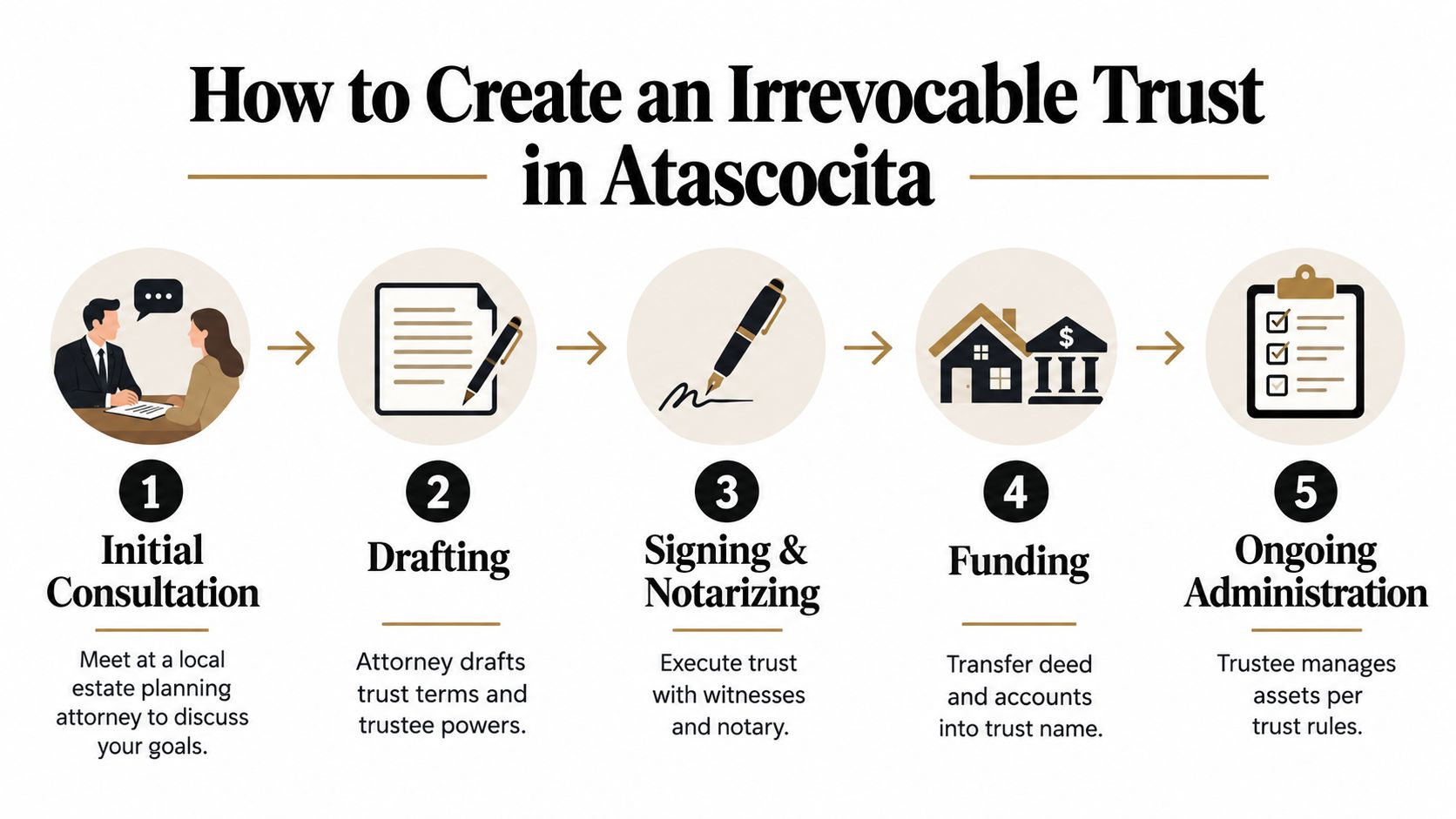
Signing alone doesn't complete the plan. The attorney or trustee should confirm that title changed, account records identify the trust correctly, and no important asset remains outside the intended structure. A certification of trust may help banks and other third parties verify the trustee's authority without receiving the complete instrument.
Federal tax administration adds another task. An irrevocable trust generally needs its own tax identification number, although an exception may allow use of the grantor's Social Security number when the trust is treated as a grantor trust and the grantor is alive, as described in this federal tax identification explanation.
The trustee should keep deeds, assignments, account confirmations, beneficiary letters, and tax records together. That file helps demonstrate that the trust was funded and administered as written.
Costs, Timelines, and Ongoing Trustee Duties
An irrevocable trust is a legal project and an ongoing administrative relationship. The total commitment may include attorney work, real-estate recording, financial-account transfers, tax coordination, and trustee services. The exact amount depends on complexity, assets, and the professionals involved, so families should request a written explanation of scope before proceeding.
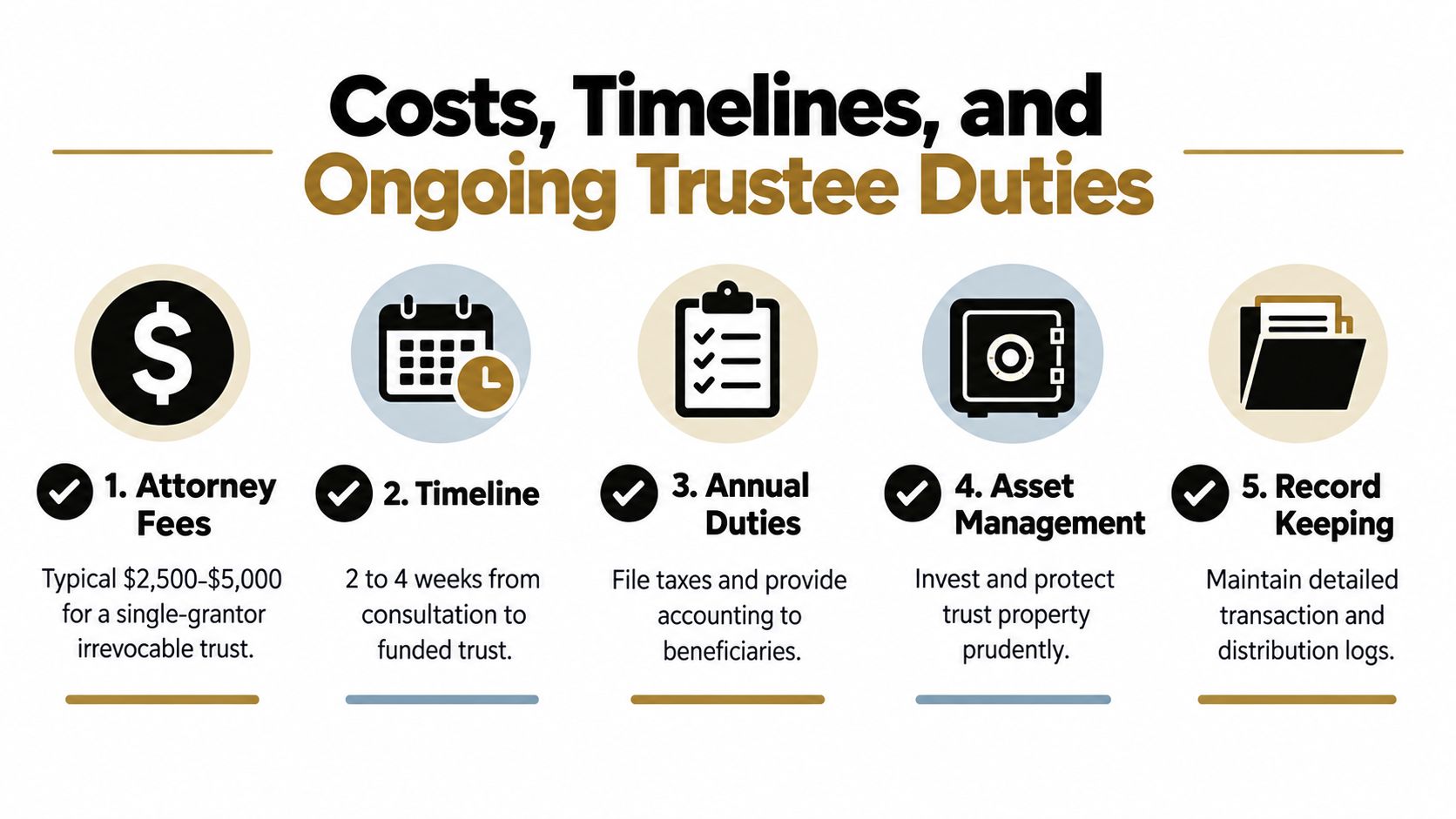
A practical planning checklist includes:
- Legal drafting: Ask what the quoted legal work includes, such as the instrument, signing meeting, deeds, assignments, and funding coordination.
- Real-estate work: Confirm which Harris County recording steps apply to any deed transfer and who will handle them.
- Tax coordination: Determine whether the trust will use its own tax identification number or qualify for grantor-trust treatment.
- Trustee selection: Compare the responsibilities and compensation of a family trustee and a corporate trustee.
- Review schedule: Establish how the trustee will monitor assets, distributions, records, and beneficiary communications.
A simple trust may move efficiently once the family has supplied complete information. Medicaid planning often needs earlier attention because the five-year look-back makes timing part of the legal analysis, not an administrative afterthought.
After funding, the trustee must keep trust property separate, maintain accurate transaction records, invest and protect property prudently, follow distribution standards, and provide required information. A beneficiary's written accounting demand generally carries a 90-day response deadline, subject to the statutory limits discussed earlier. Families needing administration guidance can review trust administration services in Atascocita.
Common Mistakes and Misconceptions to Avoid
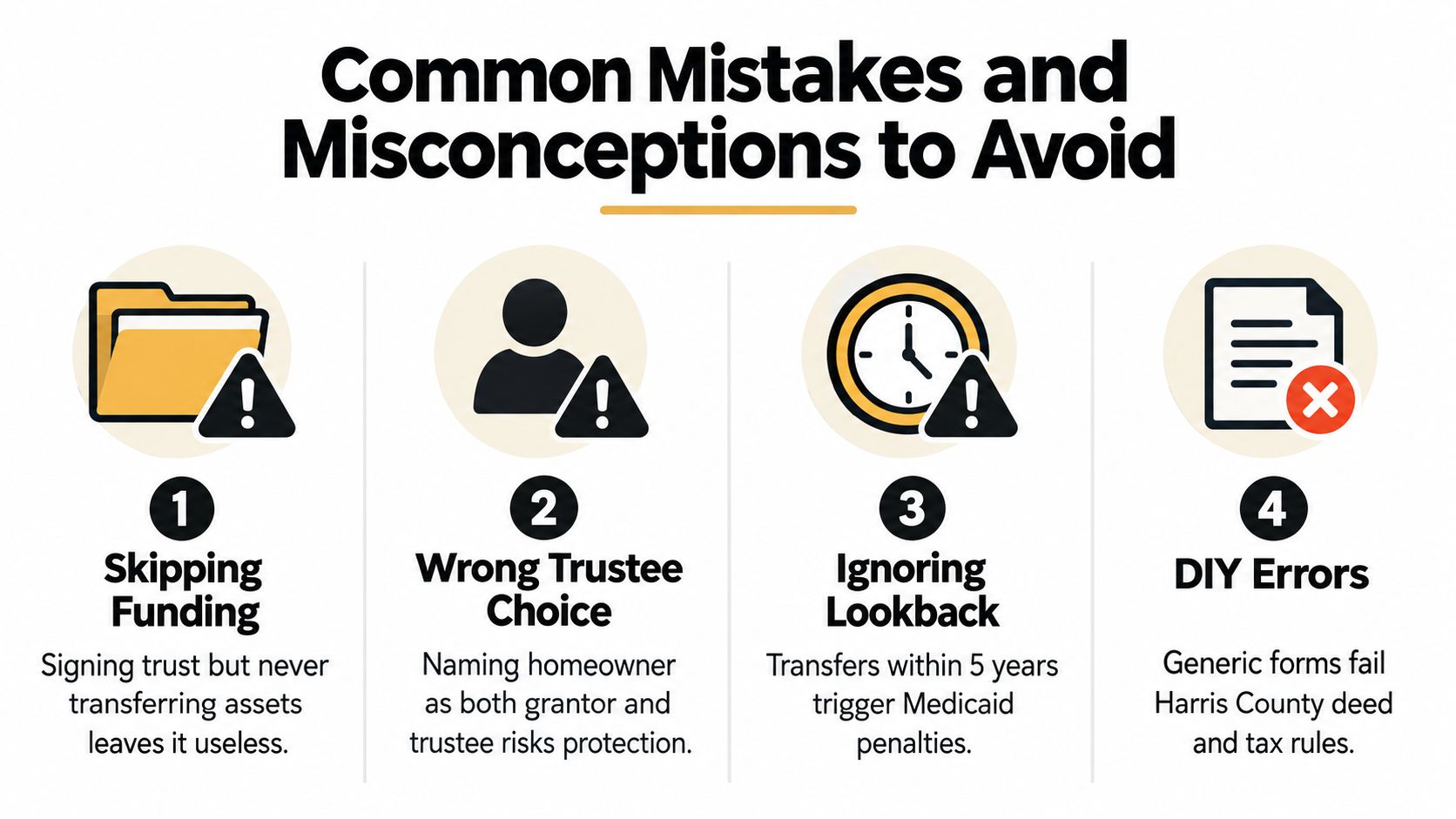
The most expensive mistake is often assuming that signing created protection. Before committing to an irrevocable trust, an Atascocita family should pressure-test these assumptions.
Did the trust receive the assets?
A signed instrument with no deed, account transfer, or assignment may hold nothing. A homeowner in Eagle Springs may believe the residence is protected, while the county property records still show individual ownership. Funding must be tracked asset by asset.
Can the grantor remain in complete control?
Naming the homeowner as both grantor and trustee may undermine the intended separation, depending on the trust design and retained powers. The trustee needs authority to manage property independently under the document. A family member may serve, but that person must understand fiduciary responsibilities and avoid treating trust money as personal funds.
Is Medicaid timing being treated honestly?
The five-year look-back doesn't disappear because the document says “irrevocable.” A transfer made near a Medicaid application may create penalties, and the grantor may have limited access during the waiting period. Families should evaluate current health, available care, income needs, and the possibility that circumstances will change.
Does the plan account for modification?
Irrevocable doesn't mean no legal change is ever possible. Texas provides limited court-supervised modification and termination procedures, but relying on future relief is risky. The document should address practical contingencies through carefully drafted distribution terms and any legally appropriate flexibility.
Is the trust being mistaken for absolute immunity?
A trust doesn't protect a fraudulent transfer, and it doesn't automatically defeat an existing creditor claim or a spouse's established property rights. Generic out-of-state forms can also fail to address Texas title, execution, administration, and tax issues. Local drafting matters because the Texas Trust Code and Harris County property records shape the result.
Your Next Steps With a Local Atascocita Attorney
Start by gathering a complete picture of the family. Bring deeds, account statements, business documents, existing wills or trusts, insurance information, beneficiary designations, debts, family relationships, and any Medicaid or long-term-care concern. You don't need to know which trust you want before the meeting. You need enough information for the attorney to compare options.
During an intake meeting, ask direct questions:
- What control would I give up?
- Which assets should remain outside the trust?
- How would the five-year look-back affect my timing?
- Who should serve as trustee, and what happens if that person can't serve?
- How will the trust coordinate with my will, tax filings, marital-property plan, and beneficiary designations?
A local attorney may also coordinate with a financial advisor or CPA when asset ownership, tax reporting, or investment administration requires additional review. Families comparing counsel can use this resource on how to pick a lawyer in 2026 to organize questions about communication, experience, and fit.
Starting before a health crisis, lawsuit, divorce, or probate dispute usually gives a family more room to evaluate choices. The Law Office of Bryan Fagan, Atascocita TX Lawyers, handles estate planning alongside family law, criminal defense, and civil matters for residents of Atascocita, Humble, and Harris County. A consultation is confidential, and the purpose is to match the legal structure to the family's actual needs, not to sell permanence for its own sake.
The Law Office of Bryan Fagan – Atascocita TX Lawyers can review your assets, family circumstances, trustee choices, and Medicaid timing before you create or fund an irrevocable trust. Contact the Atascocita office to schedule a free consultation and discuss a practical plan for protecting your property and supporting the people you love.