A family in Atascocita may own a suppressor or another regulated firearm and still have no clear answer when a parent becomes incapacitated or dies. The surviving spouse may not know who can lawfully possess the item, adult children may assume they can take it home, and a trust that was never updated may no longer reflect the family's wishes. Searching for a gun trust in Atascocita, TX usually means you're looking for more than paperwork. You're trying to protect your household, organize responsible access, and reduce the risk of an unlawful transfer.
This guide explains how a gun trust works, how federal NFA rules interact with Texas trust administration, and what Atascocita and Humble families should consider before creating or updating one. It also covers trustee selection, trust funding, ATF filings, succession, and common mistakes that can create problems in Harris County households.
Why Atascocita Families Consider a Gun Trust
A family in Atascocita might begin with a practical concern. A husband owns a suppressor and a short-barreled rifle, his wife occasionally uses the items, and both want their adult child to help manage the property if either parent becomes unable to do so. Their concern isn't only who inherits the items. They also need to understand who may possess them before an inheritance occurs and what process applies afterward.
That concern becomes more serious when the family's estate plan includes a will but no coordinated plan for regulated firearms. A will can describe who should receive property, but NFA firearms also remain subject to federal transfer rules. The people named in the estate plan may need guidance before they take possession, transport the items, or attempt to transfer them.

A local estate plan needs more than a generic form
Atascocita and Humble residents often have family members living in different parts of northeast Harris County, or relatives who may become trustees after a death or incapacity. A trust that names the wrong person, lacks clear successor language, or doesn't explain how trustees may be added can create confusion at the moment the family most needs clarity.
A gun trust is a revocable trust used to hold NFA firearms, including suppressors and short-barreled rifles. Federal requirements apply to the firearms and their transfers, while Texas law governs the private trust relationship and its administration. Those two systems need to work together.
Families may consult an Estate Planning Attorney in Atascocita for wills, trusts, and estate plans for Atascocita families. A properly coordinated plan can address ownership during the settlor's lifetime, shared trustee responsibilities, incapacity, and the eventual transfer of already-registered items.
The objective is controlled access and an orderly transition
The trust doesn't eliminate federal compliance. Instead, it gives the family a structure for identifying the people who may manage trust property and the people who should take over later. It also creates a written record that can be reviewed when a trustee changes or an inheritance occurs.
Family planning point: The safest time to decide who should manage regulated firearms is before an emergency, not while relatives are trying to interpret documents after a death.
What a Gun Trust Is and How It Works in Plain English
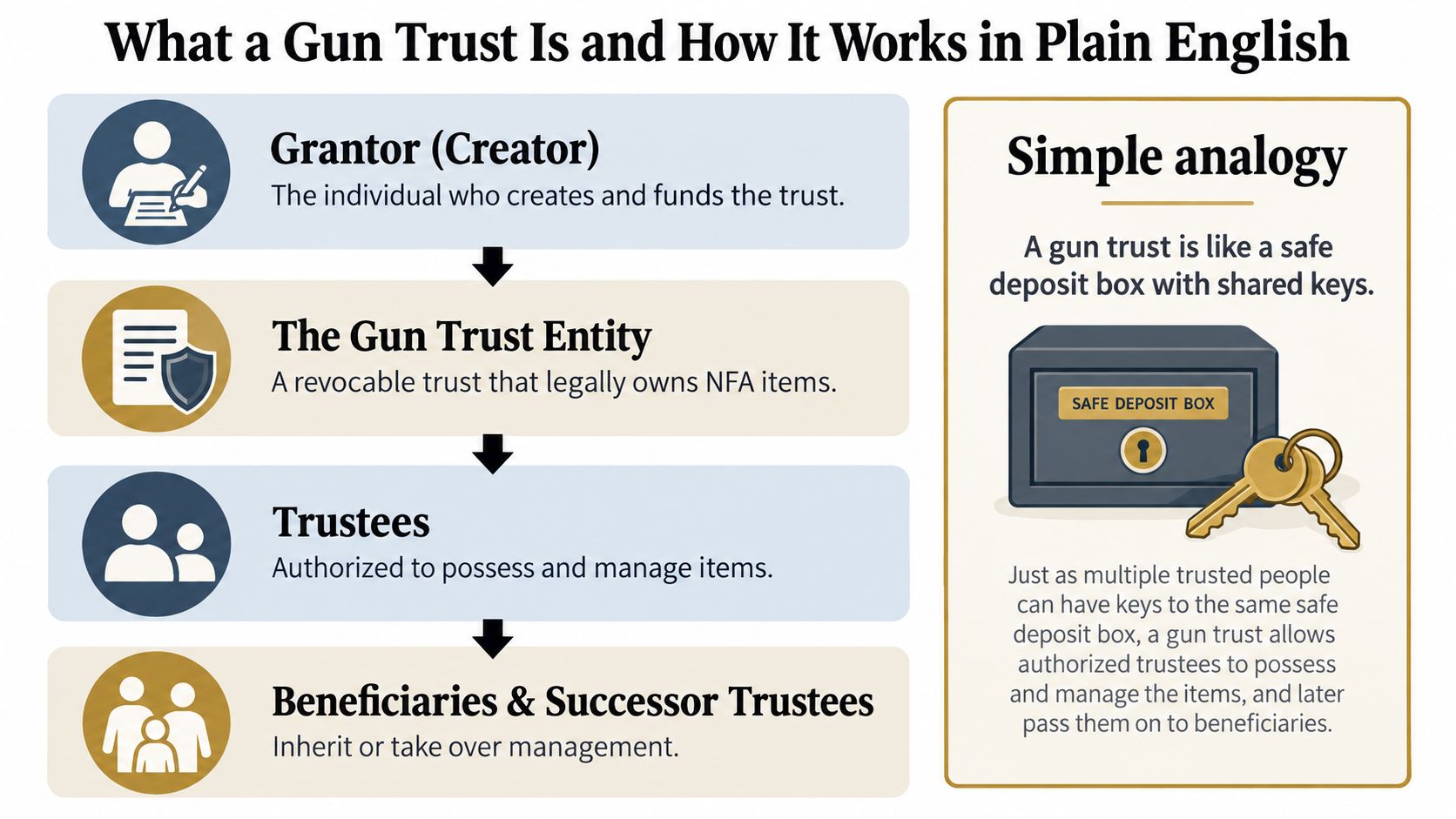
Think of a gun trust as a family safe with written access rules. The trust, rather than an individual alone, becomes the legal owner of the NFA firearm. The trust document identifies who can act for the trust, how someone may be added or removed, and who should manage the property if the original creator can't continue.
The person who creates the trust is commonly called the settlor or grantor. That person establishes the terms and transfers property into the trust. The trustees manage the trust and may possess or handle trust property within the limits of federal law and the trust document. The beneficiaries are the people who may ultimately receive the trust property.
The roles should be selected deliberately
A settlor might name a spouse as a co-trustee and an adult child as a successor trustee. That arrangement can support continuity, but only if each person understands the responsibility. A trustee isn't just a name on a page. Under federal ATF practice, each trustee or other responsible person can be subject to a background check when the trust applies for a new NFA registration, as explained by this Texas gun trust estate-planning resource.
The trust can also help a family distinguish between someone who may eventually inherit an item and someone who currently has authority to manage it. Those roles aren't always identical. A beneficiary may have a future interest without being authorized to possess the firearm during the settlor's lifetime.
Why revocability matters
A revocable trust can generally be amended while the settlor has the legal ability to make changes. That flexibility may help when a trustee moves away, becomes unsuitable, dies, or no longer wants the responsibility. The document should explain how amendments and trustee appointments occur, rather than leaving family members to guess.
The trust is the ownership and succession framework. The ATF application remains the federal compliance process.
A gun trust doesn't make an NFA item exempt from federal regulation. It also doesn't turn a private family handoff into a lawful transfer. Its value comes from coordinating legal ownership, authorized management, and succession in one written structure.
Federal NFA Rules and Texas Law for Atascocita Owners
The federal and Texas parts of a gun trust serve different purposes. Federal law controls the NFA firearm, the making or transfer application, responsible-person submissions, and applicable tax treatment. Texas law governs the private trust document, its validity, trustee powers, amendments, and succession provisions.
For most NFA transfers, the applicant uses ATF Form 4 and pays a $200 transfer tax. Making an NFA firearm requires ATF Form 1 approval. Individual Form 4 applicants also face federal requirements involving fingerprints, photographs, and a Chief Law Enforcement Officer signature, which helped make trusts a common estate-planning structure for regulated firearms. These rules are summarized in this Texas gun trust explanation.
Federal and Texas requirements side by side
| Requirement Area | Federal ATF Rule | Texas Treatment |
|---|---|---|
| NFA transfer | Most transfers use ATF Form 4 and the applicable transfer tax | Texas does not replace the federal transfer process with a private handoff |
| Making an NFA firearm | Making or manufacturing requires ATF Form 1 approval | The trust must still be valid under its governing documents |
| Responsible persons | Each responsible person tied to the trust files ATF Form 23, also called the Responsible Person Questionnaire, with the trust's Form 1 or Form 4 submission | Trustee appointments and removals should follow the trust's written amendment and governance provisions |
| Trust copy | ATF requires a complete copy of the trust and related supporting documents with an application | The trust is generally a private estate-planning document, not a public state or county filing |
| Trust validity | The ATF reviews the trust submitted with the application | The trust should remain legally valid for the entire time it holds NFA firearms |
Rule 41F changed trust administration
Since ATF Rule 41F took effect in 2016, every time a gun trust submits Form 1 or Form 4, each responsible person tied to the trust must also submit ATF Form 23, fingerprints, and photographs. The change made trust ownership more administratively complex, but it also standardized the compliance process nationwide. The federal requirements and the rule's effect on responsible persons are discussed in this Texas gun trust member resource.
Texas residents generally don't file the gun trust with Texas or Harris County. But the absence of county recording doesn't make the document informal. When the trust applies to the ATF, the agency requires the complete trust, amendments, and current co-trustee appointment documents. Internal governance matters because the ATF needs to understand who has authority under the trust.
A trust that becomes invalid after incapacity or death can create a serious possession and transfer problem. Successor-trustee language, amendment procedures, and continuity provisions should be reviewed before the trust acquires regulated property.
How to Create and Fund Your Gun Trust in Atascocita
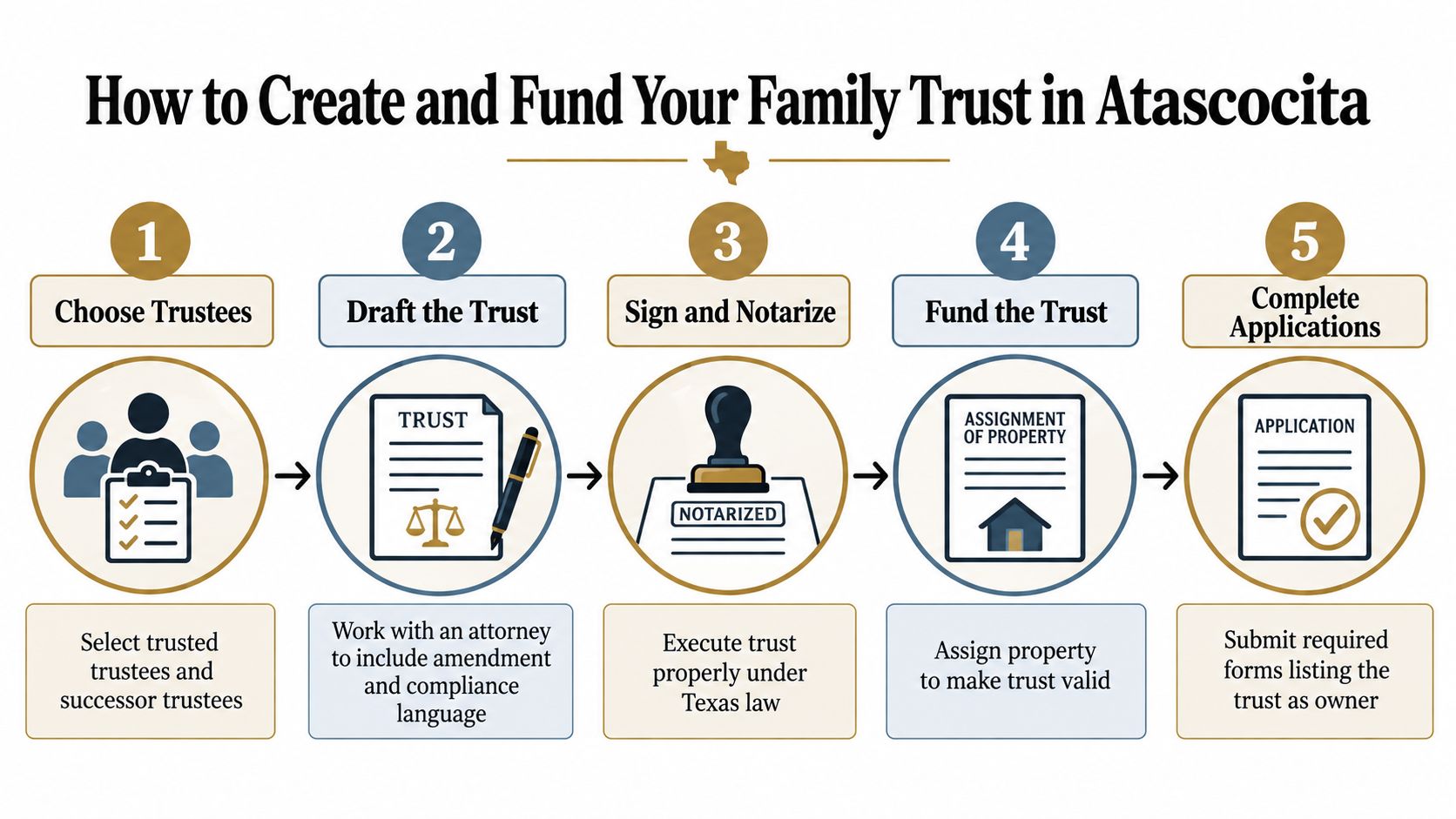
Creating a gun trust is easier to manage when the family treats it as a sequence of decisions rather than a single form. The settlor must decide who will manage the property, how the trust will be changed, how it will be funded, and how the family will respond to death or incapacity.
Start with people, not firearms
First, identify the settlor, current trustees, co-trustees, beneficiaries, and successor trustees. A spouse may be a logical co-trustee, but the family should consider whether that person understands the responsibilities and can comply with federal requirements. An adult child might be named as a successor without becoming a current trustee.
Trustee selection deserves careful attention because every responsible person can trigger additional federal paperwork and a background check when the trust applies for a new NFA registration. Families comparing general trust-planning principles may find it useful to select a trustee carefully before finalizing the document.
Build the document around continuity
The trust should identify trustee powers, possession rules, successor appointments, incapacity procedures, amendment methods, and lawful-use restrictions. It should also explain how co-trustees are appointed and how someone leaves the role. This detail matters if a trustee moves from Atascocita, becomes incapacitated, or can no longer serve.
The trust should be signed and notarized as required for a valid Texas trust arrangement. Attorney review can help ensure that the document's language works with the family's broader wills, powers of attorney, and estate plan. Residents can review general trust-creation information through this Atascocita trust-planning resource.
Fund the trust and prepare the ATF submission
A trust needs property to carry out its purpose. The family should follow the assignment and funding instructions for the trust, keep the executed document with all amendments, and maintain current trustee appointment records. For an NFA acquisition, the trust is listed as the owner in the federal application process.
Depending on the transaction, the submission may include:
- Form 1 or Form 4: Use the federal form that matches making or transferring the NFA item.
- Trust documents: Provide the complete trust, amendments, and current co-trustee appointment records.
- Responsible-person materials: Each responsible person may need fingerprints, photographs, and Form 5320.23.
- Tax information: Apply the federal tax rules associated with the specific NFA item and transaction.
For inheritance, already-registered NFA items may qualify for transfer by ATF Form 5 when the transfer occurs by operation of law, which can avoid the transfer tax in qualifying cases. The legal details and filing distinction are addressed in this Texas NFA gun trust guidance.
The following video can provide general visual context for trust administration, but it doesn't replace legal advice about a specific firearm or family:
Costs Timeline and Key Clauses to Include
Families often focus first on the cost of drafting a trust, but the larger issue is whether the document will continue to function as family circumstances change. Complexity can depend on the number of trustees, the number and type of NFA items, the required federal filings, and the extent of coordination with the rest of the estate plan.
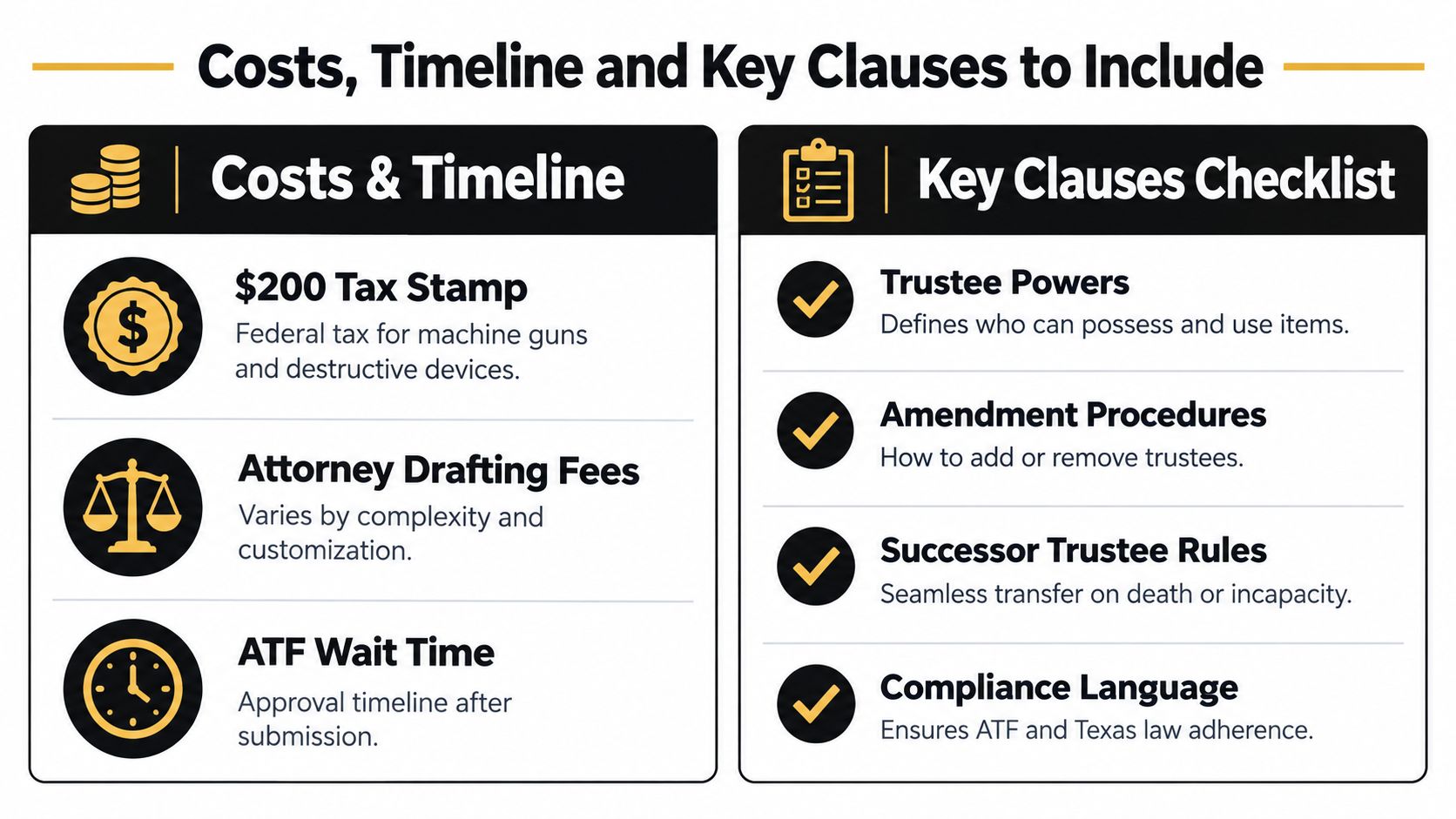
The federal tax structure also depends on the item. The current framework includes a $200 tax for machine guns or destructive devices, while other NFA firearms may fall into a $0 tax stamp category, as explained in this NFA trust template resource. The transaction type and item classification should be confirmed before filing.
What drives the practical workload
Adding responsible persons can increase the number of fingerprints, photographs, and Form 5320.23 submissions. Each trustee's status therefore affects the administrative burden. Trustee selection also matters because responsible persons are subject to background checks when the trust applies for a new NFA registration.
Approval timing depends on the ATF submission, the application type, the item, the responsible-person materials, and whether the trust documents are complete and consistent. A missing amendment or unclear appointment record can create avoidable questions.
For broader planning, families can review the cost of an estate planning lawyer in Atascocita while separating attorney drafting charges from federal taxes and other transaction expenses.
Clauses worth reviewing before signing
Use this checklist when evaluating a draft:
- Trustee powers: The document should explain who may manage, possess, store, and transfer trust property within applicable law.
- Successor trustee rules: The trust should identify who takes over after death, resignation, or incapacity.
- Incapacity provisions: The document should provide a practical method for determining when a trustee can no longer serve.
- Amendment procedures: The trust should explain how trustees and other terms may be changed.
- Compliance language: The document should direct trustees to follow federal NFA requirements and applicable Texas law.
- Record maintenance: The family should know where to keep the signed trust, amendments, appointments, and ATF approvals.
A good trust doesn't promise a simpler federal process. It creates a reliable system for following that process over time.
Common Pitfalls and How Atascocita Owners Avoid Them
A common assumption is that naming someone in a trust automatically gives that person immediate authority to possess an NFA firearm. It doesn't. The person's role, the trust's language, and federal responsible-person requirements all matter.
Consider a Humble couple who names an adult child as successor trustee but never explains when that person may take over. If one parent becomes incapacitated, the family may be left with uncertainty about authority and documentation. Clear successor and incapacity provisions can reduce that confusion.
Informal changes create formal problems
Families sometimes add a co-trustee through an informal letter, email, or conversation. That may not satisfy the trust's amendment requirements, and the ATF may require current appointment documents when reviewing an application. Trustee changes should follow the written trust procedure and be documented carefully.
Another mistake is treating an NFA firearm like ordinary personal property. A private handoff between relatives doesn't replace the applicable federal transfer process. The family should identify the correct federal form before anyone takes possession as an owner or transferee.
A trust can fail through neglect
A trust may begin as a valid document but become difficult to use when the settlor dies, a trustee becomes incapacitated, or amendments are misplaced. The trust should remain legally valid for the entire time it holds NFA firearms. Families should keep the original trust, amendments, trustee appointments, and ATF records together and review them after major life changes.
Each responsible person can also face a background check when the trust applies for a new NFA registration. That makes trustee selection a compliance decision, not a courtesy appointment. Before filing, an attorney can review whether the proposed trustees, trust language, and supporting records align.
Practical rule: Don't add, remove, or replace a trustee casually. Follow the document, preserve the records, and confirm the federal consequences before making the change.
Protect Your Family and Firearms With Local Guidance
A properly drafted and maintained gun trust can give an Atascocita or Humble family a clearer way to manage NFA firearms during life and after death. It can identify current trustees, establish succession, organize amendments, and connect the family's private estate plan to the federal application process.
The work has several parts. You'll need to understand whether the transaction calls for Form 1, Form 4, or a qualifying Form 5 inheritance transfer. You'll need to select trustees carefully, keep the trust valid, preserve current documents, and account for the responsible-person requirements that apply to new registrations.
This planning also belongs beside your broader estate plan. Wills, powers of attorney, ordinary personal property, and regulated firearms should not operate as disconnected documents. A local estate planning attorney near Atascocita can help your family evaluate how these pieces fit together, while also identifying questions that may require separate family, criminal, or civil legal advice.
If you're in Atascocita, Humble, or northeast Harris County and you're unsure whether an existing trust is complete, don't wait for a death, incapacity, or proposed transfer to expose the problem. Gather your trust, amendments, trustee records, and ATF paperwork, then schedule a consultation to discuss the next legally appropriate step.
The Law Office of Bryan Fagan – Atascocita TX Lawyers offers estate planning guidance involving wills, trusts, and family succession planning, including help organizing questions about NFA ownership and trustee responsibilities. Visit Law Office of Bryan Fagan – Atascocita TX Lawyers to request a free consultation at the Atascocita office and discuss a plan for protecting your family and managing regulated firearms responsibly.