Skip to content
When I talk to families here in Atascocita and Humble, I often hear them say that trusts sound complicated or like something only for the super-rich. Let me tell you, that’s one of the biggest myths in estate planning. Setting up a trust is actually one of the most effective and practical ways for residents of Atascocita, Humble, and northeast Harris County to protect what you’ve worked for, take care of your children, and make sure your wishes are followed—all without the headaches and public nature of probate court.
Think of it as creating a private rulebook for your property, managed by someone you hand-pick. It's a supportive legal tool that we can help you put in place.
How a Texas Trust Secures Your Family’s Future
At its core, a trust is a legal agreement where you place your property to be managed for your loved ones. Picture a secure box where you put your most important assets—your house in Atascocita, your savings, your investments. You then name a person you trust to manage that box and distribute the assets according to the rules you wrote. It's a straightforward concept that gives families in our community incredible peace of mind and control over their legacy.

One of the single biggest benefits? A trust lets your estate skip the probate process in Harris County, which can be a long, drawn-out, and very public affair. Since the trust—not you personally—owns the assets, they don't get tangled up in court when you're gone. This privacy and efficiency are why so many local Atascocita families are making this a cornerstone of their planning. We go into more detail on this in our guide on how to avoid probate in Texas.
The Key Players in Your Trust
Before we can build a trust, it's important to know who the main characters are. Under Texas law, a trust relies on three distinct roles to make sure everything works as it should. Understanding these roles is the first step in creating a clear, effective plan for your family.
Here are the three essential people involved:
- The Grantor: This is you. You're the one creating the trust and putting your assets into it. You make all the rules.
- The Trustee: This is the manager you appoint to handle the trust's assets. While you're alive and capable, you can (and usually do) act as your own trustee, keeping total control. You’ll also name a successor trustee to step in when you no longer can.
- The Beneficiaries: These are the people or even charities who will ultimately benefit from the assets in the trust. Most often, this is your spouse, your children, or other relatives you wish to support.
When you clearly define these three roles, you’re laying a rock-solid foundation for your estate plan. It ensures your instructions are carried out to the letter and your family is cared for exactly the way you want them to be.
This structure is what allows for a smooth transition of your legacy, giving your loved ones stability and one less thing to worry about during a tough time. Here at The Law Office of Bryan Fagan in Atascocita, we guide local residents through these decisions every day. If you're ready to see how a trust can protect your family, we’re here to help.
Choosing the Right Trust for Your Family's Needs
Once you've decided to create a trust, the next big question is: which one? It's easy to get lost in the legal jargon, but for most families here in the Atascocita and Humble area, the choice usually boils down to a few core options based on their specific goals.
This isn't just a legal decision—it’s a personal one, driven by what you want to achieve. Are you looking for maximum flexibility to adapt to life's changes? Is your top priority protecting your hard-earned assets from potential lawsuits? Or do you need a specialized plan to care for a loved one with unique needs? Your answers will point us to the right type of trust for your family.
The Revocable Living Trust: The Go-To for Most Families
For the vast majority of people, the Revocable Living Trust is the workhorse of Texas estate planning. I like to think of it as a flexible container you create for your assets. While you're alive and well, you're in complete control. You can change it, add property, remove property, or even scrap the whole thing if you want.
Imagine a couple in Atascocita who puts their house in Eagle Springs and their investment portfolio into a revocable trust. They can name themselves as the trustees, so nothing changes in their day-to-day management of those assets. The real benefit comes later. When they pass away, everything in the trust can be passed to their children directly, completely bypassing the public, time-consuming, and often expensive Harris County probate courts.
It's the most popular choice for a reason. You can find out more by reading our articles on living trusts in Texas. It gives you control now and simplicity for your family later.
The Irrevocable Trust: When You Need a Fortress of Protection
On the other side of the spectrum is the Irrevocable Trust. The name says it all—once you put assets into this trust, you generally can't take them back or change the terms. You're formally giving up control and ownership.
So, why would anyone do that? Because of the powerful protection it offers. For a small business owner in Humble, moving key business assets into an irrevocable trust can shield them from future creditors or lawsuits. For families with significant assets, it can also be a crucial tool for minimizing or even eliminating estate taxes.
An Irrevocable Trust is a permanent move, but its permanence is precisely what gives it strength. It's a powerful tool for asset protection and advanced estate planning goals.
This isn't a decision to be made lightly. You're trading flexibility for a much higher level of protection, so it's essential to be certain about your goals before heading down this path.
A Quick Comparison
To help you see the differences at a glance, here’s a straightforward comparison of the two main types of trusts we work with for local families in the Atascocita area.
Revocable vs Irrevocable Trusts Key Differences for Texas Residents
| Feature | Revocable Living Trust | Irrevocable Trust |
|---|---|---|
| Flexibility | High. You can amend, change beneficiaries, or dissolve it at any time. | Low. Generally cannot be changed or revoked once created. |
| Control | You retain full control over the assets as the grantor and typically as the trustee. | You give up control and ownership of the assets to the trust. |
| Probate Avoidance | Yes. Assets in the trust bypass the probate process. | Yes. Assets in the trust bypass the probate process. |
| Asset Protection | Limited. Assets are still considered yours and are vulnerable to creditors. | High. Assets are shielded from your future creditors and lawsuits. |
| Estate Tax Reduction | No. Assets are still included in your taxable estate. | Yes. Assets are removed from your estate, potentially reducing estate tax liability. |
| Best For | Most families seeking to avoid probate and manage assets for their heirs. | Individuals seeking asset protection, tax planning, or to qualify for benefits. |
Understanding these distinctions is the first step in making an informed choice for your family’s future.
Specialized Trusts for Unique Family Situations
Life isn't one-size-fits-all, and neither are trusts. Sometimes a family has very specific needs that require a custom-built solution.
-
Special Needs Trusts: Let's say you have a child who relies on government benefits like Medicaid or SSI. A direct inheritance could actually do more harm than good by disqualifying them from these vital programs. A Special Needs Trust creates a fund to pay for quality-of-life expenses—things like therapy, education, or travel—without ever putting their benefits at risk. This is a compassionate way to provide for them.
-
Qualified Terminable Interest Property (QTIP) Trusts: These are incredibly helpful for blended families, which are common in our Atascocita communities. A QTIP trust can provide for your current spouse for the rest of their life, while legally ensuring that whatever is left over goes to your children from a previous marriage. It’s a thoughtful way to take care of everyone you love.
There's a reason trusts are becoming so common. Surveys show that more than 30% of Americans over 65 now have a trust, and that number jumps to 45% for households with over $1 million in assets. People are realizing they are the best way to avoid probate and protect their legacy.
Picking the right trust structure is the single most important part of this process. It all comes down to your family, your finances, and your vision for the future. We're here to listen to your story and help you find the perfect fit.
How to Actually Set Up Your Trust in Texas
Alright, you understand why a trust is a powerful tool. Now, let's walk through the how. Moving from theory to action is where your estate plan truly comes to life. Creating a trust isn't a single event; it's a step-by-step process of deliberate decisions. For our clients here in the Atascocita and Humble areas, we always break it down into manageable steps that turn your intentions into a solid legal document that stands up for your family.
This is about more than just paperwork. It’s about organizing your life, making some deeply personal choices, and ultimately creating a plan that lets you sleep better at night. Let's walk through what it really takes.
This chart gives you a bird's-eye view of the journey, from your initial goals to sitting down with an attorney to make it official.
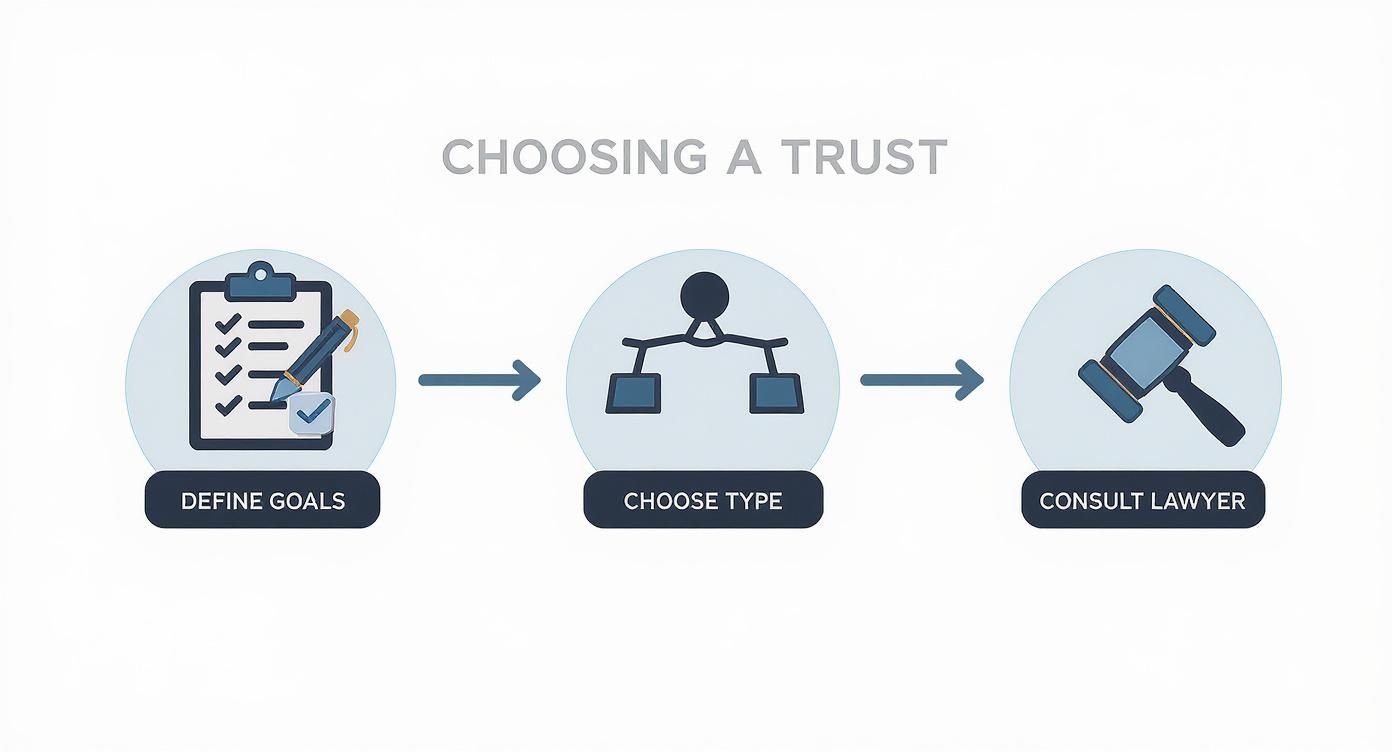
As you can see, it's a logical flow. Everything starts with what you want to achieve and ends with getting professional legal help to lock in your wishes.
First, Get Your Ducks in a Row: Gathering Your Information
Before a single legal document is drafted, we need a clear picture of everything you own. Think of it as creating a financial snapshot of your life. This simple step is critical because it ensures nothing gets left out of your trust by accident. Any asset not in the trust could get stuck in probate court—the exact headache we're trying to avoid.
Start by pulling together these key documents:
- Real Estate Deeds: For any property you own, whether it’s your main home in Atascocita, a rental in Humble, or a piece of land anywhere in Harris County.
- Account Statements: This means everything—checking and savings accounts, investment portfolios, retirement funds like 401(k)s and IRAs, and life insurance policies.
- Vehicle Titles: For your cars, boat, or any other vehicle with a title.
- Business Documents: If you're a local business owner, grab your partnership agreements, LLC operating agreements, or articles of incorporation.
Having this information ready from the start makes the whole process smoother and gives both you and your attorney a complete view of your estate.
The Heart of the Matter: Making Key Decisions
With your assets inventoried, it's time for the personal decisions that give your trust its purpose. These choices are all about who you trust to carry out your wishes and what kind of future you want for your loved ones.
Choosing Your Trustee (and Successor Trustee)
This is, without a doubt, the most important decision you'll make in this process. The trustee is the person or entity responsible for managing the trust's assets. For a revocable living trust, you'll almost certainly be your own trustee while you're alive, which means you keep full control of your assets.
The real question is: who will be your successor trustee? This is the person who takes over when you pass away or if you become unable to manage your own affairs. This person must be:
- Completely Trustworthy: Someone with unshakeable integrity.
- Organized and Diligent: They'll be handling important paperwork, deadlines, and distributions.
- Financially Responsible: They don't need to be a Wall Street wizard, but they must be sensible with money.
- Fair and Impartial: This is especially vital if they are also a beneficiary. They have to follow your rules and treat everyone fairly.
Choosing a successor trustee is an act of profound trust. It’s essential to select someone who you are confident will honor your wishes and act in the best interests of your beneficiaries, no matter what.
While trust in large institutions has seen a decline, personal trust in professional advisors remains strong. Recent data highlights that 76% of adults in the U.S. trust their personal financial and legal advisors to help them manage trusts and estates responsibly. You can read more about the research on advisor trust from the 2025 Edelman Trust Barometer.
Naming Beneficiaries and Setting the Rules
Next, you need to be crystal clear about who gets what, when, and under what conditions. Your beneficiaries are the people or organizations who will receive the assets from your trust. You can be as general or as specific as you want.
For instance, you might decide:
- Your children receive their inheritance in stages—maybe one-third at age 25, one-third at 30, and the rest at 35. This can protect them from making mistakes with a large sum of money when they're young.
- A specific amount is set aside in the trust to pay for a grandchild's college education.
- Your home in Atascocita goes to one particular child, or you might instruct the trustee to sell it and divide the proceeds equally among all your children.
These instructions are the engine of your trust. The clearer you are, the less chance there is for confusion or family arguments down the road.
Bringing It All Together: Drafting the Trust Document with an Attorney
Once you’ve gathered your information and made these crucial decisions, the final step is to have the formal trust document drafted. We know it's tempting to use an online template, but that's a risky shortcut. Texas law has specific requirements, and a generic form from the internet can't possibly account for your unique family situation or the intricacies of Harris County property law.
Working with a local Atascocita attorney ensures your trust is a legally sound plan that does exactly what you want it to do. We can help you think through complex scenarios, offer practical advice on choosing a trustee, and write clear, unambiguous language designed to prevent problems later.
This is the step that protects your legacy and, more importantly, protects your family. To talk about creating a trust that’s built for your life, schedule a free consultation with our Atascocita office today.
Funding Your Trust to Make It Legally Powerful
You've done the hard work: made the big decisions, chosen your trustee, and had an attorney draft a trust document that perfectly captures your wishes. It's a huge milestone, but there's one final, critical step that many people surprisingly overlook—the one that actually turns your document from a piece of paper into a powerful legal tool.
This step is called funding the trust.
Think of your new trust as an empty, secure box. It's built and ready, but it can't protect anything until you actually put your assets inside. Funding is simply the process of transferring the ownership of your property from your individual name into the name of the trust. If you skip this, your trust is effectively empty, and your assets will almost certainly end up in Harris County probate court. That's the very outcome you worked so hard to avoid.

This process isn't automatic; it requires deliberate, careful action to retitle each and every asset. Getting this part right is what makes your entire estate plan work for your family when they need it most.
Moving Your Real Estate into the Trust
For most families in the Atascocita and Humble areas, their home is their single biggest asset. Making sure it’s properly transferred into your trust should be at the top of your list. The way we do this is by preparing and filing a new deed with the Harris County Clerk's Office.
This new deed changes the legal owner from, say, "John and Jane Doe," to something like, "John Doe and Jane Doe, Trustees of the Doe Family Revocable Trust dated January 1, 2025." This simple legal change is what allows your successor trustee to manage or distribute the property according to your instructions, completely bypassing the court system.
Transferring Financial Accounts and Investments
Your bank accounts, investment portfolios, and other liquid assets also need to be formally moved into the trust. The exact process can vary a bit from one bank to another, but it generally follows a few key steps.
- Bank Accounts: For your checking and savings, you'll work directly with your bank to change the account's title into the trust's name. They'll likely ask to see a copy of your trust document or a shorter document called a certificate of trust.
- Investment Accounts: Non-retirement brokerage accounts are handled in much the same way. Your financial advisor or brokerage firm will have you complete their specific paperwork to transfer ownership to the trust.
- Retirement Accounts (401(k)s, IRAs): Now, these are a special case. You do not retitle your IRAs or 401(k)s into the trust's name. Doing so would be treated as a full withdrawal, triggering a massive and unnecessary tax bill. Instead, you update the beneficiary designation on these accounts, naming the trust as the primary or contingent beneficiary. This way, the funds flow into the trust after you're gone and are managed by its rules.
Properly funding a trust is the final, essential act of creating your estate plan. Skipping this step or doing it incorrectly can undo all your careful planning, leaving your family to navigate the complexities and costs of probate.
Updating Beneficiary Designations
It's a common misconception that a will or trust controls everything. In reality, many assets pass to heirs based on a simple beneficiary designation form. It is absolutely vital to review every one of these and make sure they align with your new estate plan.
For instance, your life insurance policy is a contract. The insurance company is legally bound to pay the death benefit to whomever you named on that form, no matter what your trust says. To ensure the proceeds are managed by your trustee—which is especially important if you have minor children—you must change the beneficiary of the policy to your trust. This prevents a court from having to appoint a guardian to manage a large lump sum of money for your kids.
The same exact principle applies to:
- Annuities
- Payable-on-death (POD) bank accounts
- Transfer-on-death (TOD) investment accounts
Each of these must be reviewed to ensure the designations work with your trust, not against it. Overlooking this detail is one of the most common and costly mistakes we see in our practice. It’s a simple update that can prevent immense confusion and family conflict down the road, and it’s a perfect example of why professional guidance is so valuable—we help you see the complete picture.
Common Mistakes to Avoid When Creating Your Trust
Setting up a trust is a powerful way to look out for your family. From our experience helping families all over Harris County, we’ve seen the peace of mind a solid plan can bring. But we've also witnessed the heartache—and the expense—that comes from a few common, completely avoidable mistakes.
Taking a moment to understand these pitfalls now can save your loved ones a world of trouble later. Let's walk through some of the most frequent issues we see and talk about how you can sidestep them, protecting both your family and your legacy.
Selecting the Wrong Trustee
This is, without a doubt, one of the most critical decisions you'll make, and it's where many people stumble. It's so tempting to simply name your oldest child or a close friend, almost out of a sense of duty. But while their heart might be in the right place, are they really cut out for the job?
A trustee has to be organized, financially responsible, and able to make tough, impartial decisions, especially when family emotions are running high.
We recently worked with an Atascocita family where the father had named his brother as the successor trustee. The brother was a great guy, but he had a long history of making poor financial choices. After the father passed away, the brother mismanaged the trust funds, leading to a huge loss of assets and creating a painful rift between him and his own nieces and nephews—the very people the trust was meant to protect.
A trustee has a fiduciary duty under Texas law to act solely in the best interests of the beneficiaries. You need to choose someone for their reliability and sound judgment, not just their relationship to you.
When you're making this choice, ask yourself:
- Are they good with money? How do they manage their own finances?
- Can they be impartial? Will they be able to follow your instructions to the letter, even if other family members pressure them?
- Do they have the time and willingness? This is a huge responsibility, not a small favor.
In some cases, especially with complex estates or difficult family dynamics, bringing in a professional trustee, like a bank's trust department, is the smartest move.
Writing Vague or Unclear Instructions
Think of your trust document as your instruction manual for the future. If that manual is vague, you're not planning for peace—you're accidentally creating a recipe for conflict.
Ambiguous language like "distribute the assets as my children see fit" is a classic example. It sounds nice, but it can be interpreted in a dozen different ways, sparking disputes that strain family bonds and rack up legal fees.
For instance, a client from Humble wanted his trust to pay for his grandchildren’s "college education." But what did that actually mean? Was it just tuition for a state school? Did it include room, board, and books at a private university? Did "college" also cover trade schools or a master's degree? This lack of clarity forced his children into a difficult position, trying to guess what he would have wanted.
Be specific. Define your terms. If you want assets handed out at certain ages or after hitting specific life milestones (like graduating from college), spell it out clearly. The more precise you are, the easier you make it for your trustee to simply honor your wishes.
Relying on Generic Online Templates
In an effort to save a few bucks, it’s easy to fall for the promise of one-size-fits-all online trust templates. This is one of the riskiest shortcuts you can possibly take.
These generic documents aren't designed to comply with specific Texas laws. More importantly, they can't possibly account for your unique family situation, your specific assets, or what you're actually trying to accomplish.
We once consulted with a family whose father used a cheap online service. The document completely failed to include the necessary language to create a Special Needs Trust for his disabled son. That oversight put his son's essential government benefits at risk. Fixing it after the fact was far more expensive and stressful than just doing it right the first time.
Your family isn't generic, so your estate plan shouldn't be, either. Working with an experienced local attorney ensures your trust is a solid, personalized document that holds up in Texas and truly protects the people you care about.
If you're ready to create a trust the right way and avoid these common mistakes, we're here to help. Schedule a free, no-obligation consultation at our Atascocita office and let's talk about your family's future.
Your Questions About Texas Trusts Answered
As you start thinking about creating a trust, it's completely normal for a lot of questions to bubble up. Here in our Atascocita office, we talk with families from all over northeast Harris County who often have the same concerns. Let's walk through some of the most common questions we hear every day.
How Much Does It Cost to Set Up a Trust in the Atascocita Area?
The honest answer is: it depends. The investment really hinges on your family’s specific circumstances and how complex your assets are.
It can be tempting to go with a cheap online form, but I've seen firsthand how those one-size-fits-all documents can turn into expensive legal headaches later. They simply aren't tailored to Texas law or your unique family dynamics.
When you work with a local attorney, you're getting a trust that's built just for you—one that's legally solid and will actually work the way you want it to. We always start with a free consultation to hear about your goals and give you a clear, upfront understanding of the costs involved in truly protecting your family.
Can I Be the Trustee of My Own Revocable Living Trust?
Yes, you absolutely can. In fact, it's the standard way we do things here in Texas. The person creating the trust (we call them the grantor) almost always serves as the first trustee. This setup means you keep full, uninterrupted control over your property, just like you do now.
You'll also name a "successor trustee." This is a person or financial institution you trust to step in and manage the trust if you become incapacitated or when you pass away. This ensures a smooth transition of control without ever having to step foot in a courtroom.
The real beauty of a revocable trust is that you give up zero control. As your own trustee, you can buy, sell, and manage your assets just as you always have. The only difference is now you have a powerful plan in place for the future.
Do I Still Need a Will If I Have a Trust?
Yes, a will is still an essential piece of the puzzle, even with a rock-solid trust in place. Think of it as a safety net. We typically draft a specific type of will, called a "pour-over will," to work alongside your trust.
Its entire job is to "catch" any assets you might have forgotten to move into the trust or that you acquired right before you passed away. The will then simply "pours" those assets into your trust. This makes sure every last thing is distributed according to your plan by the trustee you picked.
How Does a Trust Help My Family Avoid Probate in Harris County?
Probate is the official court process for settling an estate. Anything titled in your individual name when you die has to go through it. But here's the key: assets inside your trust aren't legally owned by you anymore—they're owned by the trust.
Because of that simple fact, they bypass the probate court entirely. You can learn more about why that's such a huge relief for families in our guide on how long probate takes in Texas.
When you pass away, your successor trustee can step in and distribute the assets privately and efficiently, all according to your written instructions. This saves your loved ones a tremendous amount of time, money, and the stress of dealing with a public court proceeding.
Creating a trust is one of the most powerful and considerate things you can do for your family and your legacy. At the Law Office of Bryan Fagan – Atascocita TX Lawyers, we're committed to helping our neighbors in Atascocita and Humble build estate plans that deliver real security and peace of mind. To talk about your own situation, schedule a free, no-obligation consultation with us today.