Skip to content
A grandmother in Atascocita drops her grandchild off at school, helps with homework, keeps extra clothes at her house, and spends most weekends together. Then a family conflict erupts. Phone calls stop. Visits end. She's left staring at old photos, wondering whether Texas law gives her any way to protect that bond.
If that sounds close to home, you're not overreacting. Losing contact with a grandchild can feel like a sudden grief, especially when you've been part of the child's daily rhythm in Atascocita, Humble, or nearby northeast Harris County. Many grandparents walk into an attorney's office believing love should be enough. In Texas, the law asks for much more.
A grandparents rights attorney in Atascocita TX can help you sort out a hard truth early. Some family conflicts call for patience, negotiation, or mediation. Others require fast legal action, especially when a child has been living with you, a parent is unavailable, or there are concerns about safety and stability. The legal path depends on facts, documents, timing, and the kind of case you're allowed to file.
Families in this area often face more than one legal issue at once. A grandparents' rights matter can overlap with divorce, child custody, CPS concerns, estate planning for long-term guardianship, or even criminal charges involving a parent. Texas family, criminal, and civil law can intersect quickly, and a clear plan matters.
A Grandparent's Guide to Navigating a Difficult Time
Margaret from the Humble area had a routine that felt permanent. She picked up her grandson after school, made him a snack, and sat with him while he worked through spelling words. When his parents separated, that routine disappeared almost overnight. No one gave her a clear explanation. She just stopped hearing from them.
That kind of break leaves grandparents confused because it doesn't feel like a legal problem at first. It feels personal. Then the questions come fast. Can I file for visitation? Can I ask for custody? Do I have any rights at all if I'm the grandparent?

Many people in Atascocita assume the court will automatically value a close grandparent relationship. Judges do care about family bonds. But courts don't start with the idea that grandparents are entitled to time. Courts start with parental rights, and that surprises many families.
A strong emotional bond matters. It just isn't the only thing a Texas court needs.
That's why this process can feel so harsh. You may have done school pickups, paid for groceries, covered childcare, or offered your home during a family crisis. Even then, Texas law may still require you to clear strict legal hurdles before a judge can even hear your request.
When local families feel stuck
In Atascocita and Humble, grandparents often serve as the steady adults when a parent is dealing with divorce, addiction concerns, incarceration, illness, or financial instability. They're often the ones holding the family together while everyone else is in crisis.
If you're in that position, your next step isn't guessing. It's getting a realistic legal assessment. That means identifying whether you have a family law claim, whether emergency facts are involved, and whether related issues like CPS, a pending divorce, a criminal case, or estate planning for the child's future need attention at the same time.
First You Need Standing to Enter the Courtroom
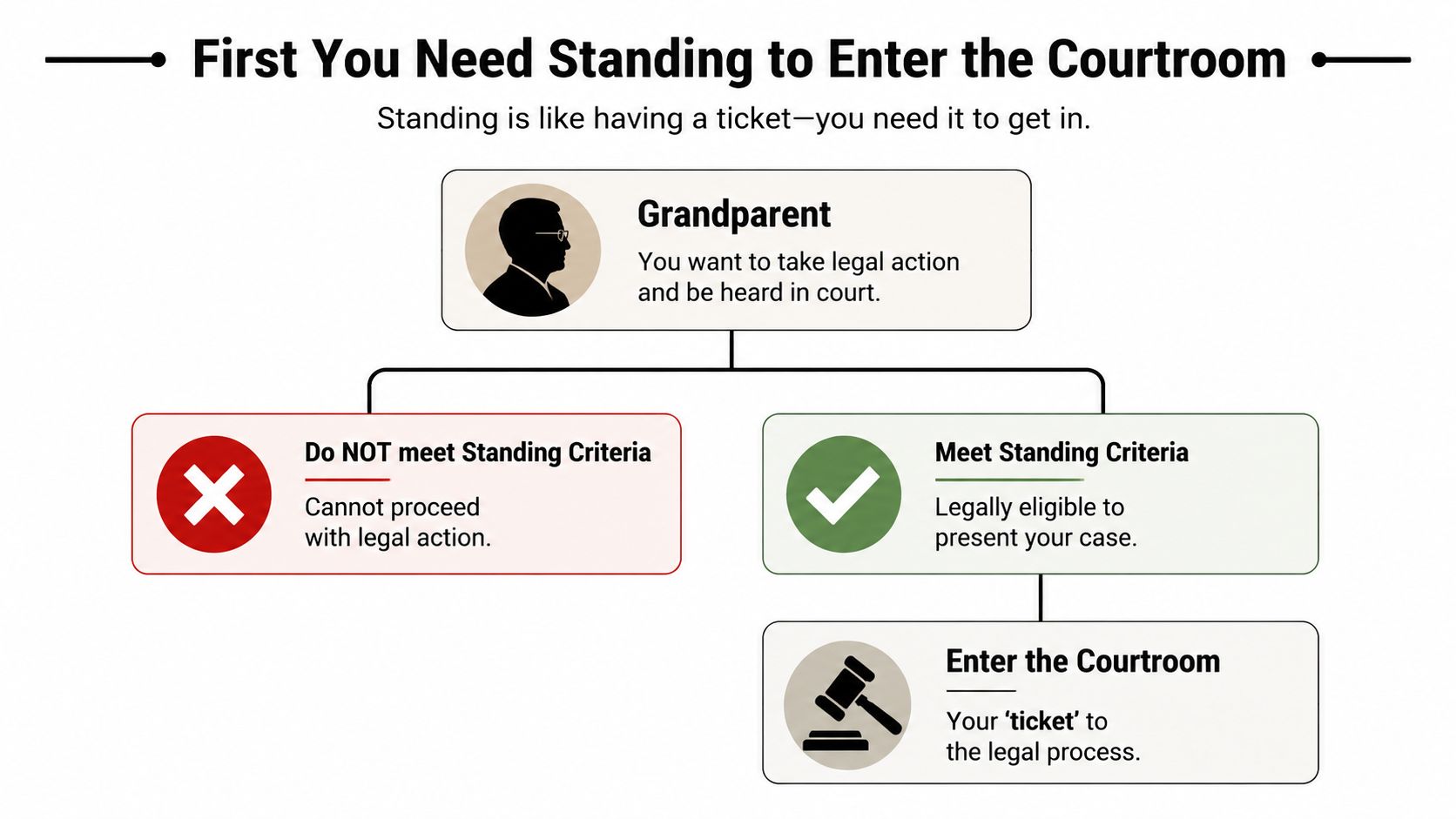
The first question isn't whether seeing your grandchild would be good for the child. The first question is whether Texas law lets you file anything at all. That legal right is called standing.
Think of standing like a ticket to enter a show. If you don't have the ticket, you don't get through the door. The court won't reach the larger story about your relationship, your sacrifices, or your concerns unless you first show that the law gives you permission to bring the case.
What Texas requires before you can file
Texas law does not give grandparents automatic standing for an original custody suit. Under Texas Family Code § 153.432, a grandparent generally must file a suit for possession or access, or a modification of an existing SAPCR, and must prove one of the statutory predicates exists, such as parental divorce, a parent's incarceration, incompetence, or death, documented abuse or neglect, or the child living with the grandparent for at least six months within the preceding two years, as summarized by Owl Law's discussion of Texas grandparent rights.
A separate summary of Texas law states that grandparents don't have an automatic right to custody or visitation and cannot petition unless they establish standing by proving at least one of these conditions exists: the parents are divorced, a parent is incarcerated, declared incompetent, or deceased, the child was abused or neglected, the parent-child relationship was terminated by court order, or the grandparent had actual care, control, and possession of the child for at least six months, as explained in Jason Wright Law's overview of grandparents' rights in Texas.
The relationship itself still matters
Even if one of those conditions appears to apply, Texas courts also look closely at whether a significant relationship existed before the family broke apart. Texas courts apply a strict standing requirement under Texas Family Code § 102.003, and a nonparent grandparent must prove a significant relationship existed before the parents' separation or divorce to gain legal footing for a visitation petition. If that relationship isn't established, the grandparent has no legal right to compel access, according to DSB Legal's explanation of grandparent standing.
That means biology alone won't carry your case.
A practical standing checklist
Ask yourself these questions:
- Was there a qualifying family event: Were the parents divorced, was a parent deceased, incarcerated, or declared incompetent, or was there abuse, neglect, or a court-ordered termination?
- Did the child live with you: Did you have actual care, control, and possession for the required six-month period?
- Can you prove the bond: Do you have records, messages, calendars, school contacts, or other evidence showing your day-to-day role?
- Is there already a family court case: If there's an existing SAPCR, your route may involve modifying that case instead of starting from scratch.
For many Atascocita residents, understanding how filings and hearings move through the local system helps reduce confusion. Harris County Family Courts: A Atascocita Resident's Guide gives a basic overview of how family law cases proceed in the Harris County courts serving Atascocita.
Requesting Visitation Versus Seeking Full Custody
Grandparents often use the words “custody” and “visitation” interchangeably. Texas courts don't. The difference affects what you ask for, what you must prove, and what role you'd have in the child's life if the court grants your request.
A visitation case asks for possession or access. A custody case asks for conservatorship, which can involve decision-making authority over education, medical care, and daily supervision. If you're trying to decide which path fits your facts, start with the outcome you really need, not the label that feels familiar.
For a broader local overview, the firm's page on grandparent visitation rights in Texas discusses how these claims fit into Texas family law.
Grandparent Visitation vs. Custody in Texas
| Aspect | Possession/Access (Visitation) | Conservatorship (Custody) |
|---|---|---|
| Main goal | Preserve contact and time with the grandchild | Obtain legal authority to care for the child |
| Decision-making rights | Usually limited. You're asking for time, not full parental authority | May involve medical, educational, and day-to-day decisions |
| When families pursue it | When contact has been cut off but parents still retain primary control | When a parent can't safely or consistently care for the child |
| Core legal challenge | Overcoming the parent's decision to deny access | Showing why a nonparent role is necessary for the child's care |
| Typical evidence focus | Harm to the child from lost contact | Facts about the child's living situation, stability, and care needs |
Visitation cases often surprise grandparents
Many people assume visitation is easier because it sounds smaller. In Texas, it often isn't. To obtain court-ordered visitation, grandparents must meet a higher burden of proof than for custody. They must show that denying access would significantly impair the child's physical health or emotional well-being, not just that visits would be nice or beneficial, according to Experts in Family Law's discussion of Texas grandparent visitation.
That standard catches families off guard. A judge isn't asking whether your grandchild loves you, whether you're helpful, or whether the conflict feels unfair. The question is whether cutting off the relationship is causing a serious enough impact that the court should override a parent's decision.
Decision point: If your facts show danger, instability, or a sustained caregiving role, conservatorship may be the more realistic conversation. If your facts center on a lost but meaningful bond, possession or access may be the issue.
Where local representation fits
Some grandparents in Atascocita need help with access only. Others are stepping into a full caregiver role because the parents are in crisis. Those are very different cases. Child Custody Lawyer in Atascocita, TX addresses custody and conservatorship representation for Atascocita families, which can overlap with grandparent cases when a child's living situation becomes unstable.
Building Your Case with Strong Evidence
A grandparent case isn't won by telling the court you love your grandchild. It's built by showing facts the court can evaluate. Documents, records, witness testimony, and timelines matter because judges need proof, not assumptions.
Under Texas Family Code § 153.432, the court's primary adjudication metric is the best interest of the child, and visitation is ordered only if the grandparent can show that exclusion from the child's life causes specific harm. That creates a high evidentiary burden, as described in Owl Law's summary of Texas grandparent visitation standards.
What to start gathering now
If you're considering a case in Harris County, start building a file.
- Communication records: Save texts, emails, call logs, and messages showing how often you cared for the child, coordinated school pickups, handled medical appointments, or provided regular support.
- Photos and calendars: Photos help establish consistency. A calendar showing overnights, holidays, school events, or babysitting dates can become important when memory fades.
- School and counseling connections: If teachers, school staff, counselors, or caretakers saw your role firsthand, their observations may help explain the child's routine and the effect of losing contact.
- Financial support evidence: Keep receipts, payment records, or proof that you paid for clothing, food, activities, or other regular needs. That can help show the depth of your involvement.
- Living arrangement proof: If the child stayed with you for an extended period, gather mail, school records, medical paperwork, or any document reflecting your address as the child's residence or contact point.
A practical local reference is evidence needed for a custody case in Harris County, Texas, which outlines the kinds of records families often need when family court decisions turn on proof.
Evidence that shows harm, not just closeness
The hardest part for many grandparents is understanding that the court wants evidence of impact on the child.
That may include changes in behavior, anxiety, school issues, distress observed by adults involved in the child's life, or professional observations that the broken relationship is affecting the child in a serious way. The law doesn't reward the deepest feelings. It responds to the clearest proof.
Keep your evidence organized by date. Judges and attorneys can work with a clean timeline much more easily than with a stack of emotional but disconnected documents.
If an order already exists
Some grandparents aren't starting from zero. Sometimes there's already a divorce decree, SAPCR order, or other family court order that shapes who has rights and responsibilities. In those situations, enforcement or modification issues may be part of the legal strategy. Enforcement of Court Orders in Atascocita addresses enforcing divorce decree and custody order provisions in Harris County, which can matter if a current order is being ignored.
Strategic Steps for Atascocita Grandparents
By the time many grandparents reach out for legal help, they've already spent weeks trying to “keep the peace.” That instinct is understandable. It can also cost you time if the child has been living with you, a parent is spiraling, or evidence is starting to disappear.
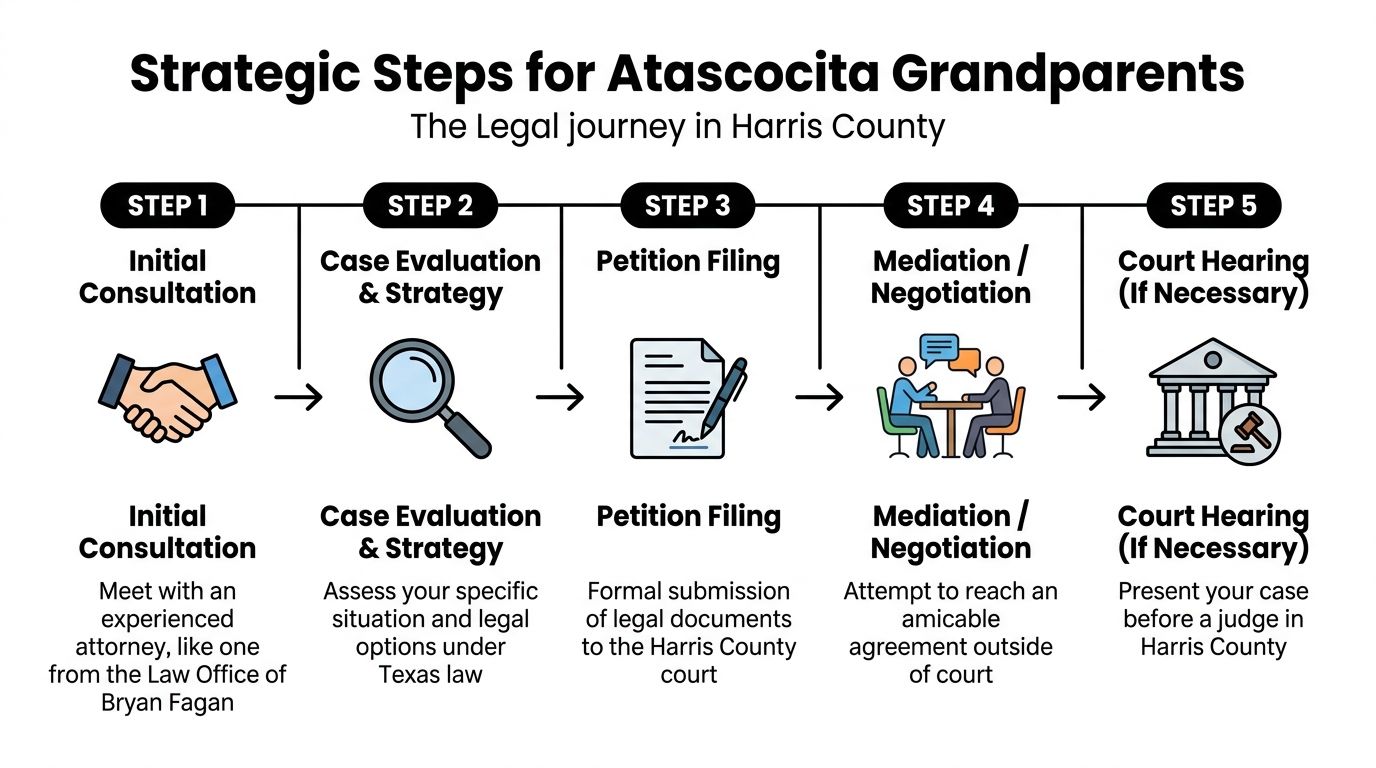
The process in Harris County usually moves through a series of practical steps. The exact path depends on whether you're seeking access, conservatorship, or a modification of an existing case.
The local roadmap
Initial consultation
You bring the timeline, names, court papers, and the facts as they happened. An attorney reviews whether you likely have standing, what kind of case fits, and whether urgent relief may be needed.Case evaluation and filing choice
The legal vehicle matters. A grandparent may need to file for possession or access, file a conservatorship case, or seek a modification in an existing SAPCR. Filing the wrong type of case can create delay.Petition filed in Harris County court
Once filed, the case enters the local court system. Parents and other parties are served, deadlines begin, and the court may set hearings or require mediation.Temporary orders or early hearings
If the situation is urgent, especially where the child's safety or stability is at issue, temporary relief may become part of the strategy.
A local attorney may help with these filings and hearings. One available local option is the Law Office of Bryan Fagan – Atascocita TX Lawyers, which handles family law matters for residents in Atascocita, Humble, and Harris County.
A visual explanation can help if the process feels abstract.
Timing issues that generic articles miss
A 2024 Texas Advocates report notes that grandparents who lived with the child for six months in the last two years have standing to petition for custody, but many articles don't explain how to prove that timeline or how to document harm to development under Section 102.004, especially within the 90-day filing window after the child moves out, as summarized by Lawyer Kennedy's discussion of grandparent custody strategy.
That detail matters in real life. If a parent with substance abuse problems leaves a child with you for months and then suddenly takes the child back, you may need to act quickly to preserve the legal position created by that caregiving period.
One issue courts watch closely
If the court thinks ongoing contact should happen but there are safety concerns, the discussion may shift toward a more controlled arrangement. In that setting, what is supervised visitation becomes relevant because supervised visitation can be part of a temporary or final family court solution when conflict or safety risks are present.
Debunking Common and Costly Myths
Bad information hurts grandparent cases. It creates false hope in some families and dangerous delay in others. Texas law is narrow in this area, and many online summaries leave out the part that matters most. The court begins with a presumption that fit parents act in their child's best interest.

Myth and reality
| Myth | Reality |
|---|---|
| I'm the grandparent, so I have automatic rights. | Texas doesn't give automatic visitation rights to grandparents. |
| If the child loves me, the judge will order visits. | Affection helps explain the relationship, but the court still needs legally sufficient proof. |
| Visitation should be easy because I'm not asking for custody. | Visitation can involve a demanding burden of proof. |
| I can wait and see what happens. | Delay can hurt, especially if standing depends on recent caregiving facts or deadlines. |
| If the parent is making bad choices, that alone wins my case. | Courts need admissible evidence tied to the child's condition and the legal standard. |
The biggest misunderstanding
A common misconception is that grandparents have automatic visitation rights. In reality, they must prove denial of access would significantly impair the child's physical health or emotional well-being, which is a high bar that often requires expert testimony and is rarely explained in generic online content, according to Lowry Family Law's analysis of Texas grandparent visitation misconceptions.
That's the point many families miss. The law does not ask whether the grandparent relationship is meaningful. It asks whether denying access creates a serious enough risk to justify court intervention over a parent's decision.
Courts don't treat grandparent cases like fairness contests. They treat them like constitutional family rights cases with narrow exceptions.
Why this matters beyond family law
Families dealing with grandparent access problems often have related legal issues in motion. A parent's criminal charge may affect availability or stability. A divorce may already be pending. A will, trust, or guardianship plan may need updating if a child has been living with a grandparent. That's why a narrow online answer often fails local families in Atascocita and Humble. The legal issue may look simple on the surface, but the strategy rarely is.
Your Questions Answered by an Atascocita Attorney
How long does a grandparents' rights case take in Harris County
It depends on the type of case, whether there's an existing order, whether emergency issues are involved, and whether the parents contest your request. Some cases move through temporary hearings and mediation before a final trial setting. Others resolve earlier through negotiated terms. The useful question isn't “How long will it take?” It's “What has to happen first?”
What if CPS is already involved
That changes the situation. If Child Protective Services is already investigating or has opened a case, your role as a possible caregiver may become more important, but the court process also becomes more technical. In those situations, families often need guidance that overlaps with abuse or neglect investigations and placement issues. If CPS is part of your family's situation, review the firm's Atascocita CPS defense attorney information as part of the larger strategy.
Can this be resolved through mediation instead of a court fight
Sometimes, yes. Mediation can work when the actual issue is communication, boundaries, scheduling, or distrust between adults. It usually works best when everyone understands the legal strengths and weaknesses before the session begins. A mediated solution can preserve relationships in a way a courtroom often can't.
What should I bring to a consultation
Bring any court papers, messages, school records, calendars, proof the child lived with you, and a written timeline of what happened. Include names, dates, addresses, and the reason contact changed. If another legal matter is involved, such as a divorce, criminal case, or estate planning concern, mention that too.
If you're worried about losing your relationship with a grandchild in Atascocita, Humble, or northeast Harris County, don't try to sort through Texas family law alone. Schedule a free consultation with Law Office of Bryan Fagan – Atascocita TX Lawyers to discuss your situation, your evidence, and the next legal step that fits your family.