Skip to content
If you're in Atascocita or Humble and a custody case has suddenly turned into a conversation about supervised visitation, you're probably carrying a lot at once. You may be worried about your child's safety. You may be the parent being asked to visit under restrictions and wondering if the court thinks you're a danger. Or you may feel lost because everyone keeps using legal terms without explaining what everyday life will look like.
Supervised visitation is a court-ordered way to protect a child while still allowing contact with a parent. It means visits happen with a neutral adult present to watch, listen, and step in if needed. For many families in northeast Harris County, that structure can lower tension, reduce risk, and create a safer path forward during a difficult case.
That practical side matters, but so does the emotional side. Children often do better when the adults around them keep the focus on calm routines and reassurance. If your family is also coping with divorce stress, this guide from Children Psych offers expert advice on child well-being post-divorce in plain language.
A Guide for Atascocita and Humble Families
Parents often ask the same question in different ways. What is supervised visitation? In plain English, it's parenting time that happens under rules set by the court because the judge believes extra protection is needed. The goal usually isn't to erase the parent-child relationship. The goal is to make contact safer.
In Texas family law, judges focus on the child's welfare first. That same child-centered approach shows up in other legal matters local families face, from custody disputes to divorce cases, and even in related planning concerns like wills, probate, or guardianship when extended family members step in to help care for a child. Different practice areas involve different rules, but the common thread is that Texas courts want stable, workable arrangements.
What supervised visitation usually means day to day
A supervised visit isn't the same as a normal weekend possession schedule. The order may control:
- Who attends: a professional supervisor, visitation center staff member, or another approved adult
- Where visits happen: a center, office, or another approved location
- How long the visit lasts: sometimes brief and tightly scheduled
- What conduct is expected: no conflict, no unsafe behavior, and no putting the child in the middle
Supervised visitation is often less about punishment and more about creating a controlled setting where the court can reduce risk.
That matters for families in Humble, Kingwood, Atascocita, and surrounding communities because the hardest part is often uncertainty. People don't know whether a judge can order it, how it works, what it costs, or how to get out of it later. Those are practical questions, and they deserve practical answers.
Why local guidance helps
Harris County cases move through local procedures, local judges, and local scheduling realities. A parent dealing with a custody dispute in Atascocita may need help understanding family court expectations, while another family nearby may also be juggling related concerns like criminal allegations, protective-order issues, or estate planning for a grandparent who has become involved in childcare. The legal issue may be family law, but the impact reaches every part of daily life.
The Different Types of Supervised Visitation
The phrase supervised visitation gets used broadly, and that's where many parents get confused. Some orders require close, continuous observation. Others are looser and focus more on safe handoffs or support during reunification. Reading the exact wording of the order matters.
According to SVN standards for supervised visitation providers, supervised visitation is a court-ordered arrangement where a neutral third party must be present to observe and monitor all interactions between a parent and child. The provider must be physically present, listen to conversations, and have authority to interrupt or end the visit if safety becomes a concern.
A simple comparison
| Visitation Type | Level of Oversight | Primary Goal |
|---|---|---|
| Supervised | Direct, ongoing observation during the entire visit | Protect the child and monitor interaction in real time |
| Monitored | Some observation or structure, but not always the same level of constant intervention | Reduce conflict and maintain accountability |
| Therapeutic | Oversight by a mental health professional in a treatment-focused setting | Support healing, communication, or reunification |
Supervised visitation
This is the most structured form. The supervisor stays present and neutral. If a parent says something inappropriate, appears impaired, becomes aggressive, or ignores the rules, the supervisor may stop the visit and report concerns.
This type is common when the court has safety concerns and wants more than casual oversight.
Monitored visitation
People sometimes use "monitored" and "supervised" as if they mean the same thing. In practice, monitored visitation can describe a less intensive arrangement, depending on the court's wording. There may still be an approved adult involved, but the purpose may lean more toward accountability and less toward minute-by-minute intervention.
A related concept is monitored exchange, where the focus is the handoff between adults rather than observation of the full visit. In a Florida study of 47 programs, 83% reported supervised visitation as a primary service and 64% offered monitored exchange, with one-on-one dependency cases and domestic violence-related matters appearing often in those programs, as reported in this research on supervised visitation programs.
Therapeutic visitation
This form usually involves a therapist or mental health professional. The setting is more treatment-oriented than enforcement-oriented. It may be used when a child is anxious, a relationship has been damaged, or the court wants structured support while parent and child rebuild contact.
The label matters less than the court order itself. If your paperwork is vague, ask your lawyer or the court for clarification before the first visit.
In some family disputes, visitation questions also involve extended relatives. When grandparents are part of the case, Grandparents' Rights in Atascocita addresses custody and visitation rights for grandparents in Harris County.
Why a Harris County Court Orders Supervised Visits
Texas judges don't order supervised visits just because one parent is upset or suspicious. The legal question is whether unrestricted access would put the child at risk. In Texas, a court orders supervised visitation only when it finds that unsupervised access isn't in the child's best interest, applying the Best Interest of the Child standard in Texas supervised visitation decisions.

What a judge may look at
A Harris County judge may consider evidence of:
- Family violence: harm, threats, coercive behavior, or a pattern of control
- Substance abuse: especially when it affects judgment, reliability, or safety
- Neglect concerns: failure to provide basic care or supervision
- Mental health concerns: when symptoms create a direct safety issue
- Flight risk or instability: concerns that a parent may not return the child or follow court rules
The key word is evidence. Judges can exercise broad discretion, but they still need a factual basis. That can include testimony, records, reports, prior orders, or other proof that helps the court understand risk.
Why allegations and proof aren't the same
Many parents assume that if abuse is alleged, supervised visitation automatically follows. Court doesn't work that way. Allegations matter, but judges weigh credibility and supporting evidence.
The broader national picture shows why this issue feels so urgent for many families. The Resource Center on Domestic Violence reports that the United States sees about 100,000 contested child custody cases annually, that studies indicate two-thirds likely involve domestic violence, and that courts award fathers joint or sole custody 70% of the time overall, while allegations of domestic violence have no demonstrated effect on whether abusers are ordered into supervised visitation, according to these custody and domestic violence facts.
Practical rule: If you're asking for supervised visitation, bring organized, credible evidence. If you're defending against it, bring equally organized proof that the child can be safe.
Some parents also wonder whether they can refuse visitation on their own when they believe danger is present. That question is more complicated than many realize, and this guide on denying visitation for safety reasons in Texas helps explain the risk of acting without a court order.
Not every family law matter involves this level of conflict. Some couples in Atascocita can resolve the end of a marriage cooperatively through an Uncontested Divorce Lawyer in Atascocita when both sides agree on the major terms.
Supervised Visitation Logistics in the Atascocita Area
Once a judge orders supervision, the next question is usually the most immediate one. How does this work? Parents in Atascocita, Humble, and northeast Harris County often need specifics fast because visits can't happen until the practical details are clear.
Who can supervise
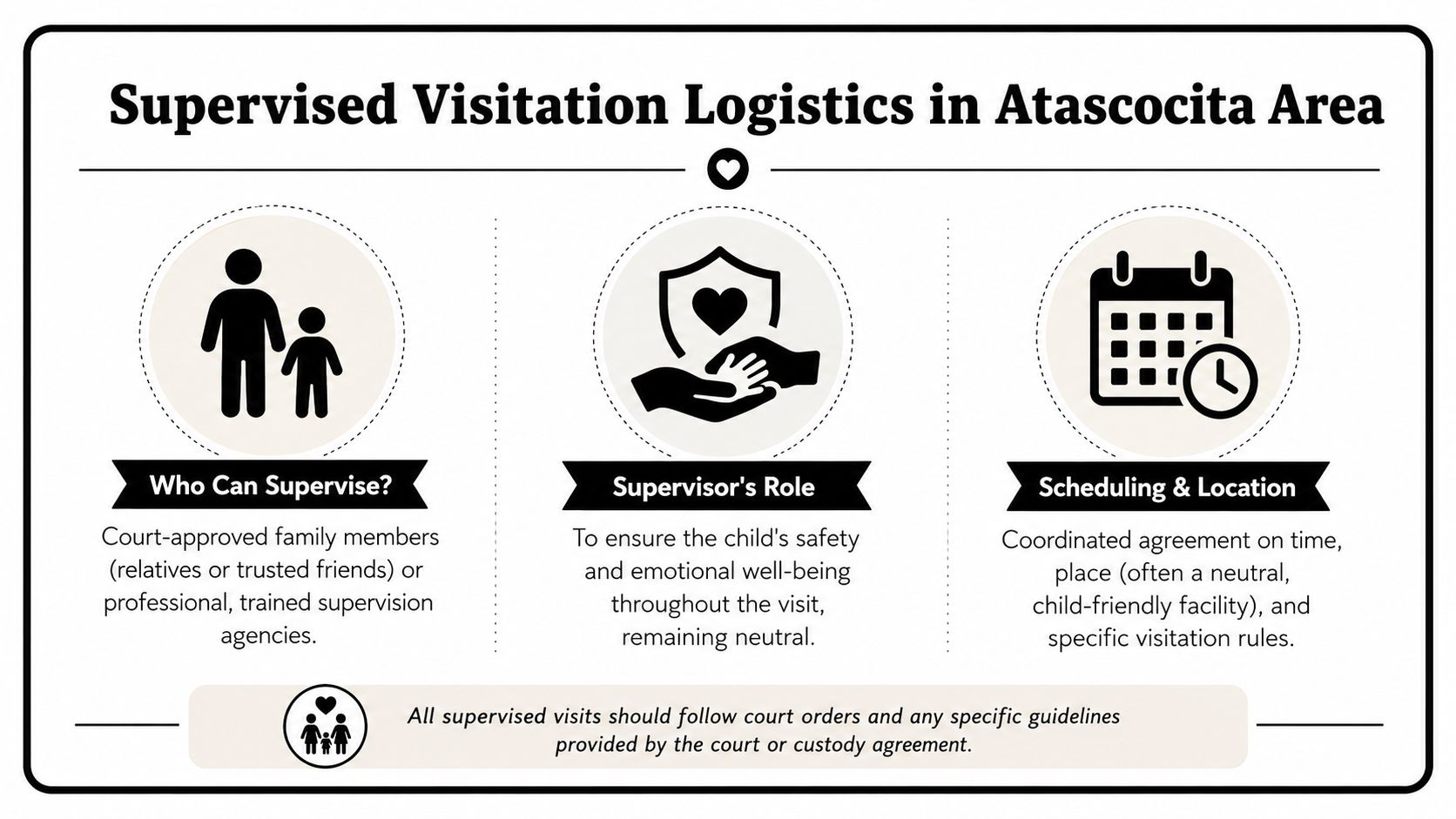
The answer depends on the court order. Some judges approve a relative or trusted family friend. Others require a professional provider or visitation center. The more serious the concern, the more likely the court is to want a neutral professional setting.
Possible supervisors may include:
- A court-approved family member: sometimes used when both parties trust that person to stay neutral
- A professional supervisor: someone trained to observe, document, and intervene
- A visitation center: often the most structured option, with rules about check-in, timing, and behavior
Where visits may happen
Location matters because the place has to match the level of concern. Depending on the order, visits may occur in a supervised visitation center, an office setting, a therapist's office, or another approved place. In the Atascocita and Humble area, families often think in practical terms about travel, school schedules, and whether the setting feels calm enough for the child.
The court may also restrict where a child can go during the visit. Some orders keep everything at one approved site. Others allow limited activities, but only if the supervisor remains present and can hear and observe what is happening.
Time, scheduling, and cost
The situation often leaves many families feeling overwhelmed. Supervised visitation is often harder to schedule than standard possession because it depends on supervisor availability, intake steps, and local demand.
A concrete Texas example helps show how structured these programs can be. Tarrant County's court visitation center charges a $50 one-time set-up fee and a $15 fee for each visit, limits visits to one hour on first and third weekends, and has a 30-day wait list for slot assignment after intake, as described by Tarrant County supervised visitation services. Harris County has its own procedures and costs, and those details can vary by provider and order.
If you're in northeast Harris County, don't wait until the week before a visit to ask about intake, fees, or available time slots. Delays often start there.
That timing issue isn't unusual. In the Florida study noted earlier, programs often ran on small budgets, and 38% reported average visits lasting only 1.5 hours, which the study described as shorter than earlier research had documented.
Knowing Your Rights and Responsibilities
A supervised visitation order is a set of instructions for every adult involved. In Harris County, judges use these orders to create structure, reduce risk, and protect the child from being pulled into adult conflict. The order may feel strict, but the point is usually simple. Give the child a visit that is safe, predictable, and calm.
The visiting parent's role
The visiting parent usually still has the right to spend time with the child. The difference is that the contact happens under rules the court has approved. In practice, that often means arriving on time, following the location rules, staying sober, and treating the supervisor as the person in charge during the visit.
That role is a lot like driving through a school zone. You are still allowed on the road, but the court has lowered the speed and added guardrails because safety comes first.
A visiting parent should usually:
- Follow the written order closely: changes to time, place, or supervision usually need agreement from the right people, and sometimes court approval
- Listen to the supervisor: if the supervisor redirects a conversation or stops an activity, comply without arguing
- Keep the child out of the case: do not ask the child for information about the other parent, court hearings, or home life
- Focus on connection: read, talk, play, and use the limited time to build trust rather than relive the conflict
If a rule feels unfair, the safer response is to document the issue and raise it through the proper legal process. Ignoring the order can create a new problem that overshadows the original one.
The custodial parent's role
The custodial parent also has rights, and also carries duties. You can expect the order to be enforced and the child to be protected. You also usually must make the child available for court-ordered visits unless the court changes the order or there is an immediate safety emergency.
That point causes a lot of confusion. Many parents believe fear alone lets them stop a visit. Sometimes the concern is real and serious, but the court still expects a parent to report the problem, keep records, and ask for relief through the court rather than make a unilateral decision.
For local context, it helps to understand the factors Harris County judges consider in child custody decisions. Those same child-focused concerns often shape supervision rules.
The child's interests come first
The child is not a messenger, witness, or referee. The child is the person the order is built to protect.
That is why many supervised visitation orders address conduct as much as location. A judge may limit what adults can discuss, who may attend, what items may be brought, or how pickups and drop-offs happen. These details can seem small, but together they lower the chance of arguments, pressure, or emotional harm.
Courts in Texas frame these decisions around the child's best interest. In everyday terms, that standard asks a practical question. What arrangement gives this particular child the safest and most stable experience right now?
A calm, ordinary visit is often the goal. For a child, boring can be reassuring.
Parents should also remember that online behavior can affect family cases. Posts, messages, and shared photos sometimes become evidence or create stress for children who are old enough to see them. Digital Footprint Check's advice offers useful guidance on protecting children online during a family dispute.
Some families need help with the larger court case surrounding the visitation issue. A Divorce Lawyer in Atascocita, TX provides divorce representation for clients in Atascocita and Harris County.
How to Prepare Your Child and Yourself for a Visit
The legal order sets the rules. Your preparation shapes the experience. For many children, the stress doesn't come from the visit alone. It comes from sensing fear, anger, or uncertainty in the adults around them.

Helping your child feel steady
Tell the child what will happen in simple, neutral language. Younger children usually need a short explanation. Older children may ask harder questions, but they still don't need adult details about court allegations.
A few helpful habits:
- Keep the message simple: tell them who they'll see, where they'll go, and who will be there
- Avoid loaded language: don't call the visit dangerous, unfair, or a test
- Stick to routine: meals, naps, schoolwork, and bedtime help children regulate stress
- Let feelings be normal: nervous, excited, sad, and confused can all show up at once
Making the visit count
For the visiting parent, short visits can feel frustrating. Don't spend that time apologizing for court, criticizing the other parent, or trying to investigate what happens at the other home. Read a book, play a game, draw pictures, or listen.
For the custodial parent, the best support is often calm preparation and calm pickup afterward. Give the child room to settle without conducting an interview the moment the visit ends.
Children usually remember the emotional tone more than the exact activity. A calm hour can do more good than a tense hour filled with gifts or pressure.
If your child uses a phone, tablet, or gaming device during or after visits, online safety may also become part of the larger co-parenting picture. This overview of Digital Footprint Check's advice offers practical ideas for protecting children online without increasing fear.
Requesting or Modifying a Supervised Visitation Order
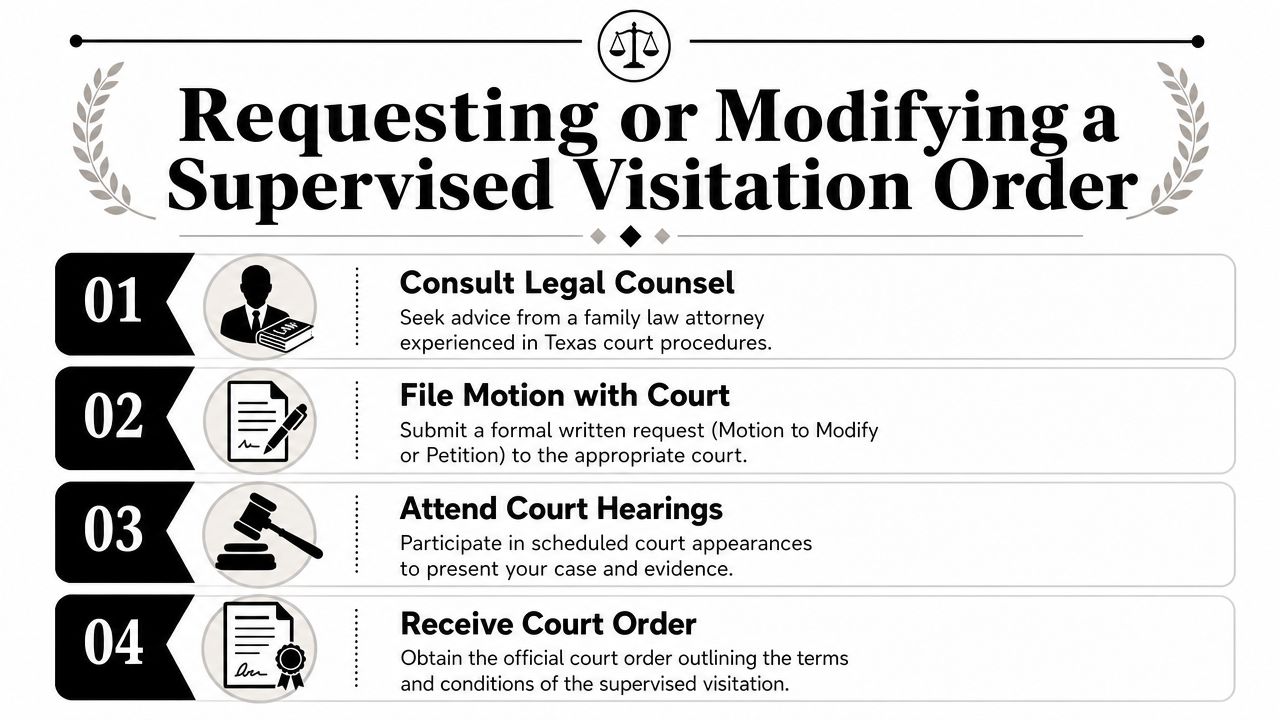
A supervised visitation order can change. In Harris County, judges often use supervision as a safety tool while they assess whether the current arrangement still fits the child's best interest.
Asking the court to order supervision
A judge usually needs more than fear or frustration. The court wants specific facts that show why ordinary visitation would put the child's physical safety, emotional well-being, or stability at risk.
That means details such as dates, police reports, medical records, text messages, prior court findings, failed drug tests, or testimony from someone with firsthand knowledge. In Harris County family court, a clear timeline often matters more than a long accusation. If you are asking for supervision, organize your proof the way you would organize receipts for a major purchase. Each document should help explain what happened, when it happened, and why the child needs protection now.
Asking the court to reduce or end supervision
If you are the parent visiting under supervision, the court usually looks for a meaningful change in circumstances and evidence that the safety concern has improved. The question is practical: what is different today, and how does that reduce risk for the child?
Helpful proof often includes:
- Completed services such as counseling, parenting classes, substance abuse treatment, or anger management if the court expected them
- Consistent, positive visits over time, with no serious problems during exchanges or the visit itself
- Written feedback from the supervisor or visitation center showing appropriate behavior and healthy interaction with the child
- Compliance with the rest of the court order including support, communication rules, and any testing requirements
Some cases change in stages. A judge may move from strict supervision to less restrictive supervision, then to unsupervised time if the parent continues to show stability. Parents often expect an on or off switch. In real cases, it works more like a dimmer. The court may loosen restrictions step by step so the child is not pushed too fast.
What families in Atascocita and Humble should do next
Start with the current order. Read every line carefully, including pickup terms, supervisor rules, location limits, and any conditions you must meet before asking for more time. Small details can control big outcomes.
Then gather your paperwork before you file anything. That may include certificates, clean test results, visit logs, school records, messages about scheduling, or reports from the supervisor. If your case already involves restricted parenting time, this page on working with a supervised visitation attorney in Atascocita explains the local legal process in more detail.
One more point matters here. Requesting supervision is not about punishing a parent, and asking to modify supervision is not about erasing the past. The court is trying to answer a narrower question: what arrangement protects this child right now, in this family, under these facts? Keeping your evidence focused on that question usually gives the judge more to work with than anger, blame, or broad claims ever will.