Skip to content

Your child may be asleep in the next room while you sit at the kitchen table in Atascocita, staring at court papers and wondering what a judge will care about. You may be asking questions that don't have easy answers at first. Will the judge believe me? Does my child get a say? Do I need school records, text messages, witnesses, or all of it?
Those questions are normal. Parents in Humble, Kingwood, and across northeast Harris County often come into a custody case feeling overwhelmed because the process sounds abstract until it becomes personal.
What helps is understanding that judges aren't supposed to decide custody based on who sounds more upset, who files first, or whether one parent is the mother or the father. In Harris County, the court is trying to answer a narrower question. What arrangement serves the child's best interest? Once you see the case through that lens, the process starts to make more sense.
Navigating Child Custody in Harris County
A custody case in Harris County usually starts long before anyone speaks in a courtroom. It starts with school pickup logs, doctor appointments, text messages about exchanges, and the routines that show who is keeping a child's life steady. For parents in Atascocita, Humble, and nearby communities, that can feel frustrating because you may already know what your family has been living. The court still needs to see it in a form it can rely on.
Court works a lot like assembling a puzzle. One dramatic accusation rarely decides the picture. Judges are usually looking at many smaller pieces over time, especially in a county as busy as Harris County, where courts handle a high volume of family cases and organized, credible information matters.
Practical rule: Facts you can document usually carry more weight than accusations you can only repeat.
That does not mean the process ignores emotion or family history. It means the court tries to protect children by focusing on proof, patterns, and workable parenting plans. In Harris County, local procedure also shapes the case in ways many statewide articles gloss over. Parents often encounter temporary orders early, mediation is commonly required before trial settings in many courts, and some disputed cases involve more formal review tools such as custody evaluations. Those local realities affect how a case develops from the beginning.
Why Harris County procedure matters
Generic Texas custody guides often stop at broad legal principles. That is only part of the story. A parent in northeast Harris County is dealing with specific court practices, crowded dockets, scheduling pressures, and judges who may have limited time to absorb poorly organized evidence.
That practical point matters. If your concerns are buried in scattered screenshots, vague claims, or last-minute filings, the judge may never get a clear picture of your child's day-to-day life. A clear timeline, school records, medical information, and a realistic parenting proposal often help far more than anger does.
Parents also tend to underestimate how much settlement efforts matter here. In many Harris County family courts, mediation is not just a side option. It is a regular part of the process. That means preparation is not only about trial. It is also about being ready to explain, support, and negotiate a parenting plan that fits your child.
Mistakes parents often make early
Parents in custody cases often assume one of four things:
- The judge will automatically spot who is telling the truth. Judges can only weigh what is properly presented.
- A child gets to pick where to live. Texas law is more limited and fact-specific than that.
- Temporary orders are just placeholders. In practice, they often influence the rhythm and expectations of the rest of the case.
- Local process is the same everywhere in Texas. Harris County has its own pace and habits, including heavy caseloads and frequent use of mediation.
One more point deserves attention. Children are often absorbing far more than parents realize during a breakup. If you are trying to protect your child emotionally while the case is pending, this expert advice on kids and divorce can help you think through those conversations with care.
Understanding how custody cases are handled in Harris County helps lower the temperature. It gives you a way to shift from fear and assumptions to records, planning, and decisions a judge can use.
The Legal Standard The Best Interest of the Child
Texas judges don't begin with a built-in preference for either parent. They begin with the child's best interest. In Harris County custody disputes, that standard gets applied through two separate questions. Conservatorship covers legal decision-making, and possession and access covers the parenting schedule, as explained in this discussion of how Texas courts decide child custody.
That split confuses many parents at first. A parent can have meaningful parenting time but not hold every exclusive decision-making right. Another parent may share decision-making while the schedule itself looks different from a simple fifty-fifty arrangement. Judges look at each part separately because family life is more complicated than a single label like "full custody."
What best interest means in daily life
In plain English, the judge is asking questions like these:
- Which parent is more likely to meet the child's day-to-day needs consistently?
- Which home offers more stability?
- How do the parents handle school, medical care, routines, and emotional support?
- Can these parents make decisions without putting the child in the middle?
Parents often hear about the Holley factors in Texas custody cases. Even when a judge doesn't read down a checklist in open court, these ideas help explain the kinds of facts that matter.
The Holley Factors What Judges Consider
| Factor | What It Means in Plain English |
|---|---|
| The child's desires | What the child wants may matter, depending on age and maturity, but it isn't the only issue |
| Emotional and physical needs now and in the future | Who reliably handles the child's care, routines, health, and support |
| Emotional and physical danger now and in the future | Whether there are safety concerns, instability, violence, substance issues, or risky behavior |
| Parental abilities | How each parent actually parents, not just what each claims |
| Programs available to help the parent | Whether a parent uses available support, counseling, education, or services when needed |
| Plans for the child | Each parent's practical plan for school, childcare, transportation, healthcare, and home life |
| Stability of the home or proposed placement | Whether the child's environment is steady, predictable, and suitable |
| Acts or omissions of the parent | Conduct that may show poor judgment or a pattern that affects the child |
| Any excuse for those acts or omissions | Context matters. Judges look at explanations, not just accusations |
How to use this as a parent
Read that table like a checklist for your own life. If you tell the court you're the more involved parent, can you show attendance records, appointment logs, messages with teachers, or calendars? If you say the other home is unstable, do you have something more concrete than suspicion?
Children usually do better when parents keep them out of adult conflict and give them simple, reassuring explanations. If you're struggling with those conversations, this guide with expert advice on kids and divorce can help you communicate in a way that supports your child emotionally.
A judge isn't looking for a perfect parent. Judges know families are under stress. They're looking for the parent, or shared arrangement, that best supports the child's safety, stability, and healthy development.
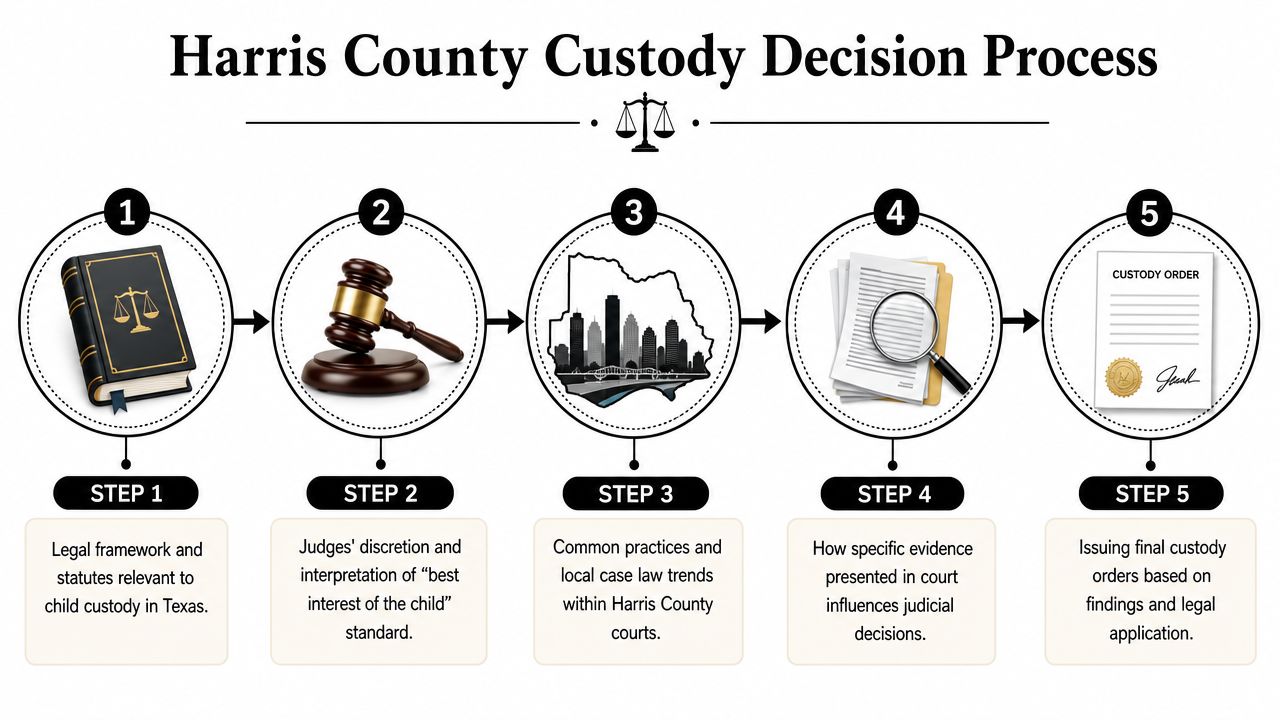
How Harris County Judges Apply This Standard
A lot of parents in Atascocita and Humble walk into this stage of a case with the same worry. If both sides say they love the child and both sides want custody, how does a Harris County judge choose?
In Harris County, the answer often comes down to clarity. Judges handle a heavy family-court docket, so they usually have limited time to sort through anger, side stories, and old grievances. They are looking for a clear picture of the child's daily life, each parent's judgment, and whether the plan in front of the court will work in real life.
Why judges focus on organization
A custody hearing works a lot like putting together a school attendance record. One missed day might matter. A pattern matters more. The judge is usually trying to see patterns over time, not decide the case based on who sounds more upset or more polished in court.
That is why organized information carries so much weight in Harris County family court. Judges often give more attention to proof that is easy to follow and tied directly to the child, such as:
- Neutral records: school files, medical records, counseling information, and other documents from outside sources
- People with firsthand knowledge: teachers, daycare staff, relatives, counselors, coaches, and others who have seen the child's routine
- A workable timeline: who handled drop-off, homework, appointments, exchanges, and missed visits, with dates and context
- A realistic parenting plan: where the child will sleep, how transportation will happen, how school nights will work, and how decisions will be made
A short, well-supported story usually helps more than a stack of accusations.
How local Harris County procedures shape custody decisions
This is one place where Harris County feels different from a generic Texas guide. In many contested cases, parents are required to try mediation before the court gives them a full trial. That means the judge may first see the case after settlement efforts have already narrowed the issues, or after it has become clear that the parents cannot agree on major questions involving conservatorship, possession, or decision-making.
If the case stays highly disputed, the court may use additional tools to get a fuller picture. One of those tools is a custody evaluation. If you are not familiar with that process, this overview of what a custody evaluation involves in Texas custody cases gives a helpful starting point.
A custody evaluation is closer to an investigation than a single interview. The evaluator may review records, interview parents and children, speak with collateral contacts, visit homes, and look for consistency between what each parent says and what the history shows. In some cases, mental health concerns or allegations about a parent's functioning may also lead to discussions about assessments, including testing options at Providers for Healthy Living.
Other court-appointed professionals you may see
Judges in Harris County may also appoint an Amicus Attorney or Guardian Ad Litem. Those roles are not the same as hiring your own lawyer. Their job is to help the court assess the child's circumstances and interests from a broader angle.
For parents, that changes the assignment. The question is not just, "How do I tell my side well?" The better question is, "If a judge, evaluator, or amicus looked at my parenting over the last year, what would they see?"
That shift matters. In a busy Harris County courtroom, decisions often turn on patterns, follow-through, and practical details parents in places like Atascocita and Humble live every day.
Presenting Evidence That Matters to the Judge
Once parents understand that a custody case is built on proof, the next question is obvious. What proof matters?
Judges tend to care most about evidence that connects directly to the child's life. They want to know who gets the child to school, who follows through on medical care, who communicates responsibly, and what kind of environment the child experiences in each home.

Evidence that usually helps
Strong evidence is usually specific, dated, and connected to parenting.
- School information: attendance records, report cards, teacher communications, behavior notes
- Medical records: appointment histories, prescription follow-up, therapy recommendations, vaccination records when relevant
- Communication records: respectful texts or emails showing co-parenting efforts, schedule coordination, and attempts to resolve issues
- Calendars and journals: a clean parenting log that notes exchanges, missed visits, school events, and important incidents
- Photos and home details: pictures that fairly show sleeping arrangements, study space, and day-to-day conditions
- Witnesses with firsthand knowledge: people who have seen the child's routine, not just heard your side
If you expect a custody evaluation, it helps to review what that process can involve. This overview of what a custody evaluation is gives a practical starting point.
Evidence that often falls flat
Some things feel powerful to say but don't move the case much unless they can be backed up.
- Vague accusations: "She's unstable" or "He's a bad parent"
- Old grievances from the relationship: affairs, insults, or general resentment that don't tie clearly to the child's welfare
- Social media assumptions: screenshots without context or posts that do not show parenting harm
- Secondhand stories: "My cousin heard from a friend"
Keep this in mind: The court isn't deciding who was the better spouse. The court is deciding what arrangement is best for the child.
In some cases, parents also look into outside mental health or psychological assessment options when a professional recommends it. If that issue comes up, reviewing testing options at Providers for Healthy Living may help you understand the kinds of evaluations that sometimes become part of a larger family-law picture.
What about the child's preference
Many parents get tripped up regarding child preference in custody decisions. For children age 12 or older, Texas law lets judges consider the child's stated preference, and Harris County courts may hear the child's testimony in private, as explained in this article on teen preferences in Texas custody cases.
But the judge is not taking a vote.
A child's preference is weighed against safety, stability, maturity, and the broader best-interest analysis. A thoughtful preference grounded in real reasons may carry weight. A preference that appears coached, impulsive, or disconnected from the child's needs may carry much less.
Your Case Timeline in a Harris County Court
A custody case feels less intimidating when you know the usual sequence. The exact path can vary, but most Harris County cases move through a series of familiar stages.
For many families, the process begins during or around a divorce. If that's your situation, this guide on filing a divorce in Harris County can help you understand the opening step that puts the court in motion.

Step one through step three
Filing the petition
One party files the case and asks the court for relief involving the child. That filing sets the legal process in motion and gives the case a court assignment.Temporary orders
Early in the case, the court may address where the child will live, who makes certain decisions, and how parenting time will work while the case is pending. These temporary arrangements often shape daily life for months.Discovery and information exchange
Both sides gather documents and exchange information. This can include school records, medical material, communication records, and other evidence tied to parenting issues.
The Harris County procedures many parents don't expect
Generic guides often skip the local rules that affect real cases. In Harris County, procedure can shape the outcome long before final trial. Local practice often requires mediation before temporary-orders hearings, may require co-parenting classes, and includes strict deadlines for exchanging financial, insurance, and trial materials, as noted in this discussion of custody and divorce in Harris County Texas.
That matters because compliance sends a message. A parent who meets deadlines, shows up prepared, and follows court requirements appears more credible and reliable than a parent who treats those steps casually.
The later stages of the case
Some cases settle after enough information is exchanged. Others don't.
- Mediation: Parents work with a neutral mediator to try to reach an agreement.
- Possible custody evaluation: If the court believes more investigation is needed, an evaluator may gather records, conduct interviews, and visit homes.
- Pretrial preparation: Lawyers organize exhibits, prepare witnesses, and narrow the issues for hearing or trial.
- Final trial or final agreement: If no settlement is reached, the judge hears the evidence and signs final orders.
The final hearing isn't the only moment that matters. Temporary orders, mediation posture, and compliance with local requirements often shape what the final outcome looks like.
How to use the timeline wisely
Parents in Atascocita and Humble often feel pressure to react to every provocation. That usually doesn't help. What helps is building a steady record from the start.
Focus on routines. Keep your communication civil. Save important records. Follow temporary orders carefully. If the court requires a class, take it seriously. If mediation is scheduled, arrive prepared with a realistic plan for your child.
Those choices don't guarantee a result, but they put you in a stronger position when the judge reviews the case.
How an Atascocita Custody Attorney Can Help
A lot of parents reach this stage after weeks or months of strain. School drop-offs still have to happen. Bills still have to be paid. At the same time, you are expected to make careful legal decisions in a Harris County system that moves on court deadlines, local procedures, and a judge's limited time.
That is where local help matters most.
An Atascocita custody lawyer helps turn a stressful family conflict into a clear, organized presentation the court can effectively use. In Harris County, that often means sorting out which facts support your position, preparing records in a usable format, getting ready for mediation, and making sure your requests fit the way local family courts handle custody cases. A parent may know the story by heart. A lawyer helps present that story in a form the court can evaluate. The child custody lawyer in Atascocita page gives a fuller picture of the legal support available in these disputes.
That local focus matters for a simple reason. Harris County courts are busy, and busy courts reward clarity. Judges and staff do not have extra time to sort through angry text chains, scattered screenshots, or a stack of records with no explanation. A lawyer helps trim away the noise and highlight the facts tied to parenting, stability, decision-making, and the child's day-to-day needs.
A good attorney also helps you avoid common mistakes that can undermine a case. For example, a parent may believe every bad interaction with the other parent should be shown to the judge. Usually, the better approach is to separate what feels important from what is legally important. That distinction is hard to make when you are living through it.
Here are practical ways a lawyer can help right away:
- Organize your evidence: Put school records, medical information, calendars, and communication logs in a format that supports your position.
- Prepare for mediation: Develop reasonable proposals, identify pressure points, and avoid walking in unprepared.
- Address temporary-order issues: Help you respond if disputes arise over possession schedules, exchanges, or decision-making while the case is pending.
- Keep your communication on track: Review texts and emails with the understanding that a judge may eventually read them.
- Present a workable parenting plan: Show the court how your plan fits the child's routine, not just your frustration with the other parent.
For parents in Atascocita and Humble, this support is often as much about judgment as paperwork. A lawyer can tell you when to press an issue, when to document it carefully, and when a short, calm response will help you more than a long argument. That is especially useful in Harris County, where mediation, evaluations in some cases, and crowded dockets can shape the outcome long before a final trial date.
The Law Office of Bryan Fagan – Atascocita TX Lawyers provides family law representation for parents dealing with custody disputes in this area, including help with filings, temporary orders, mediation, and trial preparation.
If you're facing a custody dispute in Atascocita, Humble, or elsewhere in northeast Harris County, you don't have to figure it out alone. Schedule a free consultation with Law Office of Bryan Fagan – Atascocita TX Lawyers to talk through your situation, understand your options, and build a plan that protects your child and your peace of mind.