Skip to content

If you're reading this in Atascocita, Humble, or somewhere else in northeast Harris County, you may be staring at text messages, school emails, and a calendar full of exchange times, wondering how any of this turns into a custody case. Most parents don't come into this process feeling strategic. They come in scared, frustrated, and worried that one mistake could affect their child for years.
That feeling is normal. It also points to the first truth about how to win a custody case in Harris County Texas. You do not win by sounding more upset than the other parent. You win by showing the court, calmly and clearly, that your child will be safe, supported, and stable in your care.
In Texas, custody decisions turn on the best interest of the child. That phrase can sound vague until you see how courts use it. In Harris County, judges want proof. They want records, patterns, compliance with local requirements, and a parenting approach that puts the child ahead of the conflict. If you're a parent trying to protect your relationship with your son or daughter, that's where your energy needs to go.
A parent in Humble might worry that the other side talks better, earns more, or is already making accusations. A parent in Atascocita might fear that because the child has mostly stayed in one home, the case is already over. Usually, it isn't that simple. Custody cases are built on evidence, preparation, and credibility.
Navigating Your Child Custody Case with Confidence
Parents often use the word "win" because they need something solid to hold onto. They want to know what to do next. In a custody case, though, the stronger mindset is this: show the court why your plan serves your child better.
That shift matters. A father in Eagle Springs who spends weekends coaching, handles school pickups, and keeps every medical follow-up in order may have a strong case if he can document that involvement. A mother in Humble who has been managing therapy appointments, homework routines, and the child's daily needs may also have a strong case if she presents those facts in a way the court can use. The court isn't looking for the parent who feels more wronged. It's looking for the parent who can prove parenting capacity.
What parents often get wrong at the start
Many parents think the first hearing will turn on a dramatic story or a broad claim like, "I'm the better parent." That's rarely persuasive by itself. Harris County custody cases reward specifics.
What works better is a file that answers practical questions:
- Who gets the child to school on time
- Who schedules and attends doctor visits
- Who knows the teachers, routines, medications, and activities
- Who can support a workable co-parenting structure
- Who follows instructions from the court
Practical rule: The parent who looks organized, prepared, and child-focused usually starts from a stronger position than the parent who arrives angry and unsupported by records.
What confidence should look like
Confidence in family court doesn't mean aggression. It means knowing your facts, keeping your composure, and making decisions that won't embarrass you later in front of a judge, mediator, evaluator, or amicus attorney.
For families in Atascocita and the surrounding area, that often means slowing things down enough to build your case the right way. Save the records. Follow the orders. Think ahead about school, transportation, health care, and exchanges. If you do that, the case becomes much more manageable than it feels right now.
Understanding the Best Interest of the Child Standard
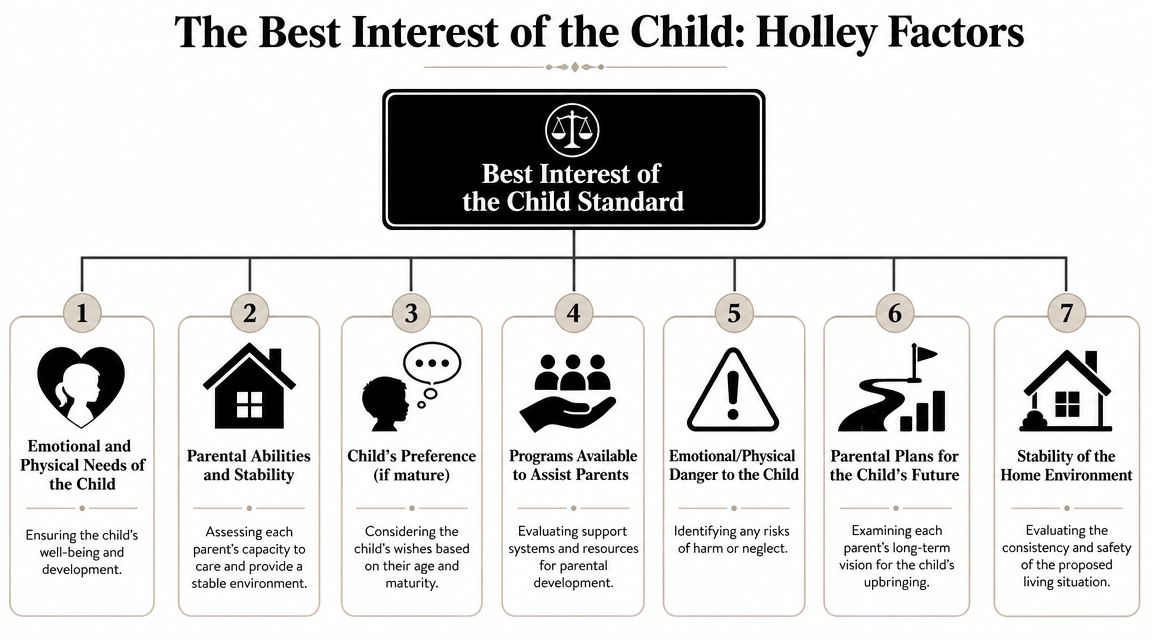
Texas courts decide custody under the best interest of the child standard, and Harris County guidance shows that judges look for concrete evidence of parenting capacity, not just statements of preference. The factors commonly weighed include emotional support, physical care, parental involvement, and stability. Judges may also consider the opinions of children at least 12 years old and may appoint an Amicus Attorney to represent the child's interests, as noted in this Harris County custody guidance.
What that standard means in real life
Parents hear legal phrases and assume the process is subjective. It isn't as loose as it sounds. The court is testing whether your home life, your choices, and your parenting history support your child's emotional and physical well-being.
A useful way to think about it is a scorecard.
| Court concern | What the judge wants to see |
|---|---|
| Emotional support | Your child feels secure, encouraged, and appropriately cared for |
| Physical care | You handle meals, hygiene, health needs, sleep, and daily supervision |
| Parental involvement | You show up for school, appointments, activities, and routine responsibilities |
| Stability | Your home, schedule, and decision-making are consistent and reliable |
| Child's input | If the child is old enough, the court may consider that view |
| Protection of the child | You reduce conflict and avoid exposing the child to harmful behavior |
Translate legal factors into proof
If you want the court to see you as the parent who best meets your child's needs, tie each legal factor to evidence.
- Parental abilities connect to records of homework help, school contacts, doctor visits, medication management, and daily routines.
- Home stability connects to a safe living space, a dependable schedule, and realistic plans for before-school care, after-school care, and transportation.
- Emotional support connects to how you talk to and about the other parent, especially in front of the child.
- Plans for the child connect to a practical vision for school, activities, counseling if needed, and holiday scheduling.
Judges don't reward the parent who makes the biggest accusation. They respond to the parent who can back up ordinary parenting with credible detail.
What parents in Harris County should remember
Some parents assume the child can make the choice. That's not how it works. A child's preferences may matter in some situations, particularly when the child is at least 12, but preference is not the whole case. The court still decides based on the child's best interests.
That means your job is not to recruit your child to your side. Your job is to become the parent whose record shows steadiness, maturity, and follow-through.
Building Your Evidence A Practical Checklist
On hearing day, the parent with the thickest stack of angry screenshots rarely comes out ahead. In Harris County, the parent who usually presents better is the one who can show a clear, organized record of daily parenting, steady judgment, and a workable plan for the child.
That matters even more in a busy court system. Judges, associate judges, mediators, and ad litems often have limited time to sort through a family's history. If your proof is scattered, repetitive, or overly emotional, good facts can get lost. Your evidence needs to be easy to follow and tied to specific parenting issues.
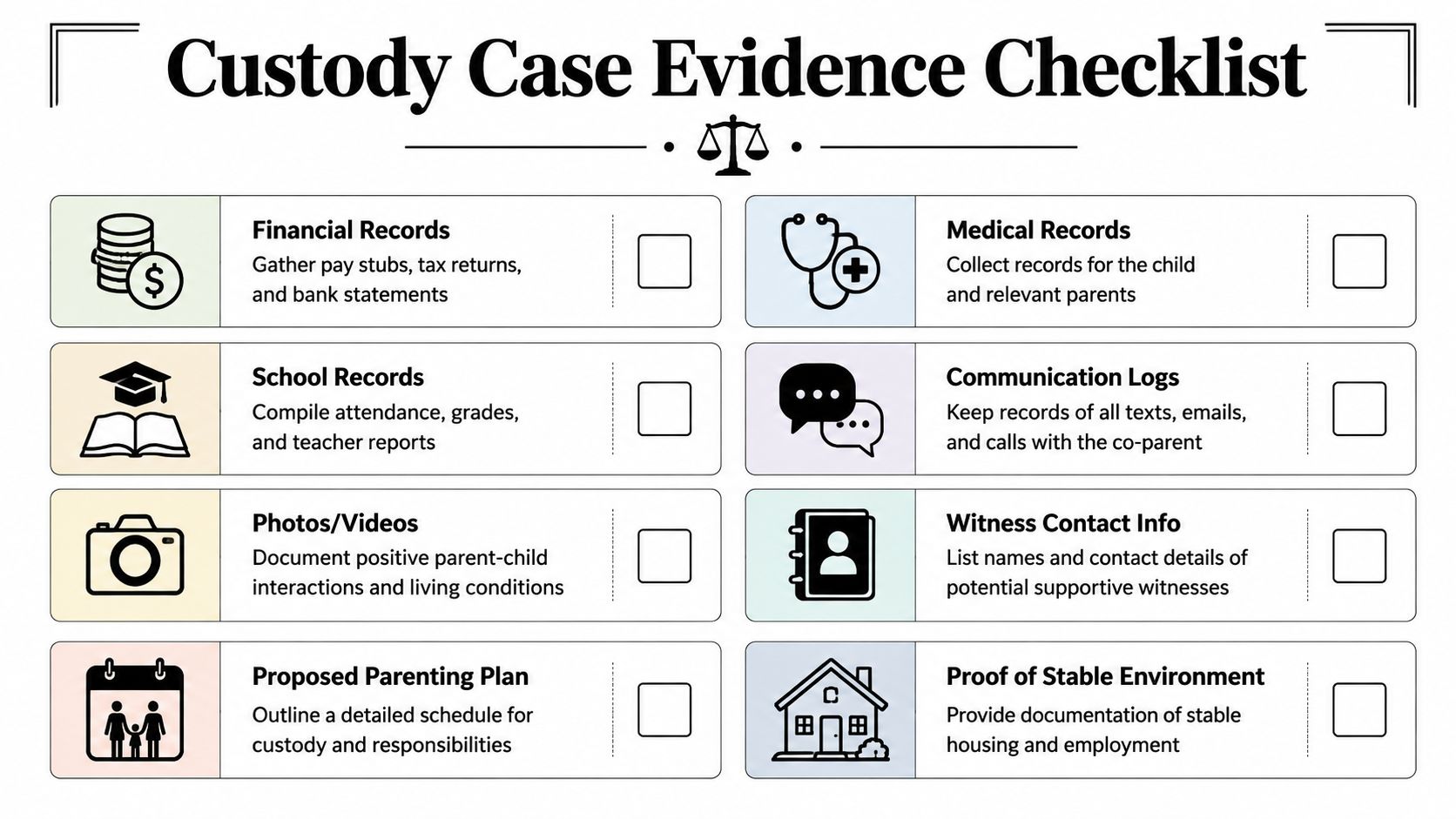
In many cases, parents should expect to exchange a Financial Information Statement, tax returns, and recent pay records before trial, as noted in this Harris County custody and divorce overview.
Start with records that show real parenting
Start close to the child's daily life. Good custody evidence usually comes from ordinary routines, not dramatic moments.
School records
Keep attendance notices, report cards, teacher emails, conference notes, tutoring records, and messages showing who signs forms, responds to school problems, and stays involved.Medical records
Save appointment confirmations, prescription information, therapy schedules, vaccination records, and discharge paperwork. If you handle medication, follow-up care, or referrals, keep proof of that too.Communication logs
Preserve texts, emails, and parenting app messages in date order. Courts often learn a lot from tone. Calm, child-focused communication helps. Threats, insults, and repeated conflict hurt.Calendar records
Use a calendar that shows pickups, drop-offs, extracurricular activities, missed visits, and schedule changes. A simple timeline often carries more weight than a long explanation.
Social media can become evidence faster than many parents expect. Before you post, read this guide on how Texas judges view social media in custody cases.
Here is a practical discussion many parents find helpful:
Organize your proof so a Harris County judge can follow it quickly
A strong file reads in chronological order and answers basic questions without making the court hunt for context. Who took the child to school? Who arranged counseling? Who offered a reasonable solution when a problem came up? Who followed through?
Use a checklist like this:
Keep a dated parenting journal
Record exchanges, overnights, school events, medical appointments, behavioral concerns, and any major change affecting the child. Keep entries factual and brief.Collect third-party documents
Neutral records from schools, doctors, counselors, coaches, and daycare providers usually carry more weight than a parent's summary of what happened.Document the home environment
Photos can help if the other side raises questions about sleeping arrangements, cleanliness, safety, or study space. Make sure the photos are current and accurate.Gather financial records early
Pay stubs, tax returns, health insurance information, and child-related expenses often become important sooner than parents expect.Save proof of your co-parenting efforts
Keep messages where you shared school information, offered extra time, proposed a practical schedule, or tried to resolve disputes without dragging the child into them.
One caution from practice. Do not flood your file with ten versions of the same point. Five hundred screenshots rarely help if three clear messages prove it better.
A persuasive custody file shows a pattern of responsible parenting, not a pile of frustration.
If you are not sure what to keep, start with anything that answers this question: how does this document help prove that my home, my decisions, and my conduct serve my child well? That approach keeps your evidence focused and makes mediation, temporary orders, and trial preparation much easier.
Key Milestones in a Harris County Custody Case
One reason custody disputes feel overwhelming is that parents often don't know what stage comes next. Once you understand the sequence, the process gets less mysterious and more manageable.
Family law makes up about 40% of all civil cases before Harris County courts, and judges may have as many as 4,000 pending cases on their dockets, which is one reason preparation matters so much in local family court, as explained in this discussion of Harris County court volume and procedure. That same local guidance notes that most courts require mediation before temporary-order hearings when custody is at issue, and parents in qualifying cases must take a co-parenting course.

The usual path through the case
Most Harris County custody matters move through a familiar pattern.
Filing the case
One parent files the petition. That filing sets the legal process in motion and defines the issues the court will decide.Service and response
The other parent gets formal notice and has a chance to respond. Early decisions made here can affect tone, pace, and advantage.Temporary orders phase
Temporary orders often govern where the child stays, how exchanges happen, who pays support, and how decisions get made while the case is pending.Mediation
In many Harris County custody disputes, mediation is part of the process before a temporary-orders hearing when custody is contested.
Why local compliance matters
Because dockets are crowded, a parent who misses deadlines, ignores required classes, or shows up unprepared often creates unnecessary problems. Courts notice that. So do mediators, opposing counsel, and evaluators.
A few practical examples:
- Take the co-parenting course promptly if your case requires it.
- Organize the paperwork early instead of waiting until the week of a hearing.
- Bring a focused temporary plan for school, transportation, and communication.
- Treat mediation seriously because many custody cases narrow or resolve there.
If you're preparing for the first major court date, this guide on how to prepare for a custody hearing can help you think through documents, testimony, and presentation.
Evaluations and child-focused appointments
Some contested cases involve more than parent testimony. Harris County family-court resources note that custody evaluations may be ordered in contested conservatorship or possession and access cases. In some matters, the court may also appoint an Amicus Attorney or Guardian Ad Litem to represent the child's interests, as covered earlier.
That changes the case dynamic. Once an evaluator or child representative enters the picture, your consistency matters even more. People outside the family conflict may now be assessing your home, your judgment, your communication style, and whether you can support the child's relationship with the other parent when appropriate.
Crafting a Compelling Parenting Plan
A good parenting plan does more than divide time. It shows the court that you have thought carefully about your child's life after the hearing ends.
Parents sometimes treat the plan as a formality. That's a mistake. A detailed, child-centered proposal can become one of the most persuasive pieces of your case because it turns general claims about stability into a working blueprint.
What a strong parenting plan should cover
A convincing plan is specific enough to be followed on an ordinary Tuesday, not just on paper. It should address:
- Possession schedule with weekdays, weekends, holidays, school breaks, and summer
- Transportation details including pickup locations, start times, and what happens if someone is late
- Education decisions such as who handles enrollment issues, tutoring, teacher communication, and school events
- Health care decision-making including routine care, emergencies, therapy, and medication communication
- Communication rules for calls, messages, school updates, and sharing important information
- Conflict-reduction terms that keep the child out of adult disputes
Local detail makes a plan more believable
If your child attends school in Humble ISD, the plan should fit that reality. It should account for the school calendar, commute times, extracurricular activities, and how homework gets handled between households. If one parent works early mornings and the other has more afternoon flexibility, the schedule should reflect that instead of pretending both homes function the same way.
In this aspect, many parents either help themselves or hurt themselves. A realistic proposal shows maturity. An unrealistic one signals that the parent is still arguing with the other adult instead of planning for the child.
The most persuasive parenting plan is usually the one that reduces confusion for the child.
Show cooperation without giving up structure
Some parents think a child-focused plan has to be vague and flexible. That isn't usually true. Children benefit from predictability. Courts often do too.
A solid plan can be firm and still cooperative. It can include methods for swapping days when needed, notice rules for travel, and expectations for sharing school and medical information. It can also set boundaries around new romantic partners, public conflict, and communication during the other parent's time.
When you present a thoughtful parenting plan, you're doing more than asking for rights. You're showing that you can manage responsibility.
Common Mistakes That Can Jeopardize Your Case
Stress pushes parents into bad decisions. The problem is that many of those decisions create evidence the other side can use.
A surprising number of custody problems don't come from one dramatic event. They come from a pattern of small, avoidable mistakes that damage credibility.
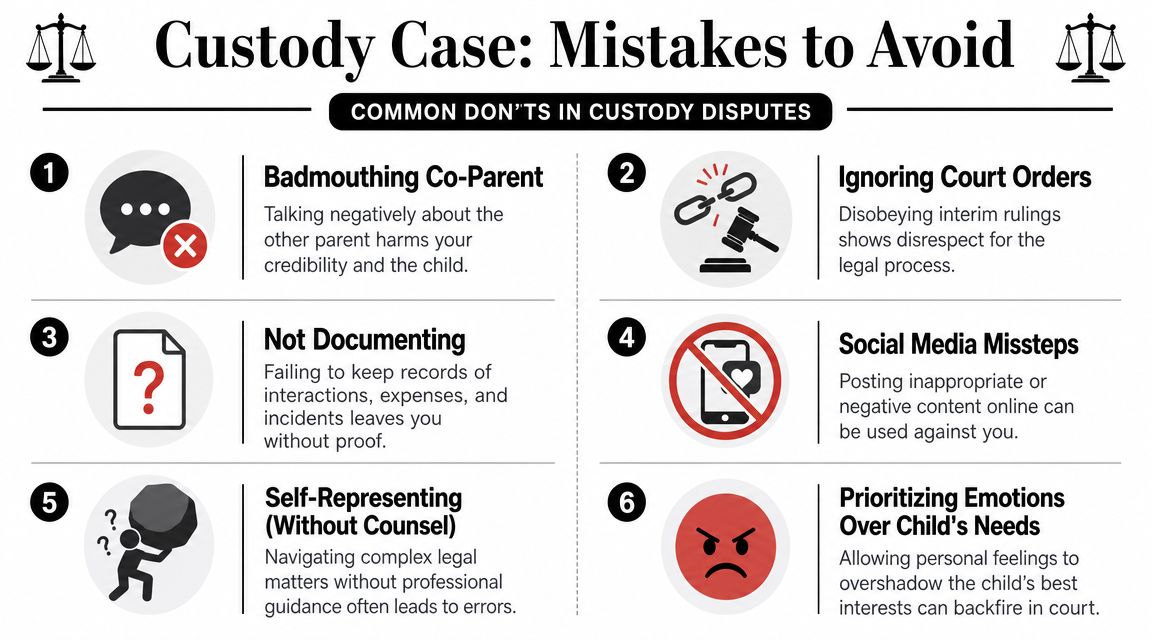
Don't do this. Do this instead
Don't post about the case online
Do keep your social media quiet and disciplined. Even posts that seem unrelated can raise questions about judgment, lifestyle, or honesty.Don't use your child as a messenger
Do communicate directly with the other parent in writing when possible. Children should not carry updates, complaints, or schedule changes.Don't send angry texts
Do write as if a judge may read every message later. Short, polite, factual communication protects you.Don't ignore temporary orders
Do follow them carefully while pursuing changes through proper legal channels. Violating an order to prove a point usually backfires.Don't make claims you can't prove
Do focus on events you can document. Unsupported allegations can hurt the parent making them.
The emotional trap
Parents often believe that visible anger proves love or urgency. In court, it often proves poor control. If you're asking a judge to trust you with major parenting authority, your conduct during litigation becomes part of the evidence.
That doesn't mean you have to be passive. It means you need to be deliberate.
| Harmful move | Better move |
|---|---|
| Badmouthing the other parent | Speak to the child in neutral, age-appropriate terms |
| Refusing all cooperation | Cooperate where you can and document where you can't |
| Showing up unprepared | Bring a folder, timeline, and proposed solutions |
| Focusing on adult grievances | Keep bringing the discussion back to the child's needs |
If your case theme is "the other parent is terrible," you're already in trouble. If your case theme is "here is how I meet this child's needs," you're on stronger ground.
Protect your credibility
Credibility is one of the few assets that affects every phase of a custody case. Once a judge, mediator, evaluator, or amicus attorney doubts your judgment, every later explanation gets harder.
So be careful with new relationships, public arguments, missed exchanges, and casual exaggeration. The safer path is usually the quieter one.
An Atascocita Attorney Is Your Strongest Advocate
A parent can walk into a Harris County courtroom with good intentions and still lose ground fast. The problem usually is not love for the child. It is failing to present the facts in a way the court can act on, especially in a busy county where judges expect parents to arrive organized, realistic, and ready for mediation.
An attorney who regularly handles custody cases in this area helps turn concern into a plan. That includes identifying the facts that matter, preparing for temporary orders, anticipating mediation pressure points, and shaping your position around what Harris County judges often look for. Stability, follow-through, sound judgment, and a workable plan for the child.
The child custody representation available through Law Office of Bryan Fagan – Atascocita TX Lawyers focuses on conservatorship, possession, and related family law disputes. For parents in Atascocita, Humble, and nearby communities, local counsel also brings practical value that generic advice cannot. Which courts move faster. Which issues tend to draw scrutiny. How to prepare a case theme that fits the facts and does not overpromise.
That kind of judgment matters.
Custody litigation is personal, but good case work is disciplined. A strong lawyer helps you make careful decisions about what to file, what to document, when to push, and when settlement serves your child better than a courtroom fight. In many cases, the best outcome comes from showing the other side, and the court, that you are the parent with the steadier hands and the clearer plan.
If you need clear guidance for a custody dispute in Atascocita, Humble, or anywhere in northeast Harris County, schedule a free consultation with Law Office of Bryan Fagan – Atascocita TX Lawyers. A confidential conversation can help you understand your options, protect your relationship with your child, and decide your next step with more confidence.