Skip to content
When you're facing a child custody issue, it feels like your entire world is on the line. Searching for a "child custody lawyer Atascocita Texas" isn't just about finding legal help; it's the first step toward securing your child's future and protecting your role in their life. The right attorney provides more than just legal advice—they offer a clear strategy and a steady, compassionate hand through one of life's toughest challenges, right here in our community.
Your Guide to Child Custody in Atascocita
If you're dealing with a child custody case in Atascocita, Humble, or anywhere in northeast Harris County, it's easy to feel lost. The court system can seem like a maze of confusing terms and procedures. Our goal at The Law Office of Bryan Fagan is to provide clear, step-by-step guidance to our neighbors, helping you feel confident as you make choices for your family.
Everything in a Texas custody case comes down to one core principle: the best interest of the child.

The Best Interest of the Child Standard
So, what does that actually mean for a family in Atascocita? A Harris County judge will look at a whole host of factors to decide what's best for your child. It’s not just one thing, but a complete picture of your family’s life.
They'll weigh things like:
- The emotional and physical needs of your child, now and in the future.
- Any potential danger to the child's well-being.
- How stable each parent's home life is.
- Each parent's ability to provide for the child and be an active part of their life.
A judge examines your family's specific situation to figure out the arrangement that will help your child thrive. This is exactly why having an attorney who understands the local Atascocita and Harris County court system is so critical—they know what our local judges focus on and how to present your case effectively.
Understanding Texas Child Custody Terminology
Before you get too deep into the process, it helps to know the language. The legal terms used in a Texas family court can be confusing, but they're important. Here’s a quick reference guide to the key terms you'll hear in your Atascocita custody case.
| Legal Term | Plain English Explanation for Atascocita Parents |
|---|---|
| Conservatorship | This is what Texas calls "custody." It outlines your legal rights and responsibilities as a parent. |
| Joint Managing Conservator (JMC) | The most common outcome. It means both parents share decision-making power. One parent is usually named the "primary" and gets to decide where the child lives (often within a certain area, like Humble ISD). |
| Sole Managing Conservator (SMC) | A less common arrangement where one parent has the exclusive right to make major decisions. This is typically only ordered in cases involving family violence, substance abuse, or neglect. |
| Possessory Conservator | This is the non-primary parent in a JMC arrangement. They have visitation rights (a possession schedule) and also share in making decisions for the child. |
| Standard Possession Order (SPO) | A default visitation schedule set by Texas law. It's designed to give the non-primary parent possession of the child on the first, third, and fifth weekends of a month, plus holidays and summer visits. |
Knowing these terms will help you better understand court documents and communicate more effectively with your attorney and the court.
Conservatorship: Joint vs. Sole
In Texas, the court's starting point is that both parents should be involved in their child's life. This is why Joint Managing Conservatorship (JMC) is the standard arrangement. In a JMC, both you and the other parent share the rights and duties of raising your child. One of you will be named the "primary" conservator, which gives you the right to determine the child's residence and receive child support.
Sole Managing Conservatorship (SMC) is rare. A judge will only order it if there's clear evidence that giving one parent exclusive rights is necessary to protect the child. This usually involves serious issues like a history of family violence, neglect, or drug abuse.
The reality for many Texas families is that custody is a major part of their divorce. With roughly 50% of divorces involving children under 18, understanding this process is crucial. The courts strongly prefer to keep both parents actively involved, which is why joint managing conservatorship is the default.
We've dedicated our practice to helping Atascocita parents navigate these complex laws and fight for the best possible outcome. To learn more about the specifics, you can review our in-depth information on child custody. When you're ready to talk about your unique situation, we invite you to schedule a free, confidential consultation at our local Atascocita office.
How to Choose the Right Atascocita Custody Lawyer
Finding the right lawyer is probably the most critical decision you'll make for your child custody case. It’s about more than just legal representation; you're looking for an advocate, a guide, and a steady hand to help you navigate a deeply personal and stressful process. A quick Google search will give you a list of names, but it won't tell you who truly understands the unique dynamics of families here in Atascocita and Humble.
You don't just need any lawyer. You need a child custody lawyer in Atascocita, Texas, who has a proven track record right here in the Harris County courts.

Look for Local Experience and Focus
There's a real home-court advantage when your lawyer regularly works within the Harris County family court system. They know the judges, understand the temperaments of opposing counsel, and are familiar with the specific procedures that can make or break a case. This isn't something you can learn from a textbook; it comes from years of hands-on experience in the very rooms where your family's future will be decided.
Also, be sure to find a firm that specializes in family law. A general practice attorney might be perfectly competent, but they simply don't have the deep, focused knowledge of a dedicated family lawyer who lives and breathes these issues every single day. The law is always changing, and you want someone who is on top of every nuance.
Prioritize Clear and Consistent Communication
Nothing adds to the stress of a custody case like an attorney who goes silent on you. You need—and deserve—to know what's happening. A solid attorney-client relationship is built on trust, and that starts with clear, consistent communication. You should feel completely comfortable asking questions and confident you’ll get straight answers in a timely manner.
When vetting potential lawyers, ask them directly about their communication policies. The best firms follow modern client communication best practices to ensure you're never left wondering about the status of your case.
Expert Tip: That first meeting is more than just a fact-finding mission—it’s a chemistry check. Pay attention to how the lawyer makes you feel. Do they actually listen to your story? Do they explain complex legal terms in a way you can understand? You should feel heard and supported from the very beginning.
Take Advantage of Free Consultations
Fortunately, families in our area have excellent access to highly qualified attorneys, which means you don't have to settle. Many of the top firms, including the Law Office of Bryan Fagan, offer free consultations for this very reason. It's a no-risk way for you to find an advocate you genuinely trust. You can see the deep roster of local talent available to Atascocita families on Super Lawyers.
We encourage you to schedule a free, no-obligation consultation at our Atascocita office. It’s your chance to share your story in a supportive environment, learn about your legal options, and see if our team is the right partner for you and your family.
Preparing for Your First Lawyer Consultation
Walking into that first meeting with a child custody lawyer can feel daunting. But this initial consultation is also your first real opportunity to gain clarity and a sense of control. You're not just hiring an attorney; you're finding a partner to guide you through one of the toughest times of your life.
The key to making this meeting truly count is preparation. When you walk in organized, we can move past basic fact-finding and dive straight into what really matters: your goals, your concerns, and a potential strategy. It transforms the hour from an overwhelming info-dump into a productive conversation about protecting your family's future here in Atascocita or Humble.
What to Bring to the Table
Before you come in, spend a little time pulling together any documents you have that relate to your situation. Don't worry if your files are a mess or if you can't find everything—that's perfectly normal. The more you can bring, though, the clearer the picture we can build from day one.
Think about gathering these items:
- Any Existing Court Orders: This is a top priority. If you have a divorce decree, temporary orders, or a protective order, please bring a copy. These documents dictate the current legal landscape of your family.
- A Brief Timeline of Events: You don't need a novel, just a simple, chronological list. Note key dates like when you separated, when the living arrangements for the kids changed, or any major incidents that could impact a custody decision.
- Basic Financials: Recent pay stubs for you are essential. If you have any idea about the other parent's income, that's helpful too. This gives us a starting point for any child support discussions.
- Your Child's Information: Having your child’s birth certificate is great. Also, jot down the names of their schools, teachers, doctors, and daycare centers in the Atascocita or Humble area. This helps establish their routine and community ties.
A consultation is a two-way street. While we are learning about your case, you should be getting a feel for our firm and our approach. Clients who come in prepared almost always leave feeling more empowered and with a clearer understanding of their next steps.
Questions You Should Be Asking
Once we have a handle on the facts, the floor is yours. This is your chance to vet your potential attorney and make sure you feel a sense of trust and confidence. Don't be shy—go beyond just the cost and dig into their actual experience and how they handle cases like yours.
Here are some of the most important questions you can ask a potential child custody lawyer in Atascocita, Texas:
- How much of your practice is focused on family law, especially custody cases right here in Harris County?
- From what you've heard so far, what do you see as the biggest strengths of my case? What are the potential hurdles?
- How will we communicate? Will I be speaking with you directly, or will most of my contact be with a paralegal?
- What’s your experience with the judges at the Harris County Civil Courthouse? Are you familiar with how they tend to rule in custody matters?
- What’s your general approach? Do you push for mediation first, or are you ready to go to court if that's what it takes?
To help you get organized, we've put together a simple checklist. Think of this as your "go-bag" for your first legal consultation. Having these documents and questions ready will ensure you walk out with a clear head and a solid plan.
Your Atascocita Child Custody Consultation Checklist
| Item/Question Category | Specifics to Prepare or Ask |
|---|---|
| Legal Documents | Bring any existing court orders (divorce, temporary orders, protective orders). |
| Personal Timeline | Create a simple, chronological list of major events (separation date, moves, etc.). |
| Financial Information | Gather your last few pay stubs and any knowledge of the other parent's income. |
| Child-Related Info | Note your child's school, doctor, and extracurricular activities. Bring their birth certificate. |
| Lawyer's Experience | Ask: "What percentage of your cases are Harris County child custody disputes?" |
| Case Assessment | Ask: "What are the immediate strengths and weaknesses you see in my case?" |
| Communication Style | Ask: "Who will be my primary point of contact? How often can I expect updates?" |
| Court Familiarity | Ask: "What is your experience with the judges who might hear my case?" |
| Strategy & Philosophy | Ask: "Do you prefer to settle through mediation, or are you more of a litigator?" |
| Costs & Fees | Ask: "Can you explain your retainer fee and hourly billing structure?" |
Having these items on hand will make your meeting incredibly efficient. The goal is to leave feeling like you have a knowledgeable advocate in your corner—someone who not only understands Texas law but also gets the unique dynamics of our local community.
You want a partner for the road ahead. When you're ready to find yours, we're here to help. You can start by scheduling a free, confidential consultation at our Atascocita office.
The Custody Process in Harris County Courts
If you’re facing a child custody case in Atascocita or Humble, the unknown can feel overwhelming. What actually happens in the Harris County court system? Understanding the legal road ahead can give you a much-needed sense of clarity and control. Let's walk through the typical journey, from the first filing to the final resolution, so you know exactly what to expect.
Your case officially gets underway when you or the other parent files an Original Petition with the court. This is the legal document that asks a judge to step in and make decisions on conservatorship (who makes decisions for the child), possession (the visitation schedule), and child support. Once filed, the other parent has to be formally notified through a legal process known as "service."
The First Steps: Temporary Orders and Discovery
Soon after filing, your attorney will likely push for a Temporary Orders Hearing. This is a critical early-stage hearing where the judge establishes the ground rules that will govern your lives while the case is ongoing. These orders cover everything from a temporary visitation schedule and who gets to stay in the family home to how much child support will be paid.
These temporary orders often set the tone for the final outcome, which is why preparation is so important. You can get a head start by reading our guide on how to prepare for your custody hearing.
Getting ready for these early meetings with your lawyer doesn't have to be complicated.
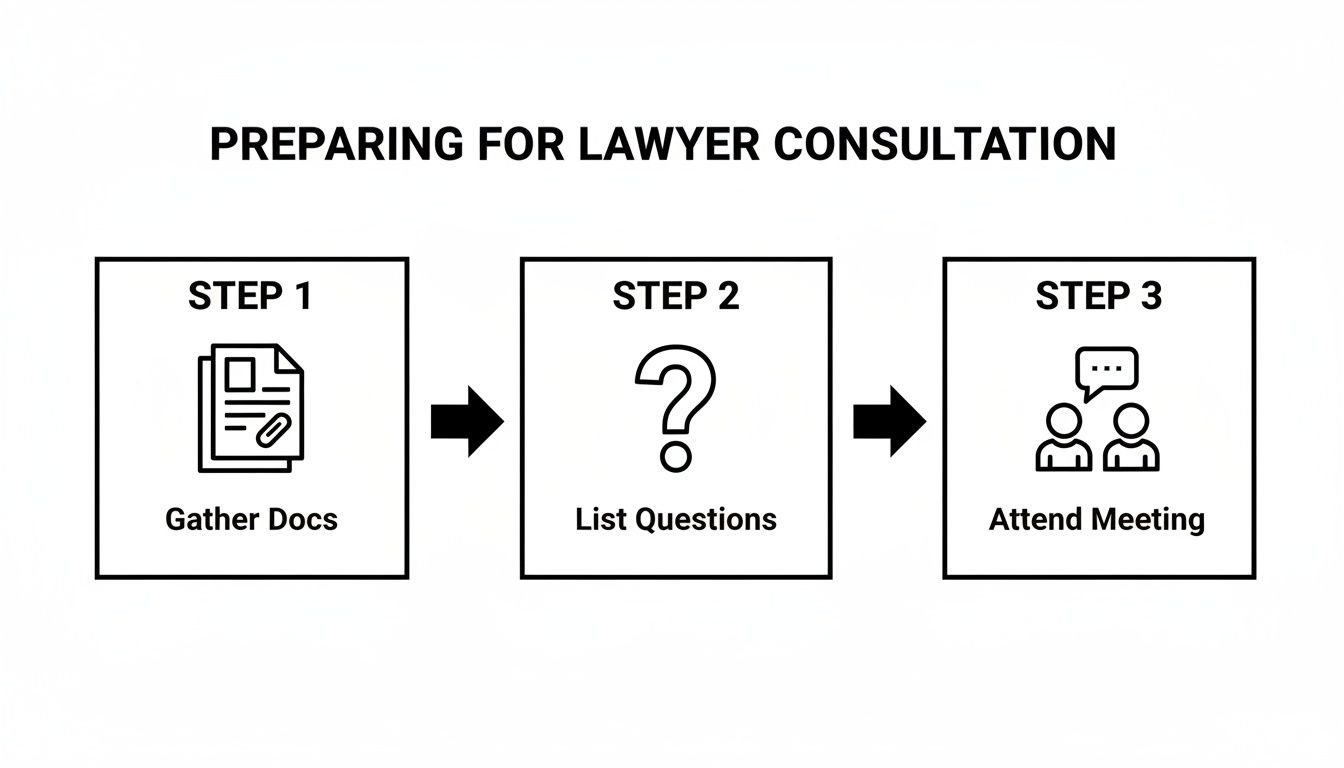
As you can see, a little organization goes a long way. Having your documents in order and your questions written down makes your consultation much more productive.
While all this is happening, your case also moves into the discovery phase. This is the formal, fact-finding part of the lawsuit where both sides exchange information. It’s where we use legal tools to build your case, including:
- Interrogatories: Written questions the other side must answer under oath.
- Requests for Production: Formal requests for documents like financial statements or emails.
- Depositions: Sworn testimony given out of court in front of a court reporter.
A seasoned Atascocita child custody lawyer will strategically use discovery to uncover the facts needed to advocate for you and your children effectively.
The Power of Mediation
In Harris County, judges almost always require parents to try mediation before they will grant you a final trial date. This is a structured, confidential negotiation session where you, the other parent, and your respective attorneys meet with a neutral mediator.
The goal of mediation isn't about one person "winning." It's a chance for you and the other parent to take control and craft a custom parenting plan that actually works for your unique family—instead of having a judge, who doesn't know you, make those personal decisions for you.
The results speak for themselves. Mediation successfully resolves 70-80% of disputes without the need for a costly and stressful trial. It not only saves money and heartache but also helps preserve a working co-parenting relationship, which is invaluable for your child's well-being down the road.
If you can reach a full agreement, your lawyers will draft a Mediated Settlement Agreement (MSA). This is an ironclad, binding contract that forms the basis of your final court order. If some issues remain unresolved, your case will then be set for a final trial, where a judge will hear the evidence and make the final call.
Protecting Your Parental Rights and Your Child's Future
When you're facing a child custody case, it's about far more than just what the visitation calendar looks like. For families here in Atascocita and Humble, a custody order is the blueprint for your child's financial security, your rights as a parent, and the stability of your family for years to come. It all comes down to the details—child support, possession schedules, and what happens when one parent doesn't follow the rules.
Trying to navigate this on your own, especially within the Harris County court system, can lead to simple mistakes with long-term, painful consequences for your family. An experienced local lawyer can help you avoid these pitfalls.

Securing Fair Possession and Child Support
Texas law is gender-neutral on paper, but achieving fair outcomes requires skilled advocacy. This is especially true when hammering out possession schedules and calculating child support. The financial stakes are enormous, and ensuring the other parent pays what they're ordered to can be a constant struggle for families in northeast Harris County.
The statistics tell a stark story. While 88% of custodial parents (most of whom are mothers) have a child support order in place, a shocking 23% of female-headed households report not receiving any of the payments they are owed. This financial gap puts incredible strain on families. You can explore how these child custody success rate statistics affect parents right here in our area.
This is precisely why having an experienced child custody lawyer in Atascocita, Texas, is non-negotiable. Our focus is on getting fair and, just as importantly, enforceable support orders from the very beginning.
Advocating for Fathers' Rights
Many fathers in our community feel like they're fighting an uphill battle to get the parenting time they and their children deserve. The numbers back this up: on average, fathers in Texas end up with around 33% of the possession time, which falls short of the national average. A good attorney knows how to challenge outdated norms and fight for what's best for the child.
We often push for more modern, balanced arrangements that truly benefit the child, such as:
- A true 50/50 possession schedule: This model gives both parents an equal footing and shared responsibility.
- The 2-2-5-5 rotation: This schedule provides great consistency for kids, who spend two nights with Parent A, two with Parent B, then five with Parent A, and five with Parent B.
These schedules encourage genuine co-parenting and ensure children get the full involvement of both parents. In particularly difficult or high-conflict cases, we can also request the court appoint a neutral expert to represent the child's interests directly. If you'd like to understand that role better, you can learn more about a Guardian ad Litem in our detailed article.
Critical Mistakes That Can Sink Your Case
How you behave during a custody battle matters—a lot. We have seen cases won and lost not on the facts, but on a parent's conduct. Even small missteps can completely destroy your credibility with a judge.
Here are some of the most common—and damaging—mistakes you must avoid:
- Airing grievances on social media: Never post about your case, the other parent, your new social life, or anything related. Assume the other side is taking screenshots of everything. It can and will be used against you.
- Ignoring court orders: You must follow temporary orders to the letter, even if you disagree with them. Defying a judge's direct order is the fastest way to lose their trust and damage your case.
- Putting the kids in the middle: Never talk badly about the other parent to your children or try to use them as messengers. Judges see this as a parent failing to act in their child’s best interest, and they have no patience for it.
Your rights and your child’s future are our only priority. If you're heading into a custody dispute, reach out to the Law Office of Bryan Fagan. We offer a free, confidential consultation at our Atascocita office to help you understand your options and feel supported.
Common Questions for Atascocita Custody Cases
When parents in Atascocita and Humble walk into our office, their minds are often racing with questions. The uncertainty can be overwhelming, and that’s completely understandable. Getting straight answers is the first step toward regaining a sense of control. Here, we address some of the most common concerns we hear every day from families in our community.
How Much Does a Child Custody Lawyer in Atascocita Cost?
This is a critical question for every family. The truth is, the total cost can vary greatly based on how much you and the other parent disagree. Most family law attorneys in our area, including our firm, operate on an hourly basis and start with an initial payment known as a retainer.
A retainer is a deposit for your lawyer's time and expertise, and your attorney bills their hours against this fund. For custody cases in the Atascocita area, a retainer might be a few thousand dollars if you and your co-parent have already reached a basic agreement. However, it can be significantly more if you're gearing up for a high-conflict court battle. Transparency is key. In any consultation, you should get a clear, written explanation of the retainer, hourly rates, and the specific factors that could drive costs up.
Key Takeaway: The more you and the other parent can agree on outside of court, the lower your legal fees will be. A case that settles in mediation is almost always significantly less expensive than one that goes to a full-blown trial.
Can My Ex and I Create an Agreement Without Going to Court?
Yes, absolutely—and this is often the best path forward for families. The vast majority of custody cases here in Harris County are actually settled without a judge making the final call. You have a couple of fantastic tools at your disposal to make this happen:
- Mediation: This is the most common route. You, the other parent, and your respective lawyers sit down with a neutral professional called a mediator. Their job is to guide the conversation and help you find common ground on everything from the possession schedule to child support.
- Collaborative Law: This is a less adversarial, team-based process. You, your ex, and your lawyers all sign a binding agreement to resolve every issue without going to court. It’s a powerful way to keep the process respectful and focused on your family's unique needs.
Both of these paths put you in the driver's seat, save a tremendous amount of money and stress, and lay the groundwork for a healthier co-parenting relationship down the road.
What Happens if We Live in Different School Districts?
This is a huge issue for families in our interconnected communities, especially between places like Atascocita, Humble, and Kingwood. To keep things stable for the child, most Texas custody orders include what's called a geographic restriction. This legally requires the primary parent to live within a specific boundary.
This boundary could be as broad as Harris County or as specific as Humble ISD or even a particular zip code. If you're the primary parent and a job or new relationship requires you to move outside that line, you can't just pack up and go. You'll need either written permission from the other parent or a new order from the judge. The whole point is to make sure the other parent can realistically maintain their visitation schedule and stay involved in the child's life.
How Do I Change an Existing Custody Order?
Life changes. A new job, a remarriage, or a child's evolving needs can make an old custody order unworkable. While these orders are intended to be stable, they aren't set in stone. However, to legally modify a court order in Harris County, a simple handshake agreement isn't enough—you have to go back to court.
To be successful, you must prove two key things to the judge:
- There has been a material and substantial change in the circumstances of the child or one of the parents since the last order was signed.
- Changing the order is in the best interest of the child.
What qualifies as a "material and substantial change"? It could be anything from a parent's relocation or significant income change to a child's request to live with the other parent (if they are old enough). An experienced child custody lawyer in Atascocita, Texas, can analyze your specific situation and advise you on whether it meets the legal threshold for a modification.
Trying to figure all this out on your own can feel impossible, but you don't have to. The team at The Law Office of Bryan Fagan – Atascocita TX Lawyers is here to bring clarity and a steady hand to your situation. We are a part of this community, and we are dedicated to supporting our neighbors. Let's talk about it. Schedule your free, no-obligation consultation with our local attorneys today by visiting us at https://www.atascocitaattorneys.com.