Skip to content
Going through a divorce is one of life’s most challenging experiences. When one or both spouses are in the military, the process becomes layered with unique rules and regulations. For military families here in Atascocita, Humble, and the surrounding communities, finding a military divorce lawyer isn't just a good idea—it's essential for protecting your rights and securing your family's future.
At The Law Office of Bryan Fagan, we understand the sacrifices military families make. Our Atascocita-based team is dedicated to providing warm, knowledgeable, and approachable guidance to help you navigate this complex journey with clarity and confidence.
The Unique Terrain Of Military Divorce In Atascocita
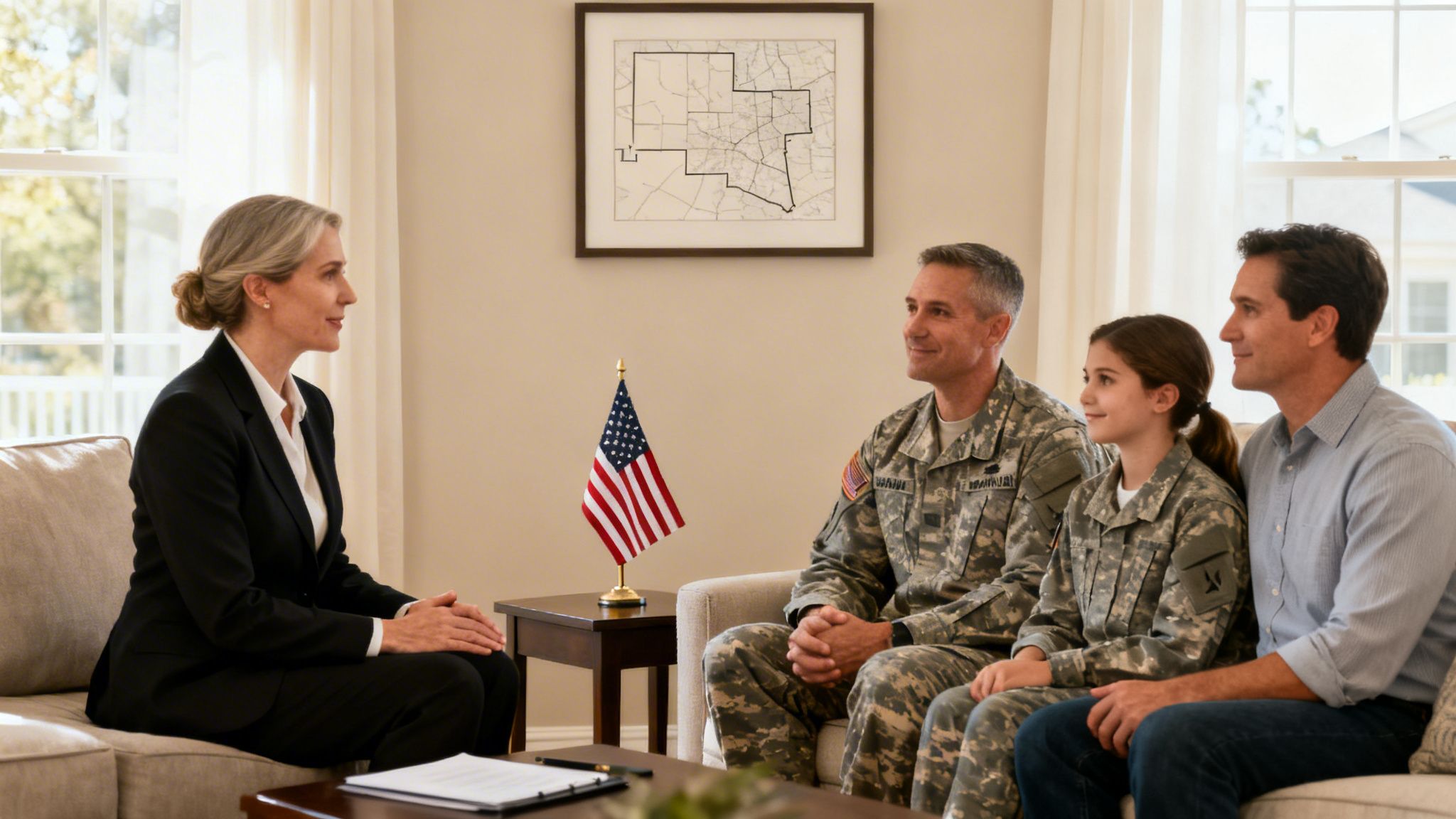
For families in our community, from Atascocita and Humble to the broader northeast Harris County area, a military divorce isn’t just a standard Texas divorce with a few extra forms. It's a completely different legal landscape where state family law and complex federal military rules overlap.
Think of it this way: your case is governed by the Texas Family Code, but it's also heavily influenced by powerful federal acts. These laws, created specifically to address the realities of military life, dictate everything from where you can file for divorce to how a military pension is divided.
Key Federal Laws You Must Know
Two specific federal laws are the foundation of any military divorce. Understanding what they do is the first step toward a fair and stable outcome for your family.
- The Servicemembers Civil Relief Act (SCRA): This law is fundamentally about fairness. It protects active-duty service members from being put at a legal disadvantage because of their military service. For example, if your spouse is deployed and cannot respond to a divorce filing, the SCRA allows the court to temporarily pause the proceedings to ensure they have a chance to participate.
- The Uniformed Services Former Spouses’ Protection Act (USFSPA): This is the act that gives Texas courts the authority to treat military retirement pay as community property and divide it in a divorce. Without the USFSPA, a non-military spouse might have no claim to this significant asset, which was earned through shared sacrifice.
So, how do these federal rules make a military divorce different from a typical civilian divorce in Harris County? The differences are significant.
Key Differences Between Civilian And Military Divorce In Texas
This table highlights the primary legal and procedural distinctions that Atascocita residents must consider when facing a military divorce versus a standard civilian divorce.
| Aspect of Divorce | Civilian Divorce In Harris County | Military Divorce In Harris County |
|---|---|---|
| Jurisdiction & Residency | Based on living in Texas for 6 months and the county for 90 days. | Can be more complex; may be based on the service member's legal residence (home of record) or where the family is stationed. |
| Serving Divorce Papers | Standard personal service by a process server or constable. | Complicated by location (e.g., on-base, overseas deployment). Specific base protocols may apply. |
| Case Timeline | Follows standard Texas timelines; minimum 60-day waiting period after filing. | Can be delayed under the Servicemembers Civil Relief Act (SCRA) if a spouse's duties interfere with their ability to participate. |
| Asset Division | Governed exclusively by Texas community property law. | Texas law applies, but the division of military retirement pay is governed by the Uniformed Services Former Spouses' Protection Act (USFSPA). |
| Child Custody & Support | Standard Texas "best interest of the child" factors apply. Possession orders are fairly routine. | Must create a detailed parenting plan that anticipates deployment, relocation (PCS moves), and long-distance communication. |
These distinctions show why you can't approach a military divorce with a one-size-fits-all strategy. It requires a nuanced, community-focused understanding that only comes with experience.
More Than Just Paperwork
A military divorce presents practical challenges that need a local attorney who gets it—someone who understands both the law and the lives of military families in our community.
At The Law Office of Bryan Fagan in Atascocita, we know that a military divorce is about real people, not just legal statutes. It's about protecting the future for families right here in our community who have already sacrificed so much for our country.
From proving residency in Harris County while a spouse is stationed thousands of miles away to drafting a custody plan that works around deployments, every step has a military-specific angle. This is where having a compassionate, experienced guide makes all the difference.
Our mission is to demystify this complex process and turn confusing legal jargon into a clear, actionable plan. You need an advocate who knows this terrain inside and out. To get clarity on your own situation, please schedule a free consultation with our Atascocita team. We're here to help.
Where To File Your Military Divorce In Texas
One of the very first questions we tackle in a divorce is deceptively simple: "Where do we actually file the paperwork?" For military families, the answer can be more complicated than you'd think. With frequent moves, deployments, and out-of-state assignments, figuring out which court has the legal authority—or jurisdiction—is a critical first step.
Getting this wrong can stall your case before it even begins, leading to frustrating delays or even having it dismissed. If you’re living in Atascocita or Humble, your goal is almost always to handle the divorce right here in Harris County. To do that, however, you must meet the residency requirements of the Texas Family Code.
So, how does that work when military life has you on the move? The law draws a sharp line between where you physically live and where your legal "home" is.
Understanding Domicile Versus Residence
To make sense of jurisdiction, you have to get your head around two key ideas. They sound similar, but in the eyes of the law, they're worlds apart.
- Residence: This is where you’re living right now. If you have an apartment in Atascocita while your spouse is stationed elsewhere, Atascocita is your current residence.
- Domicile: This is your true, legal home—the place you consider your home base and intend to return to. A service member might live in a dozen different places during their career, but their domicile stays put unless they take clear, legal steps to change it.
This distinction is everything for a military family. A service member might be on temporary assignment in California or deployed overseas, but if they’ve always considered Texas home—they vote here, have a Texas driver’s license, and plan to come back—their domicile is still in Texas.
A service member’s “Home of Record” is often powerful proof of their domicile. This is what allows them, or their spouse, to file for divorce in a Texas court even if they aren't physically in the state.
Meeting Texas Residency Requirements
To file for a divorce in any Texas court, the law says at least one of the spouses must have:
- Lived (or maintained a domicile) in Texas for the past six months.
- Lived (or maintained a domicile) in the specific county where they're filing (like Harris County) for the past 90 days.
So, what does this mean for military families in the Atascocita area? Let's look at a couple of common scenarios. If you're the non-military spouse and you've been living here for the required six-month and 90-day periods, you can file in Harris County, no matter where your active-duty spouse is stationed.
Alternatively, if your service member spouse is stationed overseas but has always maintained Texas as their legal domicile, their time spent on active duty elsewhere can be used to meet these residency requirements. This allows them to file for divorce in their home county from anywhere in the world. For a step-by-step guide, you can learn more about the process of filing for a divorce in Harris County.
Choosing the right court is the foundation of your entire divorce case. An experienced local military divorce attorney can review your family’s specific history, including PCS moves and deployments, to confirm that Harris County is the right place to file, ensuring your case starts on solid legal ground right here in our community.
How The SCRA Protects Your Rights And Your Case
When you're an active-duty service member, the last thing you should worry about during deployment is a legal battle back home. The federal government understands this, which is why the Servicemembers Civil Relief Act (SCRA) exists. For military families here in Atascocita, its purpose is straightforward: to ensure a divorce is handled fairly, even when one spouse’s military duties make it impossible for them to participate.
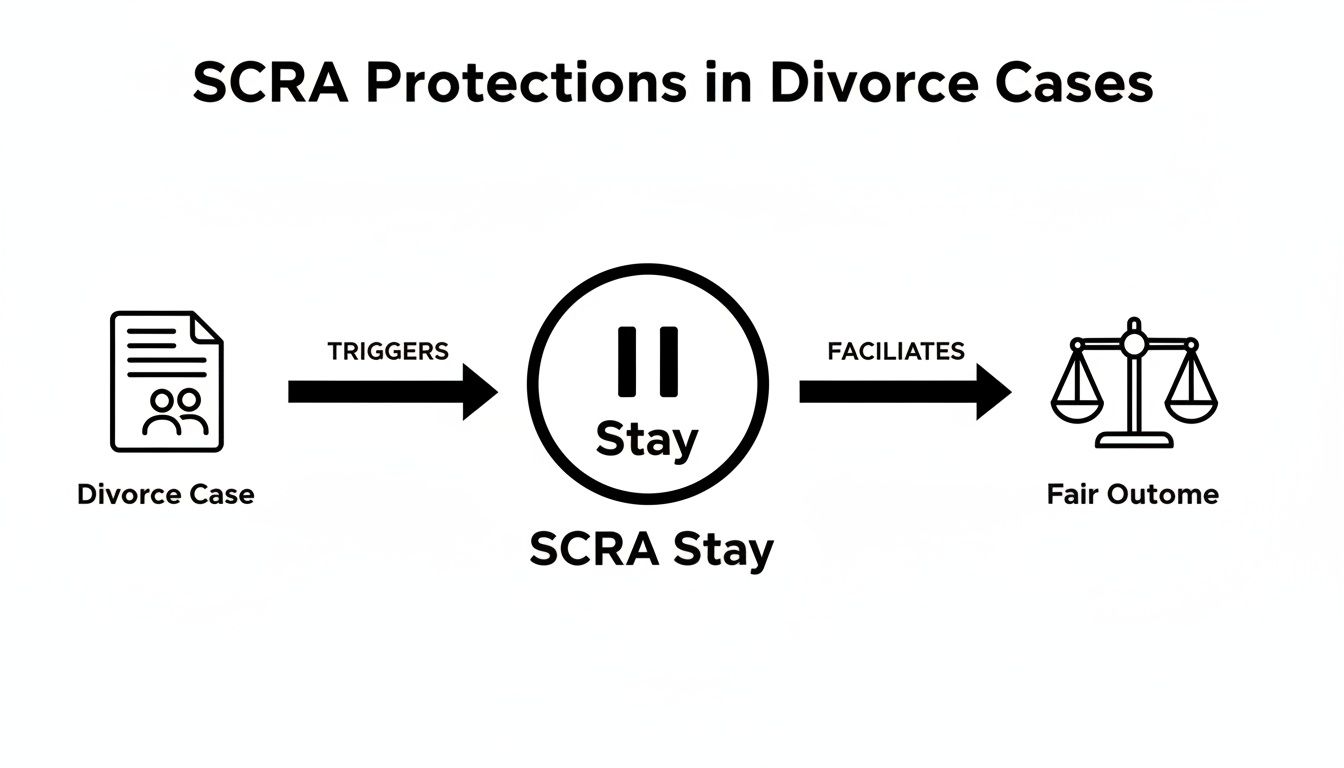
Think of the SCRA as a court-ordered "pause button." This legal pause, known as a stay, allows an active-duty service member who is deployed or otherwise unable to be involved in their divorce to ask the Harris County court to temporarily halt the case.
It's crucial to understand this isn't a "get-out-of-divorce-free" card. The stay is temporary. It doesn't cancel the divorce or make financial obligations disappear. What it does do is ensure the service member gets a fair chance to respond, attend hearings, and have a voice in the major decisions that will affect their life.
What A Stay Means For Your Case
To obtain an SCRA stay, a service member must show the court proof, typically in the form of a letter from their commanding officer, explaining why their current duties make it impossible to participate in legal proceedings.
For a family in Atascocita, this means if one spouse is deployed overseas, they cannot be blindsided by a default judgment. The SCRA ensures the case waits until they have a meaningful opportunity to appear in court and protect their rights.
Once the request is properly made, a judge will typically grant an automatic stay for at least 90 days. If the service member's duties still prevent participation after that, their attorney can ask for more time. These extensions aren't guaranteed; a judge will want to see continued proof that the delay is truly necessary and not just a tactic to drag things out.
Protecting The Rights Of The Non-Military Spouse
While the SCRA is a vital shield for service members, it can create uncertainty for the non-military spouse back home in Humble or Atascocita. What happens if you need financial support to pay the bills? What about the kids? Does your life get put on hold indefinitely?
This is where having a skilled military divorce lawyer in Atascocita on your side is critical. The law is meant to be a shield, not a sword. It cannot be used to unfairly or endlessly delay a divorce just to avoid responsibility.
Your attorney can fight to protect your interests in several key ways:
- Challenging Unreasonable Delays: If a requested stay seems excessive or you suspect it's being used improperly, your lawyer can argue before the judge why the case needs to move forward.
- Requesting Temporary Orders: A stay on the final divorce doesn't necessarily freeze everything. We can ask the court to issue temporary orders for child support, spousal support, or use of the family home, providing stability while the case is pending.
- Facilitating Communication: An experienced attorney knows how to work with the other side to find creative solutions, such as arranging for the service member to participate remotely via video conference, allowing the case to proceed even during deployment.
Ultimately, the court's job is to balance the protections of the SCRA with the rights of both spouses to reach a fair and timely resolution. It ensures military service doesn't unfairly tip the scales of justice.
At The Law Office of Bryan Fagan, we know the ins and outs of the SCRA and how it impacts families right here in Harris County. If you're worried about how a stay might affect your divorce, we can give you clear, honest answers. Schedule a free, no-obligation consultation with our Atascocita team today to understand your rights and chart a path forward.
Dividing Military Retirement And Benefits In A Texas Divorce
For military families, retirement pay isn't just a number on a statement. It represents decades of service, sacrifice, and moving your life around the globe. In a divorce, it’s often the most significant asset, which is why understanding how it gets divided is critical for your future. This is where the guidance of an experienced military divorce lawyer in Atascocita is non-negotiable; we navigate the tricky intersection of federal law and Texas’s community property rules for you.
The framework for dividing military retirement rests on a federal law called the Uniformed Services Former Spouses’ Protection Act (USFSPA). Before the USFSPA, Texas courts couldn't touch military retirement. This act was a game-changer, giving state courts the power to treat a service member’s "disposable retired pay" as property to be divided in a divorce.
Texas Community Property And Military Pensions
Here in Texas, we operate under community property law. The basic idea is that assets you and your spouse acquire during your marriage belong to both of you. Thanks to the USFSPA, this now includes the portion of a military pension earned while you were married.
This is a point we can't stress enough for families in Atascocita and Humble. Your share isn't automatic—it must be correctly calculated and explicitly awarded in your final divorce decree. For a deeper dive into this, take a look at our guide on what is community property in Texas.
The unique pressures of military life are well-documented, and unfortunately, this can strain a marriage. Divorce rates in the military—which have historically been higher for enlisted personnel than for officers—show just how different the stressors can be. For Harris County families, this means you need an attorney who gets it, someone who has handled the specific challenges of dividing a military pension under the USFSPA.
Debunking The "10/10 Rule"
One of the most common and costly myths we encounter is the "10/10 Rule." Many people come to our Atascocita office worried they get nothing because their marriage didn't last 10 years while their spouse served 10 years in the military. That is completely false.
The 10/10 Rule has nothing to do with if you get a share of the retirement pay. It only controls how you get paid.
If your marriage meets that 10/10 threshold, the Defense Finance and Accounting Service (DFAS) can pay your portion directly to you. It's a convenient, automatic process. If your marriage was shorter, you are still entitled to your community share. The difference is that the payment must come directly from your ex-spouse as ordered by the court, which makes having a lawyer to enforce the decree essential.
Just as the SCRA (another key military law) can pause a case to ensure a fair process, the USFSPA is designed to ensure a fair division of the assets you both earned during the marriage.
Other Critical Military Benefits To Consider
The pension is a huge piece of the puzzle, but it's not the only one. A thorough divorce settlement must account for other valuable benefits that are easy to overlook.
- Survivor Benefit Plan (SBP): Think of this as an insurance policy. It's an annuity that provides a former spouse with an income stream if the service member passes away first. This is not automatic. It must be elected and ordered in the divorce decree to lock it in for the former spouse.
- Thrift Savings Plan (TSP): This is the military's version of a 401(k). Any contributions and earnings that accumulated during the marriage are community property and can be divided in your Texas divorce.
- Disability Pay: It's crucial to understand that VA disability benefits and military disability retirement pay are treated differently. Under federal law, these are generally not considered community property and cannot be divided by a Texas court.
Beyond these direct benefits, it’s also wise to consider how military service might connect with other federal retirement plans. For example, military buy-back programs can be a significant financial factor for those who later enter federal civilian service. You can learn more in A Guide To Military Buy Back For Federal Retirement.
Dividing these complex assets is a minefield. One small mistake in the paperwork can cost you hundreds of thousands of dollars over a lifetime. At The Law Office of Bryan Fagan, our Atascocita team has the experience needed to protect your rights and financial future. Schedule a free consultation with us today to ensure you get the share of the benefits you rightfully earned.
Creating A Stable Parenting Plan For Military Families

For any parent, a divorce marks the start of a new co-parenting relationship. When one of you serves in the military, however, the typical challenges are magnified. The constant possibility of deployments, sudden relocations (PCS moves), and unpredictable schedules creates a level of uncertainty that most civilian families here in Atascocita never have to consider.
Our main goal is to create a detailed parenting plan—what we call a possession order in Texas—that gives your children a sense of security while being realistic about the demands of military life. This isn't about using a generic template. It’s about crafting a custom-fit solution that works for your family, both today and down the road.
Planning For Deployments And Relocations
The biggest hurdle for military families is, without a doubt, distance. A typical Texas possession schedule, which often gives one parent the first, third, and fifth weekends of a month, is completely impractical when a parent is stationed in another state or deployed halfway around the world.
Therefore, we must build a plan that anticipates these realities from the start. A well-crafted military parenting plan will always include specific language covering:
- Long-Distance Communication: This sets clear expectations for staying in touch. We'll outline how often and by what means you'll communicate, such as nightly video chats or regular emails and phone calls.
- Extended Summer & Holiday Possession: To make up for missed weekends throughout the school year, the out-of-state or deployed parent should get generous, uninterrupted blocks of time during school breaks.
- Travel Arrangements: The plan must be crystal clear about who pays for and arranges the children's travel for visitation. Getting this in writing prevents future arguments and protects your co-parenting relationship.
By planning for these things now, you avoid constant conflict later and give your kids the predictable routine they need, even when their parents live far apart.
In Texas, a deployed parent’s custody rights are protected. They cannot lose their parental rights simply because their military service takes them away from home.
Designating A Temporary Caregiver During Deployment
What happens if a single parent in the military gets deployment orders? Texas law has a specific and powerful answer. A deploying parent has the right to temporarily designate someone they trust—like a grandparent, an aunt, or even a new spouse—to step into their shoes and exercise their visitation time with the children.
This isn't an informal agreement; it must be done through a formal, written court order. This ensures the children can maintain those important family bonds and have stability in a familiar setting, perhaps right here in the Humble or Atascocita area, while their parent is serving our country.
Calculating Child Support With Military Pay
Child support in Texas follows state guidelines, but applying them correctly to a military member's income is a specialized skill. The calculation is based on a parent's "net resources," and that includes more than just base pay.
A huge point of confusion is often the non-taxable allowances. It's critical to know that both the Basic Allowance for Housing (BAH) and Basic Allowance for Subsistence (BAS) are counted as income when calculating child support in Texas. Overlooking these allowances will lead to a child support amount that is significantly lower than it should be, failing to meet your child's needs.
An experienced military divorce lawyer ensures every source of income is accounted for, resulting in a fair and accurate child support order. To understand the basic structure our courts use, you can get a good overview by reading about a Texas standard possession order.
Crafting a parenting plan that can withstand the unique pressures of military life is one of the most critical steps in your divorce. At The Law Office of Bryan Fagan, we have the experience to help Atascocita military families build durable, practical solutions that always put the children’s well-being first.
Why A Specialized Atascocita Lawyer Is Crucial For Your Case
Going through a military divorce with a general family lawyer is a bit like asking a family doctor to perform heart surgery. While they understand the basics, they lack the specific, hard-won knowledge needed for such a high-stakes procedure. When your financial future and family stability are on the line, you can't afford for your attorney to be learning on the job. You need an expert who already knows every twist and turn of the path ahead.
A military divorce isn't just a standard Texas divorce with a few extra forms. It's a different arena, governed by a complex web of federal laws and military regulations that can either protect you or cause serious, long-term problems if mishandled. From navigating the SCRA to properly dividing a pension under the USFSPA, every single step requires a very particular skill set.
How All These Pieces Fit Together
These aren't just abstract legal concepts; they are the interconnected parts of your future. A lawyer who doesn't see the full picture can easily make a mistake in one area that has a disastrous domino effect on another.
- Where to File vs. When to Proceed: A sharp attorney knows more than just which Harris County courthouse to file in. They understand how the SCRA can pause proceedings and how to work within those rules to keep your case moving forward without violating your spouse's rights—or stalling your life indefinitely.
- Pensions and Parenting: The division of a military pension is a cornerstone of your long-term financial security. At the same time, your parenting plan needs to be rock-solid and deployment-proof to protect what’s most important: your relationship with your children. An experienced lawyer ensures these two critical pillars of your divorce are handled with the precision they demand.
Handling these issues properly requires more than a quick Google search. It takes an advocate who has guided families right here in Atascocita and Humble through these exact same challenges, time and time again.
Local Experience Makes a World of Difference
It's no secret that military life comes with unique pressures. Divorce rates for active-duty personnel have often hovered around 3% to 3.5%, a figure that often outpaces the civilian population. You can see the data for yourself by reviewing the research on military divorce rates published by the Pentagon. For military families in Harris County, this isn't just a statistic; it's a reality that underscores the need for representation that truly understands the culture.
We know the sacrifices your family has made. Our entire focus is on providing the specialized legal support you need to turn the page and begin your next chapter with confidence and peace of mind.
Choosing the right attorney is the most critical decision you'll make. You need a local partner who can translate confusing military rules and Texas law into a clear strategy designed to protect you, your finances, and your family.
The Law Office of Bryan Fagan is proud to be part of the Atascocita community. We aren't just lawyers in an office building; we're your neighbors, dedicated to serving the military families who make northeast Harris County a great place to live. Let our experience bring you the peace of mind you deserve.
Your future is too important to leave to chance. Call us to schedule a free, no-obligation consultation at our Atascocita office. We’re here to listen and ready to help you find the best path forward.
Answering Your Questions About Military Divorce in Texas
If you’re considering a military divorce, your head is probably swimming with questions. That's completely normal. From our Atascocita office, we’ve guided countless local families through this process, and we’ve heard it all. Here is some step-by-step guidance on the most common concerns we address every day.
Can I File for Divorce While My Spouse Is Deployed?
Yes, you can absolutely begin the divorce process in Texas even if your spouse is on deployment. Here is the practical guidance on how it works:
- File the Petition: You start the process by filing an Original Petition for Divorce in Harris County, assuming you meet the residency requirements.
- Understand the SCRA: Be aware of the Servicemembers Civil Relief Act (SCRA). This federal law allows a deployed service member to request a "stay," which is a temporary pause on the court proceedings.
- Navigate the Stay: This stay is designed to ensure your spouse can fully participate in the divorce without their military duties getting in the way. It is not a way to avoid the divorce. We can help you file for temporary orders for support during this period and ensure the case moves forward as soon as is practical.
We Were Married for Less Than 10 Years. Do I Get Any of the Military Pension?
This is easily the biggest misconception we see. Many residents of Atascocita and Humble mistakenly believe that if they weren't married for 10 years, they get nothing from their spouse's military retirement. That's simply not true.
The "10/10 Rule" is about how you get paid, not if you get paid. It only determines if the Defense Finance and Accounting Service (DFAS) will pay you directly.
Here’s the step-by-step reality in Texas:
- Community Property Governs: Texas is a community property state. This means any portion of the retirement benefits earned during your marriage is a marital asset.
- Calculate the Marital Share: We help you calculate the exact share you are entitled to based on the length of the marriage and the service member's time in the military.
- Secure Your Share in the Decree: Even with a nine-year marriage, you are entitled to your share. The court will order your ex-spouse to pay you directly, and our team can help you enforce that order if needed.
Does My Spouse's Housing Allowance (BAH) Count as Income for Child Support?
Yes, it does. When a Texas judge calculates child support, they look at the parent's total financial picture, or what the law calls "net resources." Here’s how we ensure a fair calculation:
- Identify All Income: Our first step is to gather all of your spouse's income sources, not just their base pay.
- Include Allowances: Allowances that service members receive, like the Basic Allowance for Housing (BAH) and Basic Allowance for Subsistence (BAS), are included in the calculation. It doesn’t matter that they're non-taxable.
- Ensure a Fair Order: By including all income, we ensure the child support order is fair, accurate, and provides the support your children are entitled to under Texas law.
Will I Lose My Military ID and Tricare After the Divorce?
Whether you can keep benefits like a military ID and Tricare health coverage hinges on what’s known as the "20/20/20 Rule." Here’s how you can see if you qualify:
- First Test: The marriage lasted for at least 20 years.
- Second Test: The service member had at least 20 years of military service.
- Third Test: The marriage and the military service overlapped by at least 20 years.
If you meet all three, you can retain these valuable benefits. If you don't, you may still qualify for temporary health coverage options. We can help you explore all your avenues to ensure you have a plan for healthcare after the divorce.
Navigating a military divorce means dealing with a unique intersection of Texas family law and complex federal regulations. Here at The Law Office of Bryan Fagan – Atascocita TX Lawyers, we’re committed to giving our community's military families the clear, straightforward advice and local support they deserve. To talk about your specific situation and get practical solutions for your case, schedule a free consultation with our team by visiting us at https://www.atascocitaattorneys.com.