Skip to content
You're at the kitchen table after bedtime, looking at a court form, a daycare schedule, and a calendar that suddenly has to make sense for a baby who still wakes at night. Maybe you live in Atascocita, maybe you're driving between Humble and Kingwood, and maybe the other parent just asked for more time than your toddler can handle. In that moment, the phrase step down possession order for young children Atascocita TX stops sounding like legal jargon and starts sounding like the thing that will shape your child's mornings, naps, and handoffs.
Texas family law gives young children a different starting point than older kids. For a child under three, the court does not begin with the usual possession schedule, it looks at what is appropriate under the circumstances and also enters a future order that takes effect on the child's third birthday, when the Standard Possession Order becomes the presumptive baseline under Texas law (Texas Family Code Chapter 153). That's the part many parents miss, and it's why toddler schedules in Harris County often need to be built with more care than a one-page calendar can show.
When an Atascocita Parent First Hears About a Step Down Possession Order
The first time many parents hear the term is not in a calm planning meeting. It's in a hallway outside a courtroom, on a call with a clerk, or after a lawyer says the judge probably won't sign a full weekend schedule for an infant. The parent hears “possession order,” sees a child who still needs help with bottles or nap routines, and realizes the schedule can't be treated like an adult work rotation.
A father in Atascocita might be trying to stay involved while living in a different part of northeast Harris County. A mother in Humble might be trying to protect a baby's sleep pattern while still giving the other parent meaningful time. The emotional problem is the same in both homes. Everyone wants to do right by the child, but nobody wants a court order that ignores real life.
The worry behind the legal phrase
A step-down order usually shows up when a judge needs to balance two things at once. The child needs stability, and the other parent needs a path toward more time. That's why these orders feel so different from the standard schedules people hear about in older-child custody cases.
Practical rule: if your child is under three, the court is thinking about development first, not convenience first.
That can feel frustrating when a parent wants certainty. It can also feel fair when the current schedule is too abrupt for a toddler who barely knows the rhythm of both homes. The law gives the court room to build something narrower at first, then expand it later.
If you're sorting through that first round of questions in northeast Harris County, a Child Custody Lawyer in Atascocita, TX handles custody and conservatorship representation for Atascocita families and can help translate the order into plain English. That kind of guidance matters because the schedule on paper has to work in the world, not just in a courtroom file.
What a Step Down Possession Order Actually Means in Texas
A step down possession order is a court-approved schedule that starts smaller and grows over time. This approach helps build contact in a way a very young child can comfortably handle, starting with close support and gradually increasing independence as comfort and ability grow.
The shape of the schedule
For toddlers and infants, the first stage might be short daytime visits, more frequent handoffs, and fewer transitions that disrupt sleep or feeding. Later stages can add longer periods of possession, and in some cases overnights, once the child is ready for them. The exact order depends on the child and the family, not on a single template that fits every home.
The big difference from the Standard Possession Order is simple. The SPO is a standardized baseline for older children, while step-down orders are built for the early years when the law is more individualized. Texas courts treat children younger than three as a distinct legal category and must enter an order that is appropriate under the circumstances of that child's age, while also entering a prospective order that takes effect on the child's third birthday, when the Standard Possession Order presumptively begins to apply (Texas Family Code Chapter 153).

Why judges use this structure
Very young children do not experience time the way older kids do. A long stretch away from a primary caregiver can feel very different to a toddler than it does to a school-age child. Sleep patterns, daycare routines, and attachment patterns also matter in a way that courts take seriously.
That's why a step-down schedule is often easier to live with than a sudden jump into a full weekend arrangement. It gives the child a chance to move through the change gradually, which is exactly what the word “step-down” is getting at. The schedule steps down the intensity of change for the child, then steps up the other parent's time as the child grows.
How Texas Family Code Chapter 153 Treats Children Under Three
Texas Family Code Chapter 153 treats the period before age three as a separate stage, because a toddler's schedule is not just a smaller version of an older child's schedule. In Harris County, that means the court usually starts with the child's daily reality, feeding times, nap patterns, daycare handoffs, transportation, and how each parent has cared for the child so far, before it writes a possession order that is meant to work in the world. If a parent is asking for a toddler-focused schedule, the judge is looking for a plan that fits the child's age and circumstances, not a rigid calendar copied from an older-child case.
What the judge is really looking at
That kind of order is specific, not random. The judge looks at the child's developmental needs, the caregiving history, how far apart the homes are, and the best-interest factors that make a toddler schedule workable rather than chaotic. Texas law does not push a baby into an older-child pattern just because one parent wants more time.
The Texas Access materials explain that phased-in orders are commonly used for children under age 3, especially when there has been little or no prior contact, and that the noncustodial parent should complete a set number of possession periods before moving to the next stage (Texas Access alternate parenting time and possession orders). In practice, that matters because the court is building a bridge for the child, not asking everyone to jump straight to an older-child schedule.
A Harris County judge may also look for signs that the parents can follow instructions without turning exchanges into conflict. If one parent has been the steady daytime caregiver and the other is just beginning to build routine contact, the court may favor shorter, more frequent visits at first. When parents later need to revise that structure, a modification of visitation attorney in Atascocita can help frame the change around the child's actual routine instead of old assumptions.
Why the third birthday matters so much
The third birthday is the point where the court's approach changes. Before it, the order is customized for the toddler stage. After it, the Standard Possession Order becomes the usual baseline in Texas family cases, and the court can write the future transition into the order so the change is already mapped out when that birthday arrives.
That is why toddler possession orders often feel more like a handoff plan than a fixed weekend schedule. The judge is not only deciding who gets time now, but also how the child moves into the next stage without a sudden shift that may be hard on the child or the parents. A family that is already arguing about pickup times, nap schedules, or missed exchanges will usually need a more careful order than a family with a calm history of shared parenting.
If you are building or challenging an order in Harris County, the details matter. A parent asking for a toddler schedule should be ready to talk about routines, not only rights. The best orders for this age group are usually the ones that match the child's day, fit the parents' distance from each other, and leave the court with a clear path for what happens as the child grows.
Step Down Schedule vs Standard Possession Order Side by Side
A parent usually understands this best when the two models sit next to each other. One is built for babies and toddlers, the other for older children. One starts with more frequent, shorter contact, the other starts with a predictable school-year rhythm.
The Standard Possession Order typically gives the non-primary parent the first, third, and fifth weekends, plus a Thursday possession period during the school year, and it often includes extended summer time in many Texas cases. The step-down model looks different because the child's age is different and the court is responding to that difference.
| Feature | Step Down Order (Under 3) | Standard Possession Order (3 and Older) |
|---|---|---|
| Starting point | Shorter, age-specific contact | Standard calendar-based access |
| Overnights | Often fewer or none at first | More regular overnights |
| Exchange rhythm | More frequent, more gradual | More predictable weekend and weekday pattern |
| Focus | Development, attachment, caregiving history | Standard possession framework |
| Transition point | Changes as the child matures | Begins to apply at age three |
The Texas Access materials note that a common implementation of a phased schedule requires completion of a specified number of possession periods before advancing to the next phase, with the child ultimately transitioning to the SPO after the initial phases are completed (Texas Access children under age 3). That is the legal bridge between infancy and the older-child schedule.
A court order for a toddler is also about logistics. If both homes are in Atascocita or nearby Humble, the handoffs may be easier to manage than they are across a longer drive. If daycare is involved, the exchange plan needs to line up with pickup and drop-off routines, not fight them. The Texas Attorney General's parenting-time overview notes that many guides stop at the formula and do not address school-based pickup, sleep, daycare, or attachment patterns, even though those issues affect how the step-up works in daily life (Texas Attorney General parenting-time overview).
For a more detailed look at the older-child baseline, see Standard Possession Order in Texas.
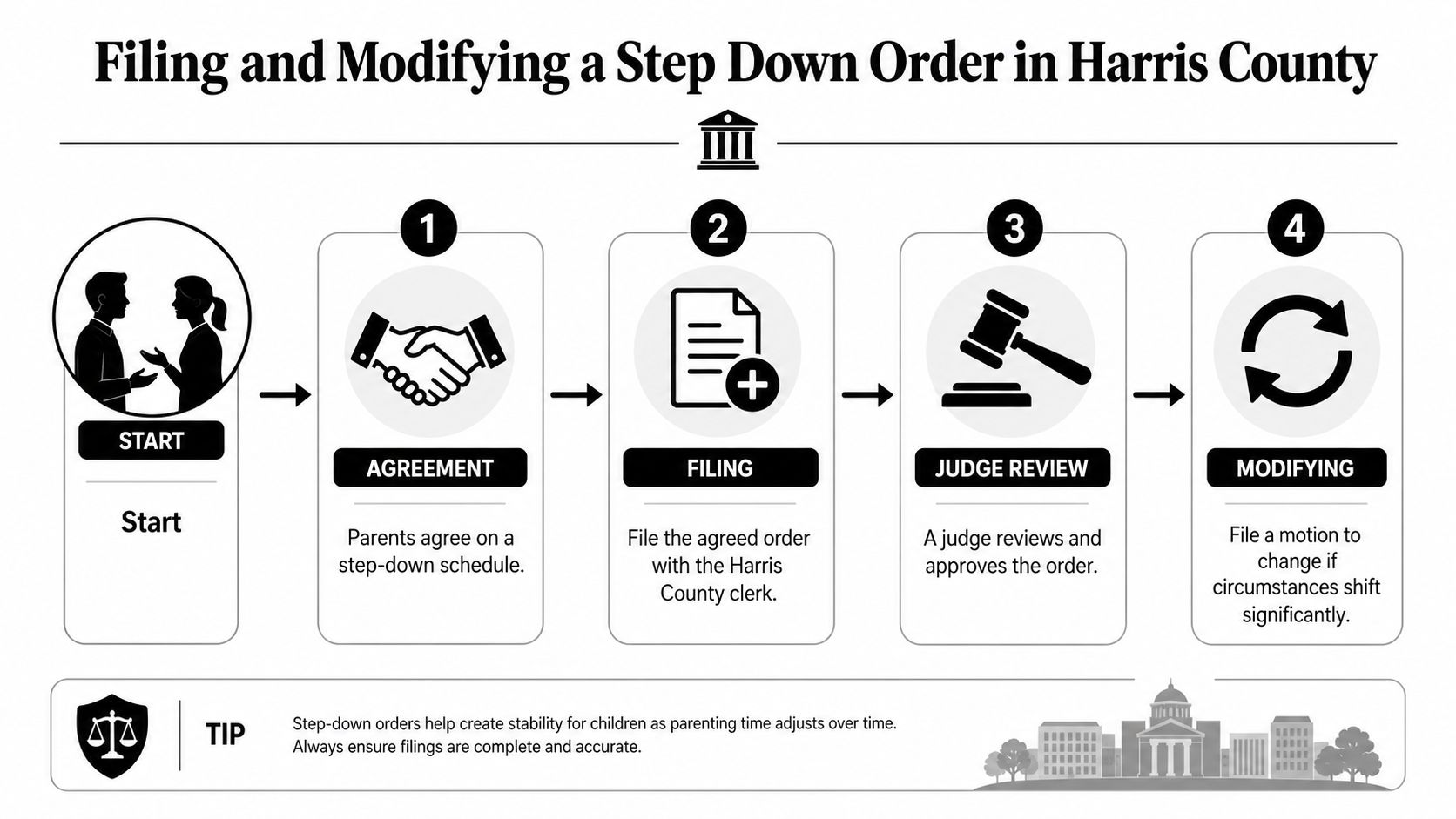
Filing and Modifying a Step Down Order in Harris County
Most parents get a step-down order one of two ways. They either reach an agreement that gets folded into a final divorce or custody decree, or they file a suit affecting the parent-child relationship in Harris County and ask the judge to sign a possession plan. The process usually starts with a petition, then moves into temporary orders if the parents need an interim schedule, then often into mediation, and finally into a final hearing or trial if no agreement is reached.
How the process usually unfolds
The first filing tells the court what you're asking for. After that, temporary orders can set a short-term schedule while the case is pending, which matters a lot when a baby's routine can't wait for months of conflict. Mediation gives the parents a chance to settle the exchange details without a contested hearing, and many families in Atascocita and surrounding Harris County communities resolve the schedule there.
Practical rule: if a toddler schedule is going to work, the order has to be specific enough that both parents can follow it on a tired Tuesday night.
A parent does not need to wait for repeated problems before asking for a change. If the current order no longer fits the child's age or the family's reality, modification can be the right tool. A modification of visitation attorney in Atascocita can help with that process, especially when the schedule needs to change as the child approaches age three or when the current arrangement is no longer practical.
What helps in court
Judges tend to pay attention to concrete evidence. That usually includes the caregiving history, daycare records, pediatrician notes, and proof that each parent has followed prior orders consistently. Those are the kinds of facts that show a schedule is workable for the child instead of just convenient for one parent.
A common implementation of a step-up possession order is a phased schedule that requires completion of a specified number of possession periods before advancing to the next phase, with the child ultimately transitioning to the Standard Possession Order after the initial phases are completed (Texas Access children under age 3). That structure is enforceable because possession orders are court orders, not informal promises. If a parent does not comply, district and county courts can enforce the order.
Sample Phase Schedules Parents in Atascocita Can Picture
A good toddler order is easier to understand when you can sketch it on a calendar. The point is not to mimic someone else's case, because every family looks a little different. The point is to see how a phase can grow without forcing a baby into an older child's rhythm too soon.
A simple early phase for an infant
For a very young child, a phase might begin with short daytime contact spread across the week. A parent could have time on a few separate days, with exchanges that fit around feeding and nap patterns. In a family living near Atascocita's neighborhoods, those handoffs might happen at a neutral location that doesn't add stress to the child or the parents.
That kind of schedule keeps the child in touch with both parents while protecting the routines that matter most. The non-primary parent gets meaningful contact, and the primary caregiver keeps the continuity that infants often need.
A later phase for a toddler
Once the child is older and the schedule feels stable, the order can expand. A toddler may move from daytime visits into limited overnights, then into a fuller pattern if the child tolerates the change well. That progression is exactly why the order is called step-down, then step-up in practice, because the early restrictions are easing as the child matures.
The Texas Attorney General's parenting-time materials note a practical gap that many families face, questions about whether a parent can seek a preemptive modification before the third birthday, how school-based pickup rules affect exchange logistics, and how sleep, daycare, or attachment patterns should influence the timing of the step-up (Texas Attorney General parenting-time overview). Those are not abstract questions in a house with a toddler. They're the difference between a smooth exchange and a rough evening.

If you want to think through a phase chart on paper, start with three questions.
- How does the child sleep? If naps and bedtime are still fragile, overnights may need to wait.
- How does daycare work? If pickup windows are tight, the exchange plan has to match them.
- How has the child handled prior transitions? The order should reflect real behavior, not wishful thinking.
Those examples are illustrative, not one-size-fits-all. They help a parent see how the pieces fit before the order gets drafted.
Mistakes Atascocita Parents Make With Toddler Possession Orders
The hardest mistakes are usually the avoidable ones. Parents often want to be flexible and cooperative, but that can backfire when the order leaves too much room for argument. Toddler cases need precision because toddlers run on routines, not on good intentions.
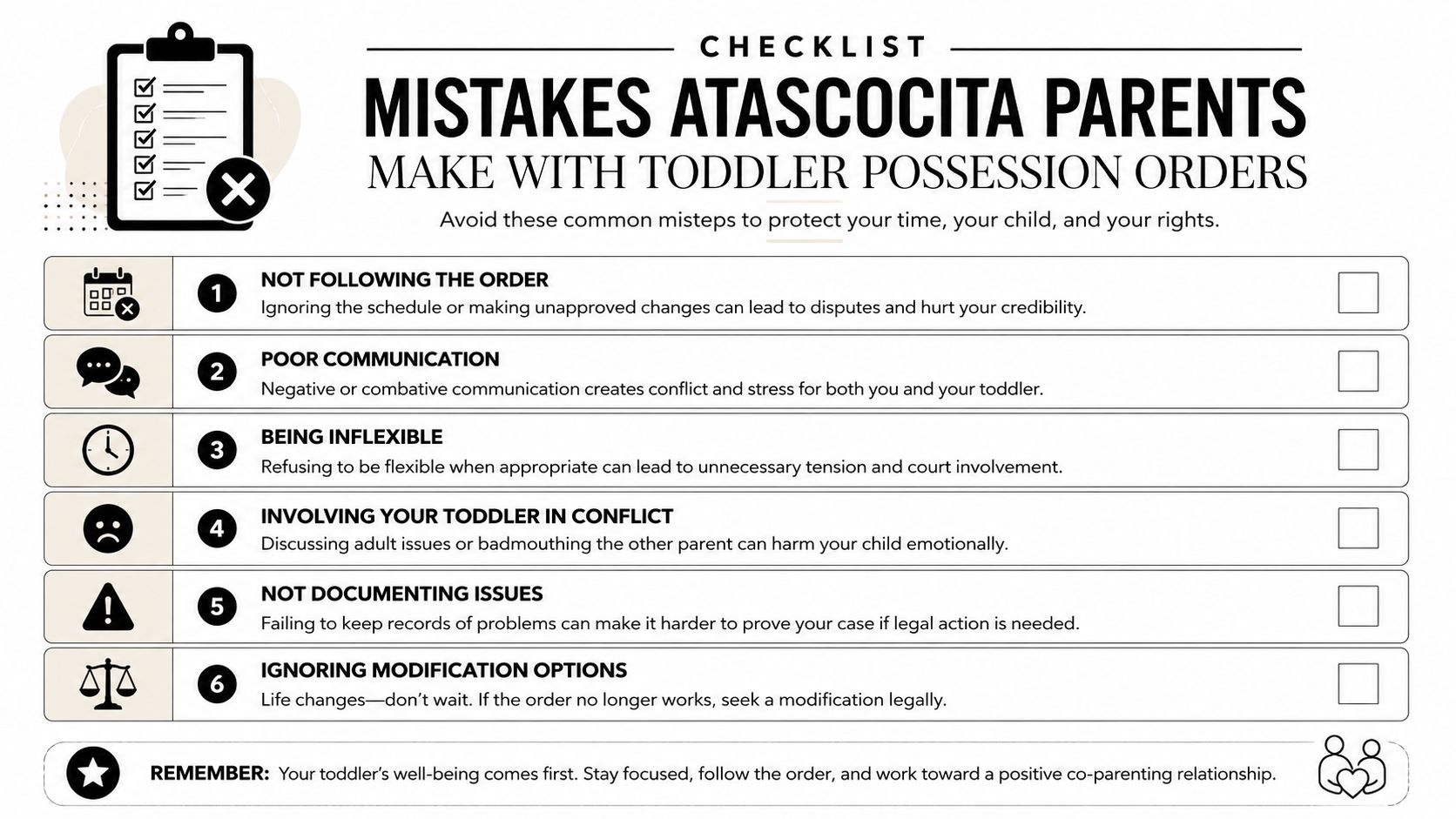
The most common problems
- Overnights too soon. Some parents agree to a full overnight schedule before the child is developmentally ready. That can lead to exhaustion, regression, and conflict over the child's behavior.
- Vague exchange language. If the order doesn't say where and when the handoff happens, the parents may end up arguing in a parking lot.
- No daycare or feeding detail. A toddler's day doesn't stop for the legal calendar. If the order ignores meals, naps, or pickup times, it creates avoidable tension.
- Skipping the future order. A strong toddler order should still address what happens on the third birthday. The court shouldn't have to start from scratch when the child ages into the SPO.
- Treating the order like a favor. A possession order is a court order. If the language is loose, enforcement gets harder.
Courts care about clarity because clarity reduces conflict.
The fix is usually straightforward. Use specific exchange windows. Write out daycare pickup rules. Say what happens when the child completes a phase. Tie the change to the child's age or development, not to a parent's memory of what was said in mediation. That kind of drafting protects everybody, especially the child.
The order also needs to match the family's day-to-day reality. A toddler who is still attached to one caregiver may need a slower transition than a child who is already comfortable moving between homes. That's not favoritism. It's the court trying to fit the schedule to the child's actual needs.
Your Next Step in Atascocita and a Free Consultation
Start with the basics before you talk strategy. Gather daycare and school records, write down the child's current caregiving routine, and note what you want the schedule to look like around the third birthday. If you already have an order, bring the exact language so someone can see whether it needs to be clarified or modified.
A consultation should feel like a conversation about your child, not a speech about legal jargon. If you sit down with a family lawyer, expect to talk through the child's routine, the current exchanges, and whether the order needs a phased structure or a modification. For parents in Atascocita, Humble, and northeast Harris County, the local court context matters as much as the text of the order itself.
If you want to review your options, the free consultation page for an Atascocita family lawyer is a good place to begin. That first meeting can help you figure out whether the issue is drafting, enforcement, or a change that should be filed before the child turns three.
The Law Office of Bryan Fagan – Atascocita TX Lawyers helps families in Atascocita and Humble work through custody, visitation, and modification issues with clear guidance and local focus. If you're trying to understand a step down possession order for young children Atascocita TX, visit Law Office of Bryan Fagan – Atascocita TX Lawyers to talk through your child's schedule, your goals, and the next legal step.