
You can be doing everything right on your end, then you find out your child spent a Saturday night with a sitter, a grandparent, or a new partner while your co-parent was supposed to be on duty. That kind of situation leaves a lot of Atascocita and Humble parents feeling sidelined, especially when they already miss time with their child. A right of first refusal can help address that gap, but only if it is built into the custody order and drafted with care.
For families in northeast Harris County, the issue usually is not whether the idea makes sense. It's whether the order says enough to make it work in real life. The Law Office of Bryan Fagan helps Atascocita parents sort through those details so they can protect parenting time without turning every short absence into another conflict.
When Your Child Is Left With a Sitter During Your Ex's Parenting Time
A common call starts the same way. A parent in Atascocita expects their child to be with the other parent during that parent's possession time, then learns the child was with a babysitter, an aunt, or a family friend. The disappointment is real, and so is the confusion. Many parents assume there must be a built-in rule that says the other parent has to call them first.
That rule can exist, but only if the custody order includes it. In Texas custody practice, a right of first refusal is not automatic. It has to be negotiated or ordered, and without that language, a judge is unlikely to impose it later on their own. A parent who wants this protection needs to raise it early, not after the child has already been handed off to third-party care.
Why this matters in Atascocita households
This issue shows up often when one parent works late, travels, or depends on other caregivers. If the order does not say otherwise, the parent with possession can usually arrange child care as they see fit. That can feel unfair to the other parent, especially when the child is nearby in Humble or Kingwood and could have been with a parent instead of a sitter.
Practical rule: if you want the chance to care for your child before a sitter steps in, the order has to say so clearly.
That's why local parents often want a lawyer to read the order line by line. A short clause can change the entire day-to-day rhythm of custody. For some families, that kind of detail is the difference between feeling shut out and staying meaningfully involved.
If you're also dealing with broader possession concerns, the custody guidance on custody when one parent travels for work in Texas can help you see how these issues overlap in real cases.
What a Right of First Refusal Actually Means in Texas Custody Cases
A right of first refusal means a parent must offer the other parent the chance to watch the child before using a sitter, relative, or daycare. In practice, it gives a parent the first shot at child care during the other parent's possession time when that parent cannot be there personally. The child stays with a parent when possible, rather than being handed to a third party by default.
Texas does not create this rule automatically in the Family Code. It only exists if a temporary order or final order says so. That makes the wording just as important as the idea. If the clause is vague, the parents can end up fighting about what should have been a simple handoff.
The basic mechanics
The usual setup works like this:
- One parent becomes unavailable during their possession time.
- The order requires that parent to notify the other parent.
- The other parent gets the first chance to care for the child.
- If the other parent cannot take the child, third-party care can be used.
That sounds straightforward, but the details carry most of the weight. The order should say how much notice is required, how notice must be delivered, and how long the other parent has to answer. Without that language, one parent may believe they followed the rule while the other parent believes the offer came too late or not in the right form.
Notice methods matter in Harris County courtrooms because judges want a clause parents can follow on a weekday night, not just in theory. Text message may work in some orders. Others may call for phone calls, email, or a specific sequence of contact so there is a record if the issue comes up later. For parents comparing this kind of clause to a more standard schedule, the Standard Possession Order in Texas gives the baseline, and the right of first refusal adds another layer on top of it.
A right of first refusal also does not change conservatorship. It does not decide who has the child's legal rights and duties overall. What it does is increase the chance that the child spends time with a parent instead of a non-parent caregiver, which can matter a lot in the day-to-day rhythm of an Atascocita or northeast Harris County household.
You may also hear this issue come up in broader family discussions, including Grandparents' Rights in Atascocita, because Texas families often care about how much care stays within the family circle and who steps in when a parent is unavailable.
When Harris County Judges Will Approve This Clause
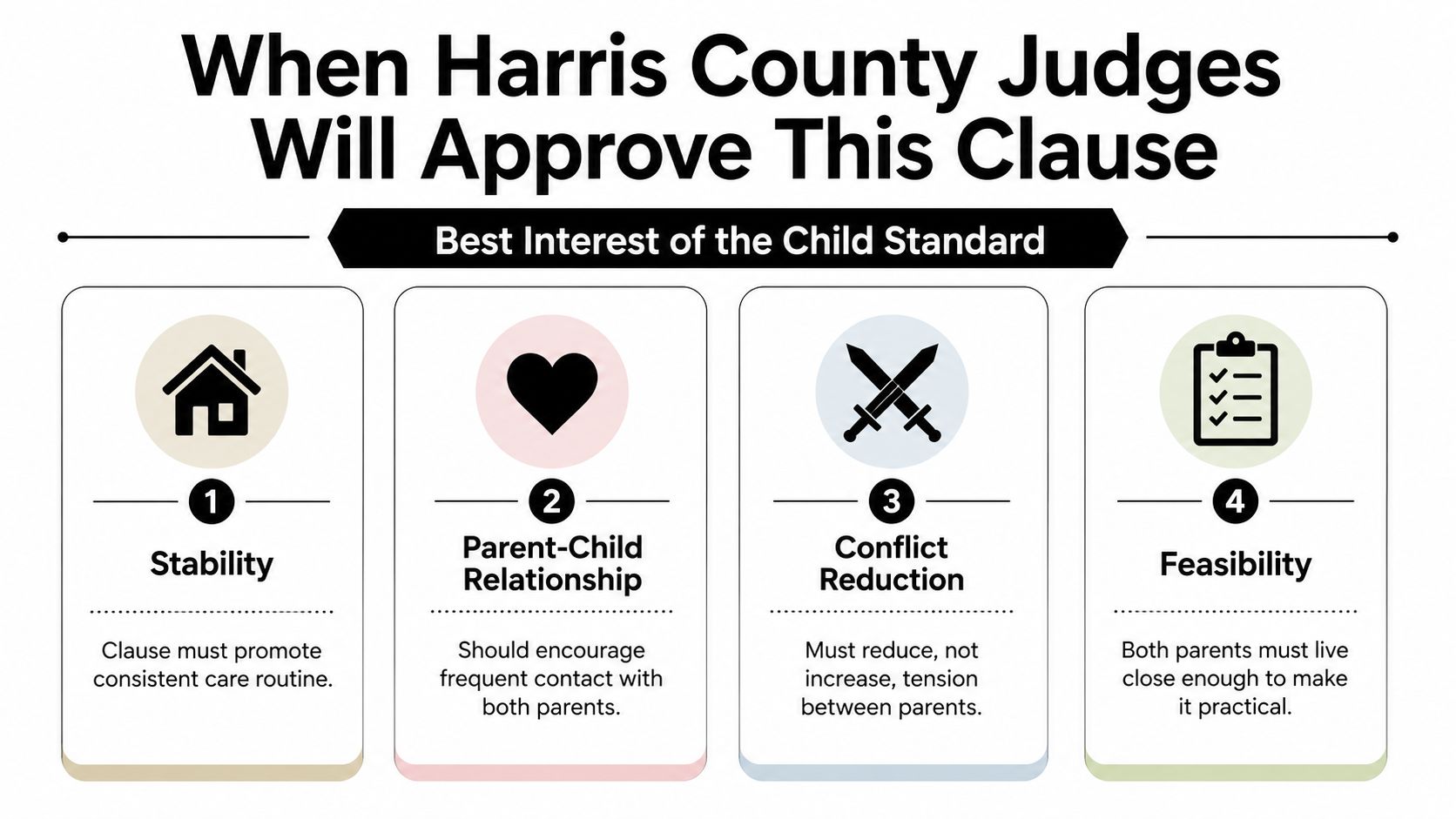
Harris County judges look at a right of first refusal through the best-interest-of-the-child standard in Texas Family Code §153.002. That standard does not favor one parent's preference by itself. It asks whether the clause helps the child. If it adds stability, preserves parent-child contact, and fits the family's real schedule, the court may see value in it. If it creates more friction than benefit, the judge may push back.

What judges usually care about
In practice, the court pays close attention to how the clause would function in a family's actual routine. A parent living in Atascocita may be close enough to make the exchange practical, while a parent farther away may make the same clause hard to use on short notice. Work schedules also matter, because a parent who regularly travels or works overnight may need different wording than one who keeps a predictable day shift.
The child's age and needs matter too. Younger children may benefit from a smoother handoff between parents, while older children may have school, activities, and routines that make last-minute transfers harder. Judges also watch the level of conflict. If parents already argue over pickup times and text messages, the clause can become another battleground instead of a stability tool.
A judge is more likely to approve a clause that reduces uncertainty than one that turns every delay into a dispute.
This is why the clause has to be tied to the child's best interests, not a parent's desire to supervise the other parent. In northeast Harris County, that usually means the request should be framed around practical care, reliable notice, and the child's routine. A clause that is too aggressive can look less like a child-focused tool and more like a control tactic.
For parents working through custody and conservatorship issues, the Child Custody Lawyer in Atascocita, TX resource is one place to compare how these clauses fit into a larger parenting plan.
Essential Components of a Well-Drafted Right of First Refusal Clause
A strong clause does not just say, “The other parent gets first chance.” It spells out the trigger, the notice method, the response deadline, and who handles the exchange. That kind of precision is what turns a good idea into an enforceable part of a Texas custody order.
The details that keep the clause usable
First, the order should define the trigger event. Does the clause start after four hours of absence, after an overnight absence, or only when the parent cannot supervise for a certain block of time? If that part is vague, one parent may think a two-hour appointment triggers the clause while the other thinks it does not.
Second, the notice procedure needs to be practical. Texas custody orders often require notice by text, call, or another written method. The key is not the app or platform itself, but whether both parents can prove the notice happened. A phone call with no follow-up can become a he-said-she-said dispute later.
Third, the response window should be realistic. The other parent needs enough time to answer, but not so much time that the child's care becomes uncertain. Fourth, transportation must be addressed. If one parent has to drive across northeast Harris County every time the clause is used, the arrangement can break down fast.
Here's the kind of language parents may see in a draft:
If a parent is unable to personally supervise the child during their possession for more than the stated period, that parent shall first offer the other parent the opportunity to care for the child before arranging third-party care.
That single sentence still needs support around it. It should say whether the rule applies to work travel, illness, school breaks, or evening appointments. It should also identify what happens if the other parent does not respond in time.
Common drafting mistake: writing a clause that sounds fair but never says how it works on a Tuesday night at 6:00 p.m.
Poor drafting usually shows up later as argument over minor delays, unclear texts, or whether a grandparent counts as “third-party care.” In a real Harris County case, that uncertainty can make enforcement much harder than parents expected. If you are reviewing your order now, look for missing deadlines, missing notice rules, and any language that leaves too much room for interpretation.
When a Right of First Refusal Helps and When It Hurts
This clause works best when both parents live close enough for exchanges to be realistic. In Atascocita and Humble, proximity can make the difference between a smooth handoff and a logistical headache. It also tends to work better when parents can communicate without turning every message into an argument.
When the relationship is steadier, the clause can do exactly what families want. It can keep a child with a parent instead of a sitter, preserve contact, and reduce the sense that one parent is being cut out of ordinary caregiving moments. For working parents with changing schedules, that extra layer of parenting time can feel meaningful.
The problems start when the clause becomes a surveillance tool. A parent may start checking the other parent's every move, questioning short errands, or treating the right as a way to force constant reporting. In higher-conflict cases, the clause can create more phone calls, more accusations, and more court filings than the family had before.
A simple comparison
| When it helps | When it hurts |
|---|---|
| Parents live nearby | Parents live far apart |
| Communication is calm | Communication is hostile |
| Child care needs are predictable | Schedules change constantly |
| Both parents can exchange the child easily | Every handoff becomes a dispute |
The phrase right of first refusal possession Atascocita TX often gets used by parents who want more parenting time, but not every family needs the same tool. Sometimes an expanded possession schedule works better because it avoids repeated back-and-forth over short absences. Sometimes the best answer is a narrower clause that only applies to overnight care.
The Law Office of Bryan Fagan – Atascocita TX Lawyers can help parents compare those options in the context of the child's routine, the distance between homes, and how much conflict already exists. That kind of practical review matters because the wrong clause can create exactly the stress a parent was trying to avoid.
How to Request Enforce or Modify This Clause in Atascocita
A parent in Atascocita often reaches this point after the same problem keeps repeating. One child gets left with a sitter, a relative, or another adult during the other parent's time, and the family needs a clearer rule about what should happen next. At that stage, the question is whether the clause should be requested in a new order, enforced because it was ignored, or modified because the wording no longer fits the child's routine.
The practical path starts with the paperwork already in place. In Harris County family court, the judge will usually want to see the existing order, the messages that gave notice, and the response, or lack of one. If the issue is a new request, the clause needs to be written into the custody documents with enough detail that both parents can follow it without guessing.
For a request, the wording matters as much as the idea. The order should identify the trigger, the notice method, and the time limit for a response, because those are the points that usually cause trouble later. A clause that says only that one parent gets first refusal is too vague to use well when a child needs care on short notice.
For enforcement, the record should show a pattern, not a single frustrating afternoon. Save texts, emails, voicemails, and call logs that show when notice was given and how the other parent handled it. If the child was routinely left with a sitter or another adult instead of being offered to the other parent first, that history is what helps the court see the issue clearly.
For modification, the court needs a reason the current language no longer works. A change in work hours, a different school schedule, or a clause that is too broad for the family's actual routines can all make the old wording harder to apply. In those cases, the goal is not to start over from scratch, but to adjust the order so it fits the child's real life better.
If you need a starting point for a change to possession terms, the modification of visitation attorney in Atascocita page gives a useful overview of how these requests are handled in custody cases. That kind of review is helpful because a first refusal clause works best when the trigger is clear, the notice method is practical, and the order matches the way families in northeast Harris County typically exchange parenting time.
A few steps usually help:
- Keep the order and the messages together: The court will want to compare the written language with the actual notice that was sent.
- Show the pattern: Repeated failures to offer the time matter more than a single mistake.
- Use the order's exact terms: Enforcement depends on what the clause already says, not on what one parent thought it meant.
- Bring records that fit daily life: Work schedules, calendars, and travel notes can show why the clause should be used or revised.
A careful review can show whether the current order protects your parenting time or leaves too many gaps. If you want help deciding whether to request, enforce, or modify the clause, schedule a free consultation with the Atascocita office of the Law Office of Bryan Fagan.
Common Questions Atascocita Parents Ask About First Refusal Rights
One of the first questions parents ask is whether the clause applies to every short errand. The answer depends on the order. Some clauses only trigger for longer absences, while others apply whenever the parent cannot personally supervise the child for the defined period. That is why the trigger language has to be specific.
Parents also ask what happens if the other parent does not answer in time. Usually, the order should say what counts as a timely response. If it does not, the case can turn into a fight over whether silence meant refusal or whether the notifying parent moved too quickly.
Another common question is whether grandparents or step-parents count as third-party caregivers. In many families, the answer depends on how the clause is written. If the order says the other parent must be offered the time before any third-party care is used, then the language should spell out whether relatives are included. That wording avoids arguments later.
Some parents also wonder how this fits with a standard possession order. The right of first refusal does not replace the possession schedule. It sits on top of it, affecting what happens when the parent in possession cannot personally care for the child. If the schedule is the map, the clause is the detour rule.
Best takeaway: the order controls everything. If the wording is unclear, the court may have to interpret it later, and that is rarely where families want to be.
Every family's situation is different, especially in Atascocita, Humble, and the surrounding Harris County communities. A clause that works well for one household may create unnecessary tension in another. That is why personalized legal guidance matters before you sign, enforce, or modify anything.
If you're dealing with a custody order and wondering whether a right of first refusal makes sense for your family, the attorneys at Law Office of Bryan Fagan – Atascocita TX Lawyers can review your order, explain your options, and help you build a plan that protects your child's routine. Schedule a free consultation at the Atascocita office if you want clear answers about drafting, enforcing, or modifying this clause in a way that fits your family's real life.