Both Atascocita and Humble divorce cases are filed in Harris County, at the downtown family courts on 201 Caroline Street in Houston. Texas also uses a 60-day waiting period, plus a six-month Texas residency rule and a 90-day county residency rule, so the question isn't which neighborhood has its own divorce court, it's whether you're ready to file in the right county and move the case forward the right way.
If you live in northeast Harris County, that answer matters fast. People waste time looking for a local courthouse that doesn't exist, or they file too early after a move and create problems they could've avoided.
| Factor | Atascocita | Humble |
|---|---|---|
| Divorce filing county | Harris County | Harris County |
| Local divorce courthouse | None separate for the community | None separate for the community |
| Main filing venue | Harris County family district courts downtown | Harris County family district courts downtown |
| Timing rules | Texas residency and county residency control filing | Texas residency and county residency control filing |
| Practical result | Same court system, different commute | Same court system, different commute |
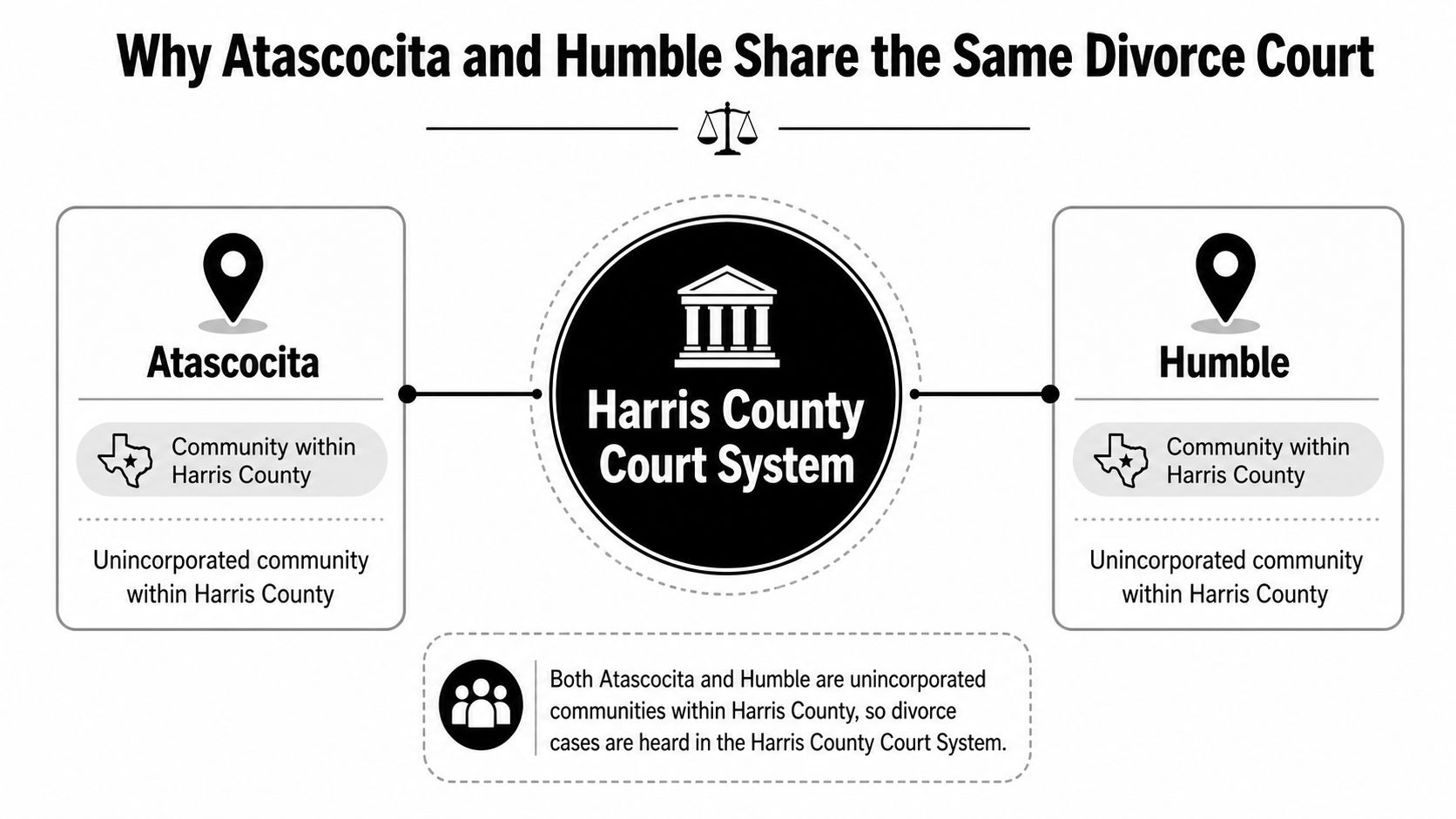
Why Atascocita and Humble Share the Same Divorce Court
Atascocita vs Humble divorce court which county is the right question because the answer starts at the county line, not the neighborhood sign. Both communities file through Harris County, and Harris County family district courts sit downtown at 201 Caroline Street in Houston. Texas district courts have original jurisdiction over divorce cases and most family-law matters, so there isn't a separate Atascocita courthouse or a Humble-only divorce court for residents to use. Harris County filing and jurisdiction basics
The county system is the reason
That setup exists because Texas family cases run through the county court structure, not through neighborhood courts. For families in Atascocita and Humble, that means the courthouse door is the same one every other Harris County resident uses for a divorce filing. Once the petition is filed, the case is handled under Harris County procedures, not by a separate local system for northeast communities.
Practical rule: if you're in Atascocita or Humble, think county, not city, when you're figuring out divorce venue.
If you still need to get your paperwork in order, a local print shop that handles legal jobs can help with court packets, copies, and service sets. Camelot Print & Copy legal services is one example of that kind of support. The same county-based setup shows up in other family-law matters, and that is why a local court search can send you in the wrong direction if you expect a separate neighborhood courthouse.
If you want a Harris County family-court overview tied to Atascocita, this local page lays out the courthouse setup in more detail: Harris County family court attorney for Atascocita.
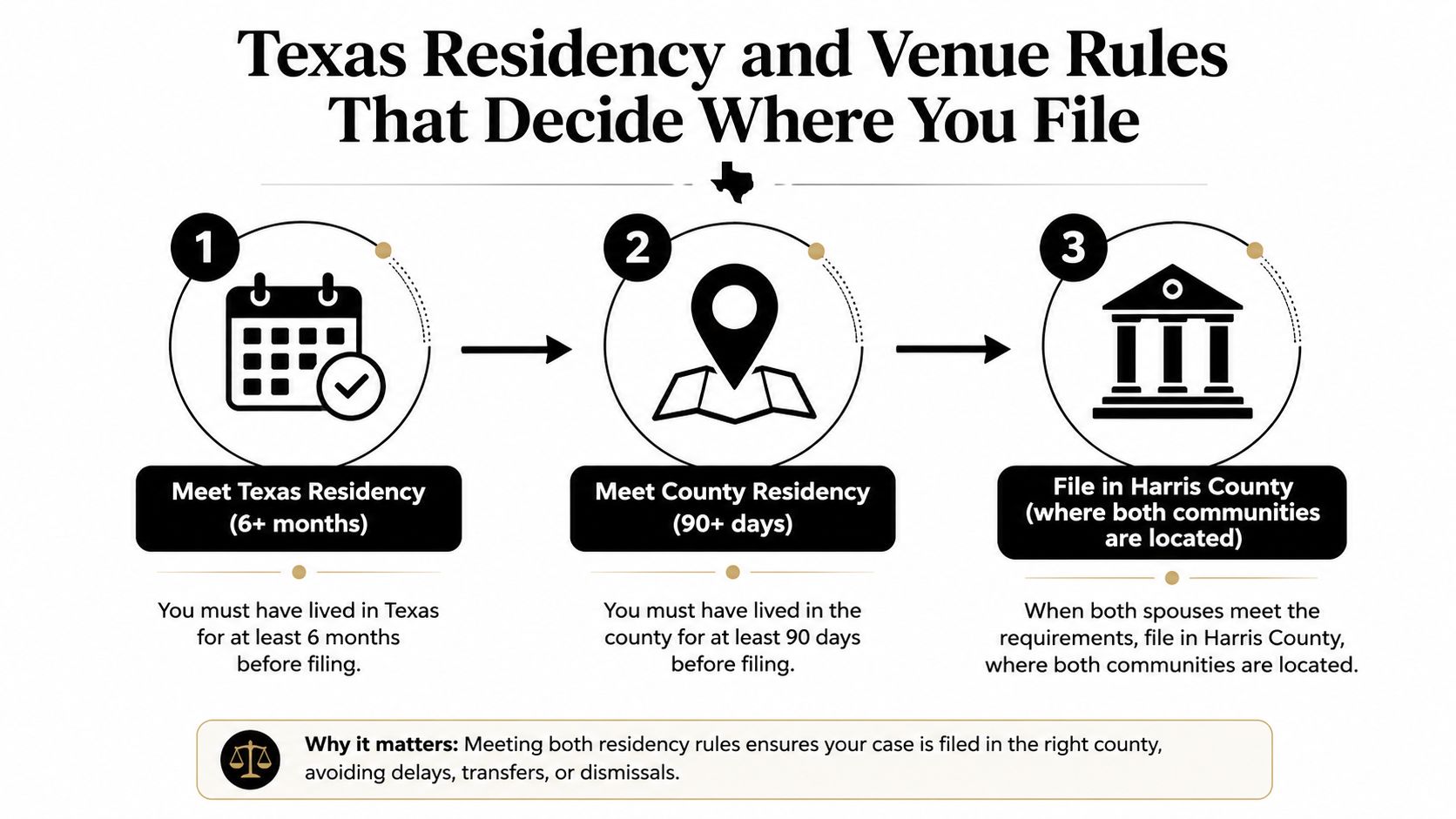
Texas Residency and Venue Rules That Decide Where You File
Texas uses two filing thresholds that control where a divorce starts, and both matter before anybody talks about hearings or final decrees. One spouse must have lived in Texas for six continuous months, and one spouse must also have lived in the filing county for at least 90 days. That's why Atascocita and Humble divorce cases land in Harris County, not in some city-specific court that sits closer to home. Texas filing rules for divorce
Why the county clock matters
The 90-day county residency rule is the one people misread most often. If someone just moved from another county, that timer can control when the case can be filed in Harris County, even if the person already lives in northeast Houston now. The court doesn't care which subdivision you're in, it cares where you meet the legal residency rule.
If your move was recent, check the county clock before you file. Filing too early just creates avoidable cleanup work.
The logic is simple. Texas wants the case filed where the family lives, and Harris County is the proper venue for Atascocita and Humble residents who meet the residency thresholds. That's why the legal answer is countywide, not neighborhood-specific.
If you're comparing service options, the Divorce Lawyer in Atascocita, TX listing is a straightforward place to see that divorce representation is offered for clients in Atascocita and Harris County. It's a filing-rule issue first, then a strategy issue.
Which Harris County Court Actually Hears Your Divorce
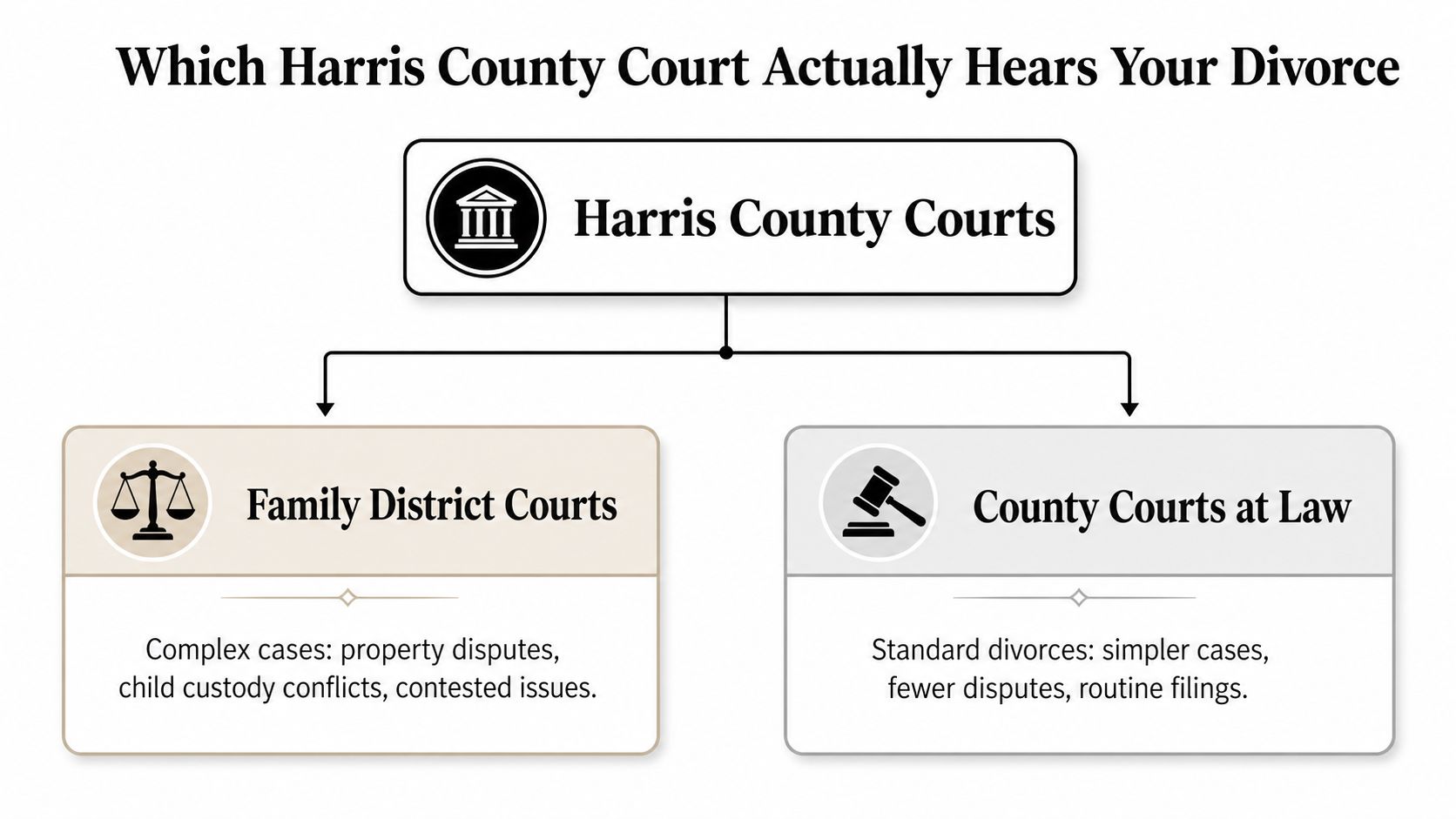
A divorce filed in Harris County doesn't bounce around randomly. Texas district courts have original jurisdiction over divorce cases, so that's the court family-law practitioners are targeting when they file the petition. Harris County also has county-level family-court handling for related matters, but the divorce itself belongs in the district court system.
What to expect on the paperwork
Court assignment happens after filing, and the case number tells you which judge's courtroom the file landed in. That's why people hear about different family district courts, even though the filing venue is the same. The assignment is administrative, but the underlying courthouse is still the Harris County family-court system downtown.
Related family-law issues can overlap with other court settings, especially enforcement questions or protective-order matters. That doesn't change the main rule for a divorce case. The divorce petition starts in the district court structure, and the case is then managed under the family-law procedures that apply in Harris County.
Don't chase the court number first. File correctly, then let the county assign the case.
That's also why courthouse intake feels formal. The clerk needs the right petition, the right venue facts, and the right case information before the file can move. If you're walking into the Harris County Family Law Center for the first time, expect the process to feel more like a structured intake line than a local neighborhood clerk's desk.
The practical takeaway is simple. If you live in Atascocita or Humble, you're not picking between two local divorce courthouses. You're filing in Harris County, and Harris County assigns the matter through its family-court system.
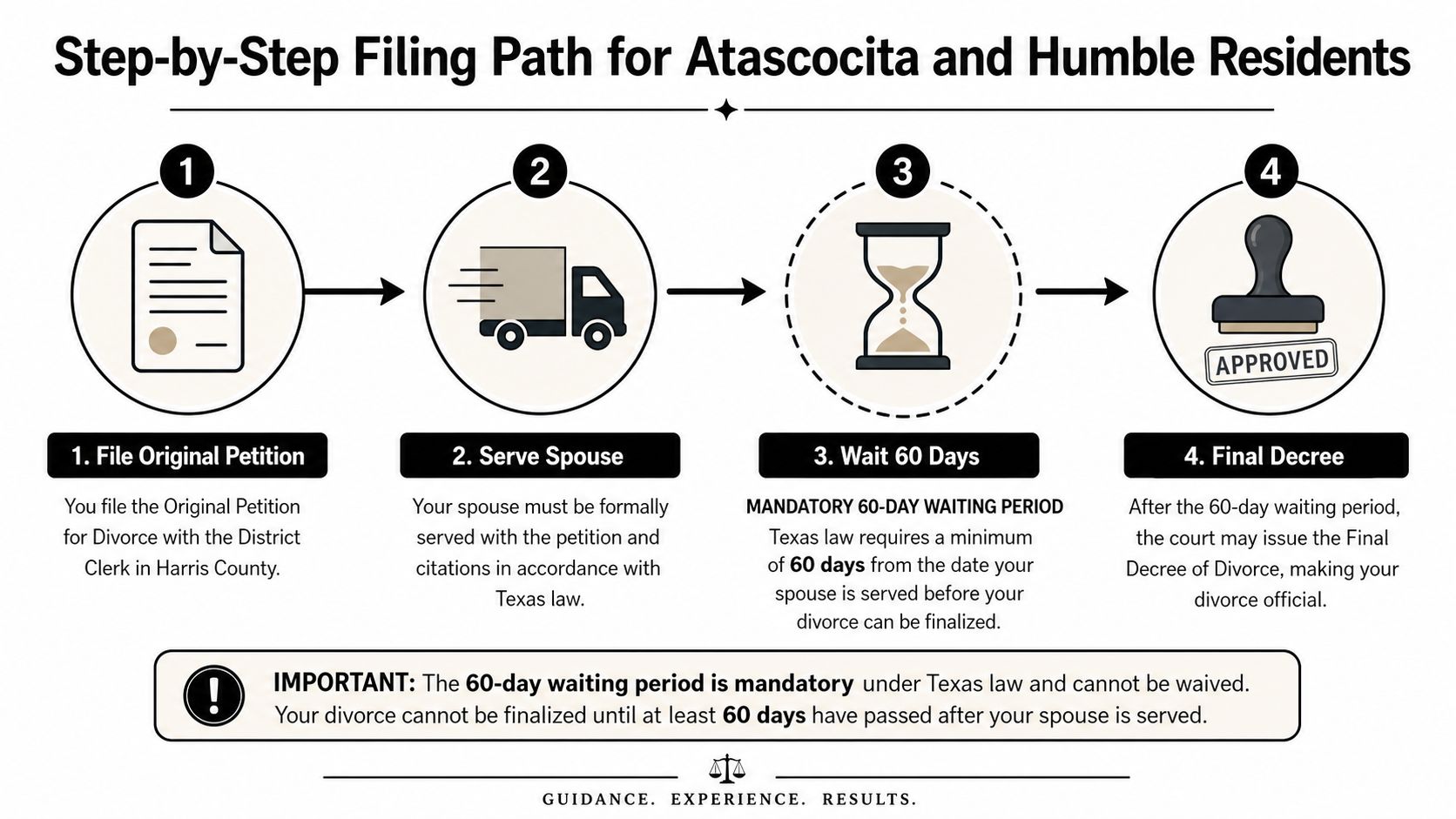
Step-by-Step Filing Path for Atascocita and Humble Residents
The divorce starts with the Original Petition for Divorce. That filing opens the case, starts the court file, and begins the legal timeline, but it doesn't finish the divorce by itself. Texas still requires formal notice to the other spouse, either through service or a waiver of service, and the case still has to sit through the 60-day waiting period before it can be finalized. How to file for divorce in Texas
The basic path
- File the petition. The clerk receives the Original Petition and assigns the case in Harris County.
- Give notice. The other spouse is served with citation, or signs a waiver if that route is appropriate.
- Wait out the clock. Texas law keeps the case open through the mandatory waiting period.
- Finish the decree. Once the case is ready, the final paperwork is presented for the divorce to be completed.
That waiting period matters even in a smooth, uncontested case. People often think a clean filing means an immediate finish, but Texas doesn't work that way. The law builds in time, and that time is part of the process whether the couple lives in Atascocita, Humble, or somewhere else in Harris County.
The downtown filing location also matters in practice. If your paperwork is going to the Harris County family courts, it helps to get the petition right the first time, because rework at the clerk's office slows everything down. Local counsel can save time by checking venue, preparing the service documents, and making sure the decree package matches the case history.
Sometimes the fastest path is to keep it simple and organized from day one. A local attorney can help with that, especially when one spouse wants to move the case forward without unnecessary court visits.
Atascocita vs Humble Filing Logistics Compared
The legal answer is the same for both communities, but the day-to-day experience isn't identical. Atascocita residents and Humble residents both file in Harris County, yet the practical route to downtown can feel different depending on where you start, how you park, and which side of the northeast corridor you live on.
| Factor | Atascocita Residents | Humble Residents |
|---|---|---|
| Filing county | Harris County | Harris County |
| Main courthouse trip | Downtown Houston family courts | Downtown Houston family courts |
| Commute feel | Usually a longer east-side drive into the county center | Usually a shorter or more direct drive from the city core area |
| Local convenience issue | Planning around traffic and parking matters | Planning around traffic and parking matters |
| Legal result | Same divorce venue and same county system | Same divorce venue and same county system |
The point of the table is not to create a fake difference where one doesn't exist. The point is to show that convenience changes, while jurisdiction doesn't. If you live closer to one access route than another, your commute shifts, but the courthouse that hears the case does not.
Where people usually get tripped up
Some residents focus too much on the neighborhood they live in and not enough on the courthouse that has authority. That's backwards. The filing venue is Harris County, and the court assignment comes after the petition is accepted.
Convenience matters for your schedule. It doesn't change which county hears the divorce.
If you're also dealing with children, support, or related family issues, the filing logistics matter even more because each trip to the courthouse can affect work, school pickup, and childcare. That's where a practical filing plan helps. You want the case handled in the right county and with as few repeat trips as possible.
Documents to Bring and Local Tips for Courthouse Day
Bring the basics first. You'll want a government-issued photo ID, a copy of your marriage certificate if you have it, any papers that show your current address, and the filing documents you're using to start the case. If children are involved, bring school records, medical information, and anything else tied to custody or support issues.
A simple courthouse checklist
- Photo identification: Bring a valid ID so you can handle clerk business without delay.
- Marriage paperwork: Keep a copy of the marriage certificate or related proof handy.
- Financial records: Bank statements, pay stubs, retirement account statements, and debt information help the file move cleanly.
- Children-related documents: School records, calendars, medical notes, and prior orders matter if custody or support is part of the case.
- Court copies: Bring extra copies of everything you plan to file or hand over.
Downtown courthouse visits are easier when you arrive prepared and dressed like you're taking the process seriously. Businesslike clothing helps in hearings, and early arrival gives you time to clear parking and security without rushing. If your case has a docket call or an attorney conference, check in as soon as you get inside and stay close to the courtroom area.
The Harris County Family Law Center can feel busy, so small details count. Keep your paperwork in one folder, separate filed copies from originals, and make sure your phone is silenced before you go into the courtroom. Those are simple habits, but they prevent a lot of avoidable stress.
If you want local legal support beyond divorce, the firm also handles family-law, criminal defense, estate planning, and civil disputes for northeast Harris County residents, so one office can often cover several related concerns at once. That kind of continuity matters when a divorce spills into property, parenting, or long-term planning questions.
When to Get a Local Divorce Lawyer Involved
If the case is high-conflict, bring in a lawyer early. If there are children, complicated property issues, a spouse who lives out of state, or a party who's already threatening delay tactics, don't try to improvise your way through Harris County family court. The filing rules are only the starting point. The work is making sure the case moves cleanly after it lands in the right county.
Good times to stop guessing
- Children or custody issues: Orders about parenting time, support, and decision-making should be handled with a clear plan.
- Property division: Homes, retirement accounts, and debt can turn a simple divorce into a document-heavy case.
- Service problems: If the other spouse won't sign a waiver, service has to be done correctly.
- Recent moves: If the residency clock is close, venue needs a careful look before filing.
- Conflict and control issues: When one spouse is hiding information or dragging things out, local court familiarity matters.
A local lawyer who works these cases in northeast Harris County understands how Harris County intake, assignment, and courtroom scheduling feel in practice. That's different from reading the statute and hoping for the best. A nearby office can also coordinate related issues like child support, protective concerns, or future estate planning if the divorce changes the family structure.
If you want to see what that looks like in practical terms, start with the local page on whether you need counsel: Do I Need a Divorce Lawyer in Atascocita, Texas. It's a good fit for residents who want a plain answer about whether to handle a case alone or get help.
For families in Atascocita, Humble, and the rest of northeast Harris County, the smartest move is to file in the right county, keep the paperwork clean, and get advice before the case gets messy. If you're ready to talk through your situation, schedule a free consultation at the Atascocita office with Law Office of Bryan Fagan – Atascocita TX Lawyers.