You're an Atascocita resident who used a debit card a friend handed you, bought something online, or received a card that later turned out to be stolen. Then a bank investigator or police officer contacts you and asks for “your side.” The situation may feel like a billing mistake, but Texas can treat credit card or debit card abuse as a felony. The safest move is to stop explaining and speak with a criminal defense attorney before answering questions.
For residents searching for credit card abuse in Atascocita, TX, the central issue is intent, consent, and your connection to the card or transaction. A person accused of abuse may not be the identity thief who opened an account or the person who stole the card. They may be a downstream participant whose conduct looks suspicious without proving criminal intent. That distinction can shape the entire defense.
Understanding Credit Card Abuse Under Texas Law
A card arrives at an Atascocita home, appears to belong to a household member, and gets used for an online purchase. Or an acquaintance hands someone a card that is later reported stolen, while the recipient keeps it in a wallet without knowing its history. Once a bank connects an unauthorized transaction to that person, a billing dispute can become a criminal investigation.
Texas Penal Code § 32.31 covers far more than stealing at a checkout counter. It addresses using a card without effective consent, presenting a fictitious card, using an expired or revoked card, receiving a stolen card, possessing a card with intent to use it fraudulently, and buying, selling, or transferring a card or card information. It also covers unfinished cards and related fraudulent conduct. Texas Penal Code § 32.31 makes possession, presentation, use, and transfer potentially significant acts.
The hidden trap is the assumption that prosecutors must prove you stole the card or created the fraudulent account. They may instead focus on whether you knowingly possessed, used, received, or handled the card in a prohibited way. A transaction tied to upstream identity theft can still place a downstream participant under investigation.
Why local residents face complicated investigations
Atascocita and Humble investigations often involve online purchases, shared household finances, delivery records, mobile devices, account credentials, and merchants outside the immediate area. The records may connect a cardholder in one location, a merchant in another, and an accused person in Harris County. That geography can affect venue and the defense strategy from the beginning.
Texas DPS treats credit-card and ATM fraud as a distinct offense class. The 2023 report's annual comparison table showed an 80.0% increase in reported cases from the previous year. It also listed recorded losses rising from $19,685,971 in 2019 to $26,736,333 in 2020, with statewide losses in the category reaching $1.242 billion in 2023. Texas DPS's 2023 report provides the source for those figures.
A small purchase can still draw attention from a bank, local police agency, or statewide investigators. Treat every request for an explanation as serious. Do not give a recorded statement or try to resolve the issue informally before speaking with a criminal defense attorney.
Public Harris County information shows the offense occurs locally, although available county data is limited. Court-outcome data records 6 cases under the label Credit Card Or Debit Card Abuse. That count cannot establish guilt in any individual case. Investigators still must connect the person to the transaction and prove the required intent, while the defense should test the reliability of the records, device evidence, witness accounts, and venue theory.
Criminal Elements That Trigger a Felony Charge
A person can face a felony accusation without making a large purchase. Under Texas Penal Code § 32.31, prosecutors may focus on possession, card information, or conduct connected to an allegedly unauthorized transaction. They still must prove every required element beyond a reasonable doubt. A resident should identify weaknesses in that theory before answering investigators or trying to explain the transaction alone.
Conduct prosecutors may examine
Section 32.31 covers several forms of alleged conduct:
- Unauthorized use: Using a credit or debit card without the cardholder's effective consent to obtain property, services, or another benefit.
- Fictitious or altered cards: Presenting or using a counterfeit, fictitious, expired, revoked, or otherwise invalid card.
- Possession with intent: Possessing a card or card information while allegedly intending to use it fraudulently.
- Receiving stolen property: Receiving, possessing, or handling a stolen card.
- Buying or selling information: Buying, selling, or transferring card information for an unlawful purpose.
- Unfinished cards: Handling an unfinished card in circumstances covered by the statute.
Texas Penal Code § 32.31 explains why these allegations are not automatically treated as ordinary misdemeanor theft based on the purchase amount. Possession itself can become a serious issue when the state claims fraudulent intent.
The upstream identity-theft problem
The alleged fraud may begin before the accused ever touches a physical card. Another person might take over an existing account, open an account using someone else's identity, or create a synthetic identity. The accused may then appear in a purchase record, delivery record, login history, or message thread.
That digital or transaction link does not establish guilt by itself. The prosecution must connect the person to unlawful conduct and prove the required mental state. Defense counsel should examine whether the person knew the card lacked consent, whether someone else directed the transaction, whether the account appeared legitimate, and whether investigators interpreted digital evidence correctly.
A public account of an example of mail theft leading to credit card fraud shows how a card can enter a fraud chain before a consumer becomes connected to a purchase. It offers background only, not evidence about an Atascocita case.
The central questions are direct: What did the person know, when did that knowledge arise, and what did the person intentionally do? Answering them requires reviewing messages, account access, delivery information, purchase history, and witness credibility. Harris County venue can also matter when records, merchants, deliveries, and alleged conduct involve different locations.
Penalties and Felony Enhancements for Card Abuse
A small online order can still lead to a serious Texas felony charge. Texas generally treats credit card or debit card abuse as a state jail felony, carrying 180 days to 2 years in a state jail facility and a possible fine of up to $10,000. This Texas penalty overview describes that baseline exposure.
The hidden trap is that the alleged conduct may involve more than a completed purchase. Possessing a card with fraudulent intent, using it without authorization, or handling a stolen or fictitious card can support the charge. A person may also face prosecution after an upstream identity-theft scheme creates the account or card, even when the person did not personally steal the original identity. The prosecution still must prove the required conduct and mental state.
The alleged victim's age can raise the stakes. Texas identifies an elderly cardholder as someone 65 or older, and the offense may be enhanced to a third-degree felony. That classification carries 2 to 10 years in prison and a possible fine of up to $10,000. The statutory rule matters in Atascocita and Humble because the cardholder's age can change punishment exposure before the court weighs the complete evidence.
The dollar amount isn't the whole story
Texas does not treat the purchase total as the only measure of seriousness. A low-dollar transaction can still create a felony case if investigators allege unauthorized use, possession with fraudulent intent, or involvement with a stolen or fictitious card. Review the charged act, not just the receipt total. The statutory defense discussion addresses these categories of alleged conduct.
A conviction can affect employment, professional licensing, housing, immigration, financial accounts, and family stability after the sentence ends. A quick plea may resolve the immediate court date while creating a lasting record.
What the enhancement means for strategy
Identify the cardholder's age at the start of the case. Counsel should test the proof of the cardholder's identity, the accused person's knowledge, the specific act charged, and whether evidence from an upstream scheme connects that person to the alleged offense.
Defense priority: Judge the case by its classification, the alleged victim's age, proof of intent, and the long-term consequences of a conviction.
Navigating the Arrest and Court Process in Harris County
A credit card abuse case may reach Harris County prosecutors even when the alleged transaction happened elsewhere. Texas permits prosecution in the county where the conduct occurred or where the cardholder resides. Texas Code of Criminal Procedure Article 13.291 makes venue a meaningful issue for residents of Atascocita, Humble, and other northeast Harris County communities. The defense should identify the proper county early, because venue can affect court assignment, investigation, witnesses, and how counsel prepares the case.
The process may start with a bank referral, merchant complaint, warrant, investigator's call, or arrest. After booking, the court addresses release and the formal accusation. At arraignment, the defendant receives information about the charge and enters a plea under the applicable procedure. Review this guide to what happens at an arraignment hearing before appearing. Treat the hearing as a legal proceeding, not a routine appointment. Statements, requests, and decisions made there can affect the case.
A local risk snapshot
Financial-crime allegations draw attention because investigators often examine connected transactions, account activity, and identity-theft reports. The FTC reported that credit cards represented 32% of top identity-theft report categories in its 2024 Consumer Sentinel Network Data Book. The FTC's 2024 Data Book also lists 44,480 credit-card identity-theft complaints in Texas in 2024.
| Metric | Data Point |
|---|---|
| Texas credit-card identity-theft complaints in 2024 | 44,480 |
| Credit cards in the FTC's top identity-theft reporting mix | 32% |
| Harris County recorded cases under Credit Card Or Debit Card Abuse | 6 |
| Texas DPS reported year-over-year growth in Credit Card/ATM Fraud cases | 80.0% |
The Harris County figure comes from local court-outcome data. The remaining figures provide state or national context. None proves guilt in an individual prosecution, but the broader pattern can lead investigators to treat a card allegation as part of a connected fraud investigation.
Protecting the rest of your legal life
A financial case can overlap with marital property, shared accounts, and household records. If divorce or a property dispute is pending, do not move or hide funds, and tell counsel about related court orders. For marital-property documentation, Prenuptial & Postnuptial Agreements in Atascocita addresses drafting and review for Atascocita clients.
Building a Strong Defense and Preserving Evidence
A single message or deleted receipt can change how investigators interpret your case. If you are accused of credit card abuse, protect your rights before trying to explain what happened. Possession of a card, an account-takeover transaction, or conduct tied to upstream identity theft can create serious exposure, so treat every record as potentially important.
Start with silence
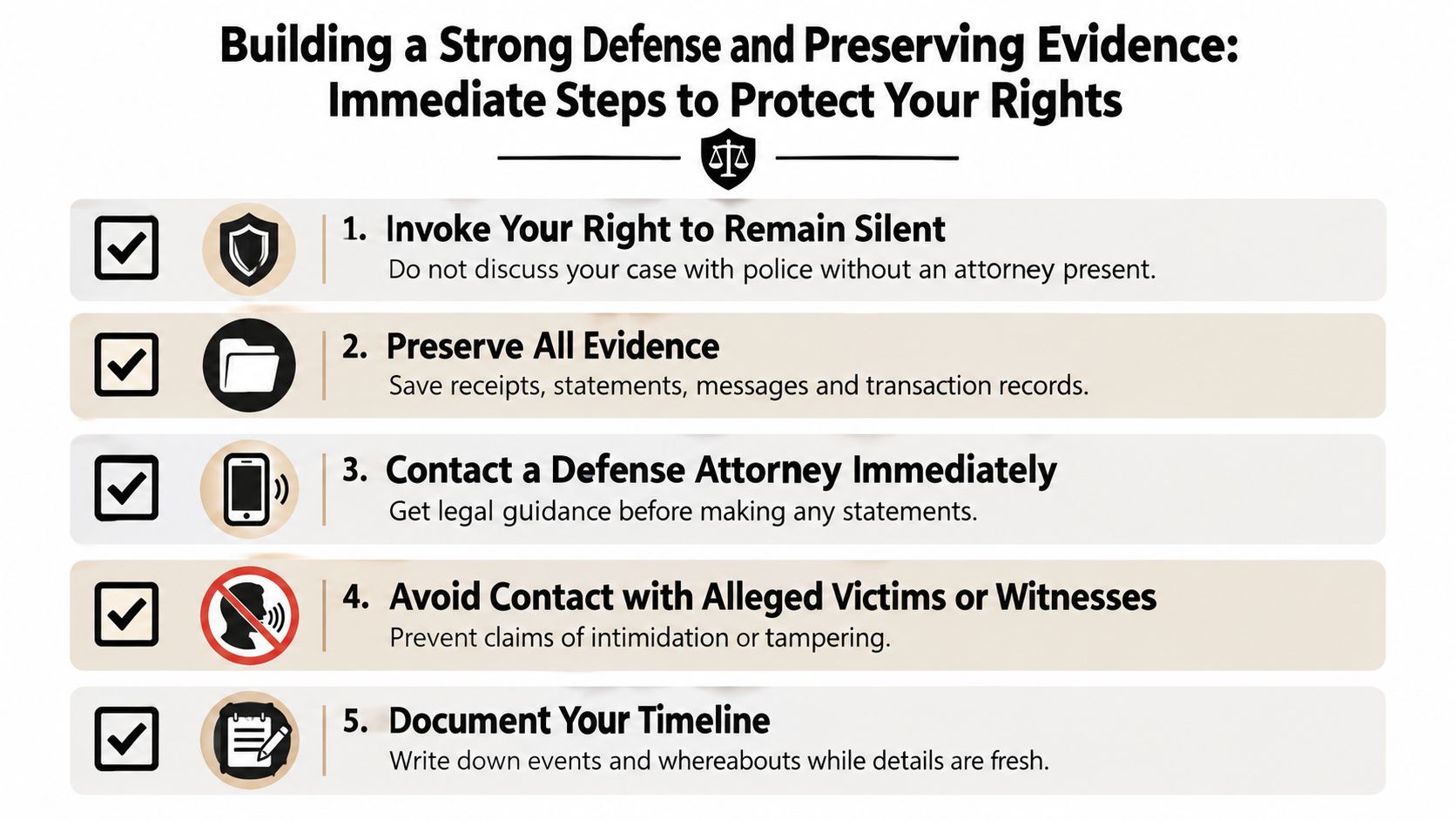
Tell investigators that you are remaining silent and want an attorney. Do not guess, fill gaps, explain an unclear timeline, or agree that a transaction was “probably” yours. An innocent explanation can become damaging when one sentence is separated from the surrounding facts.
Do not post about the accusation. Do not send a long explanation to the cardholder, merchant, bank investigator, or an alleged witness. Messages to family members can also become evidence, and repeated conversations may create inconsistent accounts. Route communications through counsel.
Preserve the complete record
Save original receipts, bank statements, order confirmations, delivery records, emails, text messages, call logs, account alerts, and communications with the cardholder. Do not delete suspicious messages or reset a phone before counsel advises you. Deletion can look intentional even if you were trying to clean up an account.
Write a private timeline while your memory is fresh:
- Record the people involved: Note who gave you the card, discussed the transaction, or had access to the account or device.
- Capture the sequence: Record when you received the card, placed an order, received a message, learned of the dispute, and spoke with investigators.
- Separate facts from assumptions: Write what you personally observed, not what another person later told you.
- Preserve devices: Keep phones, computers, cards, packaging, and related documents in their current condition.
- Avoid direct contact: Do not contact an alleged victim or witness after the accusation.
The defense may need to distinguish intentional use from an account takeover or transaction connected to upstream identity theft. Texas consumer-protection guidance recommends rapid account freezing, issuer notification, and transaction monitoring after card theft or misuse. The Texas Attorney General's card-theft guidance explains those protective measures for affected consumers.
For case planning, review this criminal defense strategy resource. Counsel can then evaluate the record and choose an appropriate motion, negotiation, trial, or other response.
Protecting Your Future With Local Legal Representation
A credit card abuse accusation can turn on facts a resident may overlook. Possessing a card, using an account connected to upstream identity theft, or completing a transaction in another county can affect the charge, venue, and defense strategy. Local counsel should examine where the transaction occurred, where the cardholder lived, where records were created, and whether Harris County venue is proper.
Timing can affect the case. For Chapter 32 offenses occurring on or after September 1, 2025, the limitations period is 7 years. This Texas credit-card-abuse limitations discussion explains why an older financial investigation may still raise filing questions. Your lawyer should identify the limitations rule for the alleged conduct and review tolling or related legal issues.
What focused counsel should investigate
A meaningful defense review goes beyond requesting a police report. Counsel should examine:
- The account history: Who opened the account, who changed its information, and whether signs of account takeover appear.
- The transaction trail: Where the purchase occurred, how it was authorized, and whether delivery or device records identify the user.
- Intent evidence: Whether messages and surrounding circumstances support knowledge of unlawful use.
- Venue: Whether Harris County, another Texas county, or multiple locations are involved.
- Collateral effects: How the accusation may affect employment, family proceedings, immigration, licensing, and financial obligations.
These issues matter because the prosecution may rely on circumstantial evidence. A lawyer must test whether the records show intentional conduct or instead point to compromised credentials, mistaken authorization, or another person's use of the account.
Technology may help with document review and compliance workflows, but it does not replace legal judgment, confidentiality analysis, or a fact-specific defense. Lawyers assessing these systems can review legal compliance AI tools, while keeping attorney supervision at the center of the case.
The Harris County criminal defense attorney resource offers local context for people facing county charges. If the accusation affects broader family planning, an Estate Planning Attorney in Atascocita can address wills, trusts, and estate plans.
The Law Office of Bryan Fagan – Atascocita TX Lawyers provides criminal defense and other legal services for individuals and families in Atascocita, Humble, and Harris County. Its broader practice includes family law, civil matters, and estate planning when a financial-crime accusation intersects with divorce, custody, property, or long-term family planning.
Taking the Next Steps After a Credit Card Charge
A credit card charge can become a state jail felony investigation before you understand what investigators believe happened. Act promptly. Gather the charging document, warrant or citation, police contact details, bank letters, merchant communications, account statements, receipts, delivery records, and relevant messages. Preserve originals without annotations or alterations.
Prepare a short timeline covering:
- What happened first: How you received, accessed, or encountered the card.
- Who had access: Household members, coworkers, friends, devices, and accounts.
- What investigators said: Names, dates, phone numbers, and each request.
- What deadlines exist: Court dates, reporting requirements, bond conditions, and preservation requests.
- What you need protected: Employment, licensing, immigration, family, and financial concerns.
Ask counsel whether the alleged conduct falls under Section 32.31, what mental state the prosecution must prove, whether an elderly-victim enhancement is alleged, and whether Harris County venue affects the defense. A transaction tied to upstream identity theft, or mere possession of a card, can create serious exposure. Do not contact an alleged victim or witness yourself. Direct investigator contact to your attorney.
The accusation may also affect family proceedings. For background on Harris County courts serving Atascocita, review Harris County Family Courts: A Atascocita Resident's Guide. Keep family-law communications separate unless counsel coordinates them.
The Law Office of Bryan Fagan – Atascocita TX Lawyers helps residents of Atascocita, Humble, and Harris County evaluate allegations, preserve evidence, and protect their rights. Schedule a free consultation through Law Office of Bryan Fagan – Atascocita TX Lawyers and bring your documents, records, and timeline.