A loose dog can turn an ordinary afternoon in Atascocita into an emergency room visit, a frightened child, and weeks of uncertainty about who will pay. Texas dog-bite law isn't automatic, and the insurance company won't value your injuries based on sympathy alone. You need a clear record of what happened, prompt medical care, and a practical plan for proving liability and damages.
This guide explains the steps Atascocita, Humble, and northeast Harris County residents should take after a bite. It covers Texas liability rules, deadlines, claim value, settlement decisions, lawyer fees, and the questions families usually ask before calling a dog bite lawyer in Atascocita, TX.
When a Neighbor's Dog Changes Your Afternoon
A Saturday walk along Will Clayton Parkway should end with groceries, a cool drink, or a quiet trip home. Instead, a dog may rush from an unfenced yard in Timarron or Atasca Woods, bark inches from your face, and clamp onto your arm before you understand what's happening.
The details stay sharp. You hear a child scream. You see blood on a shirt. The owner runs over, yelling that the dog has never done this before, then offers cash and asks everyone not to call anyone. Minutes later, you're trying to keep pressure on the wound while deciding whether to drive to the emergency room. By nightfall, you may be facing medical bills, missed work, a damaged jacket, and a child who no longer wants to walk outside.
Those first decisions matter, but you don't need to turn the moment into a lawsuit before you protect your health. You do need to preserve facts that can disappear quickly, including photographs, witness accounts, clothing, animal-control records, and the owner's statements.
Neighbor-attorney advice: Accepting help with immediate expenses doesn't automatically settle your claim. Don't sign a release or agree that payment is “all you need” before you understand the injury.
The legal roadmap is straightforward:
- Immediate safety and treatment: Get away from the animal, obtain medical care, document the wound, and report the bite.
- Fault: Texas claims usually depend on the owner's knowledge of dangerous behavior or proof that the owner handled the dog negligently.
- Deadlines: A strong claim can still fail if you miss the filing or notice requirement.
- Value: Medical bills are only one part of compensation. Scarring, pain, lost income, future treatment, and emotional harm may matter.
- Resolution: Settlement can provide certainty, while trial may be necessary when an insurer refuses to pay for lasting injuries.
The goal isn't to inflate a claim. It's to make sure the final result reflects what the bite took from you and your family.
First Steps After a Dog Bite in Atascocita
Use this order during the first 24 to 72 hours. These actions protect your health first and preserve evidence at the same time.
Move to safety. Get behind a closed door, vehicle, fence, or other barrier. Don't return to confront the dog, even if the owner is apologizing or insisting the animal is harmless.
Call for help when the attack is serious. Call 911 for severe bleeding, facial injuries, a child in danger, or an owner who becomes threatening. Harris County Precinct 4 constables may also be relevant for an incident in that area. Ask responding personnel how to obtain the report number.
Get prompt medical evaluation. Memorial Hermann Northeast, HCA Houston Healthcare Kingwood, and local urgent-care providers can assess punctures, crush injuries, tendon damage, and infection risk. Dog-bite wounds have reported infection rates ranging from 2% to 25%, with higher risk from delayed treatment, larger wounds, and bites to the hand, according to NIH StatPearls guidance on animal bites. Follow wound-care and antibiotic instructions exactly.
Photograph before the injury changes. Take clear photographs of each wound, blood on clothing, the location, broken fencing, an open gate, and the surrounding path. Repeat wound photographs as healing progresses.
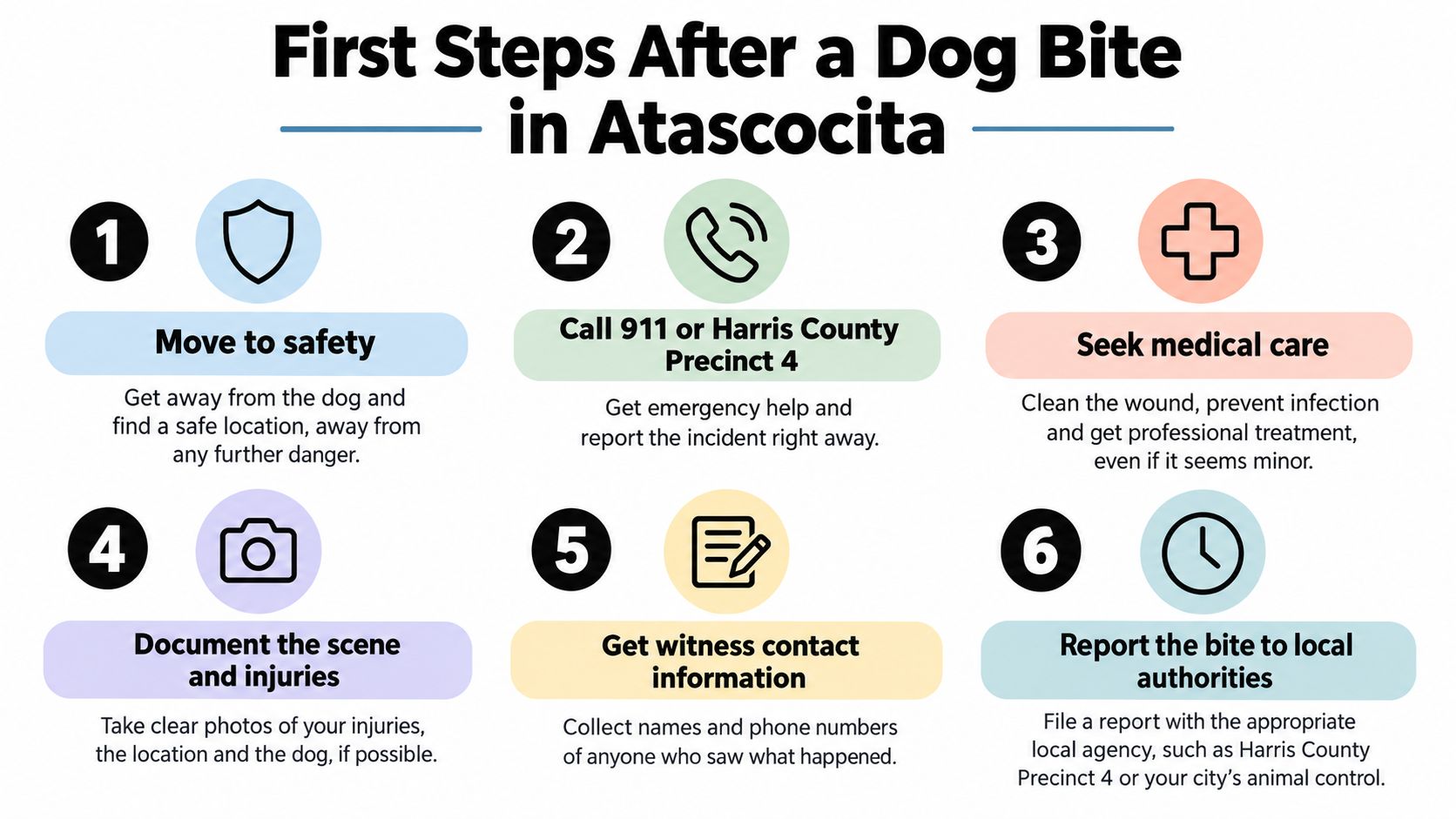
Collect names and records. Exchange contact information with the owner and witnesses. Request the dog's vaccination information, but don't argue if the owner refuses. Report the bite through Harris County Public Health and ask how to document the report.
Preserve your personal records. Keep torn clothing in a clean bag. Save prescriptions, receipts, parking costs, medical bills, and pay stubs. Write down what happened while your memory is fresh, including where the dog came from, what the owner said, and who saw the attack.
Start a daily pain journal. Record pain, sleep disruption, fear, missed activities, dressing changes, and limitations at work or school. You should also avoid giving a recorded statement to the owner's homeowner insurer before you understand what the carrier is asking and how your answers may be used. If a child was bitten, preserve the child's medical and school records and review injury-to-a-child legal guidance for Atascocita families.
How Texas Dog Bite Liability Actually Works
Texas doesn't impose automatic liability because a dog caused an injury. A claim usually follows one of two tracks: the common-law one-bite rule or ordinary negligence. The Texas Bar's explanation of dog-bite liability describes the central issue as whether the owner knew the dog had dangerous tendencies, while negligence may apply when the owner failed to use reasonable control.
The one-bite rule doesn't mean a dog gets one free attack. It means the injured person generally must show the owner knew or should have known about dangerous behavior. A previous bite is powerful evidence, but it isn't the only evidence. Prior lunging, snapping, chasing, growling, aggressive warnings, or complaints can help establish knowledge.
Negligence offers a separate path. An owner may be careless by allowing a dog to roam, ignoring a broken gate, violating a leash requirement, or failing to control an animal around children. Texas Health and Safety Code Chapter 822 and applicable Harris County rules can become important, especially when the physical scene supports the victim's account.
Evidence that changes the case
In an Atascocita apartment complex, a prior complaint to property management may show notice. In a gated subdivision, an HOA email about an aggressive dog may be more useful than a neighbor's later memory. Near Lake Houston, photographs of a broken fence, an open driveway, or a dog repeatedly roaming may support negligence even when nobody can identify an earlier bite.
Useful evidence can include:
- Prior incidents: Animal-control records, police reports, HOA complaints, veterinary notes, and messages describing aggression.
- Scene proof: Photographs of fencing, gates, leash conditions, warning signs, and the exact location.
- Witness accounts: Statements from walkers, neighbors, delivery workers, or family members who saw the attack or earlier behavior.
- Insurance information: Homeowner and renter policies often provide a practical source of payment for animal-related injuries, even when the case doesn't involve a prior bite.
| Theory | What Plaintiff Must Prove | Key Evidence | Common Setting |
|---|---|---|---|
| One-bite rule | The owner knew or should have known of dangerous tendencies | Prior bite, aggressive conduct, complaints, warnings | Neighborhood or apartment dog with a history |
| Negligence | The owner failed to use reasonable care or control | Broken fence, leash violation, open gate, witness accounts | Gated community, complex, or rural-feel lot |
| Premises-related negligence | A property manager or other responsible party failed to address a known hazard | Notice records, maintenance requests, incident reports | Apartment complex or rental property |
Don't let the owner's statement that “the dog has never bitten anyone” end the conversation. That statement addresses only one piece of the proof. The question is what the owner knew about the animal's behavior and whether reasonable control would have prevented your injury.
Deadlines That Can Quietly Kill Your Case
For most Texas personal-injury and dog-bite claims, the ordinary filing deadline is two years from the injury date under Chapter 16 of the Texas Civil Practice and Remedies Code. The Texas State Law Library outlines the residency and filing framework for Texas legal actions in its Texas legal filing guidance. A lawyer still must confirm which limitations rule applies to your injury and defendant.
Two years can disappear quickly after an emergency-room visit. Treatment may continue, photographs may be misplaced, witnesses may move, and an insurer may argue that later symptoms came from another cause. Waiting also leaves less time to identify the proper defendant and preserve records.
Shorter notice rules may apply
An attack on Harris County property or at a Humble ISD site may trigger a governmental-claim notice requirement before the ordinary lawsuit deadline. The claim materials identify a 60-day governmental-claim clock, but the exact entity, location, and statutory exception require immediate review. Government claims may also involve special notice language, service rules, and limits on damages.
Insurance policies have their own reporting provisions. Report the incident carefully, keep the policy information, and do not assume that a call to an adjuster protects every legal right. Early notice helps preserve the claim, but it does not replace legal review.
Build your deadline file now
- Record the incident date: Use the bite date, not the day you first contact a lawyer.
- Identify the property owner: Government ownership can create different notice duties.
- Save report numbers: Keep animal-control, police, school, and medical records together.
- Ask about tolling: Minors and delayed-discovery situations may involve exceptions. Never assume one applies without legal review.
- Calendar the earliest possible deadline: Treat the shortest potential notice period as controlling until counsel confirms otherwise.
Missing a deadline can end a claim, even when the wound is serious and the owner's conduct appears clear. Contact a lawyer early so the legal team can identify the correct defendant, preserve evidence, and send any required notices. In Atascocita and Harris County, the first date to calculate may matter more than the last conversation with an insurance adjuster.
What Your Dog Bite Claim May Be Worth
A dog-bite claim isn't valued by adding medical bills and multiplying the total by a secret formula. The responsible insurer evaluates liability, documented treatment, visible scarring, future care, lost income, and how the injury affects daily life. Your lawyer should build the value from evidence rather than promise a number before the medical picture is stable.
Separate the losses
Economic damages can include emergency treatment, follow-up visits, medication, wound care, therapy, reconstructive care, and related travel. If the injury affects your ability to work, claim documentation may include missed hours, reduced duties, lost commissions, and diminished earning capacity.
Non-economic damages address pain, fear, scarring, emotional distress, sleep disruption, and loss of enjoyment of life. A facial scar on a child, a hand injury affecting a worker, or lasting fear around animals may matter even when the initial hospital bill seems modest.
Medical evidence gives the claim structure. The CDC reports that nearly 1 in 5 people bitten by a dog requires medical attention, and children are more likely than adults to be bitten, with injuries to children tending to be more severe, according to CDC dog-bite guidance. Public-health data also document an estimated 6.6 million emergency-department encounters for dog bites, representing 0.3% of all ED encounters, with a rate of 13.5 per 10,000 people overall and 20.8 per 10,000 for people under 18, as reported in a national analysis available through PubMed.
Those figures don't predict your recovery. They show why an emergency-department record, photographs, and treatment history can become central evidence.
| Injury Severity | Typical Range | Key Drivers |
|---|---|---|
| Superficial wound with limited treatment | No fixed range can be responsibly promised | Medical documentation, healing, infection, pain |
| Deep puncture, hand injury, or infection | No fixed range can be responsibly promised | Surgery, therapy, work restrictions, lasting function |
| Facial scarring, child injury, or nerve damage | No fixed range can be responsibly promised | Visibility, future care, emotional effects, permanent impairment |
The insurance market provides context, not a guarantee. The Insurance Information Institute reported $1.86 billion paid on U.S. dog-related injury claims in 2025, involving 28,450 claims and an average cost of $65,450 per claim. The same reporting identified a $75,674 average claim cost in Texas in a 2026 report, as described in the Institute's dog-related injury claims analysis. A specific claim may be worth less or more depending on proof, coverage, fault, and future harm.
Settlement Versus Trial and How to Choose
Settlement is usually the practical first choice when liability is supported, treatment has stabilized, and the insurer offers enough to cover documented losses and future needs. It provides a defined result without the uncertainty, public testimony, and delay of a Harris County jury trial.
Trial becomes more reasonable when the insurer disputes the owner's knowledge, denies a broken-fence or leash violation, ignores permanent scarring, or offers less than the projected cost of future treatment. It can also be necessary when available insurance is limited and the carrier refuses to evaluate the full injury fairly.
Compare the decision in plain English
| Settlement | Trial |
|---|---|
| Gives certainty once signed | Leaves the result to a judge or jury |
| Usually resolves more privately | Requires discovery, testimony, and court appearances |
| Can provide payment sooner | May take longer and carries a risk of losing |
| Ends the claim permanently | May support a larger award, but no result is guaranteed |
Insurers weigh policy limits, their defense costs, the strength of the evidence, and the seriousness of the injury. Your lawyer should compare the offer with medical projections, wage records, scarring evidence, and the risk that a jury may assign some responsibility to the victim under Texas comparative-fault principles.
For a general explanation of settlement decision-making, the ProPlaintiff.ai settlement guide can help you understand why an offer should be measured against documented losses rather than accepted because it arrives quickly.
Mediation can give both sides a structured opportunity to resolve the dispute without a trial. Privacy, timing, litigation expense, appeal risk, and the victim's willingness to testify all belong in the decision. Don't reject settlement because you feel angry, and don't accept because you feel tired. Choose based on the evidence and the care you still need.
If the bite affects marital property, community funds, or a pending family case, get advice before distributing settlement proceeds. The Atascocita guide to characterizing a personal-injury settlement in divorce addresses that separate issue.
How a Local Dog Bite Lawyer Helps and What It Costs
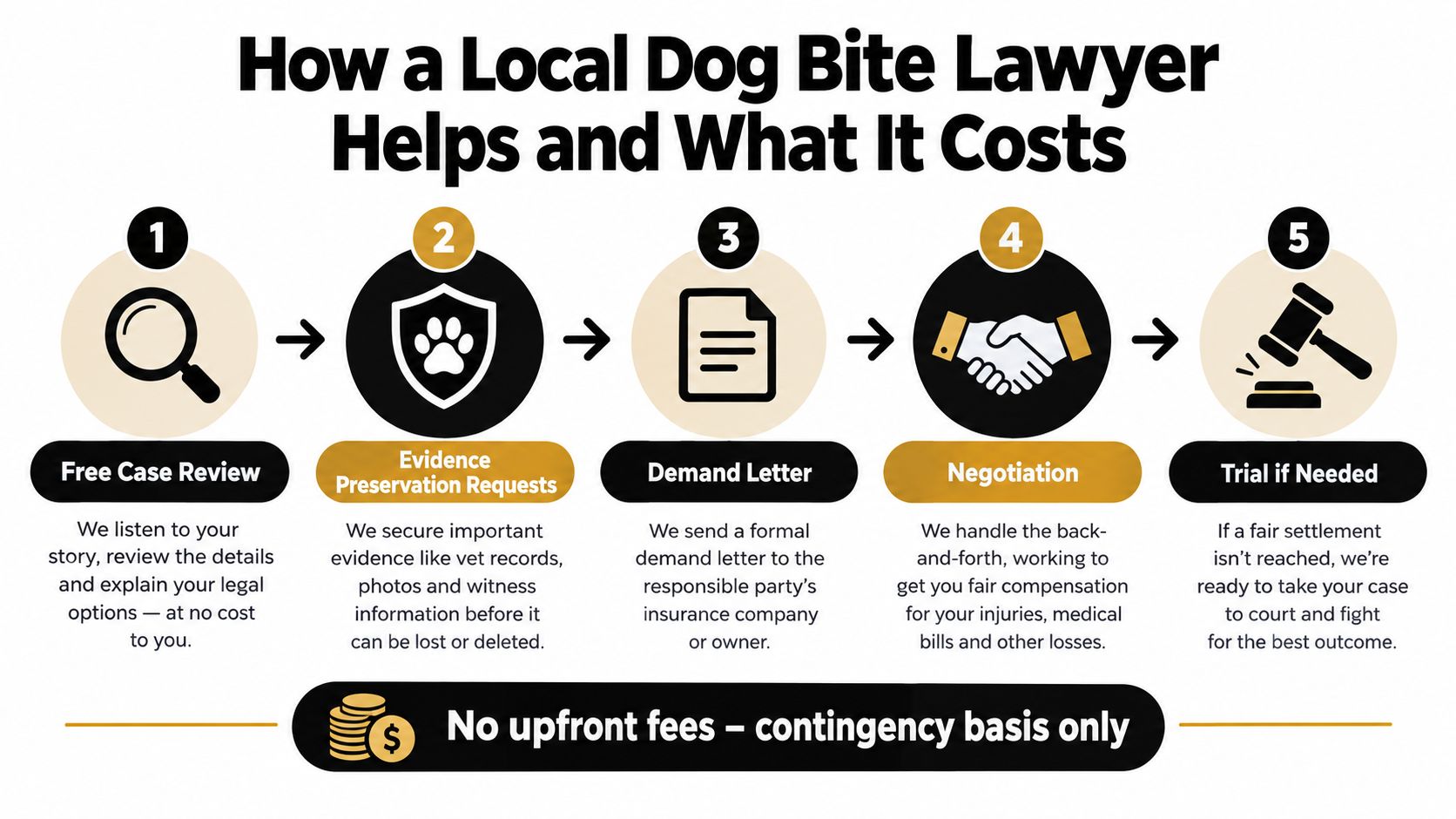
A dog-bite lawyer should give you a process, not vague reassurance. The work starts with a free case review, followed by evidence preservation requests for veterinary records, HOA complaints, animal-control reports, photographs, witness information, and insurance details.
The case lifecycle
- Case review: The lawyer identifies the dog owner, property owner, possible government defendant, injury timeline, and available coverage.
- Evidence preservation: Counsel requests records before an insurer or property manager loses them. Medical records and photographs are organized alongside scene evidence.
- Claim preparation: The demand package explains liability, treatment, wage loss, pain, scarring, and future care. It should contain proof, not just an angry narrative.
- Negotiation: The lawyer communicates with the homeowner or renter carrier and responds to low offers. You shouldn't have to repeat your story to an adjuster who is testing your account.
- Litigation when needed: If negotiations fail, counsel files suit, handles discovery, prepares witnesses, and represents you through mediation or trial.
Texas injury lawyers commonly use contingency arrangements. The fee is often 33% to 40%, depending on the stage of the case and the agreement, and case expenses may include filing fees, medical records, expert reports, deposition transcripts, and other litigation costs. Read the written contract carefully to confirm whether expenses come out before or after the fee calculation and what happens if the case doesn't recover money.
Clients generally don't pay the attorney fee upfront in a contingency case, but no fee arrangement should be assumed. Ask about medical liens, health-insurance reimbursement, case expenses, and whether you could owe costs if the claim fails.
Local counsel may know the records systems used by Atascocita veterinarians, Harris County precinct personnel, apartment managers, and defense firms. That familiarity doesn't replace evidence, but it can reduce avoidable delay and make requests more precise. If you're comparing law firms online, a guide to custom legal websites can help explain what useful legal-service information should look like, including clear practice areas and contact paths.
The Law Office of Bryan Fagan – Atascocita TX Lawyers handles civil matters alongside family law, criminal defense, estate planning, and probate. A separate Atascocita car accident lawyer resource may also help families dealing with another type of injury claim.
Questions Atascocita Families Ask and How to Begin
Should I speak with the owner's homeowner insurer before hiring a lawyer? You may report the incident, but do not give a recorded statement, sign a release, or guess about fault before you understand the claim. State what happened accurately, provide basic incident details, and save every letter, email, and voicemail from the carrier.
What if the dog was a stray or the owner has no insurance? Report the animal promptly to the appropriate local authority and collect witness information. A lawyer can investigate ownership, property responsibility, possible renter coverage, premises issues, and who controlled the dog. No insurance does not automatically end a claim, but it may change the practical route to recovery.
Does the process change when the victim is a child or older adult? It can. A child may have emotional or scarring evidence that needs careful documentation. An older adult may face greater complications from infection, falls, or delayed healing. Keep school absence records, caregiver notes, medical restrictions, and family observations.
What about an Airbnb or short-term rental? Identify the host, property manager, booking platform, property owner, and dog custodian. Rental terms, notice that the animal was present, and control over the property may determine who receives the claim and which records must be preserved.
How do hourly workers prove lost wages along FM 1960 or Beltway 8? Save schedules, timecards, payroll records, employer letters, missed-shift messages, and proof of reduced hours or restricted duties. A supervisor's written confirmation usually provides stronger support than a general statement that you could not work.
Will my health insurer take part of the recovery? Health plans may assert reimbursement or subrogation rights. Your lawyer should identify those claims, request the plan language, challenge unsupported amounts, and negotiate the balance so an overlooked lien does not consume the recovery.
Bring wound photographs, medical records, bills, wage documentation, damaged clothing, witness names, and the animal-control report number if available. Keep the dog-bite file separate from other family legal matters. Texas residency rules differ from personal-injury deadlines, and a divorce generally requires one spouse to have lived in Texas for six months and in the filing county for 90 days, according to the Texas State Law Library's divorce filing guidance. Related custody decisions focus on the child's best interest, including physical and emotional needs, danger, stability, parenting plans, cooperation, and the child's preferences when appropriate, as described in Texas custody best-interest guidance.
If your family is planning for the future, Texas independent administration may let an executor or administrator manage an estate with limited continuing court supervision, as explained in this Texas independent administration resource. These matters do not replace a bite-claim review. They do make organized records and clear communication more important when injury, family, and estate concerns overlap.
The Law Office of Bryan Fagan – Atascocita TX Lawyers can review dog-bite evidence, explain Texas liability and deadline issues, and coordinate a civil claim with related family or financial concerns. Schedule a free, confidential consultation through Law Office of Bryan Fagan – Atascocita TX Lawyers, and bring photographs, medical records, and animal-control information before the filing deadline approaches.