Skip to content
A personal injury settlement can feel like the one piece of your life that should stay yours. Then the divorce papers land, or the marriage is already on the edge, and that same check suddenly has two owners fighting over it in Harris County family court.
That is the trap for many people in Atascocita and Humble. The settlement may be tied to your pain, your treatment, and your recovery, but Texas law can still treat part of it as marital property if it covers lost earning capacity during the marriage. If you wait too long to sort that out, the money can turn into a property fight instead of a recovery tool.
When an Injury Settlement Meets a Divorce Filing
You're already dealing with doctor visits, missed work, and the stress of getting your body back in one piece. Then a settlement arrives right as the marriage starts breaking apart, and suddenly the same money that was supposed to help you heal is being treated like a marital asset.
That shift hits hard because the emotional meaning of the money doesn't control the legal outcome. In Texas divorce, the court looks at what the payment compensates for, not how badly you need it or how personal it feels. If the money is a lump sum with no clear breakdown, the fight gets messy fast.
Why the same check can trigger two different arguments
One spouse may see the settlement as compensation for a broken shoulder, permanent pain, or months of treatment. The other spouse may see a pot of money that came into the marriage and should be split like any other asset. Both reactions are predictable, but only one tracks the law.
Characterizing a personal injury settlement in divorce Atascocita TX becomes a real issue, not a legal abstract. The moment the settlement overlaps with divorce, the question becomes whether the payment is separate property, community property, or a mix of both.
Practical rule: If the settlement language does not say what each dollar is for, expect someone to fight over it later.
That is why early advice matters. A local family lawyer can look at the settlement paperwork before you sign, compare it to the divorce timeline, and help you keep the piece of the recovery that belongs to you. If you already live in Atascocita or nearby Humble, waiting until the final decree is on the table is often too late to clean up a bad paper trail.
Texas Community Property Rules and Injury Recoveries
Texas starts from a simple rule, most property acquired during marriage is presumed to be community property. That presumption is strong, and in divorce court it puts the burden on the spouse claiming separate property to prove it with clear and convincing evidence, as explained in a Texas appellate opinion on property characterization and the separate-property burden (Texas courts opinion).
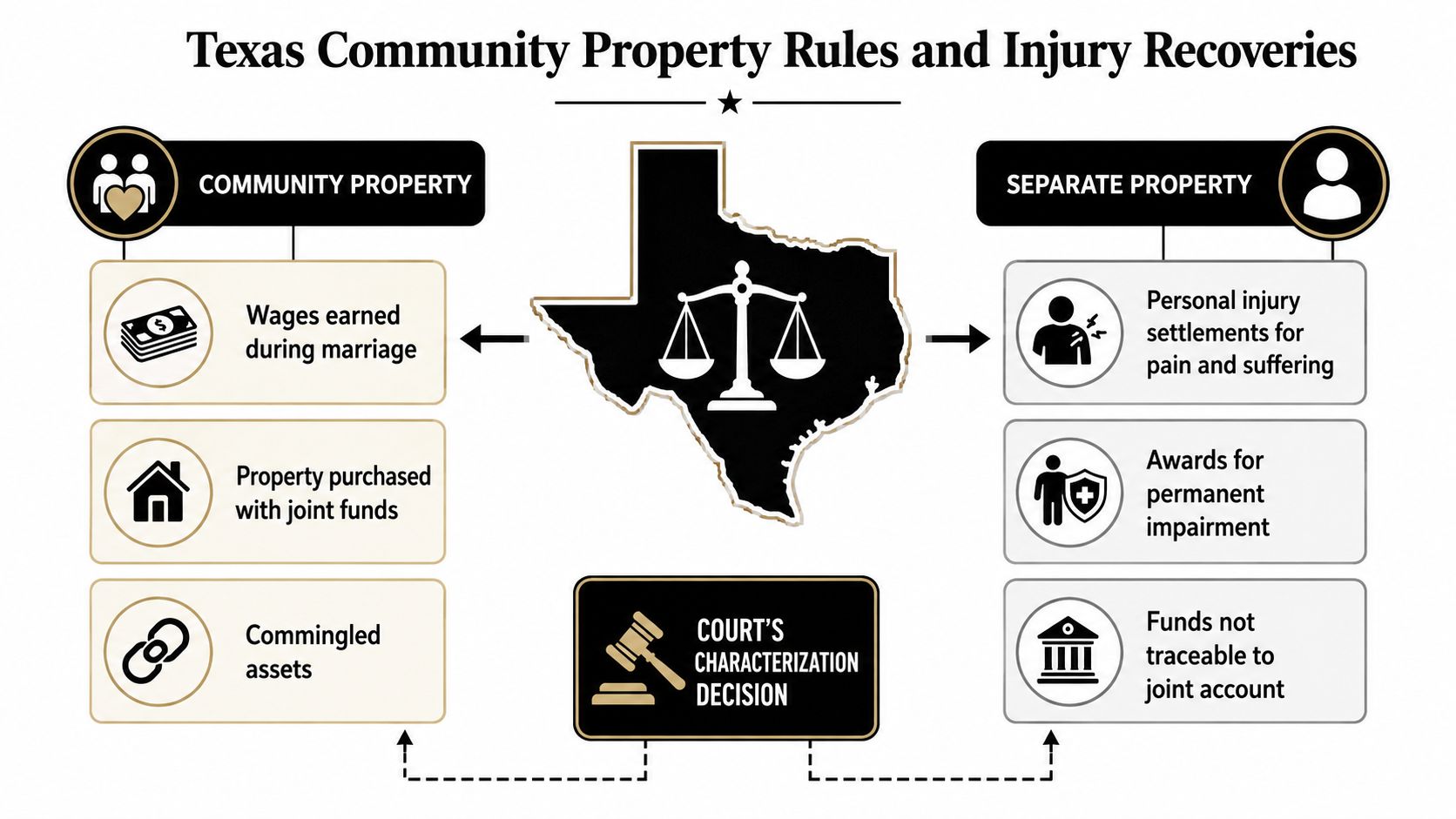
Texas Family Code § 3.001 creates a key exception. Recovery for personal injuries sustained during the marriage is generally separate property, but compensation for lost earning capacity during the marriage is community property. That means one settlement can contain both kinds of money, and the court has to classify each part correctly before it can divide anything.
Think of the settlement like a pie, not a single flavor
If your settlement includes money for pain and suffering, impairment, disfigurement, or mental anguish, that slice tends to line up with separate-property treatment. If part of the settlement replaces wages you would have earned during the marriage, that slice is community property under the statute. The court does not guess, it classifies what the proof supports.
That distinction matters in a state like Texas because the default rule reaches property acquired during marriage, and the statute only carves out specific injury-related recoveries. A summary on Texas divorce property law notes the same split, and it reinforces the practical point that the label on the check is less important than the damage category behind it (Texas property division overview).
For a local example of how this plays out in practice, the issue is central to the Property Division Lawyer in Atascocita service page, which addresses division of community property and complex assets for Atascocita divorces. A broader Texas family law resource also tracks the community-property framework used in these cases, including the presumption that property acquired during marriage belongs to both spouses (what is community property in Texas).
The same split is why settlement drafting matters so much. If the documents expressly allocate money into separate categories, courts can use that evidence to classify the payment. If they don't, you've made the judge do the sorting for you, and that is never the better position.
For readers who want a sharper overview of how plaintiffs' settlement terms are often structured, it also helps to compare that with strategies for PI firms in Texas, especially when counsel is negotiating what each damage bucket covers.
Breaking Down Settlement Damage Categories
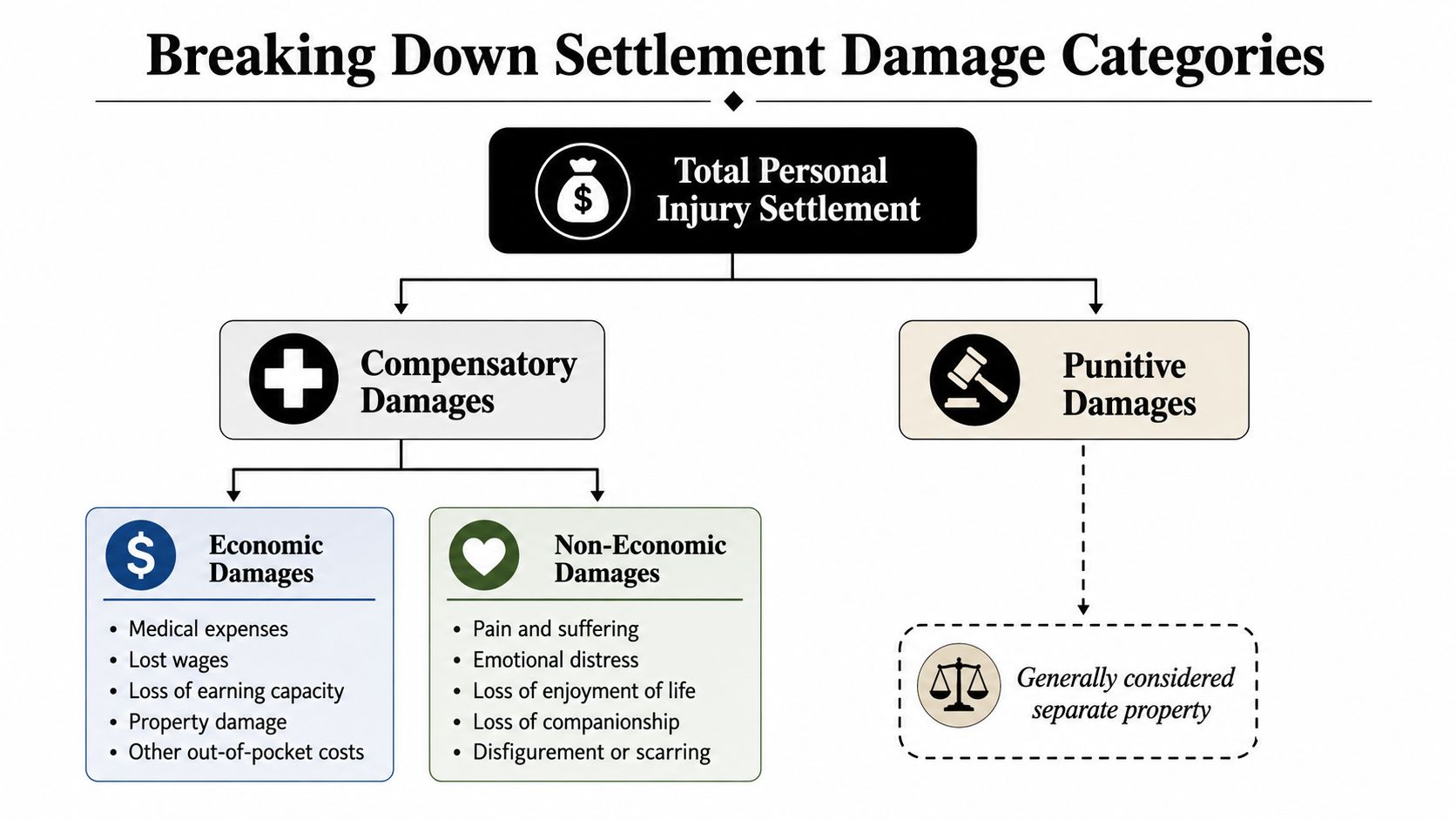
A personal injury settlement is rarely a single pool of money. It usually contains several damage categories, and the divorce court will care about each one because Texas law does not treat every dollar the same.
The categories that usually matter most
Medical expenses reimburse treatment bills, therapy, and related care. In a divorce, those payments are usually tied back to the injury claim, but the result still turns on how the settlement was drafted.
Pain and suffering compensates for physical hurt and the way the injury changed daily life. Texas law generally treats that kind of recovery as separate property when the injury happened during the marriage.
Mental anguish, impairment, and disfigurement can also support separate-property treatment when the record shows the payment was meant for bodily injury losses. The settlement agreement has to say that clearly, or the spouse claiming separate property is left trying to prove it after the fact.
Lost wages or lost earning capacity are different. If the settlement replaces income that would have been earned during the marriage, Texas treats that portion as community property. That distinction often decides whether the money stays with the injured spouse or gets divided.
That is why allocation language matters more than generic settlement language. A clean breakdown in the release or settlement agreement gives the court something concrete to follow. A vague lump-sum payment invites a fight over classification, and the burden lands on the spouse who wants separate-property treatment.
A practical settlement summary from Texas injury-resolving resources shows why the stakes are real. For auto accidents, the median settlement is about $31,000, claimants with attorney representation average $77,600, and unrepresented claimants average $17,600 (settlement statistics). Those numbers matter in divorce because a larger recovery creates more pressure to split every category and more incentive for the other side to challenge the paperwork.
Courts can only classify what the evidence supports, and a clean allocation in the settlement paperwork is stronger than trying to explain the money later.
For a local reference point, the Probate Lawyer in Atascocita, TX service page covers probate administration and estate settlement in Harris County, which is useful because family law and estate administration both depend on accurate paper trails. If the wording is sloppy now, someone else will be untangling it later.
For a closer look at how plaintiffs' counsel structures settlement terms, review settlement strategies from ProPlaintiff.ai. The point is straightforward, the documents need to say what the money is for before the divorce court asks.
Tracing and Proving Separate Property Status
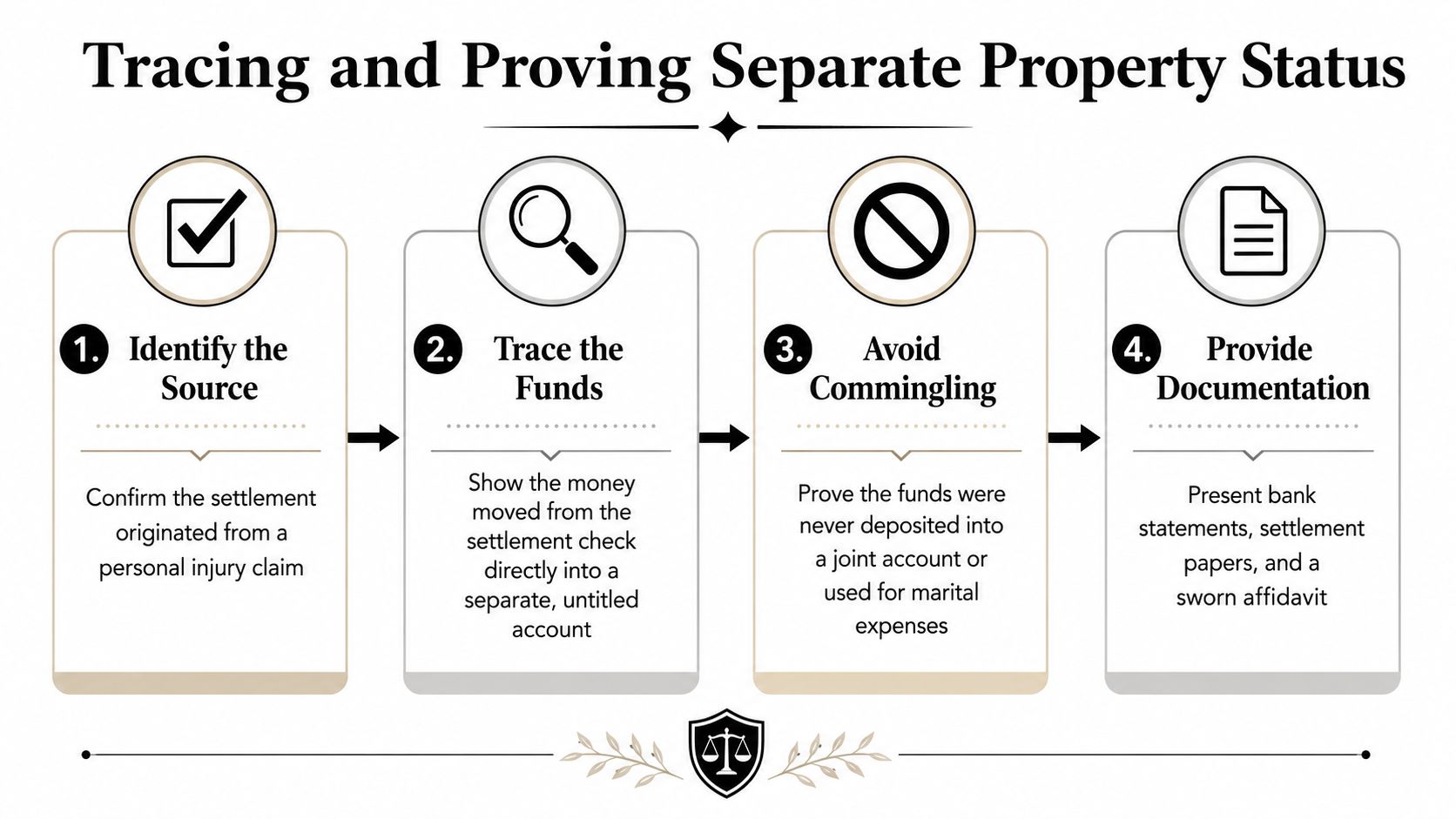
Texas puts the burden on the injured spouse to prove separate property status by clear and convincing evidence. If you cannot trace the money, you have already given the other side a cleaner path to argue that the funds belong in the marital estate.
The paper trail that protects you
Start with the settlement agreement and release. Those documents show what the payment was supposed to cover, and they matter more than assumptions or memory. Add the disbursement sheet, demand letter, mediation memo, settlement check, and bank records, because those papers help connect the claim to the deposit and then to the current account balance.
Then keep the money separate. A segregated account gives you the cleanest proof that the funds stayed apart from marital income and household expenses. If the settlement lands in a joint account, the tracing problem gets worse, especially when the money is a lump sum with no itemized allocation.
Here is the checklist I would give a client sitting across the desk in Atascocita:
- Keep the original settlement paperwork. Save the agreement, release, and disbursement records in one place.
- Open a dedicated account. Use a separate account for the proceeds, and do it before the money is spent.
- Stop joint use immediately. Do not pay marital bills from the settlement until the characterization question is resolved.
- Pull bank records early. Get statements that show where the check went and how the funds moved.
Why a mixed account creates unnecessary risk
The danger is not just that the money gets spent. It is that the trail disappears. Once settlement funds are mixed with wages, household deposits, or shared bill payments, the injured spouse may have a hard time showing which dollars stayed separate and which ones became community property through use.
The wording in the settlement papers matters just as much as the account history. Settlement language that clearly allocates the proceeds by category gives the court a real basis to follow, while vague paperwork forces a later fight over what the money was for. A carefully written allocation can make the tracing job straightforward. Sloppy language leaves room for the other side to argue that the whole fund should be treated as community property.
That is why the divorce record matters as much as the injury record. Attorneys handling these disputes should gather the live petition, settlement agreement, release, settlement check, disbursement sheet, demand letter or mediation memo, and bank records, because those are the documents that show what the money really was. Without them, a court can treat an undifferentiated lump sum as community property under Texas's presumption.
The Hidden Danger of Commingling Settlement Funds
Commingling is the mistake that ruins otherwise solid separate-property claims. It happens when a settlement check goes into a joint account, gets used for shared bills, or is blended with community income until nobody can tell which dollars are which.
That is not a minor bookkeeping issue. In divorce court, traceability is the key point. If the numbers cannot be followed clearly, the other side has a much easier argument that the entire fund should be treated as community property.
The fastest ways people lose the argument
A lot of people do the wrong thing for understandable reasons. They deposit the money where all the household funds already live. They use a chunk of it to catch up on the mortgage. They tell themselves they'll sort it out later. Later usually comes when the divorce is already underway, and then the paper trail is a mess.
My view: Do not use a settlement to patch a joint family budget until the characterization question is resolved.
That's why a dedicated account at a local Atascocita or Humble bank is the smarter move. Keep the settlement separate, keep records of every transfer, and don't use the funds for marital expenses unless you're willing to argue about them later. If the amount is large or the divorce is already active, that discipline can save you a costly tracing fight.
The same caution applies if you think your spouse is already hiding financial information. A practical guide on what happens if my spouse hides assets in divorce Texas Atascocita is relevant because hidden or blurred funds are handled through the same kind of fact-intensive proof. For enforcement problems after orders are entered, the Enforcement of Court Orders in Atascocita page is a useful local reference for enforcing divorce decree and custody order provisions in Harris County.
One more point for Atascocita families, if the settlement is sitting in a shared account now, don't assume you've lost everything. You may still have tracing work to do, but the sooner you pull records, the better your odds. Delay is what makes a solvable problem turn into a courtroom fight.
Lump Sum Versus Structured Settlement Challenges
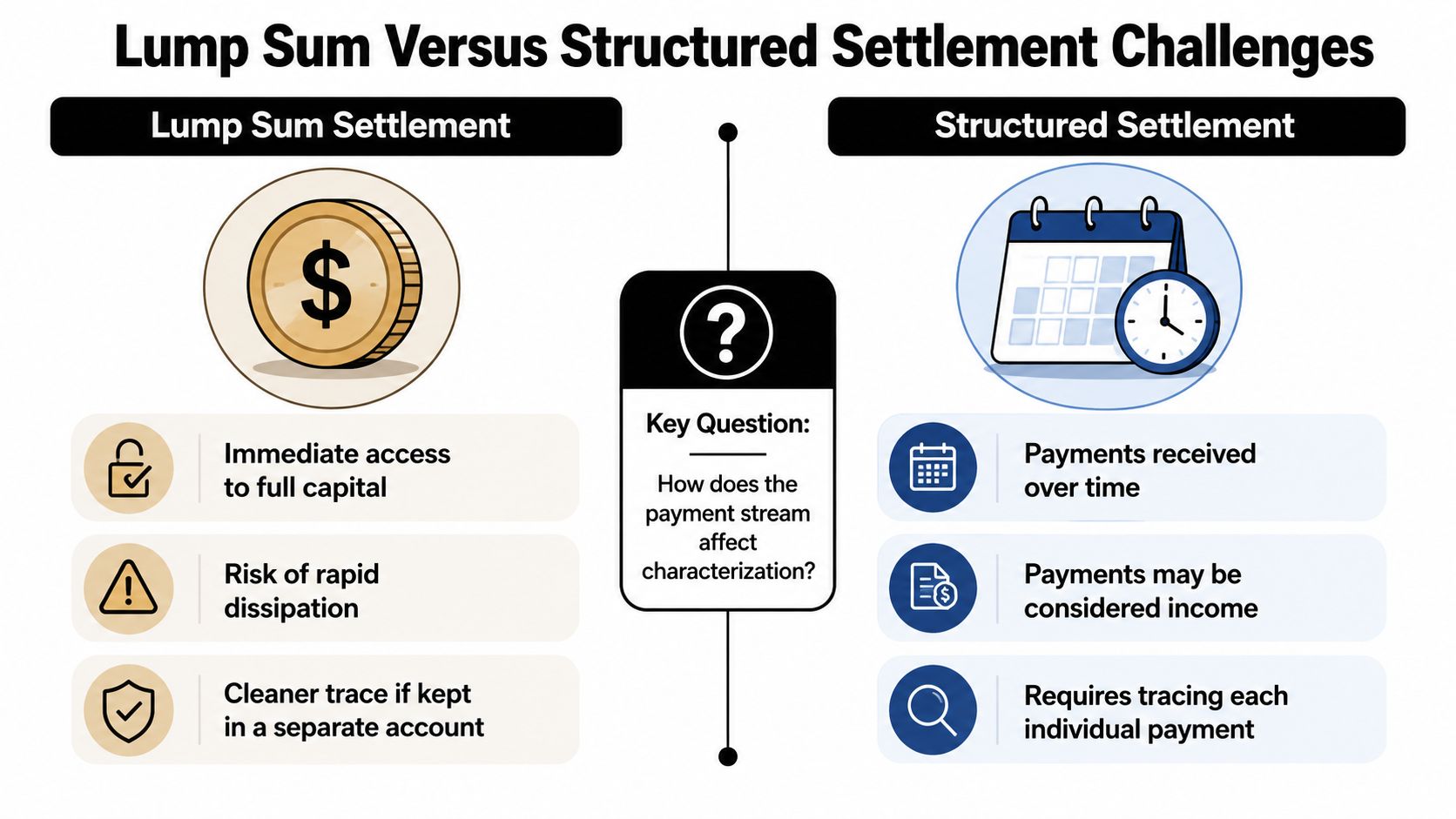
A lump sum and a structured settlement create different problems, and both can become messy in divorce if the settlement language is loose.
Lump sum payments
A lump sum gives you immediate access to the full settlement, which helps if you need to pay medical liens, replace a vehicle, or steady your household. It also gives you the cleanest tracing path, but only if you keep the money separate from the start and document every transfer.
The risk appears fast. Once that lump sum goes into a joint checking account or gets used alongside marital income, the tracing fight starts right away. A lump sum with no itemized allocation is especially exposed because the court has less to work with when it has to classify the recovery.
Structured payments
Structured settlements arrive in periodic payments over time. That can help with budgeting, but it also means every payment has to be tracked on its own while the divorce is pending. The stream may include different character components, and each payment has to be reviewed in context.
Texas case law shows why that matters. One structured settlement involved payments totaling $390,633.20, including $2,000 per month for 20 years plus larger periodic payments (Texas case law example). A long-term payment stream like that creates recurring questions about what part of the money is separate and what part, if any, reflects marital wage replacement.
Bottom line: The payment form affects the classification fight as much as the size of the award does.
If you are negotiating a settlement while divorce is already on the horizon in Atascocita, insist on settlement language that allocates the proceeds by damage category before the check is ever issued. That is far easier than trying to reconstruct intent after a dispute starts.
Settlement drafting is part of the case strategy, not an afterthought. In a divorce context, clear allocation language can be the difference between clean separate property and a divided asset.
Local Practice Tips for Harris County Divorce Courts
A judge in Harris County wants paper, not a story about how the money felt in real time. If you show up with a vague claim that the settlement was “for my injury,” you give the other side room to argue it was all community property.
The local approach is simple. The spouse claiming separate property should bring the settlement agreement, release, check, deposit history, and the account records showing exactly where the money went. When the recovery is disputed, lawyers in northeast Harris County focus hard on the allocation language and the tracing records because those are the parts the court can rely on.
What to do before the divorce file goes forward
If the settlement is still pending, move fast and ask whether temporary orders are needed to keep the funds protected. Timing can change the result in a real way, especially when the injury claim and the divorce filing overlap and the money is still moving while the court starts dividing assets.
Use the local court process to your advantage. In Harris County, early proof beats a late explanation every time, and a clean record packet helps the judge separate bodily injury compensation from wage replacement. That distinction is not academic, it decides what the court can divide and what should stay separate.
For families in Atascocita and Humble, local court familiarity matters. A Harris County Family Courts: A Atascocita Resident's Guide resource helps because it shows how cases move through the courts serving this area. The practical lesson stays the same, a better prepared file usually gets a better hearing.
If you need help with the property side of a divorce, the Law Office of Bryan Fagan – Atascocita TX Lawyers handles family law, divorce, custody, and property division matters for Atascocita, Humble, and northeast Harris County. The point is straightforward. You need a lawyer who knows how injury proceeds fit into a divorce record before the wrong form gets filed.
Protect Your Settlement with a Free Consultation
A personal injury settlement can vanish into a divorce dispute if the paperwork is sloppy. Allocation language, tracing records, and a segregated account are the three things that protect your claim, and none of them gets easier once the money has been mixed with household funds.
If your settlement includes medical records or financial details, privacy matters too. Use encryption and compliance tips when you send settlement papers, medical records, or divorce documents back and forth, because careless document handling only creates more risk in an already stressful case.
A family lawyer who handles property division should review the settlement terms, preserve the right records, and push back if your spouse tries to claim money Texas treats as separate property. If the divorce is already underway, get advice before you spend, deposit, or sign away anything.
A clean paper trail beats a guessing game. If you need to get organized, start with how to protect assets during divorce and then sit down with counsel to go through the settlement line by line. That is the safest way to protect what belongs to you and avoid a fight you never needed.
The Law Office of Bryan Fagan – Atascocita TX Lawyers helps clients in Atascocita, Humble, and northeast Harris County protect settlement proceeds, trace funds, and handle divorce property disputes with a clear legal plan. If your injury settlement and divorce are colliding, visit the firm and schedule a free consultation before you sign, deposit, or divide a single dollar.