Texas does not set a single statewide minimum age for riding in the front seat, but children under 8 years old, unless taller than 4 feet 9 inches, must use the proper car seat or booster, and major safety guidance recommends keeping children under 13 in the back seat. The legal age to ride in the front seat therefore isn't one simple number for Texas families.
A parent in Atascocita may face this question while loading a Tahoe for soccer practice, driving from Eagle Springs to school, or deciding whether a child can sit beside a grandparent in a sedan. The answer depends on more than a child's birthday. Texas law focuses on the required restraint system, while safety guidance looks more broadly at body size, seat-belt fit, airbag exposure, and crash protection.
What Texas Actually Says About Riding in the Front Seat
Texas doesn't name a single minimum age for the front passenger seat. The state's child passenger safety rule instead requires children younger than 8, unless they're taller than 4 feet 9 inches, to use an appropriate child safety seat system wherever they ride in the vehicle. The Texas Department of Public Safety's occupant safety guidance also states that Texas doesn't specify where a child must ride in the vehicle.
That distinction matters. A nine-year-old may no longer fall under the Texas car-seat requirement, but that doesn't mean the front seat is the safest choice. The legal question and the safety question overlap, but they aren't identical.
Apply the Texas rule in order
- Check the child's age and height. If the child is younger than 8 and isn't taller than 4 feet 9 inches, the child must use the proper federally approved car seat or booster.
- Use the restraint required for the child's size. The seat must be installed and used according to the manufacturer's instructions.
- Consider the seating position separately. Meeting the car-seat requirement doesn't automatically make the front seat a good choice.
- Follow the safer benchmark. The American Academy of Pediatrics and the National Highway Traffic Safety Administration recommend that children under 13 ride in the back seat.
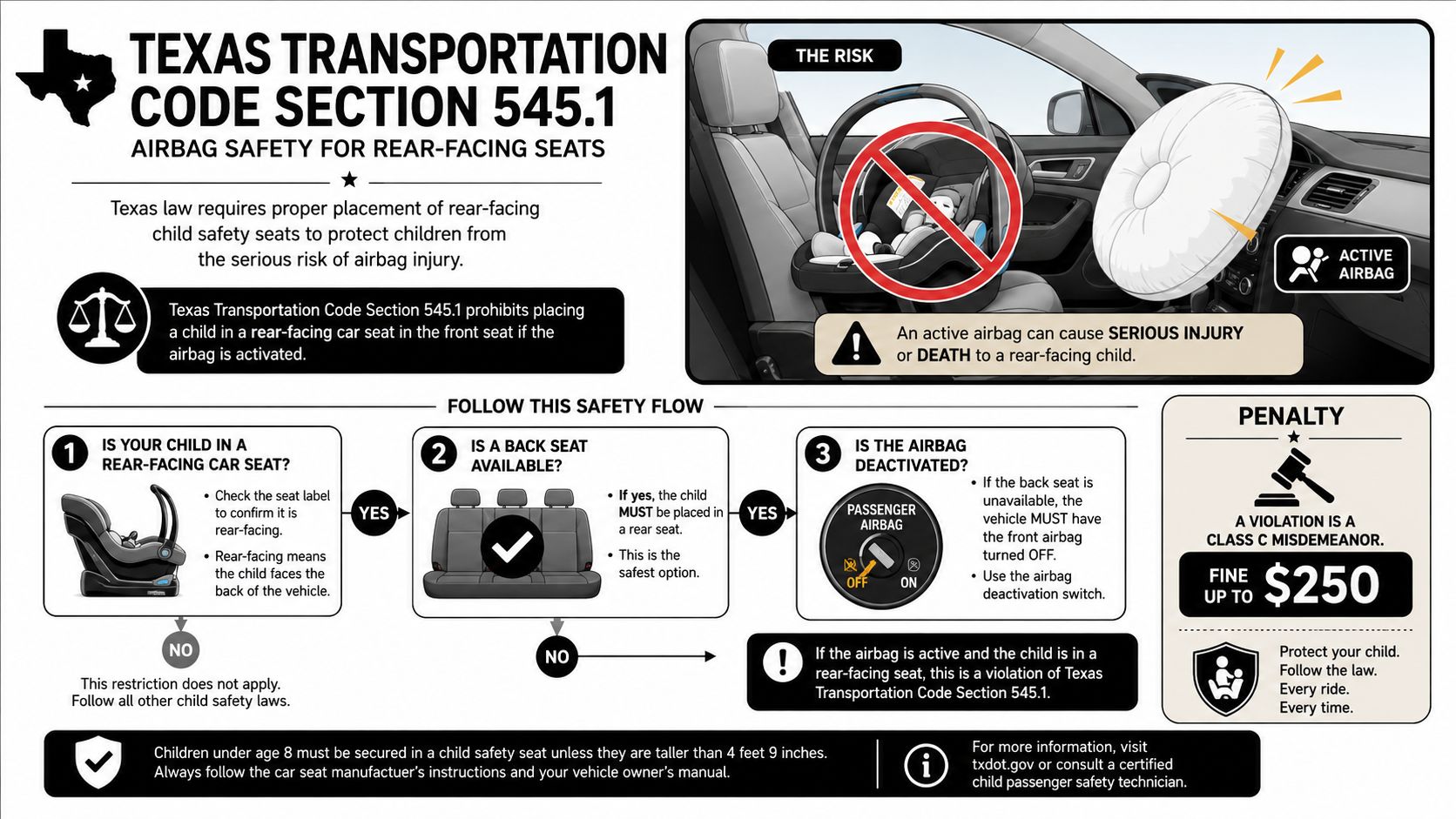
Texas DPS also identifies a specific airbag restriction. A rear-facing child seat can't be placed in the front seat when the vehicle has a passenger airbag, unless the airbag is manually turned off in the limited situation allowed by Texas guidance.
Practical rule: Texas may not give you one front-seat age, but the safest default is still to keep a child in the rear and use the restraint that fits the child correctly.
A first violation of Texas child passenger safety requirements can carry a fine of up to $250 plus court costs, as reflected in Texas child passenger safety materials. That penalty doesn't turn the legal rule into a complete safety test. Parents in Atascocita, Humble, and northeast Harris County should treat the restraint requirement as the minimum obligation, not as proof that a child is ready for the dashboard-side seat.
Car Seat and Booster Seat Stages Under Texas Law
Texas families often understand the front-seat question more clearly when they first identify the correct restraint stage. The transition shouldn't happen because a child wants to sit up front or because a younger sibling needs the preferred rear seating position.
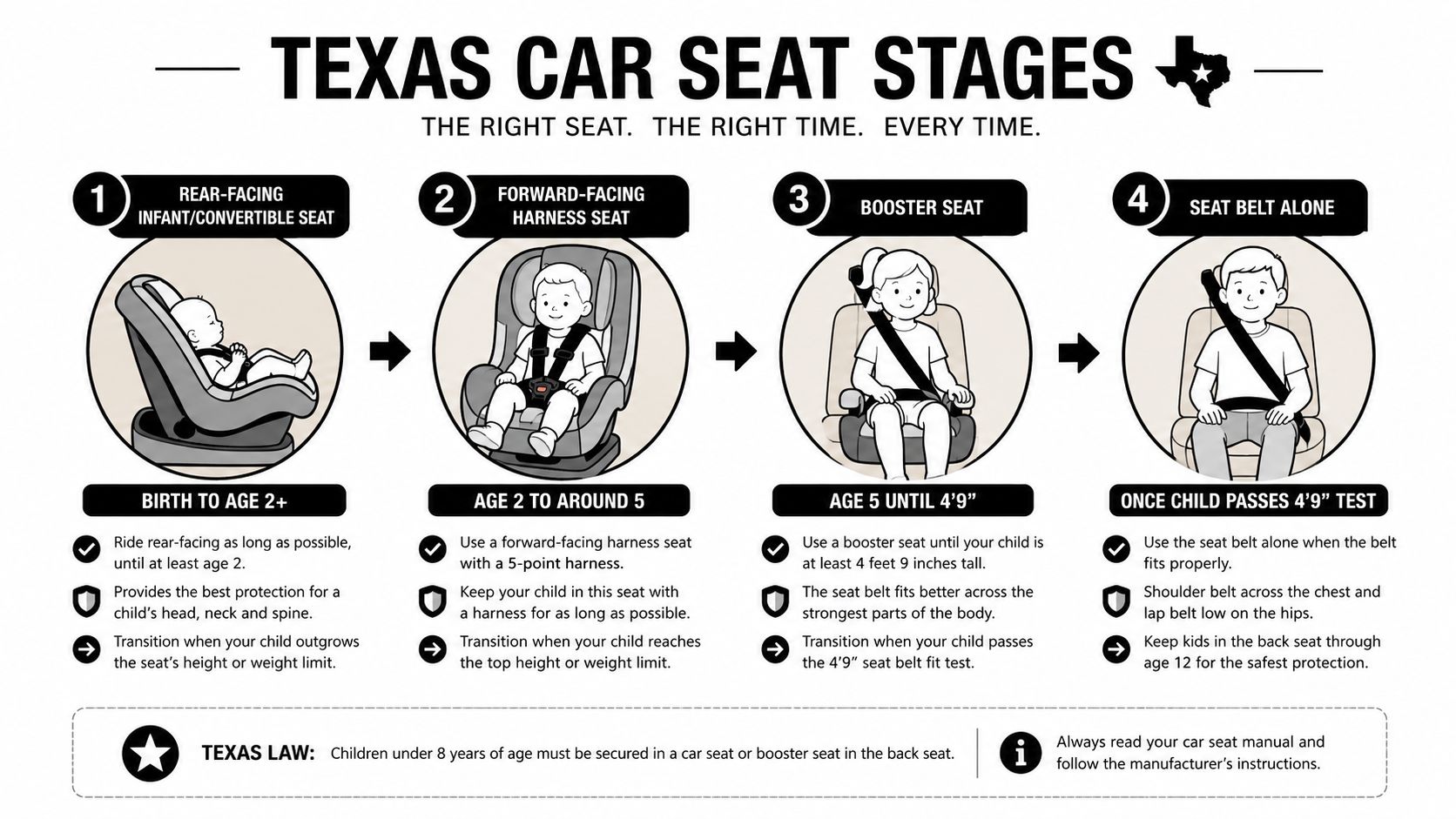
Stage one uses a rear-facing seat
A rear-facing infant or convertible seat starts at birth and should remain rear-facing until at least age 2 or until the child reaches the manufacturer's maximum height or weight. The seat supports the child's head, neck, and spine during a crash, so parents shouldn't turn the seat forward merely because the child seems cramped or impatient.
For an Atascocita family using a convertible seat in an SUV, check the seat's labels and manual before changing direction. The manufacturer's limits control the timing of the transition.
Stage two keeps the harness in place
A forward-facing car seat with a harness follows the rear-facing stage. Children commonly remain in this stage until around age 4 to 7, depending on their size and the seat's limits. A kindergartner may still need a five-point harness, while another child of the same school age may be ready for a high-back booster.
The right choice depends on the child and the equipment, not just the grade level.
Stage three positions the belt
A belt-positioning booster helps raise the child so the vehicle's lap and shoulder belt rest on the stronger parts of the body. Texas requires this stage until age 8 unless the child is taller than 4 feet 9 inches. A booster isn't optional merely because the child can buckle independently.
Parents labeling seats for daycare, school, or a shared car can use the InchBug label guide for daycare to keep identifying information organized. That can help when several caregivers move the same seat between vehicles.
Stage four uses the adult belt alone
A child is ready for the seat belt alone when the belt fits correctly, not merely when the child reaches a particular birthday. The lap belt should sit low across the hips, and the shoulder belt should cross the shoulder and chest rather than the neck or stomach. The child should also sit upright with their back against the vehicle seat and keep the belt positioned throughout the ride.
Registering a car seat with its manufacturer can help parents receive recall notices. Keep the manual available, inspect the seat after a crash, and avoid changing stages before the child reaches the seat's stated limits.
Why Safety Experts Recommend Age 13 for the Front Seat
Texas leaves the front-seat age question open, but major safety guidance gives parents a clearer benchmark. The American Academy of Pediatrics and the National Highway Traffic Safety Administration recommend keeping children under 13 in the back seat because children are generally better protected there and may face greater airbag and belt-related risks in front.
NHTSA reports that frontal crashes account for 51% of fatalities and injuries among passenger-vehicle occupants ages 0 to 15. Research cited by NHTSA also found that children 12 and under were 26% to 35% less likely to be fatally injured when seated in the rear. These figures help explain why safety professionals treat the rear seat as the default even after a child outgrows a booster.
Three reasons the rear seat remains the safer choice
- Crash exposure: The front passenger sits closer to the dashboard and frontal crash forces.
- Airbag interaction: Front airbags inflate with substantial force and can strike a smaller passenger's head, neck, or chest.
- Body and belt fit: A child's pelvis and torso may not position an adult belt as safely as an adult's body does.
The evidence doesn't mean every front-seat ride will cause an injury. It means the risk calculation favors the rear seat when that option exists.
| Risk Factor | Front Seat | Back Seat |
|---|---|---|
| Frontal crash exposure | Closer to the dashboard and passenger airbag | More distance from the dashboard |
| Airbag interaction | Greater concern for smaller occupants | No front passenger airbag directly in front |
| Belt fit | Poor fit may cause the belt to ride across the stomach or neck | Correct restraint use remains essential |
| Safety benchmark | Generally reserved for older, properly fitting passengers | Recommended for children under 13 |
Parents managing transportation terms in a custody order may find what supervised visitation can involve in Texas relevant when safety concerns affect exchanges or visitation logistics. For a broader explanation of how family law cases proceed in the Harris County courts serving Atascocita, see Harris County Family Courts: A Atascocita Resident's Guide.
The practical conclusion is straightforward. Age 13 is a safety recommendation, not a Texas statutory front-seat age. Even then, the child should have outgrown booster requirements, fit the adult belt correctly, and sit as far from the dashboard as practical.
Airbag Rules and Rear-Facing Seats in Texas
Texas treats rear-facing seats and active passenger airbags as an especially serious combination. Texas DPS states that all rear-facing child safety seats are prohibited in the front seat when the vehicle has a passenger airbag. The only legal way to install a rear-facing seat in the front of a single-cab vehicle is to manually turn the airbag off.
A deploying airbag can strike the back of a rear-facing seat with enough force to cause catastrophic injury. That danger exists even when the car seat is installed tightly and the child is correctly harnessed.
Check the vehicle before using the front passenger position
Read the owner's manual before placing any child seat in front. Confirm whether the vehicle has an airbag on/off switch, follow the manufacturer's instructions, and verify the indicator light before driving. Don't assume that a warning light, key switch, or dashboard symbol means the airbag is disabled unless the vehicle manual confirms it.
Side airbags and curtain airbags also matter. Parents should follow both the vehicle manual and the child-seat manual for seat position, recline angle, belt routing, and permitted installation locations.
Single-cab pickups create a practical limit
A single-cab pickup has no rear seating area. If the child must remain rear-facing and the passenger airbag can't be disabled, that child can't safely ride in that truck's passenger seat. An Atascocita or Humble parent may need to use a different vehicle rather than trying to solve the problem by moving the seat forward.
For an older child who must ride in front, push the passenger seat back as far as practical and follow the vehicle and restraint instructions. Texas DPS materials also explain that children no longer required to use a car seat or booster should use a seat belt in any seating position, and Texas law requires passengers under 17 to be properly restrained.
How Front Seat Age Rules Differ in Other States
Families traveling outside Texas quickly discover that the legal age to ride in the front seat isn't consistent across the country. Some states create a direct rear-seat rule for younger children when a rear seat is available. Others regulate car seats and boosters without separately naming a front-seat age.
That patchwork can affect families in Atascocita who travel through Louisiana, Arkansas, or Oklahoma on I-69 or US-59. A child who meets Texas's restraint requirement may still be subject to a different rule after crossing the state line.
| State | Front Seat Age or Rule | Booster Cutoff | Rear Seat Preference |
|---|---|---|---|
| Texas | No single statewide front-seat minimum age | Under 8 unless taller than 4 feet 9 inches | AAP and NHTSA recommend under 13 in back |
| California | State-specific child passenger rules may address seating and restraint use | Depends on the applicable child restraint requirement | Families should check current state guidance |
| New Jersey | State-specific restraint rules, with no single front-seat age stated in the cited guidance | Depends on age, size, and applicable restraint limits | National guidance favors keeping children under 13 in back |
| Other states | Rules vary, and some use direct rear-seat restrictions | State-specific | Check the law wherever the vehicle will travel |
The comparison shouldn't be read as a substitute for checking the current law in the state you're entering. State requirements can distinguish between vehicles with rear seats and vehicles without them, and they may address age, height, weight, or the availability of a particular restraint.
Separate the legal floor from the safety floor
A statute may allow a child to move forward earlier than safety professionals recommend. The AAP and NHTSA benchmark of 13 remains more conservative than many state laws, including systems that may permit a younger child to ride in front after meeting car-seat or booster requirements.
For a multistate trip, plan around the stricter practical standard. Keep the child in the rear when possible, use the correct restraint, and review the destination state's official requirements before leaving Harris County.
Real World Examples for Atascocita and Harris County Families
A three-row SUV creates different choices than a single-cab pickup. Consider an Atascocita parent driving an eight-year-old to a carpool near Eagle Springs or Timarron Lakes Elementary. If the child is no longer required to use a booster because the child is taller than 4 feet 9 inches, or has otherwise satisfied the applicable Texas restraint rule, Texas may not separately prohibit the front seat. The back seat remains the safer location, especially when another child can use the front passenger space only as a convenience.
The belt still has to fit correctly. If the child slouches, places the shoulder belt behind the back, or allows the lap belt to ride across the stomach, the adult belt isn't doing its job as designed.
A child asking for the front seat is expressing a preference, not demonstrating safe belt fit.
The single-cab pickup problem
A Humble ISD parent may drive a single-cab Ford F-150 to a job site. If an infant still needs a rear-facing seat and the truck's passenger airbag can't be turned off, the parent can't transport that infant in the front passenger seat. The practical solution is another vehicle with a usable rear seat or a compliant airbag deactivation system.
That isn't a question of whether the child is mature enough. It is a question of whether the required seat can legally and safely be installed.
Grandparents and shared transportation
A Heights or Summerwood family may rely on a grandparent who drives a sedan for school pickup. The grandparent should have the child's restraint installed in the position permitted by the seat and vehicle manuals, with the front passenger seat pushed back when an older child must ride there. A booster should remain in use until the child passes the belt-fit requirements and the Texas threshold.
Parents can also seek hands-on help. Harris County Deputy Constable car seat checks and Atascocita fire station inspection events may give families an opportunity to confirm installation and harness routing. Availability and scheduling can change, so verify event details directly before visiting.
Transportation issues can intersect with custody orders. A parent dealing with exchanges, possession periods, or age-related transportation terms may need to review step-down possession orders for young children in Atascocita. Separately, Enforcement of Court Orders in Atascocita addresses enforcing divorce decree and custody order provisions in Harris County.
A Parent Checklist and When to Call a Local Attorney
Before allowing a child to ride in front, run through the decision in a consistent order. The goal isn't to find the youngest legally permissible age. The goal is to confirm that the child, restraint, and vehicle work together without an avoidable airbag or belt-fit problem.
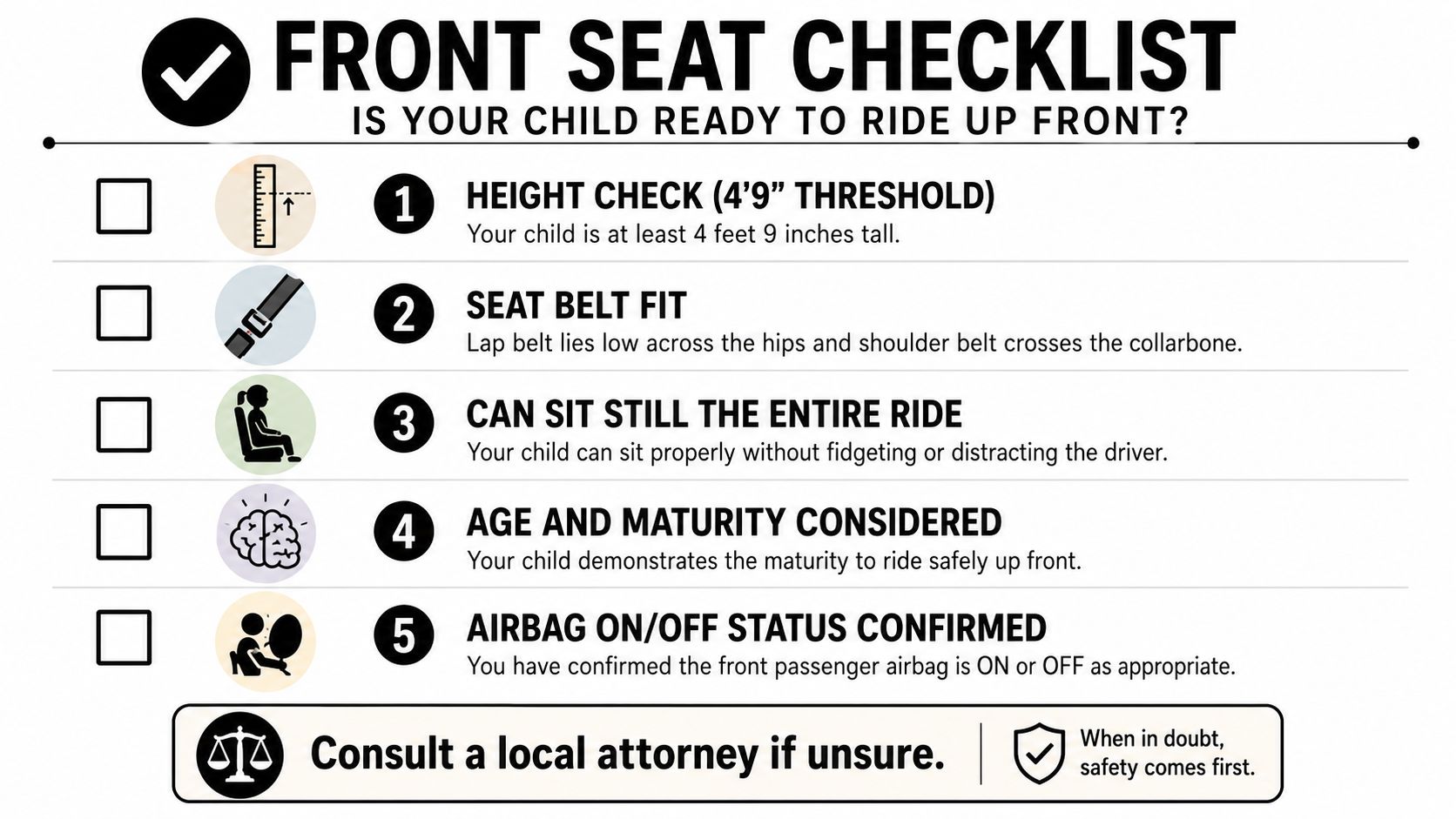
Use this front-seat checklist
- Confirm height and restraint status. Check whether the child is taller than 4 feet 9 inches and whether the child has outgrown the booster according to proper belt fit.
- Inspect the lap belt. It should lie low across the hips and upper thighs, not across the abdomen.
- Inspect the shoulder belt. It should cross the collarbone and chest, not the neck or face.
- Check posture and behavior. The child must sit upright, stay against the seatback, and keep the belt in position for the entire trip.
- Create distance from the dashboard. Push the passenger seat back as far as practical. The child shouldn't sit close to the airbag.
- Confirm airbag status. Never place a rear-facing seat in front of an active passenger airbag. Review the owner's manual and dashboard indicator.
A certified Child Passenger Safety Technician is usually the right first resource for installation, harness adjustment, booster use, and belt-fit questions. An attorney becomes relevant when transportation safety connects to a legal dispute, such as a custody transportation agreement, a proposed modification after divorce, a grandparent visitation arrangement, or liability questions after a teen-related collision.
For example, parents can review whether a custody order addresses who drives the child, which vehicle may be used, or how exchanges occur. A disagreement about those terms may require legal guidance rather than an informal text-message agreement. Parents concerned that a safety issue affects visitation can also review whether a parent can deny visitation for safety reasons in Texas.
The Harris County District Clerk's office can provide court-related administrative information, while a local family law practitioner can explain how a transportation dispute may fit within a custody case. The Law Office of Bryan Fagan, Atascocita TX Lawyers, handles family law matters including divorce, custody, support, and related court-order issues for families in Atascocita, Humble, and northeast Harris County.
Keep children under 13 in the back seat whenever possible, even when Texas law doesn't provide a single front-seat age. That approach respects both the legal requirements and the stronger safety evidence.
If a front-seat question is part of a custody dispute, visitation disagreement, divorce, or transportation provision in Harris County, Law Office of Bryan Fagan – Atascocita TX Lawyers can help you understand the legal issues and next steps. Schedule a free consultation at the Atascocita office to discuss your family's circumstances with a local attorney.